Google has been making some big changes to help businesses increase their visibility on Google Search, Google Maps, and Google+ by connecting business information across all of Google’s services. Google is calling the interconnected service Google My Business, which is set to be a one-stop shop which will allow users to access all their applications in one place.
The service will help deal with duplicate entries across Google products by asking users to entire their information one initial time, then populating it into all of Google’s services at once. TechCrunch also reported that “owners can post news events, photos, and other updates they want shared with customers” in an apparent bid to rival Facebook.
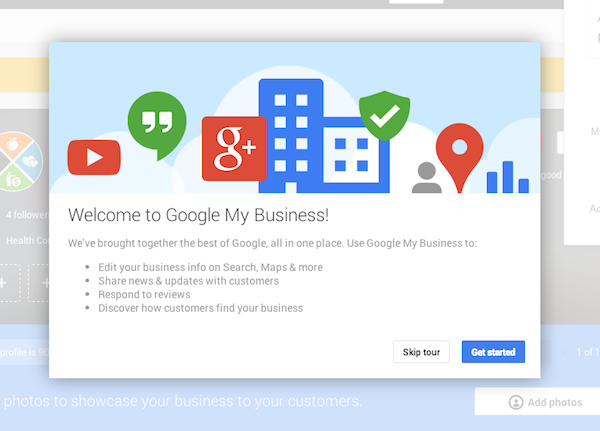
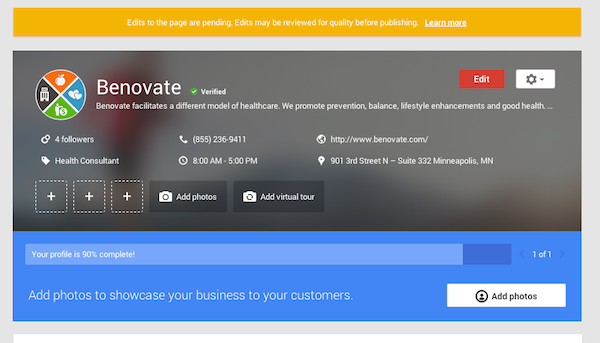
Once you’re signed in and Google has guided you through a tour of the platform, you’ll see a screen that houses your basic information that will appear on Google+, Google Places, and Google Search. From now on, you’ll be able to update business information such as store hours, phone number, or your website URL in one easy to access location.
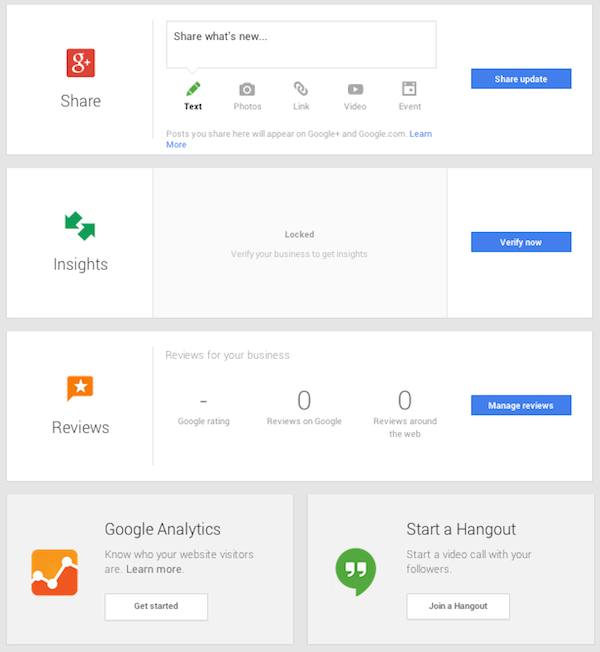
Beyond that page, you’ll be given access to the the really meaty parts of the update. From one screen, you’ll have control of your Google+ profile, from which you can share new text, photos, links, and events. You can also explore Insights, which will help you analyze your visibility, engagement, and audience. This screen also lets you manage your reviews, quickly access your Google Analytics dashboard, and even start a Hangout with the click of a button.
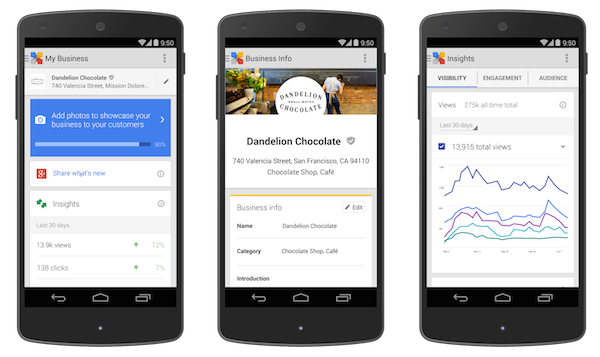
Notably, this update has already gotten a mobile launch on Android, and it appears the iOS version of Google My Business will be released n the near future.
Google My Business makes it easier than ever for small businesses to take control of their own online presence and helps level the playing ground so that any company can benefit from being online. You don’t have to be a well-established brand to make yourself visible online.
00Taylor Ballhttps://www.tulsamarketingonline.com/wp-content/uploads/2018/07/TMO-Logo.pngTaylor Ball2014-06-17 15:04:192014-06-17 15:04:19“Google My Business” Makes It Easier For Small Business To Get Seen Online
Business owners have more reason than ever to claim their Google+ business pages, because Google has finally decided to connect business pages with local listings on Google Maps.
The change allows business owners to have a more coherent presence across the web as well as improve the ability of searchers to find them. The process connects your current page to Google Maps and applies the business information, including the business address, the Google Maps reviews, business hours and more from to your page.
A large number of businesses have more than one Google+ page listed in their Google+ manager page, so this will also help clean up the clutter by combining at least two of these pages.
Google explains in detail how to connect your Google+ business page to your Google Maps verified listing on the help page, as well as instructions for creating a local page if you have yet to add your business to Google.
Pages that are newly connected to maps will display the name and verification badge from the former local page, as well as showing the business information such as hours of operation and phone numbers. The pages will also show reviews from the former local page, but will not show prior owner responses to local reviews.
00Taylor Ballhttps://www.tulsamarketingonline.com/wp-content/uploads/2018/07/TMO-Logo.pngTaylor Ball2014-06-10 13:06:282014-06-10 13:06:28Google Allows Business Owners to Connect Google+ Business Pages to Google Maps Listings
All week we try to keep you up to date with the most important SEM news across the web, but inevitably there are smaller stories that fall through the cracks. That’s why we compile all the most important news we missed this week all in one convenient place every Friday. After a quiet week before, nearly all of the major platforms have made announcements this week. Let’s start with Google and work our way down.
Google Starts Warning Searchers About Mobile URL Redirects
Google has been warning webmasters about faulty mobile redirects for months, including suggesting they may one day start receiving penalties for sending mobile searchers to the front page of a site rather than the content relevant to their search. It appears Google has opted for another solution, which allows mobile searchers to decide if they want to proceed.
Google alerted webmasters this week that smartphone searchers will begin seeing warnings for sites with redirects that don’t take them where they want to go. An example of how these warnings will appear is above. On a Webmaster Central blog post, Google stated:
We’d like to spare users the frustration of landing on irrelevant pages and help webmasters fix the faulty redirects. Starting today in our English search results in the US, whenever we detect that smartphone users are redirected to a homepage instead of the page they asked for, we may note it below the result. If you wish to proceed to the page, you can click ‘Try Anyway.’
Google Adds World Cup Street View Tours and a Loch Ness Easter Egg
Just a week before the World Cup kicks off, Google has added street view images that will allow users to tour all 12 stadiums that will be used for the tournament. Whether you want to stand in the middle of the field and do a little spin, or preview the view from the stands, you’ll be able to give a look from anywhere within the stadiums.
Google has also added significantly more images from Brazil’s painted streets and other sites across the country, but perhaps one of the most popular finds on Google Maps this week is an Easter Egg found far away from Brazil.
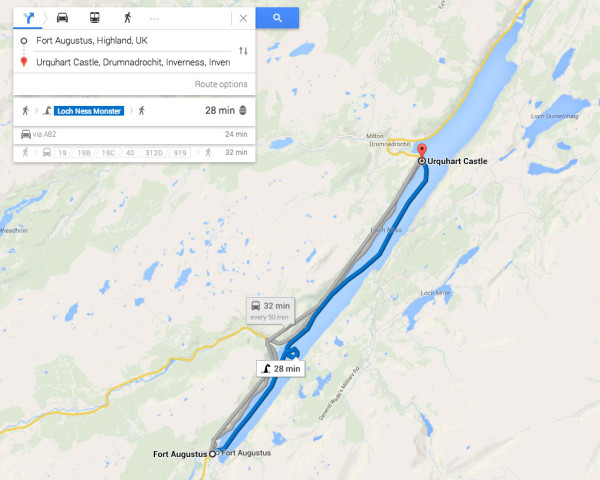
If you’d rather hunt legendary monsters than watch soccer, Google Maps is able to give you directions to Loch Ness. If that isn’t enough for you however, Google says you can always catch a ride on Nessy.
If you get directions from Fort Augustus to Urquhart Castle in Google Maps, you will get the option to travel via Loch Ness Monster. You just have to click on ‘Route Options’ and then choose ‘Fewer Transfers’ or ‘Less Walking.’ Though you have to wonder how no one has managed to get a picture of Nessy while hopping a ride down the Loch.
Bing Celebrates Its 5th Birthday With Some Memories
Bing turned five earlier this week, and to celebrate it has posted a retrospective of the last five years. Bing is also offering Bing Reward credit perks to any user who searches on the site before June 9th.
The retrospective covers all of the ways Bing’s appearance has changed over the past five years, but it also covers how it has worked to achieving its initial goals of leveraging semantic search, introducing new verticals, and generally expanding how search could function in our lives.
Bing Shows Off New Dynamic Carousel For Music Video Searches
Bing has prided itself on being ahead of the curve in respect to music and music video searching and discovery, and its latest feature continues to expand on the functionality it previously offered for music video searches.
Bing has recognized that people search for music videos very differently than they do other video content. By exploring these changes in user behavior, Bing was able to determine that music video watchers wer significantly more likely to hang around and check out other content instead of moving on once they found the video they were looking for.
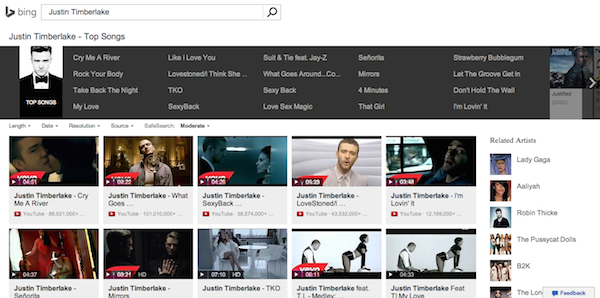
To give users easier access to all the music videos they may be interested, Bing has implemented instant access to an artist’s top hits as soon as you search only the artists name. Bing describe this as a dynamic carousel, because it allows you to open up songs and videos from teh carousel and play it within the same window. You will never have to keep going back and forth between choosing the video you want to watch and actually watching it.
The carousel also allows you to view all of an artist’s albums and watch the videos for those songs as well.
Pinterest Continues To Work Towards An Actual Ad Platform
Pinterest has made its intention to establish an ad platform for their social network very clear ever since it unveiled Promoted Pins. However, Pinterest is working slowly to guarantee that the ads shown on their platform won’t stick out or detract from the experience, and as such it has been very hands on and selective about who it allows to run ads.
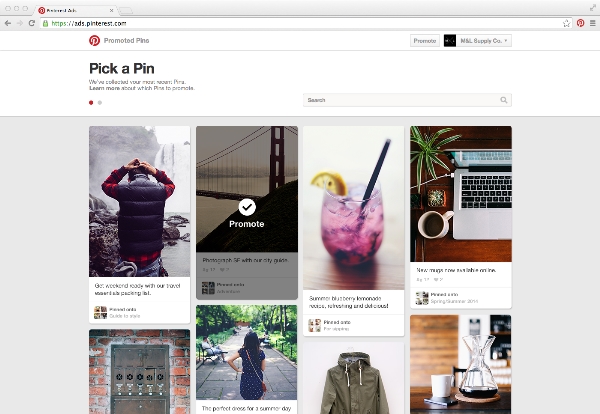
Now, businesses of all types have been given access to a do-it-yourself Promoted Pins tool that allows them to promote their own pins to more people and increase visibility. Similar to most other social ad platforms, these will work on a cost-per-click basis through ads.pinterest.com.
Pinterest also announced they would be expanding the analytics tools offered to users, giving them more insight into who is clicking and re-Pinning your content. You can get more information from their announcement.
LinkedIn Joins The “Large Cover and Profile Photo” Club
LinkedIn announced earlier this week it would be making a major design update to user profiles, which will feel very familiar to anyone who uses Facebook, Google+, or Twitter. Currently, the layout is only available to premium users, but LinkedIn says it will be available for all users after a short period. It isn’t entirely clear why LinkedIn would stagger the rollout of this layout change, but you can add it to the list of social media sites that are beginning to look very, very similar.
00Taylor Ballhttps://www.tulsamarketingonline.com/wp-content/uploads/2018/07/TMO-Logo.pngTaylor Ball2014-06-06 12:20:272014-06-06 12:20:27Quick SEM News of the Week – June 6, 2014
Every month, comScore releases a “U.S. Search Engine Rankings” report illustrating the market shares of the most commonly used search engines. From month to month the results have stayed largely the same for over a year, with Google taking in almost exactly two-thirds of the market and the other search engines like Bing and Yahoo slowly growing and shrinking by minuscule percentages.
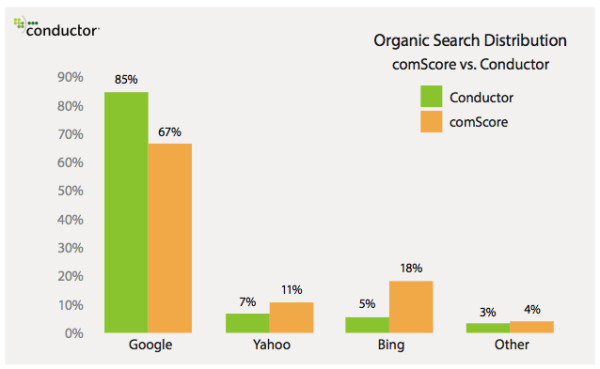
ComScore’s report is widely trusted by most of the online marketing community, but recently analysts from Conductor attempted to challenge comScore’s findings with their own report claiming Google actually rakes in a significantly larger percentage of searches. They even went as far as to title their reports “Why You Shouldn’t Trust comScore’s Numbers for Search Engine Market Share.”
For such an obvious attack on another analytics firm, you would assume Conductor was publishing new information or even comparing the same factors. As Danny Sullivan from Search Engine Land shows in his article reviewing Conductor’s findings however, Conductor’s findings shouldn’t be news to anyone paying attention, and they don’t disprove comScore’s findings.
The issue i that, when people hear that Google controls two-thirds of the search market many publishers assume they should see close to the same proportion of traffic coming from the search engine. Instead, most publishers see significantly more traffic from Google than their market score seemingly indicates.But, market share isn’t a measurement of the traffic sites receive.
The monthly report from comScore reflects the number of actual searches conducted from the major search engines. Most importantly, their report isn’t affected by where the user goes after clicking on a search listing. Sullivan refers to this type of measurement as “before-the-click” behavior. Every search gets counted equally, no matter what the destination is.
Conductor’s analysis instead focuses on “post-click” behavior, or the traffic publishers receive from search engines. In their report, the information that matters most is the post-click activity. If someone does a search and clicks on a link that leads them back into the search engine, it isn’t measured in Conductor’s report.
The discrepancy between these two types of reports isn’t anything new. In fact, Sullivan cites 2006 as the last time it received significant attention due to Rich Skrenta writing that Google’s “true market share” being 70% while most measurement services were estimating their market share at 40%. Most entertainingly, Sullivan’s response then still perfectly explains why a gap might form. So much changes in search on a daily basis it is always noteworthy when something manages to be admirably accurate after eight years. As Danny Sullivan wrote at the time:
“But a search for something on Yahoo Sports? That might be counted as a “search” and it is – but it’s not the type of search that would register with site-based metrics. The searcher might stay entirely inside Yahoo.”
Search engines with the largest gaps favor their own services more than others, which would suggest that Bing’s 13% gap indicates they direct searchers to their own services and platforms more than any other search engine. Surprisingly, Google appears to favor themselves the least, with a -18% gap.
Of course, there is always the possibility that this gap could be created or exacerbated by other factors that may not have been in play at the time. When Sullivan asked comScore for its opinion on the difference between its reports and Conductor’s recent study he was told mobile search could also potentially be an influence. Google has a higher share of mobile search than compared to desktop figures, and comScore’s reports only include data from desktop users.
Both reports serve their own purposes, but both also highlight the same issue. Google has a huge hold on search traffic that should be recognized and planned for. But, those who buy into Conductor’s study may be tempted to ignore the other search engines entirely. To each their own, but my opinion still favors an approach which puts the most weight in Google but doesn’t cut out the other search engines too much.
00Taylor Ballhttps://www.tulsamarketingonline.com/wp-content/uploads/2018/07/TMO-Logo.pngTaylor Ball2014-05-29 13:09:482014-05-29 13:09:48Just How Much of the Market Does Google Actually Control? Making Sense of Conflicting Reports
Over the past 2 days, the SEO community has received confirmation that Google is rolling out not one, but two web spam focused algorithm updates; Panda 4.0 and Payday Loan 2.0. Panda 4.0 was confirmed by Matt Cutts on Twitter, while Search Engine Land initially announced the newest Payday Loan update which was later verified by Cutts.
Google is rolling out our Panda 4.0 update starting today.
As with any major algorithm update, there is much more speculation than there are facts at the moment. However we do know a little bit about the roll outs of the algorithm updates and what they are focused on.
Panda 4.0
Panda 4.0 is being called the ‘softer update’ in relation to its precursor thanks to a discussion back in March. It has been stated that the update affects different language queries to different extents, but Google estimates the effect on English searches is about 7.5% of queries.
Considering the reports of sites seeing significant recoveries, it is safe to assume this update is a little more generous and more welcomed than than the previous updates to Panda.
Payday Loan 2.0
The Payday Loan Algorithm is a bit less well known, as it was first launched last June and only targets ‘very spammy queries’; primarily the type of spammy queries associated with payday loans, insurance, and accident claims.
A Google Spokesperson issues a statement on the update, saying:
“Over the weekend we began rolling out a new algorithmic update. The update was neither Panda nor Penguin – it was the next generation of an algorithm that originally rolled out last summer for very spammy queries.”
So far estimates say only .2% of English queries were affected by this update, though this is also an international rollout affecting different languages to different extents.
Google Webmaster Tools (GWT) is Google’s direct line to every website owner, which consequently makes it the most important set of tools and webmaster has at their disposal. GWT allows webmasters to identify any problems with their site including alerting you to any penalties placed on you by the search engine and checking for signs of malware that may have infected your site.
Probably the most surprising thing about Google Webmaster Tools is how many webmasters go without ever opening the dashboard of GWT. It isn’t like the cost is keeping them away. Seeing as Google Webmaster Tools is free, the best assumption is that many webmasters stay away from GWT because they are intimidated by the wealth of data and tools all in one place.
Simon Heseltine created an extensive overview of Google Webmaster Tools’ features and capabilities, as well as how you can leverage these tools to optimize your site and ensure everything is working as it should be. If you aren’t using Webmaster Tools, you are missing out and your site is likely suffering because of it.
00Taylor Ballhttps://www.tulsamarketingonline.com/wp-content/uploads/2018/07/TMO-Logo.pngTaylor Ball2014-05-15 12:46:002014-05-15 12:46:00What is Google Webmaster Tools?
Search engines and social media are battling for the top spot as the leading source of referral traffic to publishers on the web. Recent accounts suggested that social media may be taking the lead.
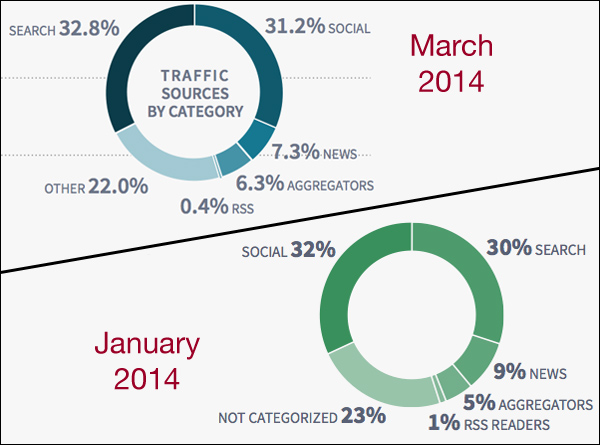
However new data from Parse.ly, a content analytics platform that counts Reuters, Mashable, Slate, and The Next Web among its many clients, shows that search has retaken the lead from social media as the top source of referral traffic in March of this year.
Parse.ly’s publishers saw 32.8 percent of its traffic coming from search in March, compared to 31.2 percent from social media. That is the exact reverse of results from data, when data showed social traffic outdid search 32 to 30 percent.
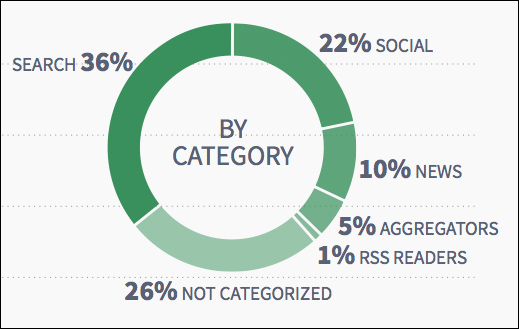
Overall the trends still favor social media, despite the good month for search in March. If you look at reports from further back, it becomes clear that search has been steadily losing ground. In October 2013, Parse.ly reported search was by far the dominant source of traffic at 36 percent, compared to only 22 percent for social.
Google sites were still the No. 1 overall source of traffic for the analytics platform’s clients during the most recent reporting period, with Facebook coming in second. Those two net giants were significantly higher sources than any other individual sites.
00Taylor Ballhttps://www.tulsamarketingonline.com/wp-content/uploads/2018/07/TMO-Logo.pngTaylor Ball2014-05-13 12:26:062014-05-13 12:26:06Report Shows Search Overtakes Social as Referral Source for Major Publishers
With the constant stream of news coming out of the online marketing industry, it can be hard to keep up with all the latest updates without missing some important information. That’s why we compile all the biggest stories you may have missed this week all in one convenient place every Friday. Let’s get started:
Facebook’s Premium Video Ads Could Cost $1 Million a Day
Facebook is attempting to walk the tight rope between monetizing through ads and not overwhelming users with constant advertisements in the news feed. But, as Facebook keeps introducing new ways to advertise on their platform, the ad space is quickly becoming crowded. New reports indicate Facebook may be attempting to manage the shifting balance between ads and user content by pricing “premium” advertising features well out of reach for smaller businesses.
The Wall Street Journal reported this week that the upcoming “Premium Video Ads”, set to launch in the next few months, will likely cost around $1 million per day, and will initially be limited to a small group of advertisers. If you have a subscription, you can read the full story from Wall Street Journal, but Martin Beck also summarizes the rumors at Marketing Land.
Facebook Announces New Upcoming Video Metrics
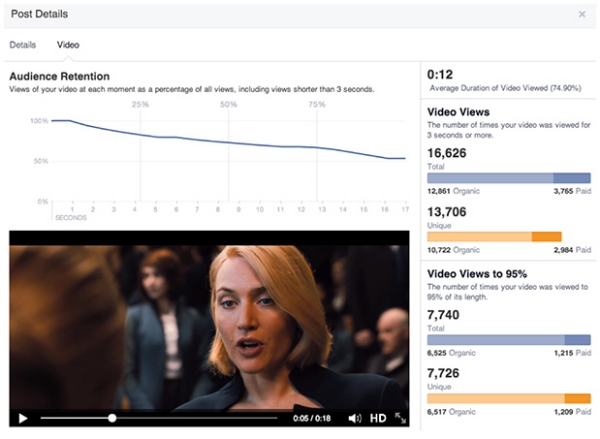
On the topic of Facebook’s method of handling video content on their platform, the social media giant also announced new metrics within Page Insights and Ads Reporting will be coming soon. This way, Page owners will be more able to analyze how users are responding to their videos, and how they may be able to improve their content.
The new metrics include more detailed view counts that will show the total number of video views, as well as the number of individual people who have watched, measurements of audience retention through the length of the video, and a breakdown of the demographics engaging with video content. Facebook’s announcement says the metrics will be available for all paid and organic videos uploaded directly to Facebook Pages, and they will be gradually rolling out in the next few weeks.
Bing is Testing Search Results Without Underlined Links
Usually Bing tries to distinguish themselves from Google as much as possible, but several people have reported that Microsoft is testing search results without underlining hyperlinks. This comes just weeks after Google officially redesigned their own search results pages around larger links without underlining.
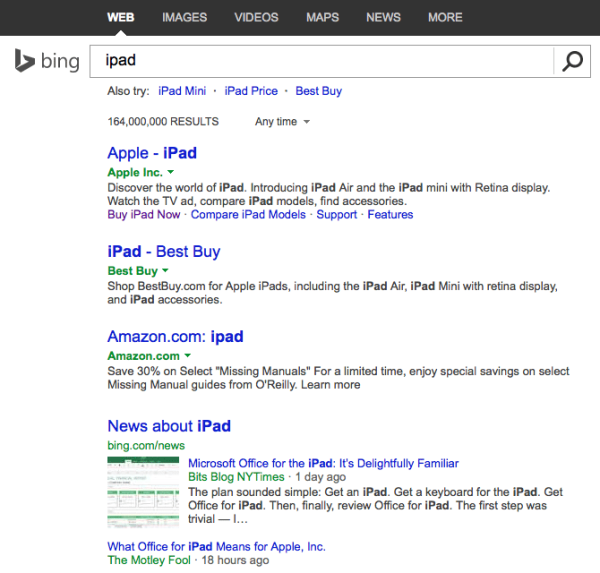
Bing is constantly testing small changes such as this to see what users respond to, but it is hard to not feel like this test is particularly inspired by Google’s recent moves. However, it is important to remember that Bing’s non-underlined links are just a test for the moment, and not a final widespread change. You can see the version of the search results without underlines being tested below.
Google Says New Parents Perform Twice as Many Searches as Non-Parents
A recent survey from Google’s Think Insights says that new and expecting parents perform 2.7 times the number of online searches as non-parents. The survey also says that 56 percent of maternity-related searches come from a mobile device.
According to Google’s analysis of the survey and their own data, they claim parents are trusting the internet more and more for child advice, as baby- and parent-related searches are on an upward trajectory. For a detailed breakdown of what Google says parents are searching for, head over to Think Insights’ report.
Google Maps Now Shows Uber Ride Options, Lane Navigation, and More
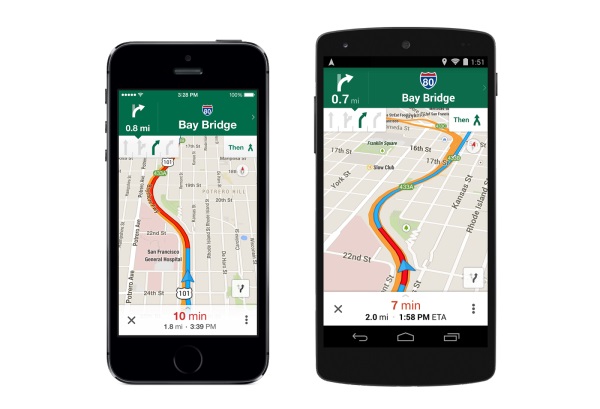
Google Maps is in the process of rolling out several new features for the iPhone and Android app, including more detailed driving directions such as lane navigation which tells you if it is important to switch lanes to stay on the right path. Google Maps also announced integration with Uber, the burgeoning ride service which connects people in need of transportation with available drivers.
According to the announcement, those who already have the Uber app downloaded will be able to compare ride times against walking directions within Google Maps, so you always know what the most efficient transportation option is. Those are just two of several new features Google is unveiling, which are all further explained here.
00Taylor Ballhttps://www.tulsamarketingonline.com/wp-content/uploads/2018/07/TMO-Logo.pngTaylor Ball2014-05-09 12:54:072014-05-09 12:54:07Quick News of the Week – May 9, 2014
You may have seen headlines proclaiming “Links are dead!” ever since the roll out of Google’s big algorithm changes, Penguin and Panda. However, it has been over two years since these changes started taking place, and there is still a heated debate surrounding just how useful links are in the hunt for high rankings. Google has remained largely mum on the issue, though their statements have largely suggested that links are only slightly less important than they were a few years ago.
Now, Matt Cutts has used one of his Webmaster Chat videos to address the question, suggesting for the first time that links may be going away (eventually).
The statement isn’t much of a shocker to the SEO community, but it is one of the first signs that links are being steadily devalued. Don’t get too excited however, you can expect links to be a significant part of SEO if Cutts is to be believed.
Matt explained that Google’s focus right now is on finding ways to parse out the content that will meet the expectations of expert users. Unfortunately, Google only has limited means of evaluating the content. This is mostly done by estimating the traffic, content style, keyword density, and engagement on a site, but links have always been used as a mark of quality. Thankfully, Google has also gotten better at judging which links are valuable.
However, as Google improves at understanding the natural language we use, it doesn’t have to rely on links as strongly. It can put more weight on the value of content and other factors expert users consider.
Cutts says it will be years before links go anywhere, but Google is slowly distancing themselves from links. It may be time to put up the headlines claiming links are dead and wait for the day when links finally don’t serve a legitimate person. We won’t reach that point for a while.
00Taylor Ballhttps://www.tulsamarketingonline.com/wp-content/uploads/2018/07/TMO-Logo.pngTaylor Ball2014-05-06 12:18:132014-05-06 12:18:13Matt Cutts Says Links are Becoming Less Important
With the constant stream of news coming out of the online marketing industry, it can be hard to keep up with all the latest updates without missing some important information. That’s why we compile all the news you may have missed this week all in one convenient place every Friday. Let’s get started:
Google Updates Guidelines Regarding Redirects
Google has had a policy against redirects intended to deceive or manipulate search engines or users, but this week they updated their Webmaster Guidelines to explicitly include mobile-specific redirects. They also include an example of a deceptive mobile redirect with a scenario where “desktop users might receive a normal page, while hackers might redirect all mobile users to a completely different spam domain.” Google details the revisions in an announcement on their Webmaster Central Blog.
Google Wants To Help You Remember Where You Parked
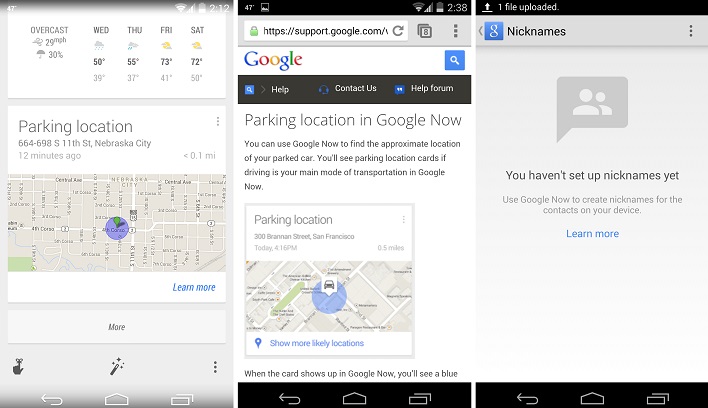
According to Android Authority, Google’s latest update to the Android version of the Google Search App includes a new feature which can help users remember where they parked their car and even give directions on how to get back to that spot. For users parking at large venues, malls, or in heavily-populated areas, this could potentially be a lifesaver. The parking reminder works by asking if you want to save a location as a Google Now card. Then when you are ready to get back to your car, you just tap on the card in the app and directions will appear.
Search Ads Get More Revenue per Conversion When Integrated With Social
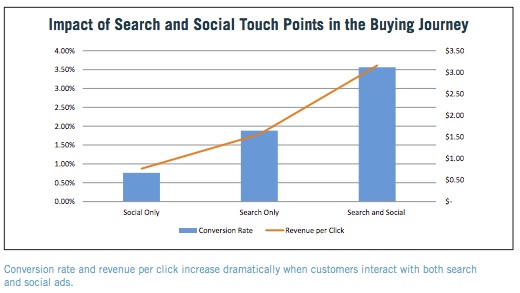
Online marketing is quickly reaching the point where you can’t approach it in a vacuum and hope for success. The days of keeping SEO, PPC, and social media marketing apart are fading fast, if they aren’t completely gone already. A new study from Marin Software confirms this y showing that advertising performs vastly better when integrated with a social advertising strategy. Jessica Lee breaks down the details of the study at Search Engine Watch, but you can also get the full white paper here.
YouTube Now Lets Channel Owners Attach Short Intros To Their Videos
This week, YouTube announced that channel owners can now add a three-second intro to their videos, allowing them to build a stronger and more cohesive brand presence across the video platform. Channel owners must upload the intro as an unlisted video, then click “Add a channel branding intro” on the InVideo Programming page. At that point, channel owners can select which videos should include the intro. However, YouTube has said intros can not be used as ads, sponsorship, or product placements, and should not be used by channels whose videos act as advertisements.
Twitter Earns 14 Million Monthly Active Users in Q1 of 2014
Twitter’s earnings report for the first quarter of 2014 shows they continue to grow in just about every area, even outperforming Wall Street estimates in all but one area. The area in which they have continued to struggle is gaining monthly active users, but even there Twitter is showing very positive signs. While not beating Wall Street estimates, Twitter monthly users did grow by 14 million since Q4 2013, culminating in 255 million total users. This is substantially more growth than shown n Q4 2013.
Vine is Coming To Desktop With New Features
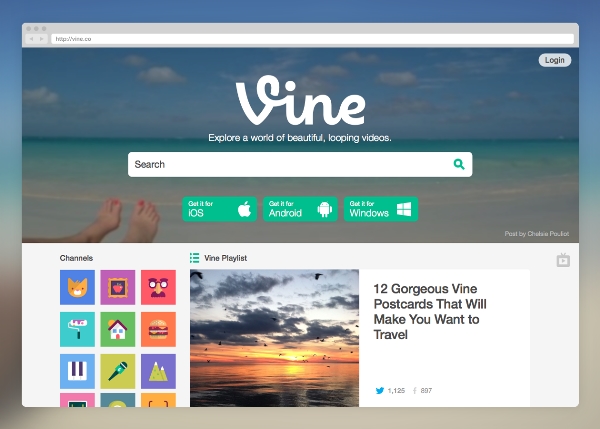
Up until now, Vine has been confined to smartphones, but this week the social video platform has made the leap to desktop with a well laid-out website and some new features. The new features include top navigation in the left which includes the home feed and popular now feed, and all feeds can now be linked together in TV mode. The biggest addition however is the new search bar that lets users search by tag, person, or location for the first time. You can get more details in the announcement on Vine’s blog, or you can see the new site for yourself here.
00Taylor Ballhttps://www.tulsamarketingonline.com/wp-content/uploads/2018/07/TMO-Logo.pngTaylor Ball2014-05-02 12:21:372014-05-02 12:21:37Quick News of the Week – May 2, 2014

 Business owners have more reason than ever to claim their Google+ business pages, because Google has finally decided to connect business pages with local listings on Google Maps.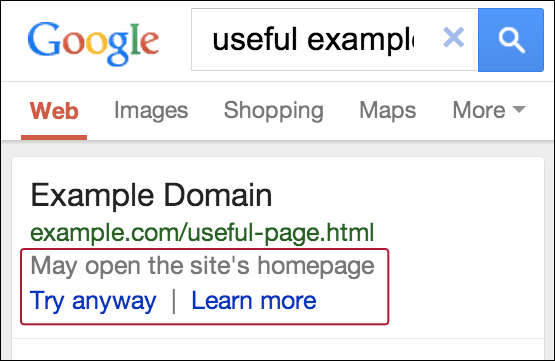



 Google Webmaster Tools (GWT) is Google’s direct line to every website owner, which consequently makes it the most important set of tools and webmaster has at their disposal. GWT allows webmasters to identify any problems with their site including alerting you to any penalties placed on you by the search engine and checking for signs of malware that may have infected your site.