Tag Archive for: Google

We try to keep our readers and clients updated with all of Google’s biggest news, whether it be redesigns, guideline changes, or newsworthy penalties. It makes sense, as Google currently receives over half of all searches made every day.

But, even those of us who keep a careful eye on the best guidelines and policy trends of the biggest search engine can end up outright confused by Google occasionally. A story reported by Danny Sullivan yesterday happens to be one of those situations.

Google has been outspoken against guest blogging or guest posts being used “for SEO purposes”, and they have even warned that sites using these questionable guest posts could be subject to penalties. However, the latest story claims that Google has penalized a moderately respected website for a single guest post. Most interesting, the post was published well before the guidelines were put into place and seems to be relevant to the site it was posted on.

The penalty was placed against DocSheldon.com, which is run by Doc Sheldon, a long-time SEO professional. Recently, Sheldon was notified that a penalty was placed against his entire site. The penalty report informed Sheldon that Google determined there were “unnatural links” from his site.

So far, this is the typical penalty put against those who are attempting to run link schemes of some form. But, obviously someone who has been around as long as Sheldon knows better than that. So what were the “unnatural links”?

It took an open letter from Doc Sheldon to Google, which he then tweeted to Matt Cutts, one of Google’s most distinguished engineers, to get some answers.

Cutts mentions one blog post published to Sheldon’s site, which appears to have been written in March 2013.

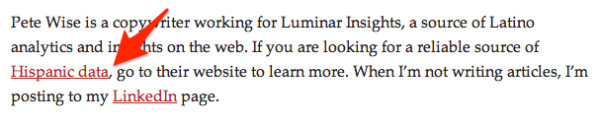
The post is exactly what the title suggests it would be (“Best Practices for Hispanic Social Networking”), but it contains two links at the end, within the author’s bio. One of the links takes you to the author’s LinkedIn page. The other, however, claims to take people to a “reliable source for Hispanic data”, which leads to a page that appears to be closer to a lead-generation pitch about big data.
Source: Search Engine Land

Source: Search Engine Land

Now, there are a few issues with the link. The page it leads to is suspect, and some would say that the words “Hispanic data” in the anchor text could be potentially too keyword rich. But, Cutts seems to imply that the content of the blog post was as much an issue as the links. As Sullivan puts it, “Apparently, he fired up some tool at Google to take a close look at Sheldon’s site, found the page relating to the penalty and felt that a guest post on Hispanic social networking wasn’t appropriate for a blog post about SEO copywriting.”

That would be a fair criticism, but if you take a closer look at the top of Sheldon’s site, he doesn’t claim the site to be limited to SEO copywriting. In fact, the heading outright states that the site relates to “content strategy, SEO copywriting, tools, tips, & tutorials”. You may take note that social practices for any demographic could certainly be relevant to the topic of content strategy.

So, as the story stands, Google has levied a large penalty against an entire site for a single blog post with one questionable link, all because they decided it wasn’t on-topic. Does that mean Google is now the search police, judge, and jury? Sadly, it appears so for the moment. Little appears to have changed since the story broke yesterday. DocSheldon.com is still dealing with the penalties, and Google hasn’t backed down one bit since the penalty was sent.

It goes without saying, the events have sparked a large amount of debate in the SEO community, especially following the widely followed penalty placed against the guest blog network MyBlogGuest. The wide majority agree this penalty seems questionable, but for the moment it appears it is best to stay under the radar by following Google’s policies to the letter. Hopefully they will become a bit more consistent with their penalties in the meantime.

Get Your Business Online Week

Still hesitant about finally making the leap and getting your business online? There are countless business owners who find themselves still on the fence about expanding your brand’s business on the internet. Some are worried about the resources available, the skills needed to make their business shine, or whether their business will actually benefit from going online, but all of those questions can be easily addressed. You just have to be ready to really invest in expanding your brand in a new way.

Today marks the start of Get Your Business Online Week, so there is no better time to make the leap to the internet. Every year Google partners with local businesses and partners to provide free virtual workshops for business owners and anyone else with an internet connection.

You will be able to speak with businesses that have already prospered online such as Barkbox, GoldieBlox, and Dollar Shave Club, and full tutorials and demos will be offered throughout the week to help you understand all the steps of building a website and establishing your brand.

Best of all, Google is doubling down on the direct link to speak to their experts with their Helpouts by Google.

If you still can’t decide whether now is the time for your business to take charge of their online presence, consider that Green Mountain Bee Farm in Fairfax, CT. experienced a five-fold increase in sales by simply expanding their business online. Meanwhile, Christine Fitzpatrick Hair and Makeup in Birmingham, Mich. managed to attract 50 percent more clients than they had before getting online.

Well, you can’t say nobody warned them. Not long ago, Matt Cutts clearly stated that Google was planning on penalizing large guest blogging networks, and yesterday Google followed through. It was widely assumed Google would be targeting MyBlogGuest, run by Ann Smarty, brand manager of Internet Marketing Ninjas, though Ann continuously defended her site, claiming they would be safe because MyBlogGuest didn’t sell links and wasn’t a “network.”

It turns out everyone but Ann Smarty was right, as Cutts announced on Monday that the guest blog network had been taken down, and MyBlogGuest vanished from the rankings, even for branded terms. Eventually Smarty even confirmed the penalty through Twitter.

MyBlogGuest has been running since 2009, and estimates they were averaging 256 articles posted per day at their height. But, the big problem is that MyBlogGuest had a very open policy on linking and refused numerous times to make it possible for links to be nofollowed.

Jennifer Slegg refers to MyBlogGuest’s true purpose as a “well-known secret” in the industry. Numerous agencies were using MyBlogGuest to promote their clients, while supporting writers who would sell links openly. The website community embraced both, making the more questionable actions wildly obvious to anyone paying attention.

Smarty is still defending her site. Since the take-down, she has spoken to multiple news outlets. She told Search Engine Watch “There are lots of networks that openly abuse the concept and promote paid guest blogging (I won’t list any names; I am not as bad as that!) but they choose to hit the oldest, best-known brand first – does it make sense? Instead of setting a good example, they make it obvious that no one is safe even such good guys as us.”

Notably, it seems that MyBlogGuest isn’t the only entity being punished in this action. Even sites that were only benefiting from the guest blog network’s policies are being struck with manual action penalties.

When Cutts made the announcement that Google had penalized the guest blog network, many speculated that sites who had been heavily using the network would also get cut down to size. Then, many sites began to notice manual actions appearing in their Webmaster Tools, but there was no clear confirmation the two were related. That is, until Cutts cleared up the situation somewhat by tweeting that Google is acting against sites that benefited from any spammy behavior on the site, which could range from running blogs hosting guest posts or benefiting from the bad links.

I could almost feel sorry for the owners of the associated sites being penalized for these behaviors, but Google has been warning about penalties for months without taking action. There has been plenty of time to cut away from questionable guest blogging practices and platforms, but many like Ann Smarty believed they could circumvent the rules. In the future, it is better to just follow the guidelines, rather than becoming the face of a new spammy industry’s downfall.

By now you’ve probably noticed your search results don’t look like they used to. Google told the public their new look was just an experiment earlier this week, but now everyone is getting to see Google’s search results pages with the new design.

Jon Wiley, Google’s lead designer for Google Search basically made the announcement the new style was rolling outto desktop when he said on Google+. “you may have noticed that Google Search on desktop looks a little different today.” He specifies desktop users because the style was showing up much more prominently on mobile before the full roll-out.

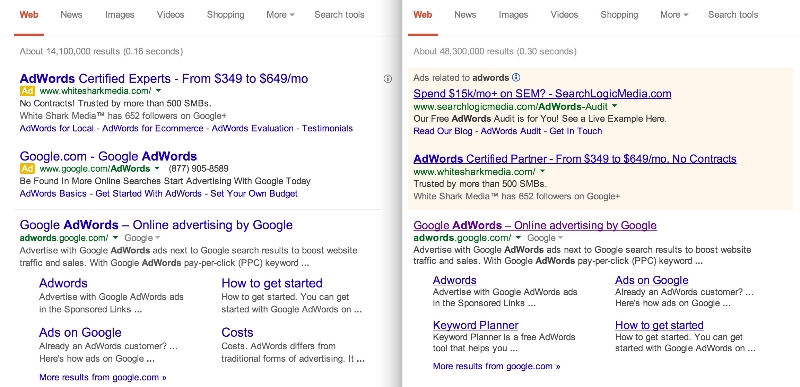
As many have noted, the new SERPs have much larger titles and the underlines have been removed. Jon also notes that Google “evened out all the line heights,” which he claims “improves readibility and creates an overall cleaner look.”

Most of those changes won’t have a huge impact on the usability of the search engine, but visitors will have to become accustomed to a different way of marking ads. Google has used smaller yellow tags to pinpoint which results were part of ads on mobile, but desktop users have still been relying on the lightly colored boxes Google has relied on for years to mark ads. Google says the change is intended to unify the mobile and desktop search experience. Jon explained:

Improving consistency in design across platforms makes it easier for people to use Google Search across devices and it makes it easier for us to develop and ship improvements across the board.

There are bound to be plenty of complaints about the redesign. I personally don’t enjoy it as much as the old style, but most will acclimate to it fairly quickly. But, it isn’t a high-profile site redesign unless people initially throw a small tantrum in the meantime.

You can compare the old and new designs below.

Google Search Results New Design


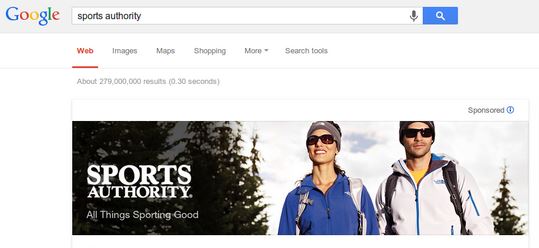
sports-authority-google-brand-banner-ad

You may remember the uproar from last October, when Google began experimenting with huge banner ads that ran across the top of branded search results. Many hailed them as the first sign of a completely branded search engine, while others weren’t as bothered by the large graphics appearing strictly on branded searches.

Either way, you shouldn’t expect to see the ads any longer. During a SMX West keynote discussion with Danny Sullivan, Google’s Armit Singhal declared the test to be over while saying that the test had failed.

Ginny Marvin suggests the test ads weren’t getting high enough click-through rates (CTR) to justify expanding or keeping around, but even Marvin admits CTR would be an odd metric to measure the success of the ads considering they acted more as a graphic introduction to brands you were searching for and didn’t include call-to-actions.

The test was very small in comparison to most Google tests, with only about 30 advertisers participating. Their banners were only shown on about 5 percent of search queries. Maybe Singhal or someone else from Google will explain how the tests were failures, but I wouldn’t bet on it. Most likely, the tests will just be forgotten like many other failed Google experiments.

However, if you missed the chance to catch some of these ads when they were appearing, or you are simply nostalgic for some nice branded banners, Marketing Land put together a slide show with many of the banners when they were still active, which you can view below.

Matt CuttsGoogle has been bringing down the hammer on spammy websites quite a bit recently with more specific penalties for sites that aren’t following guidelines. There have been several high-profile cases such as the Rap Genius penalty, and several attacks on entire spammy industries. But, if you are responsible for sites with spammy habits, a single manual action can hurt more than just one site.
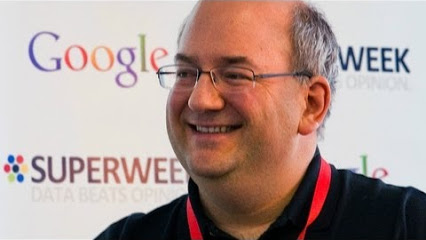
It has been suggested that Google may look at your other sites when they issue manual actions, and Matt Cutts has all but confirmed that happens at least some of the time.

Marie Haynes reached out to Cutts for help dealing with a spammy client, and his responses make it clear that the client appears to be linked to “several” spammy sites. Over the course of three tweets, Cutts makes it obvious that he has checked out many of the spammer’s sites, not just the one who has received a manual action, and he even tells one way Google can tell the sites are associated.

Of course, Google probably doesn’t review every site penalized webmasters operate, but it shows they definitely do when the situation calls for it. If your spammy efforts are caught on one site, chances are you are making the same mistakes on almost every site you operate and they are all susceptible to being penalized. In the case of this client, it seems playing against the rules has created a pretty serious web of trouble.

John MuellerThere is no escaping a Google penalty without following the rules and doing the hard work to clear your name. It is old news that if you have suffered a penalty on your site and you moveto a new domain and redirect the URLs to that new domain, the penalty stays around thanks to the redirects.

However, some SEO’s may attempt to escape the penalty by moving their site to a new domain without redirecting the URLs. That way, theoretically Google can’t follow you and put the penalty on your moved site too. Unfortunately, Google’s John Mueller has quashed the notion pretty thoroughly.

In a recent Google Webmaster Hangout, Mueller explained that even if you move the site and don’t redirect, Google may still find you and apply the penalty again. Roughly 23 minutes into the video below, John answers Barry Schwartz’s question on the topic by explaining that if you just copy and paste the pages onto a new site without many changes, Google may still be able to pick up on the site move. Even if you do not set up 301 redirects or use the change address tool in Google Webmaster Tools, Google could potentially still know you moved domains and pass along the penalty.

John does explicitly explain in the video that Google doesn’t rely on their signals alone to pass along the penalty. But, if they receive signs that you are trying to hide the same site elsewhere under a new URL without fixing the core issues with your site, they will investigate and likely apply the penalty.

In the end, you will have to do the hard work you are avoiding to ever get rid of the penalty completely. It may sometimes be better to completely tear down a site and start from scratch to fix the issues that earned you the penalty to begin with, but you can’t just run away from it forever.

You can view the video below or here.

SpellingPretty much anything Google’s most popular engineer Matt Cutts says makes headlines in the SEO community, but often his Webmaster Chat videos and advice aren’t mind-blowing by any stretch of the imagination. For instance, we recently covered a video where Cutts explained that bad grammar in the comment section most likely won’t hurt your ranking (unless you allow spam to run rampant).
For content creators, it was a legitimate concern that poorly written contents might negate the hard work putting into writing legible and well-constructed content. However, many used this to run headlines that Google doesn’t care about grammar, which is not even close to being confirmed.

As Search Engine Land points out, way back in 2011, Cutts publicly stated that there is a correlation between spelling and PageRank, but Google does not use grammar as a “direct signal.” But, in his latest statement on the issue Cutts specifies that you don’t need to worry about the grammar in your comments “as long as the grammar on your own page is fine.” This suggests Google does in fact care about the level of writing you are publishing.

It is unclear exactly where the line is for Google at the moment, as they imply that grammar within your content does matter, but they have never stated it is a ranking signal. Chances are a typo or two won’t hurt you, but it is likely Google may punish pages with rampant errors and legibility issues.

On the other hand, Bing has recently made it pretty clear that they do care about technical quality in content as part of their ranking factors. Duane Forrester shared a blog post on the Bing Webmaster Blog which states, “just as you’re judging others’ writing, so the engines judge yours.”

Duane continues, “if you [as a human] struggle to get past typos, why would an engine show a page of content with errors higher in the rankings when other pages of error free content exist to serve the searcher?”

In the end, it all comes down to search engines trying to provide the best quality content they can. The search engines don’t want to direct users to content that will be hard to make sense of, and technical errors can severely impact a well thought-out argument.

As always, the best way to approach the issue is to simply write content for your readers. If your content can communicate clearly to your audience, the search engines shouldn’t have any problems with it. But, if a real person has trouble understanding you, the search engines aren’t going to do you any favors.

Many businesses only use their Google+ Local profile for SEO. It is an important part of increasing your brand’s visibility on Google and it is incredibly easy to sign up, reap the benefits, and leave the profile alone from then on. But, it is crucial to make sure you at least set the profile up completely, otherwise you might get some interesting results.

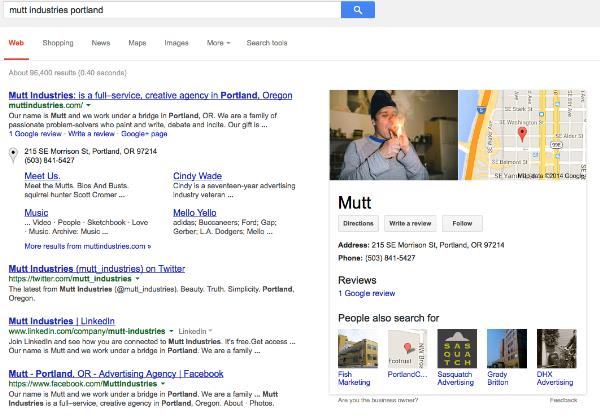
When you leave parts of your profile empty, especially your photos, Google tends to do their best to fill in the gaps. But, this doesn’t aways have the best results. For example, take Mutt Industries from Portland. Todd Mintz spotlighted their appearance on Google Plus Local and search results.

Mutt Industries

If you don’t upload pictures to your profile, Google will just use whatever they can find to fill the spot, and it might be and entirely random photo from your WordPress content. In Mutt’s case, that random photo also seemingly shows someone doing something still illegal in the majority of states, including Oregon. Obviously the image isn’t displayed prominently on Mutt’s website. It is just a random low-quality image from their hosted content.

Mike Blumenthal also noted that their Google+ Local Page is pretty much entirely devoid of all content. It has been claimed, but there is nothing else for Google to work with. If they had added just a single photo, they likely would have avoided the mix-up altogether.

If you aren’t going to use your Google+ Local Page in an attempt to engage the community, at least be sure to add enough to make your business identifiable and allow you to have some control over how you appear to searchers. A “Full-Service Creative Agency” might not be too hurt by a stoned appearance, but you probably don’t want people to think your serious business has gone to pot when they search for you.

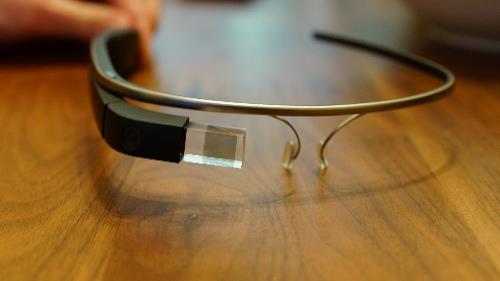
Despite not being available to the public any time soon, Google Glass has already raised quite a bit of a stir. But, not all of the stories have been good.

Source: WikiCommons

Source: WikiCommons

While plenty of testers or “Google Glass Explorers” have used the technology to engage with the world around them in a new way, there have been concerns about the safety of wearing Glass while driving or doing other activities. There have also been reports of those wearing Google Glass getting into confrontations with others for various reasons surrounding the technology.

Now, Google has released an official list of do’s and don’t’s for Google Glass to help mitigate the more negative stories that keep popping up. If you’re one of the lucky few getting to test drive Google Glass before its public release, you might consider heeding the guidelines they shared for the best experience possible.

The Google Glass Do’s:

  • Explore the world around you. Glass puts you more in control of your technology and frees you to look up and engage with the world around you rather than look down and be distracted from it. Have a hangout with your friends, get walking directions to a fantastic new restaurant, or get an update on that delayed flight.
  • Take advantage of the Glass voice commands. Glass can free your hands up to do other things like golfing, cooking, or juggling flaming torches while balancing on a beach ball (but also see Don’ts #2). This is great for looking up how many ounces in a cup while you cook, or taking a one-of-a-kind photo from your unique perspective.
  • Ask for permission. Standing alone in the corner of a room staring at people while recording them through Glass is not going to win you any friends (see Don’ts #4). The Glass camera function is no different from a cell phone so behave as you would with your phone and ask permission before taking photos or videos of others.
  • Use screen lock. Glass screen lock works like your smartphone’s screen lock: it passcode-protects your device to help prevent others from using it. If you ever lose your device or have it stolen by a budding online resale entrepreneur, you can turn off Glassware and perform a remote wipe (e.g. factory reset) of the device, removing all your information from the device. All you need to do is go to your MyGlass page on your browser, or the MyGlass App on your phone.
  • Be an active and vocal member of the Glass Explorer Community. The Explorer Program was created in order to have a place where our Explorers can give feedback, share content and communicate with the Glass team. It’s been hugely successful over the past year and this is due to our wonderful group of Explorers. They are constantly sharing their worlds with us and with each other, allowing us to hear and work on all the great feedback and stories our Explorers give us (and, wow, do they give us a lot!).

The Google Glass Don’t’s:

  • Glass-out. Glass was built for short bursts of information and interactions that allow you to quickly get back to doing the other things you love. If you find yourself staring off into the prism for long periods of time you’re probably looking pretty weird to the people around you. So don’t read War and Peace on Glass. Things like that are better done on bigger screens.
  • Rock Glass while doing high-impact sports. Glass is a piece of technology, so use common sense. Water skiing, bull riding or cage fighting with Glass are probably not good ideas.
  • Wear it and expect to be ignored. Let’s face it, you’re gonna get some questions. Be patient and explain that Glass has a lot of the same features as a mobile phone (camera, maps, email, etc.). Also, develop your own etiquette. If you’re worried about someone interrupting that romantic dinner at a nice restaurant with a question about Glass, just take it off and put it around the back of your neck or in your bag.
  • Be creepy or rude (aka, a “Glasshole”). Respect others and if they have questions about Glass don’t get snappy. Be polite and explain what Glass does and remember, a quick demo can go a long way. In places where cell phone cameras aren’t allowed, the same rules will apply to Glass. If you’re asked to turn your phone off, turn Glass off as well. Breaking the rules or being rude will not get businesses excited about Glass and will ruin it for other Explorers.