Smaller local businesses are overwhelmingly lagging behind the rest of the market when it comes to getting online and increasing visibility and audience outreach through optimization and search engine marketing. Unfortunately the longer these companies wait to expand their business online, the further they fall behind the curve. Thankfully, Trond Lyngbø created a comprehensive article exploring the most important information anyone running a smaller local business needs to know about SEO and online marketing.
Social media is typically thought of as where all the cool kids hang out. Fast food, clothing, and entertainment all have it easy when it comes to making friends and getting retweets, but businesses in seemingly boring industries frequently settle for mediocrity out of the belief they can’t keep up with the “cooler” industries. But, Uri Bar-Joseph showed us five companies that shrug off the assumption that “boring” businesses can’t be exciting online.
Every week we try to keep you updated with all the SEM news from around the web, but the Google I/O event this week was packed full of so much information there was bound to be some stuff we didn’t get to cover. Today, we’re going to cover all the latest news from I/O and everywhere else. We’ll start with Google, but there is also some interesting Facebook news to discuss near further down.
Android Reaches 1 Billion Active Users Per Month
To open the annual I/O developers conference, Google rattled off an impressive list of statistics, as large tech companies tend to do. Of these statistics, there is one that was noteworthy and shows just how prominent smartphones have become throughout the world.
At last year’s conference, Sundar Pichai told the audience that Android had around 530 million active users per month. Over the past year, that number has almost doubled, surpassing one billion active users every month.
Other interesting stats include:
- Android users send 20 billion texts per day.
- They take 93 million selfies per day.
- Android users take 1.5 trillion steps each day.
- They check their phones 100 billion times per day.
- Android tablets represent over 60 percent of all tablets shipped.
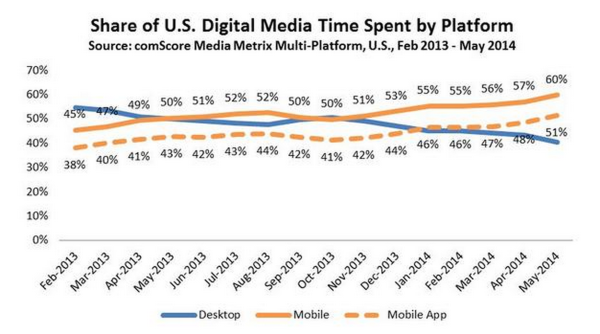
If you’re wondering what everyone is doing on their phones, you can be assured that it involves apps. comScore released a report this week showing that over half of all digital media time is now spent using apps, though its unclear whether more time is spent on Angry Birds or The Wall Street Journal’s news app.
Google Will Remove Author Images From Search Results
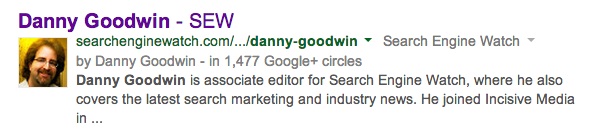
Google is continuing to push an emphasis on authorship authority, but don’t expect to continue seeing author images in your search results for much longer. In the next few days, Google will be stripping the author images and Google+ circle counts from desktop and mobile search results in an attempt to streamline search result appearances. In the announcement on Google+, John Mueller said:
“We’ve been doing lots of work to clean up the visual design of our search results, in particular creating a better mobile experience and a more consistent design across devices,” he wrote. “As a part of this, we’re simplifying the way authorship is shown in mobile and desktop search results, removing the profile photo and circle count.”
Danny Goodwin from Search Engine Watch shared an example showing what the results looked like before (shown above) and what they will look like in the very near future (below).

Google is Testing Their Domain Registry Service
Google has expanded into seemingly every facet of online activity, but up until now they have left domain registration to other service providers. That won’t stay the case for much longer as Google recently announced they will be inviting a limited number of people to test their new service called … wait for it… Google Domains.
As the shockingly creative name suggests, Google Domains will let users search, find, purchase, and transfer the domain or domains best representing their business. The service is still being built, which is part of why you shouldn’t expect for it to come out of testing in the close future. But, the service could potentially make the act of creating a website and establishing a company presence online much more easily understandable for the 55% of businesses that still don’t have websites.
Google My Business Comes To iOS and Android
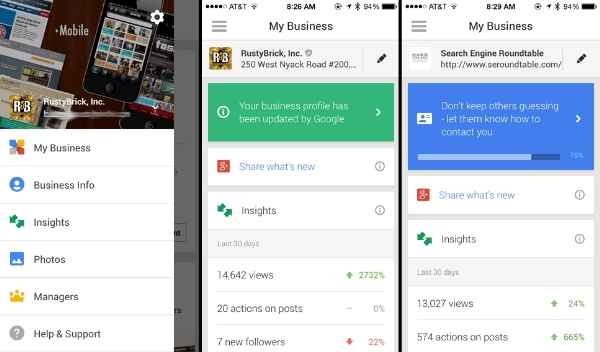
Google announced Google My Business earlier this month, and on Wednesday the official apps for the service came out on both Android and Apple smartphones. The apps offer a unified interface that will make it easier to manage your brand’s online presence on the go. App features include:
- Edit the business listing by changing hours, description, etc.
- View managers of the page but not manage them
- Post to Google+
- Add photos and update cover and profile photos
- View local insights and analytics
- Change business pages and accounts
Watch Now Now Influences Facebook News Feed Video Rankings
Facebook is constantly working on its News Feed algorithm and the latest update is intended to improve the quality of videos being served to users. The new video ranking takes note of how long users watch a video for and uses this information to influence content ranking. This metric will be combined with other long-standing metrics such as likes, comments, and shares.
In the announcement, Facebook said, “In our early tests, this improvement resulted in more people watching more videos that are relevant to them.” The announcement also noted that twice as many people watch videos on Facebook compared to the numbers from six months ago.
Wait, So Facebook is Still Popular With Teens?
You’ve undoubtedly heard the rumors, studies, and proclamations that Facebook is losing traction with teens like a car driving off a cliff. From what everyone wants to believe, all the young kids are moving to the burgeoning messaging apps to escape the prying eyes of their parents and lame extended family. Even President Obama has commented that kids “don’t use Facebook anymore.”
The problem with all this is, the numbers don’t entirely support that conclusion and two reports from the past week confirm that Facebook is still the most popular social site for the demographic by far.
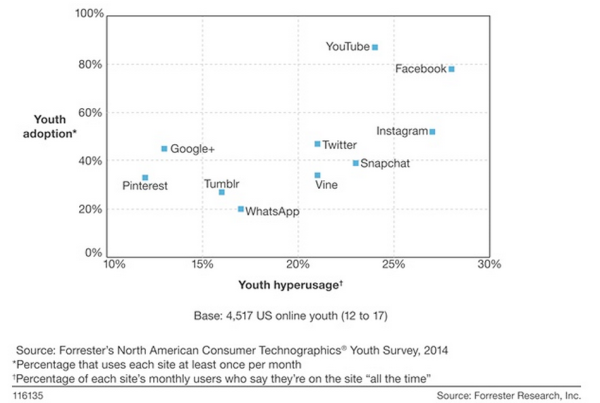
First, Forrester Research released a report showing that more than 75% of US online youth use Facebook at least once a month. Their survey polled 4,517 internet users between the ages of 12 and 17, and that Facebook has twice as many users as Pinterest, Tumblr, Snapchat, and more than Instagram and WhatsApp combined.
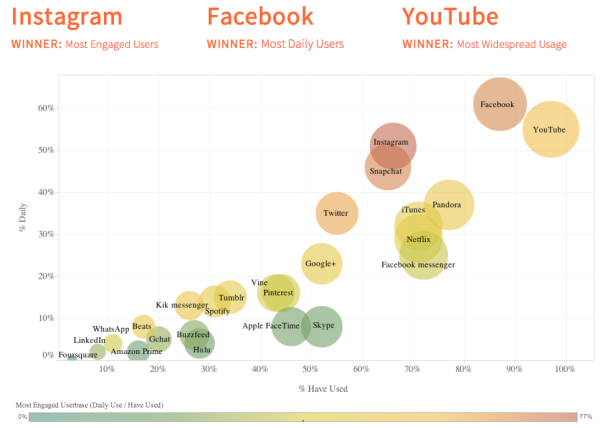
The second study, from college and K-12 education review site, Niche, found similar results from a survey of 7,000 teenage users. Specifically, 87% still use Facebook “occasionally” and 61% use it daily (including the 47% who use it “a few times a day.)
You can find countless articles offering SEO tips filled with practical advice about how to stay within Google’s guidelines and optimize the code on your website. You’re also likely to find plenty of buzzwords and catchphrases like “content is king.” But, all of these practical tips won’t do you much good if you are approaching SEO with the wrong perspective.
It seems counter-intuitive, but good SEO means you need to stop thinking about yourself. You have to think about what your audience wants and how to reach people in new and interesting ways. It is hard to do this if your entire motivation is to “rank higher” or “get more traffic.”
ResultFirst shared an infographic that can help you reshape the way you think about SEO and use a perspective that favors your audience, because a happy audience always leads to growth and success for your business.

At this point, it is undeniable that any business with a website should have some form of mobile optimization, whether that means a responsive website, separate mobile URLs, or dynamic serving. But, many businesses with limited resources are attempting to solve this issue by essentially tacking on mobile optimization as an afterthought.
According to a new report from BrightEdge, 27 percent of sites have some form of errors from improper mobile implementation. Even more so, the report claims that sites with mobile implementation errors can cost websites up to 68 percent of smartphone traffic, an increasingly important segment of traffic.
BrightEdge’s Mobile Share Report examined the various types of mobile solution available and sought to uncover which configurations are the most likely to have some form of errors, as well as how these errors impact issues like rankings and traffic.
Notably, Google has indicated that responsive design, dynamic serving, and separate mobile URLs are all accepted forms of mobile implementation, although they have also deemed responsive websites as their preferred solution. As such, BrightEdge was especially interested in seeing if sites with responsive design was less likely to result in errors or had a better chance of ranking.
Interestingly, according to BrightEdge there was no significant difference between smartphone rankings based on mobile configuration.
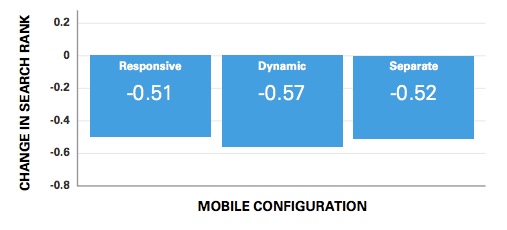
“Data from BrightEdge’s Data Cube shows that for a given keyword, on average, a website’s rank for smartphone users varies only slightly based on the type of mobile configuration a website has implemented,” the report said. “So, for example, if a site is ranked No. 3 on a desktop, it would rank 3.5 (on average) on a smartphone device. This data represents the average across billions of keywords studied.”
Notably, the report indicates any difference in rank is likely due to local search results pushing other more universal results down on the SERP.
So, with sites using all mobile solutions ranking relatively even, why would Google endorse responsive design?
Responsive design showed the least chance for mobile errors, especially over using separate mobile URLs. In fact, 72 percent of sites using separate mobile URLs had errors, while responsive design showed a minuscule number of sites with errors. Dynamic serving rested nicely in the middle with a 30-percent error rate.
Some of the most common errors can be seen below:
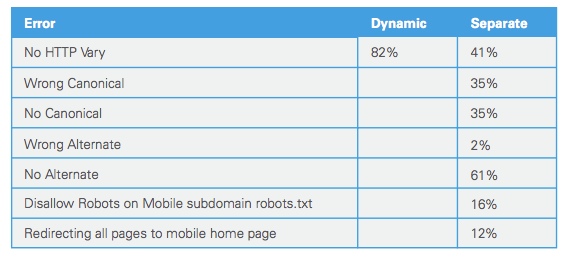
“For separate mobile URLs, there are a handful of common mistakes made in implementation,” the report said. “BrightEdge research showed that no HTTP Vary header was a common mistake amongst two approaches: dynamic serving (82 percent) and separate mobile URLs (41 percent). And among the separate mobile URL approaches, not having an alternate URL tag was the most common error 61 percent of the time.”
These errors are important because they create a poor user experience, which can push traffic away. Even worse, Google has outright said that sites who don’t provide a good mobile experience may not be able to compete in search results overall.
While sites using the various mobile implementation options correctly are ranking fairly evenly, it is obvious that responsive design is still the safest bet. Any option can work, but you are significantly more likely to avoid errors that could cause you problems by simply choosing the least error-prone option: responsive design.
For the longest time, online marketing was all about making yourself visible on search engines, with a heavy emphasis on Google. But, social media, smartphones, and the wide array of apps with their own search capabilities are beginning to take a chunk out of search engine traffic and marketers are going to have to expand their focus if they want to continue to be successful.
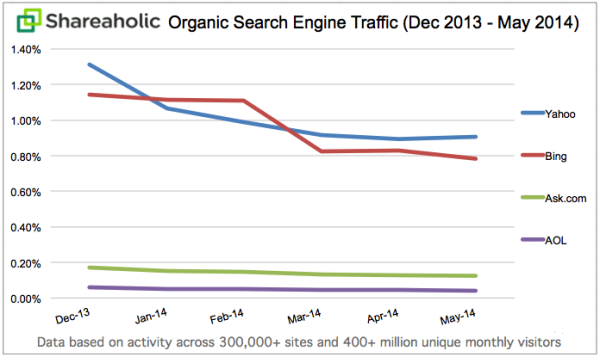
A new report from Shareaholic shows that all of the top five search engines – Google, Bing, Yahoo, Ask.com, and AOL – have all seen a significant decline in search traffic since December of 2013.
The report used data from December 2013 through May 2014 to evaluate aggregate organic search traffic numbers from more than 300,000 publishers reaching an audience of more than 400 million monthly unique visitors. From that data, Shareaholic saw that Google’s search traffic fell 17 percent between last December and May of this year.
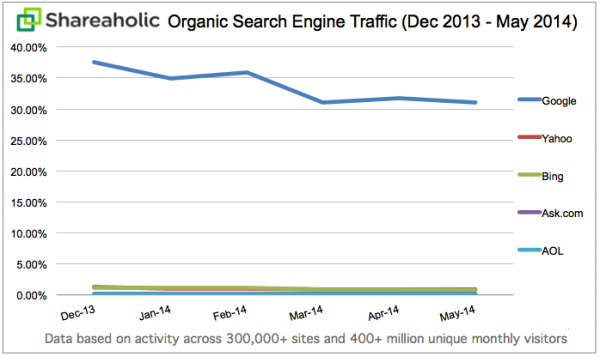
Bing, Yahoo, Ask.com, and AOL saw even larger drops in traffic compared to Google, with Bing and Yahoo both experiencing 31 percent declines.
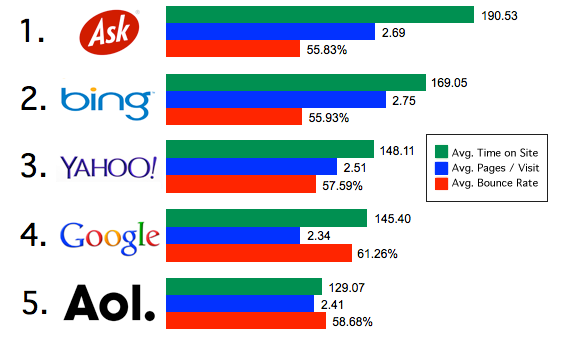
Shareaholic also looked at engagement from each search engine and found that although Google accounts for 17 times more traffic than Bing, Yahoo, Ask.com, and AOL combined, their users are often less engaged. This suggests that while Google may still control the vast majority of search traffic, it’s users may not be as valuable as the other more engaged searchers from across other search engines.
All week we try to keep you up to date with the most important SEM news across the web, but inevitably there are smaller stories that fall through the cracks. That’s why we compile all the most important news we missed this week all in one convenient place every Friday. Despite the distractions of the world cup, there have been some pretty big announcements throughout the week. So, let’s get to it.
Google Preps Online Retailers With Best Practices
With the clock ticking before Shopping Campaigns becomes the default campaign type for running Product Listing Ads at the end of August, Google is trying to help prepare retailers and marketers by issuing best practice guidelines to help everyone make the transition smoothly.
For the most part, the guidelines listed aren’t far off from the original PLA recommendations. Yes, the paper covers product feed optimization and newer updates, but most of it is a refresher for those who have been working with retailers for a while now, including classic rules like “use relevant titles and high quality images.”
However, marketers and retailers may be interested in the new recommendations about how to structure new shopping campaigns, especially as we enter the transition period.
You can download the whitepaper of the guidelines from Google here.
Sneak a Peak at Google’s New Reconsideration Rejection Forms
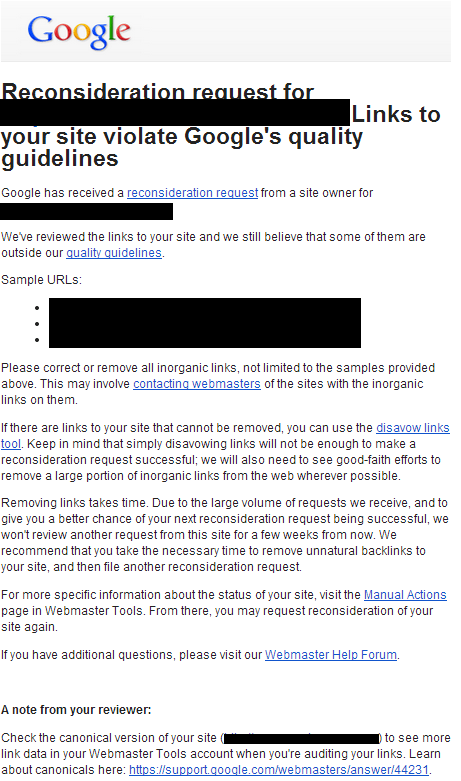
Last week, Matt Cutts made headlines throughout the SEO community by announcing that Google will be revising their reconsideration requests rejection notices with more detailed information in some cases. Of course, there were plenty of skeptics, but an example of the rejection notices has been shared on Twitter by @johnwarddoyle.
Surprisingly, it seems Google made good on their promise.
Don’t get too excited. The individualized response is short and easily missed, but rejection notices at least offer some useful information for repairing a site now. Largely the note is the same as before, but down at the bottom you will see a new section titled “A note from your reviewer.” Here, you will find specific advice relevant to your site that could be potentially highly useful.
Facebook Shows Off Their Snapchat Competitor
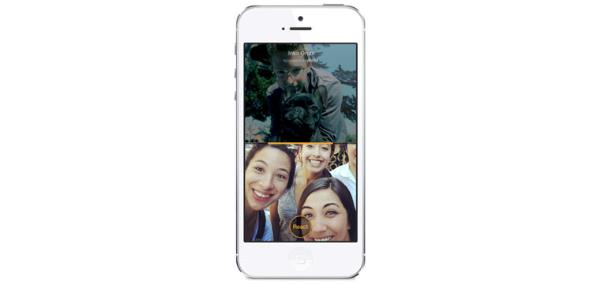
After having a $3 billion offer refused by Snapchat – the popular self-destructing photo messenger app – Facebook is trying to fight back. This week Facebook announced Slingshot, an app obviously influenced by Snapchat’s concept, but with a new twist.
Slingshot does allow users to send photos or short video messages that will delete automatically after a short period of time, but there is more to it:
To get started on Slingshot, shoot a photo or video… add some text and color, then sling it to a bunch of friends. Here’s the deal: friends won’t be able to see your shot until they sling something back to you. They can then reply with a reaction – or simply swipe your shot away.
The concept encourages reciprocal communication more and could potentially catch on, but it could just as easily fall apart in the shadow of it’s better-established rival. With the faltering youth activity on Facebook, it is hard to know how much traction this type of app can get.
Major Brand’s Seeing Engagement Plummet on Facebook
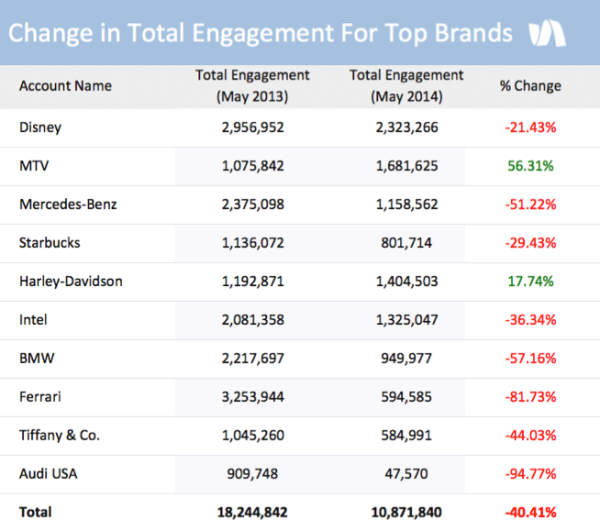
Speaking of Facebook’s problem of bleeding activity and user engagement, recent reports show that it isn’t just the teen demographic evaporating from the site. Facebook analytics provider Simply Measured says consumer engagement with Facebook posts from almost all top Interbrand companies are down significantly from last year.
According to the firm, monthly engagement is down over 40 percent since May 2013.
Only two brands on the list (MTV and Harley Davidson) say increases in engagement, while the others saw huge decreases. Overall engagement was down at least 50 percent.
Most troublesome for Facebook, the report outright cites the decreasing organic reach available on Facebook as a primary blame for the decline in engagement.
Facebook’s Graph Search Makes Its First Appearance on Mobile
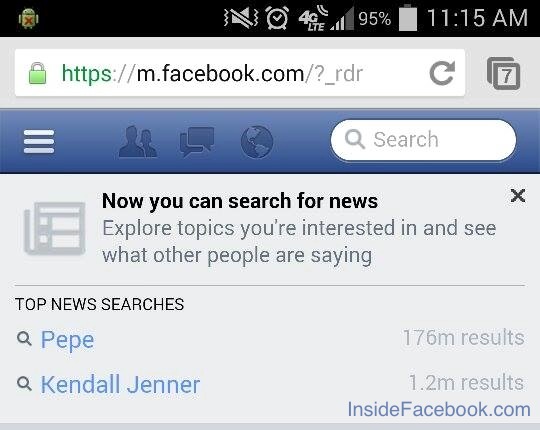
While Facebook’s Graph Search hasn’t been officially released on mobile yet, but it is most likely getting very close to being rolled out. Over the past week, many people reported encountering a test showcasing in-depth integration for the Graph Search for mobile users with all the same features you’ve come to recognize.
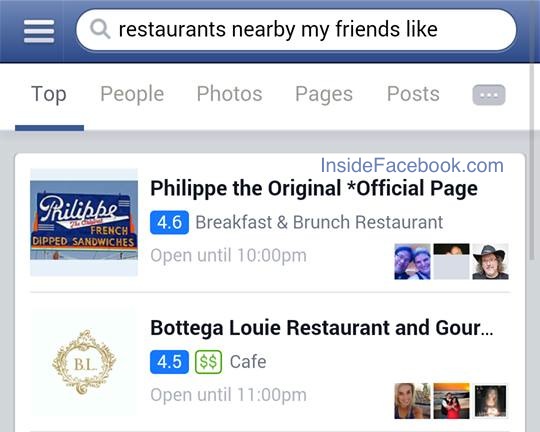
The most anyone has gotten out of Facebook is the response “we’re testing improvements to Facebook mobile search.” But, I would wager the release will be sooner than later. The current testing version for mobile seems to be able to handle all the complex searches capable on desktop and appears to be largely ready for release.
Twitter Finally Adds Animated GIF Support
Twitter’s announcement this week may seem super minor, but it has received nearly as much coverage this week as any other bit of information relevant to online marketing. The reason is simple: internet users love GIFs and this week Twitter announced you can now post and view animated GIFs on Twitter’s website and mobile apps.

Of course, the announcement came in the form of a Tweet featuring an animated GIF from Twitter Support.
Starting today, you can share and view animated GIFs on http://t.co/wJD8Fp317i, Android and iPhone. pic.twitter.com/XBrAbOm4Ya
— Twitter Support (@TwitterSupport) June 18, 2014
Previously, users could share links to GIFs via third-party services like Imgur, but starting this week you can now share and view the moving images directly on Twitter.
Importantly, GIF’s won’t start playing automatically in your feed like they do on Tumblr. Instead, when a GIF is shown, a white play button will be overlayed, allowing you to choose when a GIF starts playing.
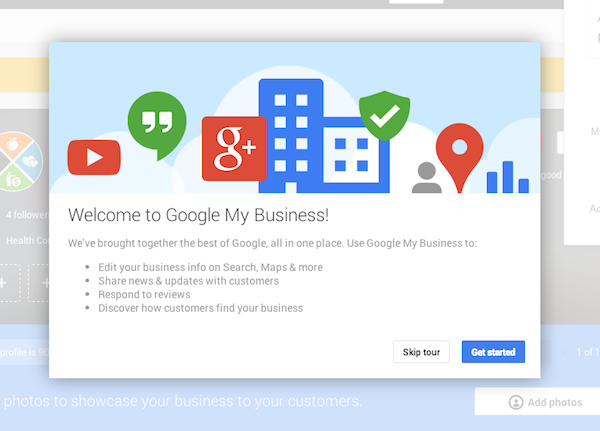
Google has been making some big changes to help businesses increase their visibility on Google Search, Google Maps, and Google+ by connecting business information across all of Google’s services. Google is calling the interconnected service Google My Business, which is set to be a one-stop shop which will allow users to access all their applications in one place.
The service will help deal with duplicate entries across Google products by asking users to entire their information one initial time, then populating it into all of Google’s services at once. TechCrunch also reported that “owners can post news events, photos, and other updates they want shared with customers” in an apparent bid to rival Facebook.
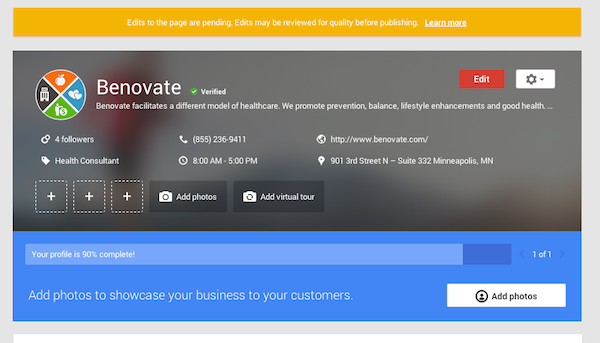
Once you’re signed in and Google has guided you through a tour of the platform, you’ll see a screen that houses your basic information that will appear on Google+, Google Places, and Google Search. From now on, you’ll be able to update business information such as store hours, phone number, or your website URL in one easy to access location.
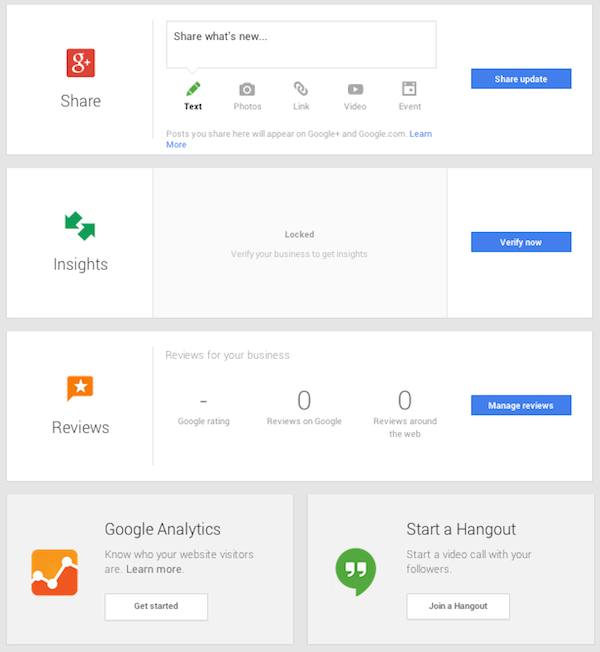
Beyond that page, you’ll be given access to the the really meaty parts of the update. From one screen, you’ll have control of your Google+ profile, from which you can share new text, photos, links, and events. You can also explore Insights, which will help you analyze your visibility, engagement, and audience. This screen also lets you manage your reviews, quickly access your Google Analytics dashboard, and even start a Hangout with the click of a button.
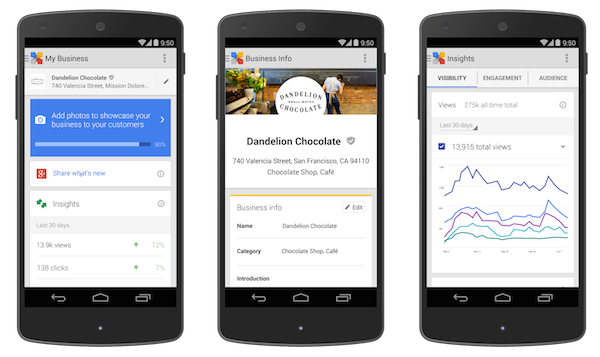
Notably, this update has already gotten a mobile launch on Android, and it appears the iOS version of Google My Business will be released n the near future.
Google My Business makes it easier than ever for small businesses to take control of their own online presence and helps level the playing ground so that any company can benefit from being online. You don’t have to be a well-established brand to make yourself visible online.
 Business owners have more reason than ever to claim their Google+ business pages, because Google has finally decided to connect business pages with local listings on Google Maps.
The change allows business owners to have a more coherent presence across the web as well as improve the ability of searchers to find them. The process connects your current page to Google Maps and applies the business information, including the business address, the Google Maps reviews, business hours and more from to your page.
A large number of businesses have more than one Google+ page listed in their Google+ manager page, so this will also help clean up the clutter by combining at least two of these pages.
Google explains in detail how to connect your Google+ business page to your Google Maps verified listing on the help page, as well as instructions for creating a local page if you have yet to add your business to Google.
Pages that are newly connected to maps will display the name and verification badge from the former local page, as well as showing the business information such as hours of operation and phone numbers. The pages will also show reviews from the former local page, but will not show prior owner responses to local reviews.
All week we try to keep you up to date with the most important SEM news across the web, but inevitably there are smaller stories that fall through the cracks. That’s why we compile all the most important news we missed this week all in one convenient place every Friday. After a quiet week before, nearly all of the major platforms have made announcements this week. Let’s start with Google and work our way down.
Google Starts Warning Searchers About Mobile URL Redirects
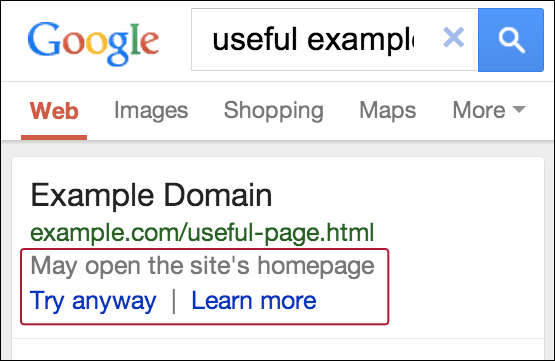
Google has been warning webmasters about faulty mobile redirects for months, including suggesting they may one day start receiving penalties for sending mobile searchers to the front page of a site rather than the content relevant to their search. It appears Google has opted for another solution, which allows mobile searchers to decide if they want to proceed.
Google alerted webmasters this week that smartphone searchers will begin seeing warnings for sites with redirects that don’t take them where they want to go. An example of how these warnings will appear is above. On a Webmaster Central blog post, Google stated:
We’d like to spare users the frustration of landing on irrelevant pages and help webmasters fix the faulty redirects. Starting today in our English search results in the US, whenever we detect that smartphone users are redirected to a homepage instead of the page they asked for, we may note it below the result. If you wish to proceed to the page, you can click ‘Try Anyway.’
Google Adds World Cup Street View Tours and a Loch Ness Easter Egg
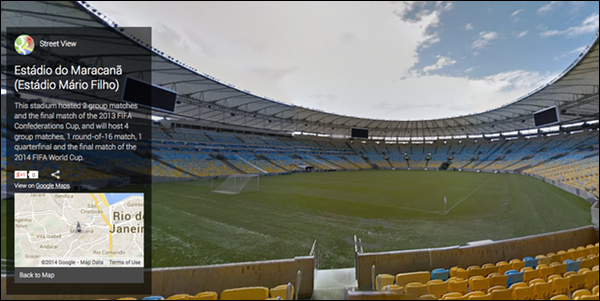
Just a week before the World Cup kicks off, Google has added street view images that will allow users to tour all 12 stadiums that will be used for the tournament. Whether you want to stand in the middle of the field and do a little spin, or preview the view from the stands, you’ll be able to give a look from anywhere within the stadiums.
Google has also added significantly more images from Brazil’s painted streets and other sites across the country, but perhaps one of the most popular finds on Google Maps this week is an Easter Egg found far away from Brazil.
If you’d rather hunt legendary monsters than watch soccer, Google Maps is able to give you directions to Loch Ness. If that isn’t enough for you however, Google says you can always catch a ride on Nessy.
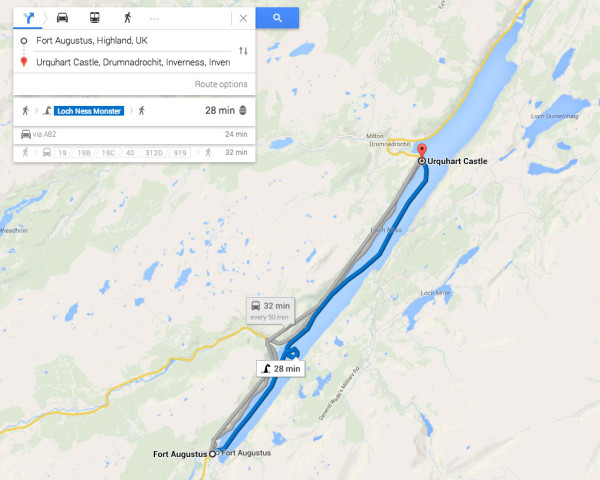
If you get directions from Fort Augustus to Urquhart Castle in Google Maps, you will get the option to travel via Loch Ness Monster. You just have to click on ‘Route Options’ and then choose ‘Fewer Transfers’ or ‘Less Walking.’ Though you have to wonder how no one has managed to get a picture of Nessy while hopping a ride down the Loch.
Bing Celebrates Its 5th Birthday With Some Memories
Bing turned five earlier this week, and to celebrate it has posted a retrospective of the last five years. Bing is also offering Bing Reward credit perks to any user who searches on the site before June 9th.
The retrospective covers all of the ways Bing’s appearance has changed over the past five years, but it also covers how it has worked to achieving its initial goals of leveraging semantic search, introducing new verticals, and generally expanding how search could function in our lives.
Bing Shows Off New Dynamic Carousel For Music Video Searches
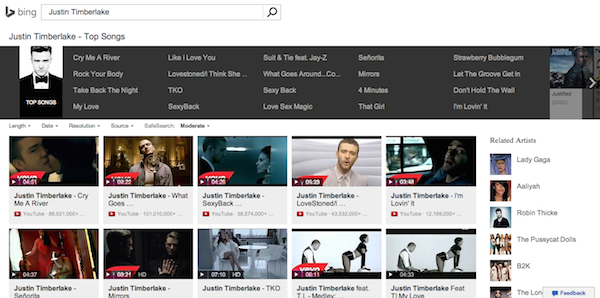
Bing has prided itself on being ahead of the curve in respect to music and music video searching and discovery, and its latest feature continues to expand on the functionality it previously offered for music video searches.
Bing has recognized that people search for music videos very differently than they do other video content. By exploring these changes in user behavior, Bing was able to determine that music video watchers wer significantly more likely to hang around and check out other content instead of moving on once they found the video they were looking for.
To give users easier access to all the music videos they may be interested, Bing has implemented instant access to an artist’s top hits as soon as you search only the artists name. Bing describe this as a dynamic carousel, because it allows you to open up songs and videos from teh carousel and play it within the same window. You will never have to keep going back and forth between choosing the video you want to watch and actually watching it.
The carousel also allows you to view all of an artist’s albums and watch the videos for those songs as well.
Pinterest Continues To Work Towards An Actual Ad Platform
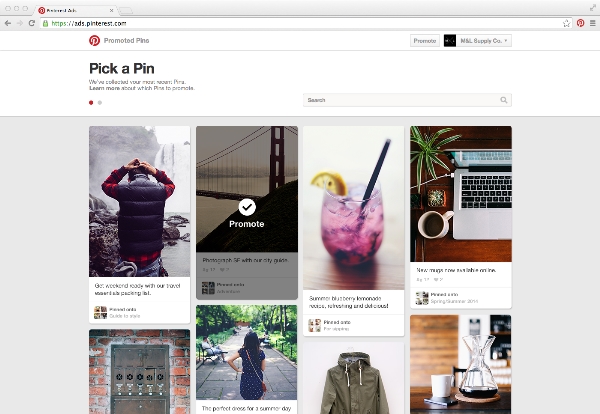
Pinterest has made its intention to establish an ad platform for their social network very clear ever since it unveiled Promoted Pins. However, Pinterest is working slowly to guarantee that the ads shown on their platform won’t stick out or detract from the experience, and as such it has been very hands on and selective about who it allows to run ads.
Now, businesses of all types have been given access to a do-it-yourself Promoted Pins tool that allows them to promote their own pins to more people and increase visibility. Similar to most other social ad platforms, these will work on a cost-per-click basis through ads.pinterest.com.
Pinterest also announced they would be expanding the analytics tools offered to users, giving them more insight into who is clicking and re-Pinning your content. You can get more information from their announcement.
LinkedIn Joins The “Large Cover and Profile Photo” Club
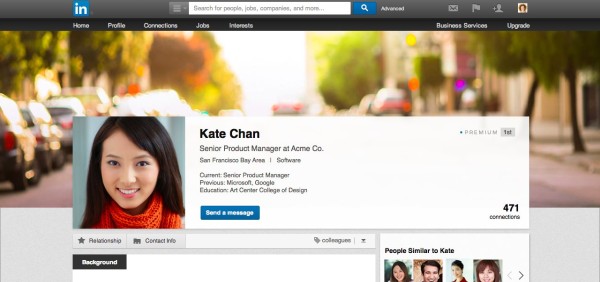
LinkedIn announced earlier this week it would be making a major design update to user profiles, which will feel very familiar to anyone who uses Facebook, Google+, or Twitter. Currently, the layout is only available to premium users, but LinkedIn says it will be available for all users after a short period. It isn’t entirely clear why LinkedIn would stagger the rollout of this layout change, but you can add it to the list of social media sites that are beginning to look very, very similar.
From Our Blog
 Google Tests Including Video In Local Search AdsApril 24, 2026 - 4:19 pm
- Google’s March 2026 Core Update Has Finished Rolling OutApril 9, 2026 - 7:51 pm