Online marketing can be difficult for newcomers to get a grasp on thanks to the absolutely huge amount of jargon involved. It can be mind boggling to attempt to work through all the terms without any clear or simple explanation offered. Worst of all, context often doesn’t help because these terms often rely on an understanding of other specialized words and jargon.
If link bait or link spam are foreign words or a Google bomb sounds like a weapon of mass destruction, you could most likely benefit from a glossary that explains all the strange language surrounding SEO. Thankfully, Moz.com offers exactly that.
David LaFerney shared a complete glossary of SEO terms that are absolutely essential to working your way through the industry or taking charge of your business’ web presence. The glossary was published over 7 years ago, but for the most part the terminology of SEO hasn’t changed. For the most part, what has changed over the last half-decade is how these systems work together.
00Taylor Ballhttps://www.tulsamarketingonline.com/wp-content/uploads/2018/07/TMO-Logo.pngTaylor Ball2014-09-15 13:32:482014-09-15 13:32:48An Essential Glossary for SEO
Seeing as Google isn’t giving away their search engine ranking factors playbook anytime soon, many people working in the search industry work constantly to discern as much as possible about how the biggest search engine ranks websites. One group of those people are SearchMetrics, who release a yearly ranking factors study.
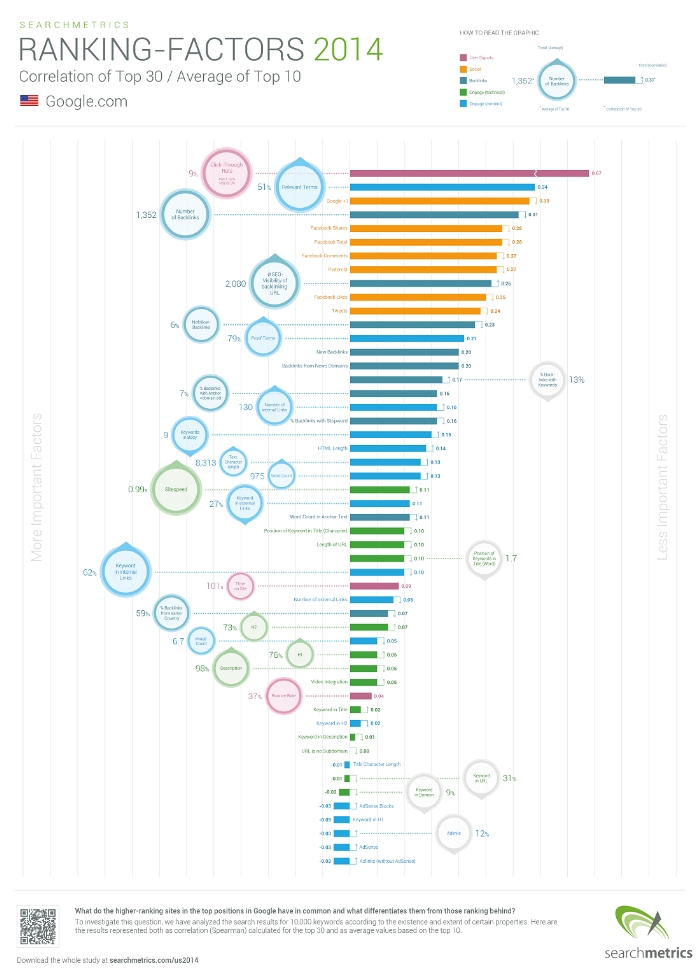
As of yesterday, SearchMetrics 2014 ranking factors study is available to study, and they claim this year’s is the largest study they have ever done, with almost 100 pages and dozens of new ranking factors to review such as time of site, bounce rate, fresh links, and others.
Most importantly the study may answer one of the biggest SEO questions of the year; is content really the new king of search marketing? According to this report, the mantra of the SEO industry over the past few months is in fact true, as Marcus Tober comments that content is “no longer an addition to, but is the main focus of, SEO.”
Barry Schwartz broke down the most prominent ranking factors for Search Engine Land if you want the quick version, or you can get the full report directly from the source here.
00Taylor Ballhttps://www.tulsamarketingonline.com/wp-content/uploads/2018/07/TMO-Logo.pngTaylor Ball2014-09-09 13:04:462014-09-09 13:04:46The Latest Ranking Factors Study Confirms Content is King
Last week, Google confirmed they would be pulling all authorship information from their search results pages but confusion between Google Authorship and Author Rank has been causing some chaos in the SEO world.
Before you start burning bridges that feed into Author Rank and can legitimately help your site, take the time to check out the explanation on the situation from Danny Sullivan. The explanation helps clear up how authorship can die and Author Rank is still alive and as important to search as ever.
00Taylor Ballhttps://www.tulsamarketingonline.com/wp-content/uploads/2018/07/TMO-Logo.pngTaylor Ball2014-09-03 12:53:572014-09-03 12:53:57Google Authorship Is Still Dead, But Author Rank Is Alive and Well
A few weeks ago, Google announced they would begin favoring sites who switch to HTTPS in search results. At the time of the announcement, most of the SEO community was skeptical at best and few believed the HTTPS ranking factor would have any effect on rankings whatsoever. Well, it has been a couple of weeks and we have the verdict.
The skeptics were absolutely right.
SearchMetrics decided to evaluate whether HTTPS had any discernible effect on search results of any form. According to Marcus Tober of SearchMetrics, there is no data to prove HTTPS has any effect on Google rankings after the launch of the ranking factor.
In a nutshell: No relationships have been discernible to date from the data analyzed by us between HTTPS and rankings nor are there any differences between HTTP and HTTPS. In my opinion therefore, Google has not yet rolled out this ranking factor – and/or this factor only affects such a small section of the index to date that it was not possible to identify it with our data.
Tober shared his data along with his report, and it all matches all the anecdotal evidence available as well. Site owners across the web rushed to update their site to the new favored HTTPS, but there is nary a single story I could find suggesting it had any ranking influence at all.
At the time of the announcement, Google did suggest that switching over could possibly influence rankings, but they also called it a “very lightweight signal” so there’s no need to grab your pitchforks. But, these results may have some lessons for those who were expecting and easy and quick ratings boost with minimal work.
00Taylor Ballhttps://www.tulsamarketingonline.com/wp-content/uploads/2018/07/TMO-Logo.pngTaylor Ball2014-09-02 13:38:402014-09-02 13:38:40HTTPS URLs Don’t Appear To Get Any Rankings Boost
There was a time not too long ago when every SEO professional felt confident proclaiming that Authorship was the future of search, but it appears the predictions couldn’t have been much more incorrect.
When Google was pushing Authorship as a part of their search system, it frequently repeated that authorship information would help users identify more trustworthy sources and improve the quality of results. In the end, it was ultimately little more than a picture and name next to content and was often ignored by users.
This problem was reflected in the confirmation by Google’s John Mueller that authorship information will be entirely stripped out of search results. In the statement, Mueller explains:
“Unfortunately, we’ve also observed that this information isn’t as useful to our users as we’d hoped, and can even distract from those results. With this in mind, we’ve made the difficult decision to stop showing Authorship in search results.”
If we are being honest, the vast majority of Google users probably won’t even notice a difference and site owners shouldn’t be too concerned since Authorship didn’t help increase traffic to pages. But it has received considerable attention from the online marketing community because it seemed like a common sense and simple way to improve listings. In the long run however, it just didn’t work.
Mueller did clarify that Google will continue focusing on Schema.org structured markup, saying: “This markup helps all search engines better understand the content and context of pages on the web, and they’ll continue to use it to show rich snippets in search results.”
Google has worked for years to ensure speakers of all languages can use and benefit from their search engine. But with the increasing use of conversational and voice search, another issue has risen.
Millions of people around the world are at least partially multilingual, including up to 20 percent of the U.S. population. Starting today, Google can now understand those languages at the same time.
As announced in a blog post from today, multilingual people can change their settings one time and then speak in any of up to five of Google’s 50 understood languages and be understood. Before, users could only use a single language at a time, but now they can switch between languages as they are most comfortable.
Now, you can just make a small, one-time change to your settings, and then you can switch back and forth easily. Google will automatically detect which language you’re using. (For now, you need to stick to one language per sentence though.) You can select up to five languages total—enough to satisfy all but the most advanced polyglots. Whether you get a spoken response from Google depends on the language you use and your query (and you’ll see more languages and features added over time).
While this is beneficial for many Americans, this could be seen as downright revolutionary for many areas of the world where children and immigrants speak the native language and an adoped dominant language interchangeably.
Last week, many webmasters and SEO’s received a scare in the form of extortion emails from a supposed SEO threatening to plague a site with negative SEO if they do not pay a ransom of$1,500.
It seems the emails concerned even the most prominent members of the SEO community such as Dan Petrovic and Steve Webb. Even more interesting, despite assurances from Google that they would investigate the threats, a fair portion of the community appears to be at least moderately troubled by the threats. This gives an indication of just how easy people perceive negative SEO to be.
The email cuts straight to the point opening with, “This is an extortion email.” It then goes on to explain exactly how the individual(s) will enact specific tactics which can hurt a site’s performance in Google and potentially cause a site to be deindexed by the search engine.
The full text of the emails is as follows:
Hello,
Read this email very carefully.
This is an extortion email.
We will do NEGATIVE SEO to your website by giving it 20,000 XRumer forum profile backlinks (permanent & mostly dofollow) pointing directly to your website and hence your website will get penalised & knocked off the Google’s Search Engine Result Pages (SERP) forever, if you do not pay us $1,500.00 (payable by Western Union).
This is no false claim or a hoax, download the following Notepad file containing 20,000 XRumer forum profile backlinks pointing to http://www.negativeseo.cn.pn/ (this is our website and go and see on this website, you will find our email address [email protected] from which this email right now is being sent to you) :
Just reply to this email to let us know if you will pay just $1,500.00 or not for us to refrain or not from ruining your precious website & business permanently. Also if you ignore this email and do not reply to this email within the next 24-48 hours, then we will go ahead and build 20,000 XRumer forum profile backlinks pointing directly to your website.
We are awaiting your wise decision.
RS
Thankfully, it appears the entire situation has been nothing more than empty threats. Despite several credible SEO figures reporting the extortion emails, no one has reported paying the extortion amount and there are no signs that negative SEO is being put into action against these sites.
00Taylor Ballhttps://www.tulsamarketingonline.com/wp-content/uploads/2018/07/TMO-Logo.pngTaylor Ball2014-08-18 13:13:502014-08-18 13:13:50Webmasters and SEOs Receive Widespread Extortion Email, Should You Be Worried?
Now that we’ve all hopefully gotten over the “links are dead” hysteria, SEOs and webmasters are beginning to worry about their backlink profiles again. In the past it was easy. You could buy links or make enact one of the many now-banned tactics to try to artificially inflate your backlink profile and it seemed like no one was the wiser.
Of course things have changed quite drastically, as you should know by now. Backlinks need to be earned, and they need to be quality. As many analysts will tell you, building backlinks these days is more about relationship building than it is about farming as many links as possible. But how are you supposed to earn these prized high quality links?
SEOChat asked a long list of SEO experts where their most valuable links came from, and each gives an example of how you can earn links yourself by simply providing a service to your users and important figures related to your industry.
00Taylor Ballhttps://www.tulsamarketingonline.com/wp-content/uploads/2018/07/TMO-Logo.pngTaylor Ball2014-08-12 12:09:302014-08-12 12:09:30How Did The Experts Get Their Best Backlinks?
In the past, several Google employees have suggested they would like to see site security included as a ranking factor within their search engine. Now, Google has followed through and announced that going HTTPS, or adding a SSL 2048-bit key certificate on your site, can potentially give you a small ranking boost.
Don’t expect to propel yourself to the top of the search results by adding HTTPS, as Google refers to it as “a very lightweight signal” within the larger scheme of things and only affects “fewer than 1% of global queries.” However, it was also implied that the new ranking signal may get beefed up in the future in an attempt to encourage all site owners to increase the security on their sites.
The change should come as little surprise to anyone who heard Matt Cutts, Google’s head of search spam, publicly endorse the idea of making SSL a ranking factor just a few months ago.
Unlike many ranking changes that Google makes, the risk of drawbacks is small. Google has been saying that switching to HTTPS should not have an effect on SEO for years, so long as you take a few steps to guarantee your traffic stays steady. Mostly, such steps relate to communicating to Google so it understands how to read your site.
Google has also said they will be releasing for information and resources for webmasters deciding to adopt HTTPS, but for now all they offer are these tips:
Decide the kind of certificate you need: single, multi-domain, or wildcard certificate
Use 2048-bit key certificates
Use relative URLs for resources that reside on the same secure domain
Use protocol relative URLs for all other domains
Check out our site move article for more guidelines on how to change your website’s address
Don’t block your HTTPS site from crawling using robots.txt
Allow indexing of your pages by search engines where possible. Avoid the noindex robots meta tag.
00Taylor Ballhttps://www.tulsamarketingonline.com/wp-content/uploads/2018/07/TMO-Logo.pngTaylor Ball2014-08-07 13:33:562014-08-07 13:33:56Give Your Rankings a Small Boost By Improving Your Site’s Security
It has been a few weeks since Google caught the search world by surprise with the release of its local search algorithm which has been nicknamed “Pigeon.” Out of all of Google’s search algorithms, Pigeon was likely the most well-received at its initial roll-out, but is that still the same now that some time has passed?
While we at TMO still feel that Pigeon has the potential to help local businesses and searchers improve their local results, it is always good to get the opinions from other experts in the search marketing community. Thankfully, Search Engine Land did just that. They compiled the opinions of several authority figures in search marketing, and needless to say the consensus is mixed.
Much of the criticism is related to buggy issues likely to be resolved in the near future, but there is also plenty worthy of discussing and lots of room for improvement. You can find out exactly what the experts had to say here.
00Taylor Ballhttps://www.tulsamarketingonline.com/wp-content/uploads/2018/07/TMO-Logo.pngTaylor Ball2014-08-05 13:25:472014-08-05 13:25:47What Do The Experts Think of Google’s Latest Algorithm?

 Last week, Google
  A few weeks ago, Google

 Last week, many webmasters and SEO’s received a scare in the form of extortion emails from a supposed SEO threatening to plague a site with negative SEO if they do not pay a ransom of$1,500.
 While we at TMO still feel that Pigeon has the potential to help local businesses and searchers improve their local results, it is always good to get the opinions from other experts in the search marketing community. Thankfully, Search Engine Land did just that. They compiled the opinions of several authority figures in search marketing, and needless to say the consensus is mixed.