
Tag Archive for: Google

google-alerts1

While it is increasingly important for your site to be mobile-friendly, there are some unique risks to running a mobile-friendly site webmasters should be aware of. Google has been encouraging sites to implement mobile-friendly strategies, but it is also cracking down on mobile-only redirects if they are used for fraudulent or deceptive purposes.

Most of the time, mobile-only redirects are used to send mobile users to content they requested in a mobile-friendly format, however some use the redirects deceptively to direct smartphone traffic to unwanted content. In some cases these deceptive redirects can send smartphone users to entirely different websites than the one they requested.

The majority of webmasters aim to use redirects properly, but it has recently been found that deceptive redirects can find their ways onto websites without the webmaster ever knowing. This can potentially happen one of two ways:

  • Advertising: A malicious script installed to display ads may redirect mobile users to a different site without the webmasters knowledge.
  • Hacking: Some hackers set up redirects to spammy or malicious domains for mobile users only.

While it has become known that these redirects can be created without a webmaster’s awareness, Google has recently made it clear they will continue penalizing sites with these deceptive redirects. Google’s webmaster guidelines explicitly forbid these types of redirects and the search engine says it will enact manual penalties when they are discovered.

Thankfully, there is an incredibly easy test you can do right now to make sure your site hasn’t come down with a case of deceptive redirects. Just search for it in Google on your phone and click on the results.

Google also encourages webmasters to monitor their sites for user complaints as well as regularly reviewing analytics data for unusual activity such as any sudden drops in mobile traffic.

If you do find any evidence of deceptive mobile-only redirects, Google recommends checking Search Console for any warnings about site hacks. If you don’t see any alerts, it is possible there may be an issue with third-party scripts on your site. To figure out which one is causing problems, you will have to go through and disable them one at a time until the problem is resolved.

google-rankbrain-algorithm

Move over Penguin and Panda, Google’s newest search signal doesn’t rely on engineers to keep it updated and refreshed. RankBrain, a new artificial intelligence system, is already processing a “very large fraction” of searches on Google every day.

RankBrain was announced in an exclusive report from Bloomberg and has already been implemented to help Google address and better understand the large number of ambiguous queries made on the search engine every day.

RankBrain isn’t a complete algorithm, but instead acts as one of the “hundreds” of signals Google uses to rank sites and content for users. Reports estimate Google uses over 10,000 signals and sub-signals, but RankBrain isn’t your average signal.

According to Greg Corrado, Google senior research scientist, RankBrain is now the third most important signal in matching results to a search query. He would not say what the other two more important signals were.

RankBrain basically extends Google’s ability to understand associations between words and use those associations to provide better results. For example, in the past a search for “Barack” would pull results from pages and content that contain that specific word. Now, the same search might also include results which include information related to “US President,” “Barack Obama,” or even possibly “Michelle Obama’s husband.”

As Bloomberg explains in the report:

RankBrain uses artificial intelligence to embed vast amounts of written language into mathematical entities — called vectors — that the computer can understand. If RankBrain sees a word or phrase it isn’t familiar with, the machine can make a guess as to what words or phrases might have a similar meaning and filter the result accordingly, making it more effective at handling never-before-seen search queries.

It may not seem like a huge revelation for the search engine, but RankBrain plays an important role in filtering the results users see. It is still unclear just how far RankBrain extends and how it processes signals such as links or photos on pages, but chances are RankBrain has already had an impact on your results you are seeing when you perform a search.

mobile-closeup-campaign

Last week, during Recode’s Code/Mobile conference, Amit Singhal, senior vice president of Google Search, announced that over half of all searches conducted on Google each month are coming from mobile devices.

Mobile has quickly become a dominant force in search, but it has only overtaken desktop in both search and ad volume over the past year.

For this count, Google is not including mobile devices with screens over 6 inches in size, such as tablets. According to the company, Google is primarily counting mobile views as those coming from smartphones.

During his announcement, Singhal explained how the definition of search is changing as the way people interact with their devices and the internet evolves:

“Search as we think about it is fundamentally how you will interact with computing. Computing may live in a 4-to-6-inch device, it may live in a desktop, it may live on a 1-inch round device.”

The news was leaked by John Mueller on Google+ this week, while offering a warning to those who have yet to make their sites mobile-friendly:

“More than half of Google’s searches are now coming from mobile. If you haven’t made your site (or your client’s sites) mobile-friendly, you’re ignoring a lot of potential users. “

According to Search Engine Journal, Google also announced it has indexed over 100 billion links within apps, showing how Google is growing beyond the traditional idea of the web page.

Google is launching a new set of algorithm changes intended to remove hacked sites that spew spam from the search engines. According to the company, the changes will affect approximately 5% of queries and has already begun rolling out.

Google says it is cracking down on hacked spam to protect both searchers and site owners, but the move could have consequences for legitimate site owners unaware their site has been hacked. These sites are dangerous to those who visit them as they can lead to malware downloads, marketing of illegal goods, or completely redirecting people to unintended, low-quality sites.

For queries with a particularly large amount of hacked spam present in the SERPs, Google says you may see an overall reduction in the amount of results shown. According to the announcement, this is because Google is working to make sure users only see the most relevant results for their queries.

In some particular searches, as much as a quarter of the search results have been removed.

Google has said these changes will be part of an ongoing effort to continuously refine its algorithms to improve SERPs and cut out bad content.

google-alerts1

Google has issued a stern warning against those who repeatedly try to game the search engine. In a blog post published at the Google Webmaster Blog, Google’s Search Quality Team said any webmaster who repeatedly violated the Google Webmaster Guidelines and gets caught will face “further action” against their sites.

In the post, Google explored how site owners are getting hit with manual penalties, going through the extensive efforts to get the penalty revoked, and immediately going back to their old spammy ways.

However, Google says these people aren’t slipping under the radar like they may think. The Search Quality Team explains even the most subtle changes get picked up by the search engine:

“For example, a webmaster who received a Manual Action notification based on an unnatural link to another site may nofollow the link, submit a reconsideration request, then, after successfully being reconsidered, delete the nofollow for the link.”

These type of shenanigans won’t get anyone on the friendly side of Google, and repeat violators will see further reconsideration requests become harder and harder to earn. While they won’t say exactly what penalties to expect, they also say that sites it determines were deliberately attempting to spam will be hit with “further actions”.

It can sound tempting to try to earn some short-term gains by bending and breaking the rules, but in the long run you are digging your own grave. Google doesn’t forget, and it certainly won’t stop checking on your site after you get a penalty removed. If you want to stay out of trouble, make sure you stay on the right side of the Webmaster Guidelines.

Nasa Twitter

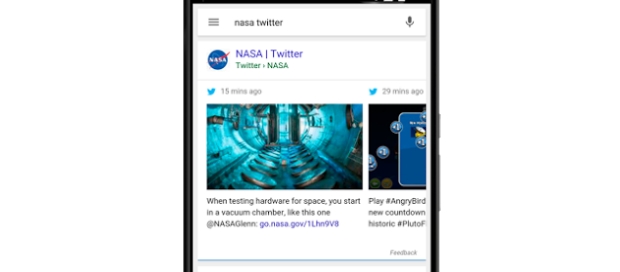
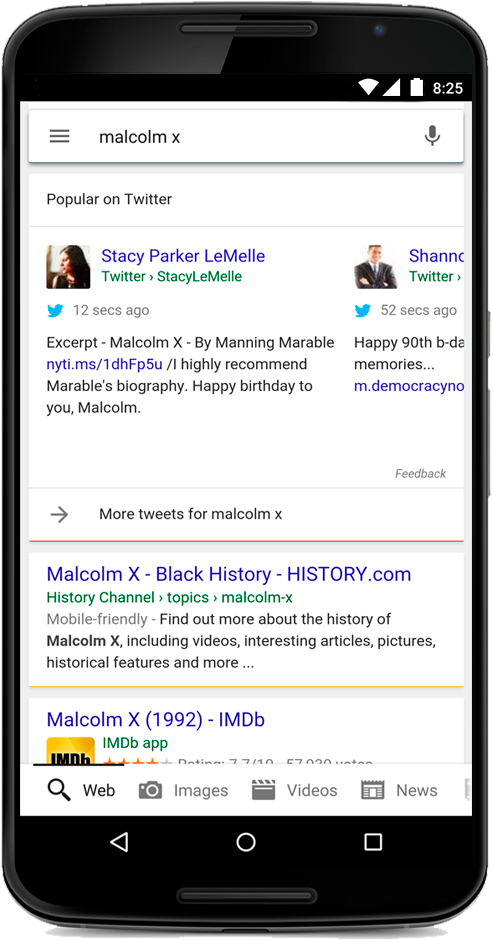
After months of fluttering in and out of Google’s search results as a set of experiments, Twitter is officially a part of the desktop SERPs. Google officially announced the news on Twitter and in an updated post on the Google blog, saying they have expanded displaying Twitter content in the Google desktop search results.

Tweets have been a part of mobile results since May, but the announcement officially brings them to desktop searches as well.

The update is started rolling out to all English users around the globe. Once implemented, Google will show Tweets in a carousel in the main column of the organic search results, but only when Google finds them relevant. Users do not need a Twitter account to see the Tweets in their SERPs or click on the results.

malcom-x

Many are already reporting seeing the Tweets within their results, but it is unclear how long the full roll-out will take.

mobile-closeup-campaign

It has been clear for some time now that neglecting to have a mobile-friendly site can hurt your Google rankings, particularly in mobile search results. However, some have been wondering if the reverse is also true. Does having a desktop-friendly web site have a similar negative impact on your desktop rankings in Google?

Well, last Friday Google’s John Mueller clarified the situation in a Google Hangout, saying you do not need a “desktop-friendly” site in order to rank well on desktop. The only caveat is that your mobile site must still render properly on desktop.

John Mueller said that you need to “make sure that desktop users can still see some of your content, if it is formatted in a way that works best for mobile, that’s perfectly fine.”

“You definitely do not need a specific desktop website in addition to a mobile website,” Mueller added.

If your business depends on desktop traffic and conversions to properly reach your market, it is still highly important to provide a pleasing experience when users come to your site. For that reason, I’d hesitate to suggest going all-in on mobile leaning design utilizing extra-large buttons and minimal navigation.

The most reliable strategy is to use a design technique such as responsive design to provide a great experience for users no matter where they are coming from. If that isn’t an option, it may still be best to keep operating separate sites for mobile and desktop so you don’t wind up losing customers just because they are using a desktop computer or smartphone.

You can see the full video below, or jump to 12:50 in the video to get straight to Mueller’s answer.

letters-718843_640

As you may have heard, yesterday Google announced massive restructuring that included launching a new parent company called Alphabet and appointing a new CEO. This is obviously big news, but it has also left many webmasters scratching their heads wondering what impact the new “slimmed down” Google will have on search.

Under the announcement, which was made by former Google CEO and new CEO of Alphabet Larry Page, Google will now be scaled down to only include the operation of the company’s primary internet products, while the newer research and innovation ventures will fall under the Alphabet umbrella.

For example, these ventures include Wing, a drone delivery system, Calico, a company focused on anti-aging, as well as robotics research and more.

The new, smaller Google will be led by new CEO Sundar Pichai. Since the announcement, several former and current Googlers, such as Matt Cutts, have expressed excitement about Pichai’s new leadership and think he is a great choice for moving the company forward.

Page says the restructuring will allow for a renewed focus on Google and described Pichai as someone who cares deeply about innovation.

While it is hard to predict the long-term implications of the restructuring, it seems as if there will be no immediate changes to Google search or AdWords. So, you can breathe a sigh of relief for now.

Starting now, Page will no longer be a part of day-to-day operations at Google, instead running Alphabet with President Sergey Brin. The pair says they are excited to be able to give attention to “more ambitious” projects, and they have no plans to turn Alphabet into a large consumer brand. Rather, Alphabet is set to be a platform for companies to grow their own brands.

The recently announced Google Panda algorithm update raised eyebrows for several reasons. Of course, any Google algorithm news is worthy of attention, but this specific update was unique in several ways that had SEOs and webmasters wondering what the deal was. Finally, Google has given some insight into why Panda 4.2 is so different from past algorithm updates.

There’s still not much information about why there was such a long lull between algorithm updates – over 10 months – but, Google’s John Mueller did recently provide some answers as to why the algorithm update is rolling out significantly slower than normal.

In a Google Hangout session between Mueller and webmasters, John explained the rollout is taking several months instead of the usual few days or weeks due to “technical reasons.” He also explicitly said the long rollout isn’t specifically intend to “confuse people” as some have suggested.

Both the SEM Post and Search Engine Roundtable transcribed Mueller’s comments on Panda:

This [Panda rollout] is actually pretty much a similar update to before. For technical reasons we are rolling it out a bit slower. It is not that we are trying to confuse people with this. It is really just for technical reasons.

So, it is not that we are crawling slowly. We are crawling and indexing normal, and we are using that content as well to recognize higher quality and lower quality sites. But we are rolling out this information in a little bit more slower way. Mostly for technical reasons.

It is not like we are making this process slower by design, it is really an internal issue on our side.

Webmasters have expressed frustration with the long rollout because it is taking much longer than normal to see results from the algorithm, and Mueller’s comments only provide a small window into how the algorithm is functioning.

Here is the video, from the start of the conversation:

Google Authorship

Google+ has been a controversial and underwhelming social media platform mostly populated by profiles made out of obligation in order to use Google’s services, but this will change soon as Google announced Google+ will no longer be a requirement for services across Google’s network.

Since Google made their social platform a requirement for all other services across their site, including Gmail and YouTube, there has been a strong pushback from users. The negative reaction was especially prevalent for YouTube users, who were forced to create new Google+ pages if they wished to create a new video channel.

In the announcement, Google conceded making Google+ mandatory for all users may have been a mistake:

“When we launched Google+, we set out to help people discover, share and connect across Google like they do in real life. While we got certain things right, we made a few choices that, in hindsight, we’ve needed to rethink.”

Over the next few months, Google will be uncoupling Google+ from all services. This means all it will take to access any Google products or services is a simple Google account. Once this is complete, users will be able to use YouTube, Gmail, or Google Analytics using a traditional Google account.

For users who were already pushed into making Google+ accounts, you will soon be able to remove it, although Google didn’t provide any more details about how or when.

With this change, Google+ will now be completely optional. This may be good news for users, but it will be interesting to see how the platform handles the shift. Many have already proclaimed the social network is dead, but it is entirely possible setting it free from the rest of Google may finally give the platform a chance to grow with only members who want to be on the social network.