
Tag Archive for: Google

Mobilegeddon

Mobilegeddon

In less than 24 hours, we will all be living in a post-“Mobilegeddon” world. That means Google’s mobile friendly update will start rolling out tomorrow after months and months of rumors and hints. Normally Google doesn’t announce upcoming algorithm changes ahead of time – perhaps because it creates a panic – however this time the company gave webmasters plenty of time to make sure they are prepared.

Basically, the mobile friendly algorithm aims to make sure users who are searching with smartphones are only shown sites that are properly optimized for mobile devices.

Given that Google has been heavily implying this day would come for over a year, it is slightly surprising to see the number of panicked webmasters. Google has given brands every opportunity to ensure their sites are up to snuff, but Zineb Ait Bahaiji of Google’s Webmaster Trends team confirmed the algorithm will have the largest impact of any of Google’s recent algorithms.

Google’s Penguin and Panda algorithms are infamous for their impact on search results pages, but Bahaiji told the crowd at SMX Munich that the mobile algorithm would absolutely affect more than either animal-themed algorithms.

Panda affected 12% of search queries when it was released, while Penguin impacted 3.1% of queries.

If you are concerned your site isn’t prepared for the oncoming “Mobilegeddon”, check out our previous coverage to see what you need to do to appease the search engine’s new algorithm. You can also check to see your site’s status by using Google’s mobile friendly testing tool.
Google is constantly making changes – both big and small – and the latest changes will affect how your site appears in the search results.

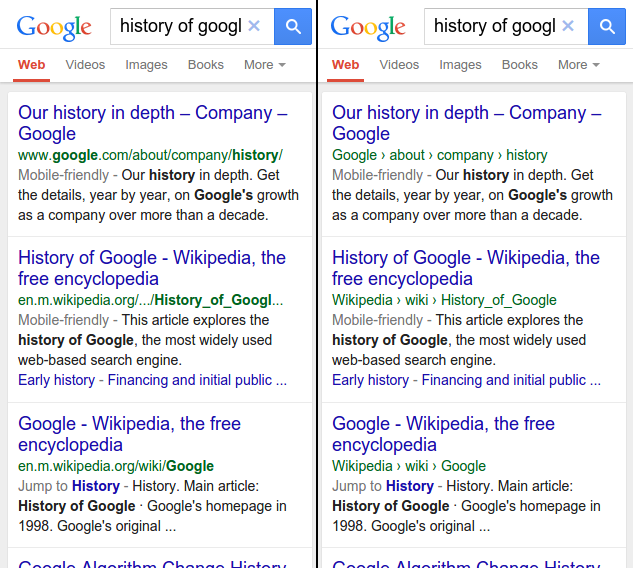
Yesterday Google announced it would be altering how URLs are shown on mobile search results. Well, altering isn’t the right word. More accurately, Google is completely removing URLs in favor of the “real world” name of the site.

Instead of showing the simple URL, the search engine will display the site’s location in a breadcrumbs-like format, as shown below:

domain_replacement_before

As Google explains in their announcement, the change intends to make searching easier for users.

“To help mobile searchers understand your website better when we show it in the mobile search results, today we’re updating the algorithms that display URLs in the search results to better reflect the names of websites…”

The new style will be rolled out gradually and are exclusive to mobile search results. For now, the change will only be affecting the US, but will likely come to other countries in the near future.

If you want to keep control of how your site name is shown, there is a simple structured data markup set you can use.

Just use this structured data markup to tell Google’s algorithms exactly how you want your website name displayed.

Google’s upcoming mobile-friendly algorithm has webmasters panicking as the deadline fast approaches. As always, when there is fear there is also plenty of misinformation.

In particular, there is one myth going around which is stirring up quite a bit of trouble.

Google has attempted to be clear that their new mobile algorithm will demote pages that don’t pass a mobile-friendliness test when they might appear in mobile search results pages. Unfortunately, that is being misconstrued.

gtxcelpoopoo-1429100580

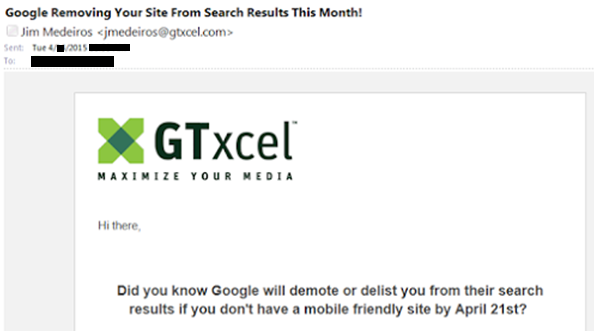
As Barry Schwartz shared, emails are going around proclaiming Google will be completely removing sites from search results if they don’t live up to the mobile standard. Not demoted, but completely de-listed and removed from Google.

The rumor was noticed when Ashley Berman Hale, an active personality in the Google Webmaster Help Channels, posted an email she recently received with the title “Google Removing Your Site From Search Results This Month!”

The copy of the email then goes on to say, “Did you know Google will demote or delist you from their search results if you don’t have a mobile friendly site by April 21st?”

Now, the mobile algorithm on the horizon is certainly controversial among webmasters, but there is no need to be spreading outright lies. Google’s initial announcement of the algorithm was relatively vague, but they have been working hard to make sure webmasters’ questions were getting answered. It also didn’t take long for many of the experts from Google to chime in and clear the air.

Google’s Gary Illyes posted a response on Twitter:

Google’s John Mueller also posted a short statement on Google+ to make matters perfectly clear:

It’s great to get people motivated to make their website mobile-friendly, but we’re not going to be removing sites from search just because they’re not mobile-friendly. You can test your pages & reach our documentation (including some simple tweaks that might work for your CMS too) at http://g.co/mobilefriendly

Hopefully this settles the matter once and for all. Google’s algorithm WILL demote your site on mobile search results, but it WILL NOT affect you on desktop search results or completely remove you from the listings.

You would think the sky is falling given how webmasters and online marketing experts are responding to Google’s huge upcoming mobile algorithm. Sites are tossing around all manner of terrifying nicknames such as the mobilepocalypse, mobilegeddon, mobocalypse, or mopocalypse to stir up fear and panic, but the truth is the upcoming update shouldn’t be all that scary for you.

If your site serves mobile users and you care at all about your customers, you should already have made efforts to make your site mobile-friendly. While a big ranking drop seems frightening, the truth is that mobile users are probably already avoiding your site. Don’t think of the upcoming change as being forced to change your site to please search engines. Thank of it as improving your site for mobile users.

Countless sites are talking about the “mobilepocalypse” as if the world is ending, but I’ve already covered the simple set of steps you need to take to check that your site is ready for the mobile update. If you aren’t passing Google’s mobile test, this infographic from Nine Hertz will walk you through what needs to be done before the 21st.

 Mobilepocalypse

GMB Put On Map

Google is doubling down on their efforts to bring local businesses around the world online with a new program called “Let’s Put Our Cities on the Map.

The new program seeks to assist small businesses and local organizations from over 30,000 cities worldwide to set-up complete local listings on Google.

The search engine claims consumers are 38 percent more likely to visit and 29 more likely to consider purchasing from businesses with complete listings, yet a huge number of companies do not have local business listings on any search engine.

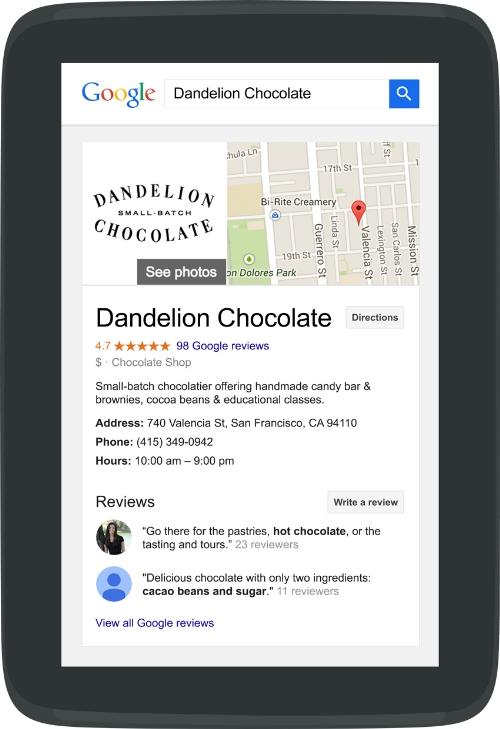
Dandelion Marketing

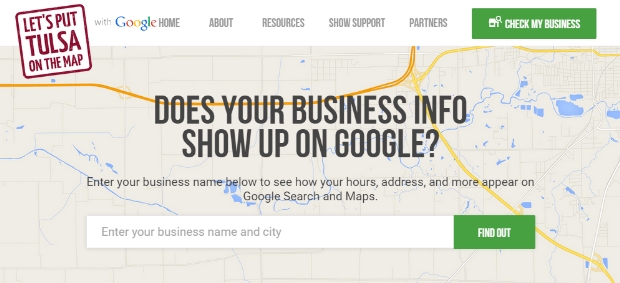
For the new initiative, Google is providing each participating city with a custom website where local businesses can see how they appear on Google Maps and in search results.

Google is also giving local business owners an easy-to-follow guide for getting their business listed with Google My Business, as well as a free website and domain name for a year through Google’s partner Startlogic.

The program is also encouraging consumers to get involved, by inviting consumers to create postcards in support of their favorite local businesses which can be shared on Google+, Twitter, Facebook, and LinkedIn. However, Google makes it clear these postcards won’t have any impact on search engine ranking.

“Sharing the postcards won’t make businesses appear higher in search, but will hopefully spur them to verify and start managing their business listing,” a Google spokesperson told Search Engine Watch.

Google is also partnering with local organizations such as chambers of commerce and small business development centers to offer workshops aimed at teaching local businesses how to control the information listed about them on Google Search and Maps.

SmartphoneNot long ago Google announced its upcoming mobile-friendly algorithm change, but the search engine is making efforts to help webmasters prepare as well as possible. Google has been offering a steady stream of information helping webmasters avoid common mistakes while converting websites to mobile-friendly designs.

After answering questions over Twitter, Google also decided to directly ask webmasters what they were confused about and what problems they were encountering. Then, Google compiled the most common mistakes and shared them in a simple and easy to explore list.

According to Google, the most commonly mentioned mobile mistakes are:

  • Blocked JavaScript, CSS and image files: In order for Googlebot to see your site as a real user would, always allow access to these files in your site’s robots.txt.
  • Unplayable content: This consists of certain types of videos, or other content, that are not playable on mobile devices, such as license-constrained media or media that requires Flash.
  • Faulty redirects: If you have separate mobile URLs, you must redirect mobile users on each desktop URL to the appropriate mobile URL.
  • Mobile-only 404s: Some sites serve content to desktop users accessing a URL but show an error page to mobile users. Instead, redirect mobile users to an equivalent mobile page to avoid 404s.
  • App download interstitials: This is when websites block the view of pages with a prompt to download the site’s native app. Instead, use a small HTML banner at the top of the page.
  • Irrelevant cross-links: This is when users are linked to desktop-optimized pages from the mobile version of the site, and vice versa. Check your links to make sure that they point to the correct equivalent page.
  • Slow mobile pages: In order to avoid user frustration, ensure your mobile pages load quickly. You can check your page speed with Google PageSpeed Insights.

You can learn more from the complete guide here.

Firefox Yahoo

Google has been heavy-handed in trying to woo Firefox users back to their search engine since Yahoo became the default search engine for the browser. It also appears to be working.

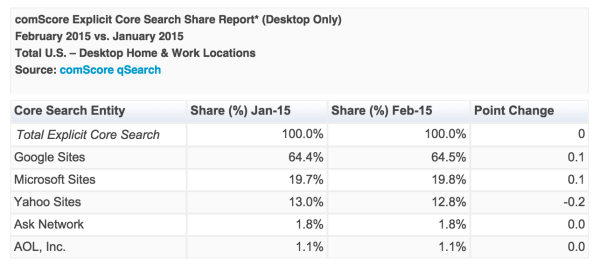
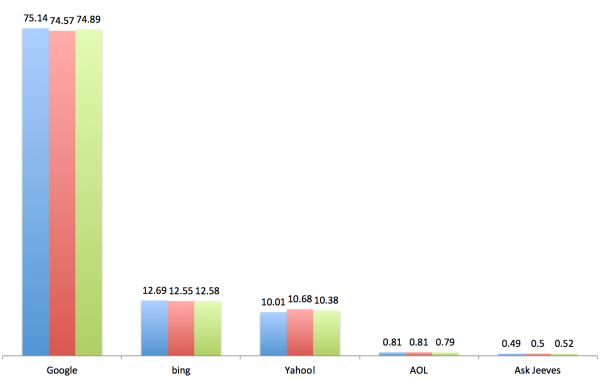
ComScore released the latest US search market share numbers for February and it seems Yahoo is gradually losing the gains they have made since they made a deal to become the default search engine for the browser and Google is reaping the benefits.

Screen-Shot-2015-03-18-at-10.47.35-AM-600x278

Since the switch over lost Google a small portion of users, Google has been practically begging users to make switch back. While there hasn’t been a mass exodus back to the motherland of Google, Yahoo is seemingly losing a slow but steady stream of users back to Google.

According to comScore’s report, Yahoo lost approximately 10 percent of its search volume from January to February, while Google recouped a tenth of a point along with Bing. This lines up with another recent report from StatCounter which also indicated a loss by Yahoo between January and February.

Screen-Shot-2015-03-18-at-10.57.59-AM-600x379

From the time Yahoo became the primary search engine to January, Yahoo had gained 1.2 points. Now Yahoo is still above their previous levels, but it has list .2 percent of those gains. The question is whether the trend continues.

It is important to note comScore’s numbers don’t include data from mobile searches, where Google is even more dominant.

Gary Illyes at SMX West Photo Credit: Steve Boymel

Gary Illyes at SMX West
Photo Credit: Steve Boymel

After months of hints, Google officially announced they would be including mobile-friendliness as a ranking factor in their search engine results last week. Now we are getting more information about how the mobile-friendliness signal will be implemented when it goes into effect next month.

Google’s Gary Illyes answered several questions about the new ranking signal at SMX West, where he explained the ranking factor would operate in real time and works on a page-by-page basis.

The conversation started when Gary was asked if there was a deadline for when webmasters need to have their sites updates to avoid being negatively affected by the launch of the signal. According to his response, the algorithm will operate in real time, so you could theoretically update any time you want and expect to start benefiting from the signal immediately.

Most likely, the signal won’t actually operate in real time for webmasters, but will reflect the version indexed by Google. That means sites that don’t get indexed very often may want to ensure their sites are updated soon, while sites that are crawled and indexed daily can address the issue when they see fit.

Google has not clarified, but all sites will still get the most benefit from having their webpages ready before the April 21st launch.

Gary also stated the algorithm will operate on a page-by-page basis, so you will need to ensure every important individual page is updated.

This is important for many webmasters who have sub-sections or unique areas of their page that would be difficult to make mobile-friendly. If you have pages that aren’t intended for mobile users, you don’t have to worry about them impacting your other pages.

If you have many pages that aren’t easily usable for mobile visitors, you might want to reconsider your strategy overall as more traffic is coming from smartphones and tablets every day. The new ranking algorithm is a big statement from Google about the importance of mobile in the current state of the internet, and you can expect to continue to struggle if you resist the changing tides.

The release of Google My Business was intended to make it easier for businesses to maintain a consistent appearance across all of Google’s services, but one feature was seriously lacking. While Google My Business allowed businesses to upload an image to their profile, the companies still had difficulty controlling which images would be used in various listings.

That is a serious problem when you are trying to establish a consistent brand presence online.

Screen-Shot-2015-02-23-at-2.24.26-PM-515x600

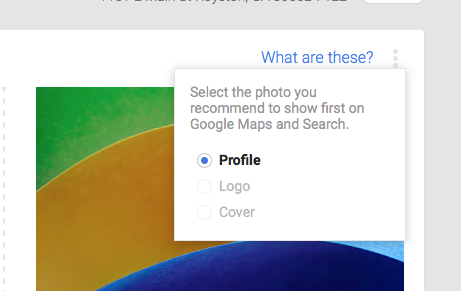
Today, Google announced a major update to Google my Business that finally gives companies some agency in their appearance across Google’s platform. As the announcement explains:

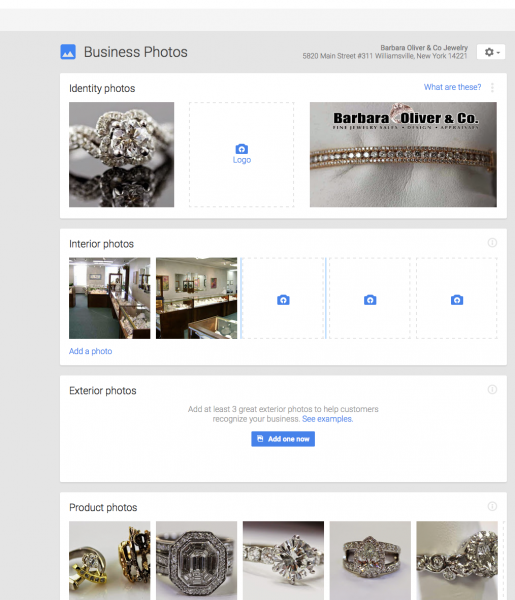
Starting today, you can tell us which image you’d like to appear when customers search for your business on Google. Just log in to Google My Business on the web or in the Android or iOS apps, and visit the Photos section. While you’re there, you can also give your business a fresh look online by updating your profile, logo and cover photos.

Google My Business Photos

The upgrade unifies Google’s three interfaces for images into one simple interface. There is no longer any guesswork in making sure your brand is always presented how you want it on the search engine.

Google Help Files explains the best practices for uploading photos for your business:

Your photos will look best on Google if they meet the following standards:

  • Format: JPG, PNG, TIFF, BMP
  • Size: Between 10KB and 5MB
  • Minimum resolution: 250px on the longest side for profile & logo photos; 720px on the longest side for other business photos
  • Aspect ratio: The longer dimension of the photo should be no more than four times the shorter dimension. Landscape photos look better than portrait photos on Google products. Panoramic photos may use different aspect ratios.
  • Quality: The photo should be in focus, well-lit, have no photoshop alterations, and no excessive use of filters. The image should represent reality.

googleadwordsGoogle AdWords is one of the most powerful tools available to companies trying to get their ads seen online. The only problem is the service can often feel overwhelming to those who are not experienced with the tool, especially with the near constant updates.


Thankfully Google is making it easier for business owners and advertisers to keep up to date and learn the ropes of AdWords with a super useful how-to-guide to paid search.

The guide is part of the Google Best Practice series, located in the Help section of AdWords. The series provides practical advice on using AdWords products to get the most out of paid search and covers everything from optimizing keywords to measuring analytics data.

To help keep up with the frequent updates, AdWords has also added a timeline tool which displays new features and changes to policy and guidelines in a convenient location. The timeline shows recent updates chronologically, so you can easily see what the latest news is.  The tool will show brief descriptions of all new products, features, and updates, with links to more information.

Considering AdWords updates hundreds of times a year, this timeline will be a godsend to many advertisers who are vigilantly watching for updates.