
letters-718843_640

As you may have heard, yesterday Google announced massive restructuring that included launching a new parent company called Alphabet and appointing a new CEO. This is obviously big news, but it has also left many webmasters scratching their heads wondering what impact the new “slimmed down” Google will have on search.

Under the announcement, which was made by former Google CEO and new CEO of Alphabet Larry Page, Google will now be scaled down to only include the operation of the company’s primary internet products, while the newer research and innovation ventures will fall under the Alphabet umbrella.

For example, these ventures include Wing, a drone delivery system, Calico, a company focused on anti-aging, as well as robotics research and more.

The new, smaller Google will be led by new CEO Sundar Pichai. Since the announcement, several former and current Googlers, such as Matt Cutts, have expressed excitement about Pichai’s new leadership and think he is a great choice for moving the company forward.

Page says the restructuring will allow for a renewed focus on Google and described Pichai as someone who cares deeply about innovation.

While it is hard to predict the long-term implications of the restructuring, it seems as if there will be no immediate changes to Google search or AdWords. So, you can breathe a sigh of relief for now.

Starting now, Page will no longer be a part of day-to-day operations at Google, instead running Alphabet with President Sergey Brin. The pair says they are excited to be able to give attention to “more ambitious” projects, and they have no plans to turn Alphabet into a large consumer brand. Rather, Alphabet is set to be a platform for companies to grow their own brands.
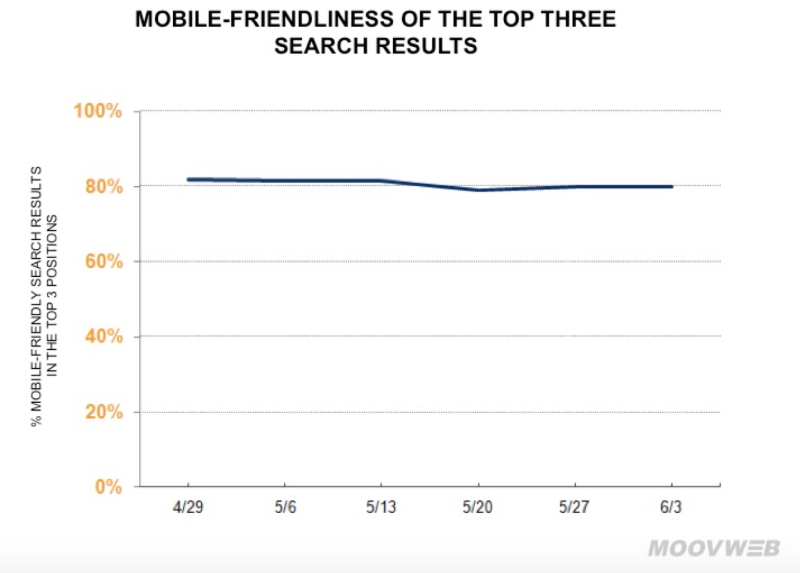
When Google rolled out its Mobile-Friendly Algorithm the results were initially underwhelming. Despite weeks of frightening articles about the so-called “Mobilepocalypse” or “Mobilegeddon”, the search results listings were largely the same in the immediate wake of the algorithm launch. However, a new study from Moovweb shows brands without mobile-friendly sites are starting to feel the pain.

The new study, which tracked clear visibility and ranking, shows consequences are beginning to affect sites who have yet to make their site easily usable for mobile searchers.

Screen-Shot-2015-08-05-at-4.12.51-AM-800x573

Moovweb has been tracking “1,000 important e-commerce keywords in a range of industries” ever since the rollout of the Mobile-Friendly Algorithm on April 21 to see how the new algorithm is impacting mobile rankings on Google.

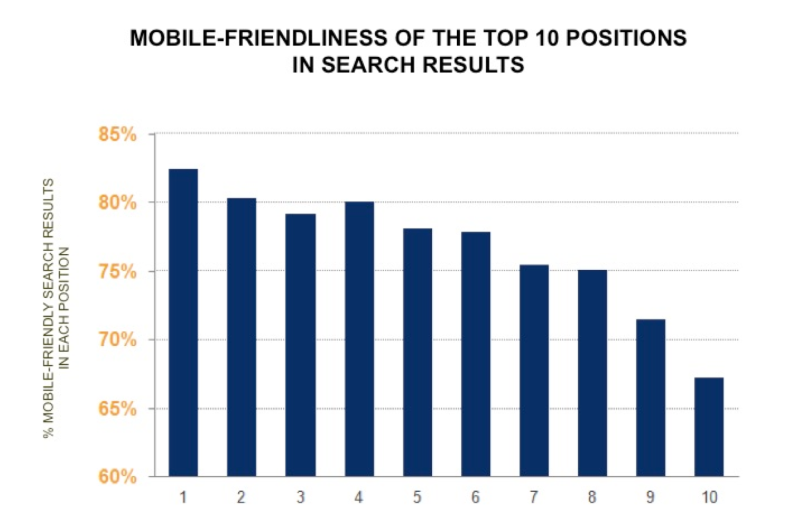
According to the study, top listings for search keywords were mobile-friendly 83 percent of the time, and 81 percent of the time the top three listings were. A review of the full page results showed 77 percent of page one results on Google mobile SERPs were mobile-friendly.

Screen-Shot-2015-08-05-at-4.12.28-AM-800x527

The chart above shows the percentage of mobile-friendly sites in each of the top 10 positions across all keywords tested.

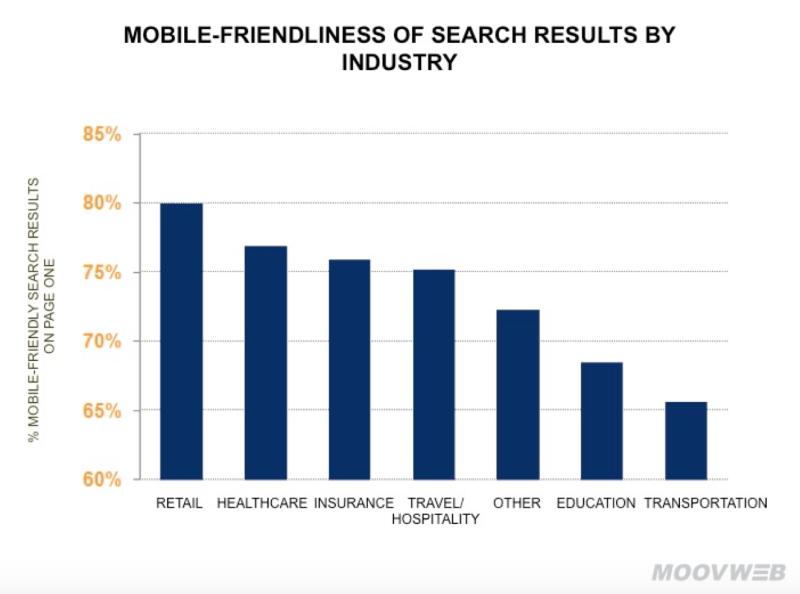
The company says mobile-friendliness in search results varied by vertical, with some industries being distinctly more mobile-friendly than others. Out of seven categories studied, retail had the most mobile-friendly results and transportation showed the lowest percentage of mobile-friendly results.

Screen-Shot-2015-08-05-at-4.12.43-AM-800x594

It may have taken months, but the impact of Mobilegeddon is starting to become more obvious, but there is good news if you are starting to feel the pain. Google’s Mobile-Friendly Algorithm runs in real time, so you can make your site mobile-ready any time and expect to see fast results on mobile SERPs.

The recently announced Google Panda algorithm update raised eyebrows for several reasons. Of course, any Google algorithm news is worthy of attention, but this specific update was unique in several ways that had SEOs and webmasters wondering what the deal was. Finally, Google has given some insight into why Panda 4.2 is so different from past algorithm updates.

There’s still not much information about why there was such a long lull between algorithm updates – over 10 months – but, Google’s John Mueller did recently provide some answers as to why the algorithm update is rolling out significantly slower than normal.

In a Google Hangout session between Mueller and webmasters, John explained the rollout is taking several months instead of the usual few days or weeks due to “technical reasons.” He also explicitly said the long rollout isn’t specifically intend to “confuse people” as some have suggested.

Both the SEM Post and Search Engine Roundtable transcribed Mueller’s comments on Panda:

This [Panda rollout] is actually pretty much a similar update to before. For technical reasons we are rolling it out a bit slower. It is not that we are trying to confuse people with this. It is really just for technical reasons.

So, it is not that we are crawling slowly. We are crawling and indexing normal, and we are using that content as well to recognize higher quality and lower quality sites. But we are rolling out this information in a little bit more slower way. Mostly for technical reasons.

It is not like we are making this process slower by design, it is really an internal issue on our side.

Webmasters have expressed frustration with the long rollout because it is taking much longer than normal to see results from the algorithm, and Mueller’s comments only provide a small window into how the algorithm is functioning.

Here is the video, from the start of the conversation:

 Panda

Google has confirmed it has released a Google Panda refresh over the weekend, over 10 months after the last update to the algorithm.

The latest refresh is unique from past updates as it went virtually unnoticed by webmasters until it was announced by Barry Schwartz. This is because it is being rolled out far slower than in the past. Previous updates were rolled out usually over a period of a few days or at most a couple weeks, but Google says this latest update could potentially take months to fully roll out, even on a site-by-site basis. However, as it is a site-wide algorithm, it will not be on a page-by-page basis.

Google was not willing to provide any information about why the rollout is being done so slowly.

Unfortunately, the slow rollout does not mean you can expect to make any last minute changes to save your site. It is too late to change your fate with Panda 4.2, although it’s always good to make any improvements you know are needed.

Schwartz also noted his personal SEO news site, which was penalized by Panda 4.1, does show an increase in organic traffic since the update. That means others who were hit by the last update may see small improvements as well.

The Panda refresh is expected to impact approximately 2-3% of queries, meaning it is a relatively small update.

While the refresh may be good news to webmasters who were impacted by 4.1, most people are less pleased – particularly by the slow rollout.

It may be months before we know the impact of the refresh thanks to the slow implementation, but, considering there hasn’t been an update since October of last year, it was past time for it to happen.

Mobile search has gotten a lot of attention this year as it has overtaken desktop search in many metrics, but a new report from mobile loyalty company SessionM shows how ubiquitous the use of mobile devices to aid in the shopping experience has become.

SessionM surveyed 12,000 randomly selected US smartphone users on their mobile shopping behaviors and the findings highlight just how large a role mobile devices play in the shopping process.

The company said 85 percent of respondents reported their m-commerce buying was steady or had increased compared to a year ago while approximately 15 percent told the company mobile buying had increased “significantly.

Personal data security and/or poor user experiences (e.g., too small images or text) were cited as barriers preventing mobile e-commerce from more growth.

According to the findings, more than 90 percent of respondents had made a retail purchase within the past 90 days before the study. The majority (73 percent) of those purchases were made in traditional, brick-and-mortar stores, and approximately 53 percent said they found the in-store experience superior to online/mobile shopping.

However, the study also found mobile search plays a vital role in the in-store shopping process. The overwhelming majority of respondents (90 percent) said they use their smartphones in stores while shopping. The top activities on smartphones while in-stores breaks down as follows:

  1. Price comparisons — 54 percent
  2. Looking up product information — 48 percent
  3. Checking reviews online — 42 percent

SessionM also had recommendations for valuable marketing opportunities for retailers from the data:

  • Opportunity surrounding in-store push notifications about deals/offers (57 percent were more likely to shop at a store if available)
  • Loyalty programs (76 percent would be more likely to shop at a store if available)

The data confirms what several other studies have found in the past. Shoppers are using their smartphones in stores to help them make informed purchases, but many retailers are failing to take advantage of any of the opportunities this presents.

So far, 2015 is shaping up to be a huge year for the mobile internet. Between Google’s “Mobilepocalypse” and the news that searches from mobile have overtaken desktop search volume, mobile was already on the way to dominance, but a new report from IgnitionOne shows mobile search spend is also growing by leaps and bounds.

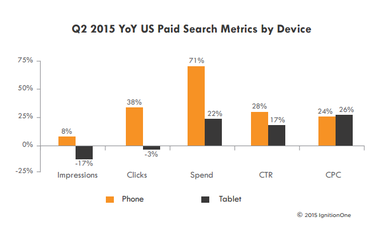
According to the recent Q2 Digital Marketing Report, paid search spending has risen 22 percent for tablets last year, and a massive 71 percent for smartphones.

Both mediums showed comparable growth in CPC and CTR (24 and 28 percent for phones, 26 and 17 percent for tablets), but smartphone clicks have outpaced those from tablets by 41 percent. The report also noted smartphone impressions had climbed 8 percent, but tablet impressions have declined by 17 percent.

“Google has incredible dominance on [the mobile] side,” says Will Margiloff, chief executive (CEO) of IgnitionOne. “But they still have, for the most part, a mobile display business and not really a native to phone and tablet business like Facebook. Google’s got their work cut out for them when it comes to mobile native or native display, and the only real player there is Facebook.”

ignitiononestudy1-370x229

The report also showed Google’s display growth was down 9 percent year-over-year while Facebook’s is up 48 percent, which gives the social platform 16 percent of the display share. In comparison, Google’s share is at 31 percent, down from 38 percent last year.

After years of debate whether another search engine could ever prove to be a meaningful challenge to Google’s market share dominance, Facebook’s recent gains suggest it may actually be social media that poses the greatest challenge to Google.

ignitiononestudy2-370x229

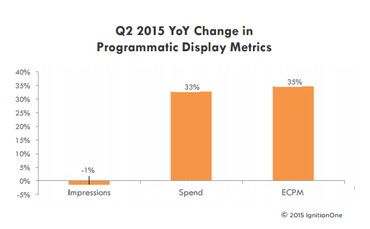
IgnitionOne’s research found programmatic data spend increased 33 percent year-over-year while eCPM rose 35 percent from last year. Impressions, however, have fallen 1 percent.

If you’re a business owner who has decided to get serious about your company’s online presence and marketing, you’ve almost certainly heard about search engine optimization. Unfortunately to the uninitiated, SEO can seem impenetrable with its endless technical jargon and conflicting opinions from experts about exactly how to get the best online visibility. It can feel a lot like jumping in the deep end without learning how to swim first.

Search Engine Optimization doesn’t have to seem so intimidating however. There may be a lot to learn before you are an expert, but with just a few basic ideas you can drastically improve your business’s online profile.

This infographic from SEOHalt will help guide you through the basics of SEO and give you the vocabulary you need to really get an understanding of what search engine optimization is and how it affects online marketing efforts. Once you’ve got these ideas under your wing, you’ll be ready to dive into the deeper waters of SEO without having to worry you’ll drown.

 SEOBasics

 Emojis

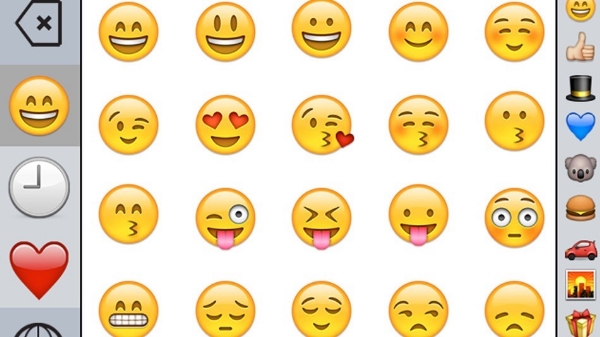
It was fun while it lasted, but Google has followed through on their promise to remove emojis from titles in search results.

In April, Expedia became the first major brand to start experimenting using emojis in search results titles. For example, a search listing for beach rentals may have included a wave emoji on Expedia listings.

It wasn’t long until many other major brands followed suit, but Google ultimately decided the trend was not something they wanted to promote. During a Google Hangout in early May, John Mueller, a webmaster trends analyst for Google, announced the search giant would be removing the emojis.

True to Mueller’s word, emojis disappeared from search results early this morning, as first noticed by Jennifer Slegg at The SEM Post.

Notably, Google has only seemed to remove the emojis from titles. Norwegian Airlines, known for creating the very first emoji URL, appears to be unaffected.

While the hearts, waves, and smiley faces are gone from Google, emojis are still currently appearing in Bing searches. Microsoft’s search engine started showing emojis in title tags shortly after they began appearing in Google, but there’s no word if they intend to follow Google in phasing them out now.

Google Mobile

Most reports have made Mobilegeddon out to be a farce with only a small effect on Google’s search results overall. New analysis from digital agency Koozai, however, suggests small and medium businesses (SMB) felt quite an impact when Google rolled out their mobile friendly algorithm.

According to Koozai’s May survey of 2,000 SMB’s with 50 or fewer employees, nearly half (46%) of all respondents reported experiencing changes in ranking. Of that group, 41 percent also saw a drop in rankings by at least three spots. This may not sound like much, but a drop in just one or two rankings can have huge impacts on traffic.

“The hype that the Google mobile update would cause carnage in the search engine rankings missed the larger picture,” says Ben Norman, chief executive (CEO) of Koozai. “Exaggerating the impact meant that businesses didn’t anticipate that even small changes in their ranking can have a big impact on their organic mobile search results.”

Norman says much of the confusion is due to the idea that a single algorithm is the deciding factor when determining ranking. Google uses over 200 different factors to rank pages on search results pages, but some were led to believe the mobile optimization would be the ultimate deciding factor. On the contrary, 27 percent of businesses in Koozai’s survey reported drops in rankings despite having optimized their sites for mobile.

This leads many business owners to feel like they are being punished after acting on Google’s warnings, which Norman says illustrates how frequently SMBs are poorly educated on SEO and fail to understand e-commerce analytics.

“Many consumers today will research on mobile and then purchase on desktop,” he says. “Many SMBs are missing out on these lead-creation opportunities if they don’t know if their e-commerce sites aren’t giving their potential customers a good experience on mobile.”

Of the businesses involved, 37 percent said they were worried the mobile friendly algorithm update would impact their sales while 44 percent said they were not concerned because the majority of their sales come from desktop shopping. Nearly half said they were unsure about the relationship between devices and could not say whether mobile influenced their desktop sales. In addition, 12 percent did not know whether their sites had been optimized for mobile at all.

There were predictions well before the release of the algorithm that small and medium businesses would be the most likely to be impacted by ‘Mobilegeddon’, but many reviews of the algorithm’s effects failed to consider the disparity in their post-Mobilegeddon analysis.

It might not be a surprise to learn that Amazon dominates the search engine results pages, but you might be surprised by just how much they lead all other major brands.

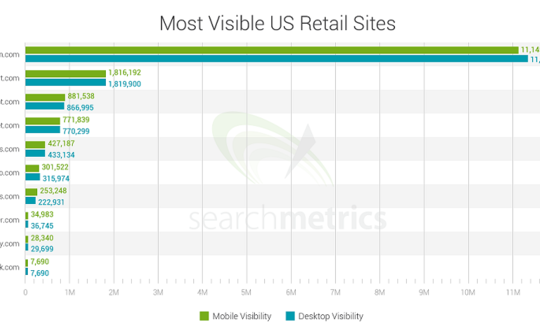
A recent performance study of 10 leading U.S. brands published by SearchMetrics makes it clear that Amazon has by far the most visibility across Google’s search results on both desktop and mobile.

searchmetrics-amazon-walmart-mobile-search-bar-chart-540x334

In the study, SearchMetrics used the top 10 retail sites listed in the National Retail Federation’s list of top 100 retailers and parsed the search results of millions of Google search terms to establish a mobile visibility score along with a desktop visibility score.

To calculate the visibility score, the study evaluated the number of times a brand appears across a keyword set, the brand’s rankings within those search engine results pages, competitiveness of keywords, and the click through rate of those results pages.

Even compared to other major competitors, Amazon is an absolute giant. With the staggering rating of 11,145,359, the online retail company dwarfs Walmart, its closest competitor with a score of 1,816,192.  Following Walmart were The Home Depot with 881,538, and Target.com, with a score of 771,839.

The focus of the study was mobile search, as it is most often the first touch point to purchase. However, the analysis also showed the rankings remain the same on desktop.