Google is experimenting with a new change that could up the profile of local businesses in the search results. The search giant is conducting a limited test featuring a new card carousel of results and content from local businesses near the top of search results pages.

Mike Blumenthal first noticed the test, but it has since been confirmed by Google. The “Local Business Cards” use the same functionality as Candidate Cards, which were recently launched. The main difference with this new test is how limited it is.

Currently, Google is only including a “few dozen” hand-chosen local businesses in the experiment. Instead of pulling the content being used to fill the cards from search engine content or Google My Business listings, Google is also using custom content for the cards.

This test is also notable for being the first time Google has allowed animation or GIFs on the search results pages.

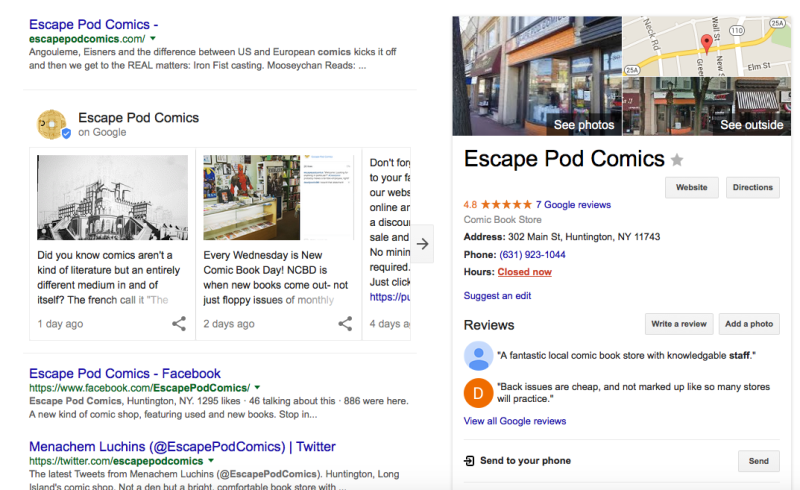
On desktop, you can see the Local Business Cards directly adjacent to the Knowledge Panel featuring that business. On mobile, it is shown below the Knowledge Graph. You can see an example below:

The idea behind the new test is to allow businesses to stand out more in search results and highlight content or information about the business’s products or services in ways not quite possible through the Knowledge Graph. With this in mind, Google has also made content directly sharable from within the carousel.
Screen-Shot-2016-03-04-at-2.33.00-PM-800x490

Most likely this is an early test since Google chose such a small number of businesses and is using custom content to fill the cards. There’s no telling when or if Google will roll out the feature to a wider audience. Hopefully, the cards come soon, as they could be a huge benefit for local businesses that depend on organic search traffic.

Google is always changing. Over just the past few years, the way search works has changed radically – moving to a more user-based model and mobile-first mindset.

This shift in attitudes has changed how the world’s most famous search engine works down to its very foundation, with the intent of moving away from a system that started with information and aimed to connect it with its audience. Instead, Google has made it its philosophy to start with the user and aim to provide the best search results for them.

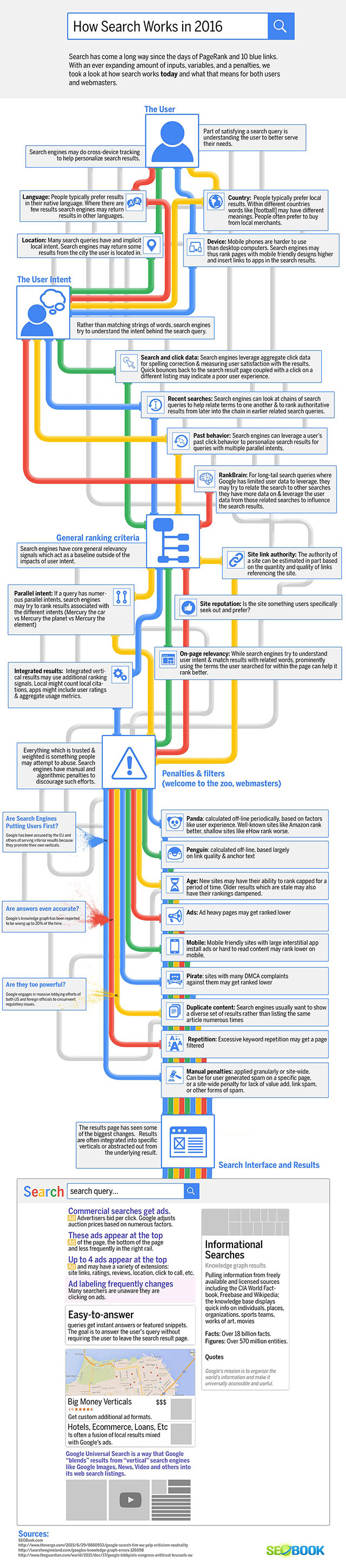
SEOBook recently shared an infographic to visualize how Google’s search engine works in 2016. It shows that in SEO and Google Search, you can’t rely on the same methods from 2013 to keep your business growing online today.

You can see the infographic below. If you can’t see the small text, a larger version is available at SEOBook.

howsearchworks

Apps

Android users will soon be able to install apps to their smartphones directly from Google search results. According to Android Police, Google has begun testing the new feature which will let users bypass the Play Store and directly install an app by performing a Google search.

To try out the feature, open the Google app on any Android phone and search for any app you want to install. Within the Google card, which previously directed users to the Play Store, you will now see an Install button.

If you press the Install button, your phone will ask for the normal permissions that appear with all Play Store app download. If you accept, the app will immediately begin downloading and installing.

The feature hasn’t been rolled out to all Android phones, so there is no guarantee you will be able to directly install the app. Many users are still being directed to the Play Store.

Ryan Whitwam of Android Police speculates the feature is just in testing currently, and will see a wider rollout in the future. He also suggests the feature is likely to be available only in the Google app and not through Chrome.

bottraffic-incapsula-050115

The bad news is half or more of your website traffic likely comes from bots. The good news is that is actually a huge improvement from in the past.

A new report from Imperva Incapsula shows that approximately 48.5% of all traffic to websites comes from bots, not actual online users. That number comes from a review of over 19 billion visits to 35,000 Incapsula client websites around the world with a minimum daily traffic count of at least 10 human visitors gathered over a 90 day period in 2015.

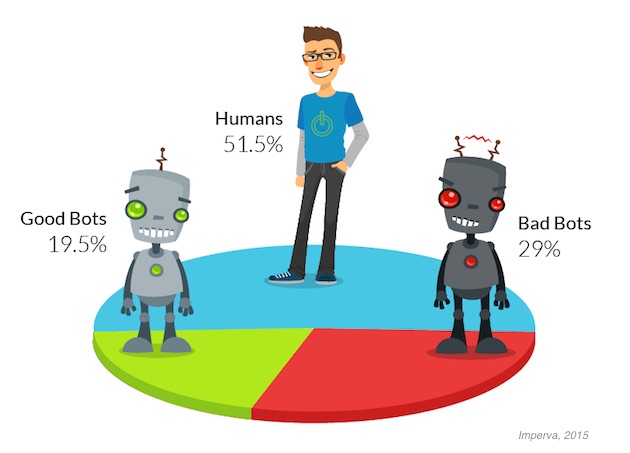
According to the data, 51.5% of all Web traffic comes from human users, while 29% come from “bad bots” which automate spam or other malicious activity, and 19.5% came from “good bots” which are used by search engines and other online services.

share-incapsula-050115

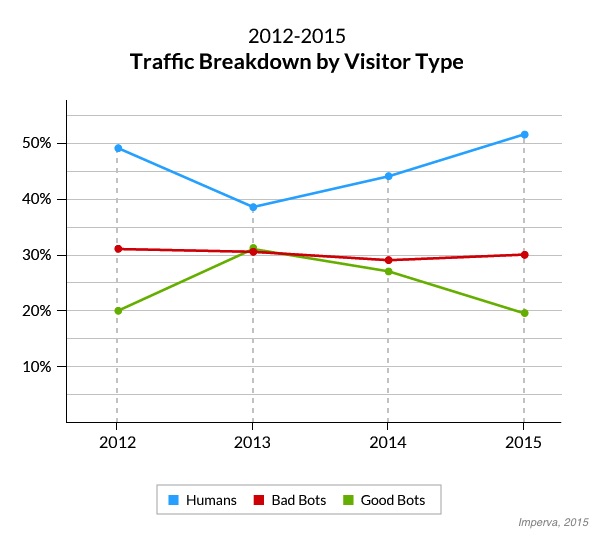
While this sounds bad, the share of human traffic is actually rising compared to past year. The report explains:

In a similar 2013 study conducted by Imperva, humans made up only 31.5% of all visits to sites, compared with 51.5% in 2015. This shift is mainly due to an increase in human traffic as more people use the Web and a decrease in good bot traffic.

size-incapsula-050115

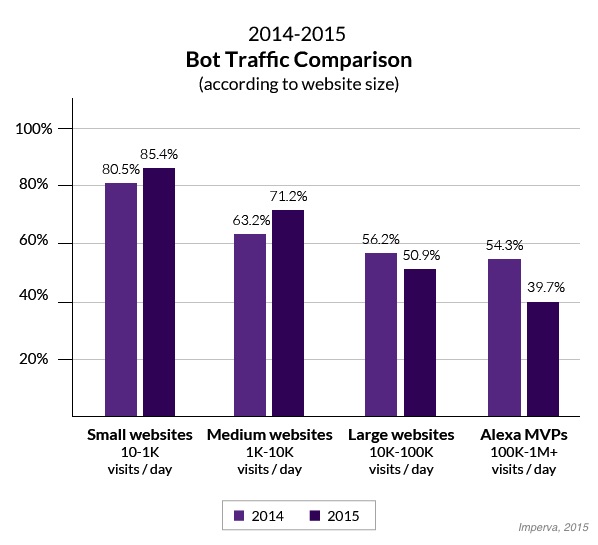
The ratio of bots-to-humans your website receives is likely influenced by how popular your site is, as the most popular sites examined showed the smallest ratio of bot traffic (39.7%). In comparison, the least popular sites included in the traffic had the highest share of bot traffic (85.4%).

No matter what percentage of your traffic comes to bots, the best solution is to continue emphasizing marketing that directly connects with real humans such as social media marketing and PPC.

BingLogo

As of January 1st, Bing is officially powering AOL’s search results as the result of a long-term deal made by the two companies in June of last year. Rick van der Kooi, Corporate VP of Microsoft Search Advertising announced the change, saying:

“Today, I am excited to share that as of Jan. 1, Bing powers AOL’s web, mobile, and tablet search, providing paid search ads and algorithmic organic search results to AOL’s properties worldwide.”

Van der Kooi also shared some interesting bits of information to help illustrate the scale of the partnership, including:

  • 1 in 5 searches happen on Bing.com
  • Bing also powers search results for the third largest search provider in the US (Yahoo)
  • With Bing now powering AOL searches, the engine now powers close to one-third of all US PC web searches.

The company looks to gain even more ground by acquiring the built-in audience from AOL, which is responsible for generating billions of search queries a year.

Unlike Bing’s deal with Yahoo, Bing’s will be powering 100% of AOL’s search results across all devices. In the Yahoo agreement, only 51% of Yahoo’s desktop search results are powered by Bing, with no support for mobile.

With 2016 looming, it can be tempting to kick back and celebrate the New Year and successful holiday season. But, as any seasoned marketer can tell you, there is never any time for rest in the world of SEO.

The past year has seen huge changes in the world of SEO, with a newly emboldened emphasis on mobile optimization and responsive design, the change to 3-pack results in local search, and the expected new algorithms running over at Google.

With that in mind, it’s time to start looking forward and preparing for a booming 2016 by predicting the biggest trends likely to define the coming year. CJG Digital Marketing is doing just that with a new infographic detailing the hottest SEO trends in 2016.

See the infographic below, or at CJG’s website.

Hottest-SEO-Trends-in-2016

The holiday shopping season is in fever pitch, which means most business owners and marketers are going full-steam-ahead on their online marketing strategies to rake in their piece of the $650 billion predicted to be spent this year.

So how can you get in on the action? Pixel Road Designs recently shared an infographic that can give your holiday marketing strategies the extra boost they need to make this holiday season a huge success.

Check out the infographic below, or at Pixel Road Designs’ website here.

PRD_Christmas_IG_021

AdWords In Store Visits

Since launching in spring, Google AdWords’ structured snippet extensions have shown themselves to be a powerful tool in the AdWords arsenal.

Structured snippets add an extra line of information with your text ads which specifically highlight important information for searchers. When implemented well, this can boost click-through rates for ads.

Now, Google has made these structured snippets even more visible in the search results by doubling the amount of information that can accompany text ads.

To do this, advertisers can select two predefined “Headers” which act as structured snippets. Then, those headers can be customized with two unique sets of values. Depending on the search results, these snippets have the potential to be displayed at the same time.

Google does say that each structured snippet extension is treated as its own ad auction, and like other ad extensions, may not always appear together.

You can boost the chances of having both extensions display at the same time by being thorough and providing as much information as you can. With more information, the ad auction is better able to select the highest quality combination of extensions. Not only does this improve your chances of having both snippets show at the same time, it also increases your overall ad performance.

For the first time, Google has released the full version of their Search Quality Rating Guidelines, a document used by Google Search Quality Rates to help determine how to rate the search results they are testing.

The document has become public in the past, through several leaks. Just this week, the October version was leaked. The search engine also released an abridged version in 2013, but now the company has decided to officially release the entire 160-page version previously only available to Search Quality Raters.

Google’s Mimi Underwood said that “ratings from evaluators do not determine individual site rankings, but are used help us understand our experiments.” She added, “The evaluators base their ratings on guidelines we give them; the guidelines reflect what Google thinks search users want.”

As expected, Underwood also implied the document will be updated over time, “as search, and how people use it, changes.”

You can download the full Search Quality Rating Guidelines here.

BingLogo

Like Google, Bing has been increasingly focused on delivering a mobile-friendly version of the web to its growing number of mobile users. Now, Bing has released a tool to help webmasters ensure their site meets the search engine’s standards for mobile-friendliness.

Specifically, the tool reviews your site based on the following criteria to decide if your site is mobile-friendly:

  • Viewport and Zoom control configuration
  • Width of page content
  • Readability of text on the page
  • Spacing of links and other elements on the page
  • Use of incompatible plug-ins

The tool will also notify webmasters if any of the above criteria were inaccessible or blocked, so you can remedy the problem.

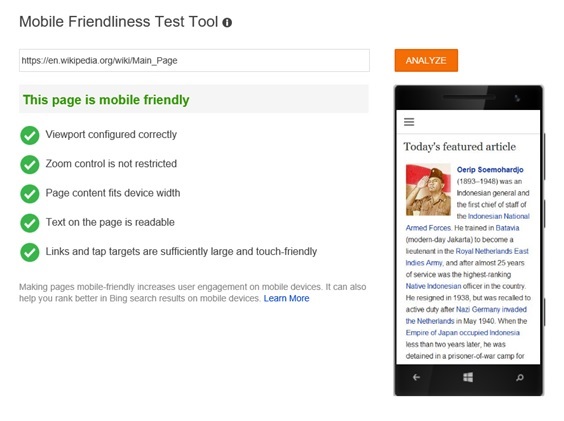
MobileFriendly

Like the tool Google offered shortly before it released its “Mobile-Friendly Algorithm”, Bing’s tool delivers an overall verdict as to whether you site would be considered mobile-friendly by the search engine.

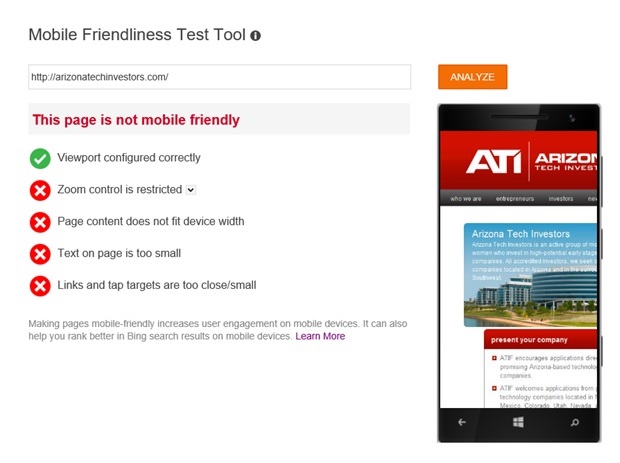
NotMobileFriendly

It will also explain what issues it detects and explain why your page fails, if that is the case.

Both Bing and Google’s tools reportedly detect essentially the same things, with little difference between the ultimate results. However, Bing’s tool is significantly faster and easier to use.