All week we try to keep you up to date with the most important SEM news across the web, but inevitably there are smaller stories that fall through the cracks. That’s why we compile all the most important news we missed this week all in one convenient place every Friday. Despite the distractions of the world cup, there have been some pretty big announcements throughout the week. So, let’s get to it.

Google Preps Online Retailers With Best Practices
Google Shopping

With the clock ticking before Shopping Campaigns becomes the default campaign type for running Product Listing Ads at the end of August, Google is trying to help prepare retailers and marketers by issuing best practice guidelines to help everyone make the transition smoothly.

For the most part, the guidelines listed aren’t far off from the original PLA recommendations. Yes, the paper covers product feed optimization and newer updates, but most of it is a refresher for those who have been working with retailers for a while now, including classic rules like “use relevant titles and high quality images.”

However, marketers and retailers may be interested in the new recommendations about how to structure new shopping campaigns, especially as we enter the transition period.
You can download the whitepaper of the guidelines from Google here.

Sneak a Peak at Google’s New Reconsideration Rejection Forms
google-reconsideration-request-rejection-note-1402921143

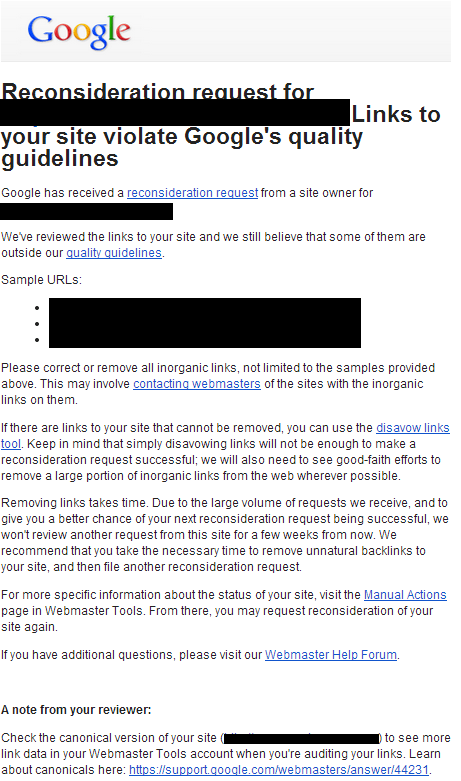
Last week, Matt Cutts made headlines throughout the SEO community by announcing that Google will be revising their reconsideration requests rejection notices with more detailed information in some cases. Of course, there were plenty of skeptics, but an example of the rejection notices has been shared on Twitter by @johnwarddoyle.

Surprisingly, it seems Google made good on their promise.

Don’t get too excited. The individualized response is short and easily missed, but rejection notices at least offer some useful information for repairing a site now. Largely the note is the same as before, but down at the bottom you will see a new section titled “A note from your reviewer.” Here, you will find specific advice relevant to your site that could be potentially highly useful.

Facebook Shows Off Their Snapchat Competitor
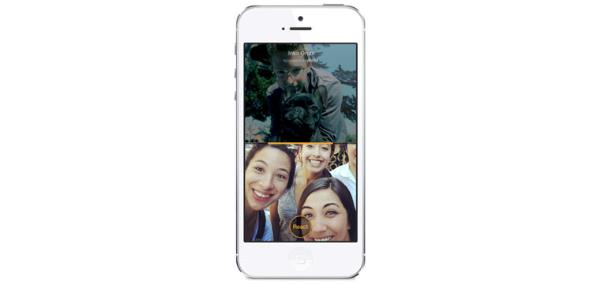
Slingshot

After having a $3 billion offer refused by Snapchat – the popular self-destructing photo messenger app – Facebook is trying to fight back. This week Facebook announced Slingshot, an app obviously influenced by Snapchat’s concept, but with a new twist.

Slingshot does allow users to send photos or short video messages that will delete automatically after a short period of time, but there is more to it:

To get started on Slingshot, shoot a photo or video… add some text and color, then sling it to a bunch of friends. Here’s the deal: friends won’t be able to see your shot until they sling something back to you. They can then reply with a reaction – or simply swipe your shot away.

The concept encourages reciprocal communication more and could potentially catch on, but it could just as easily fall apart in the shadow of it’s better-established rival. With the faltering youth activity on Facebook, it is hard to know how much traction this type of app can get.

Major Brand’s Seeing Engagement Plummet on Facebook
Total-Engagement-600x531

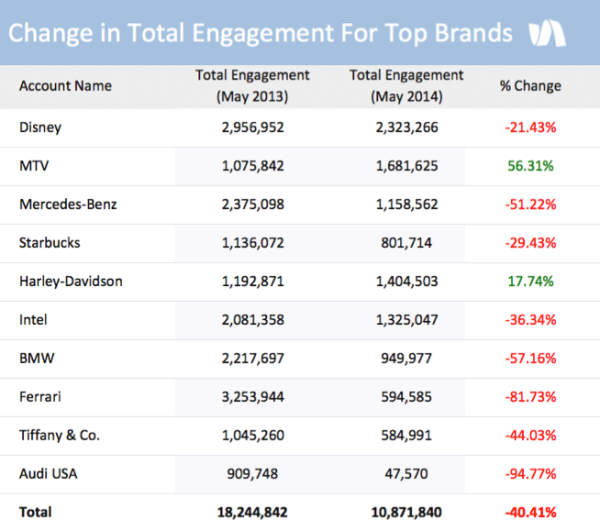
Speaking of Facebook’s problem of bleeding activity and user engagement, recent reports show that it isn’t just the teen demographic evaporating from the site. Facebook analytics provider Simply Measured says consumer engagement with Facebook posts from almost all top Interbrand companies are down significantly from last year.

According to the firm, monthly engagement is down over 40 percent since May 2013.
Only two brands on the list (MTV and Harley Davidson) say increases in engagement, while the others saw huge decreases. Overall engagement was down at least 50 percent.

Most troublesome for Facebook, the report outright cites the decreasing organic reach available on Facebook as a primary blame for the decline in engagement.

Facebook’s Graph Search Makes Its First Appearance on Mobile
graph-search-preview

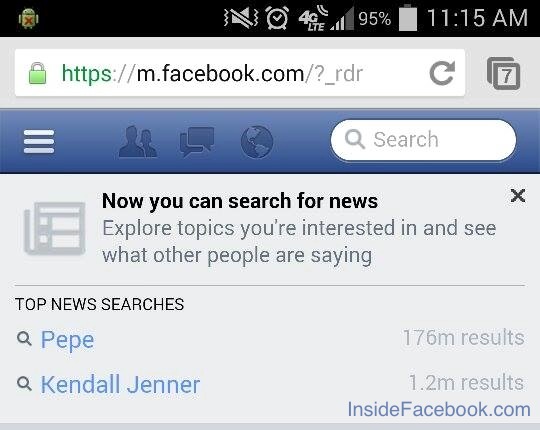
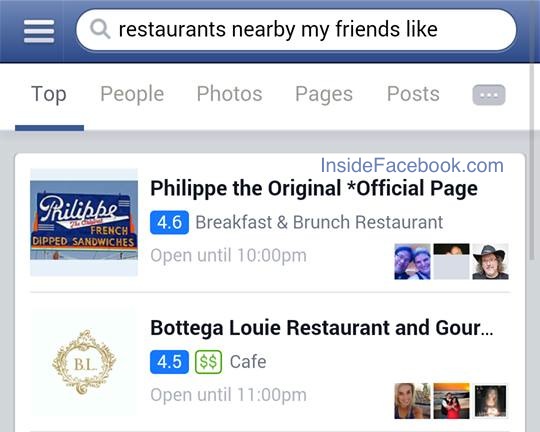
While Facebook’s Graph Search hasn’t been officially released on mobile yet, but it is most likely getting very close to being rolled out. Over the past week, many people reported encountering a test showcasing in-depth integration for the Graph Search for mobile users with all the same features you’ve come to recognize.
graph-search-restaurants

The most anyone has gotten out of Facebook is the response “we’re testing improvements to Facebook mobile search.” But, I would wager the release will be sooner than later. The current testing version for mobile seems to be able to handle all the complex searches capable on desktop and appears to be largely ready for release.

Twitter Finally Adds Animated GIF Support

Twitter’s announcement this week may seem super minor, but it has received nearly as much coverage this week as any other bit of information relevant to online marketing. The reason is simple: internet users love GIFs and this week Twitter announced you can now post and view animated GIFs on Twitter’s website and mobile apps.
tumblr_n45qzpE3Tr1qj6dyco1_500

Of course, the announcement came in the form of a Tweet featuring an animated GIF from Twitter Support.

Previously, users could share links to GIFs via third-party services like Imgur, but starting this week you can now share and view the moving images directly on Twitter.

Importantly, GIF’s won’t start playing automatically in your feed like they do on Tumblr. Instead, when a GIF is shown, a white play button will be overlayed, allowing you to choose when a GIF starts playing.
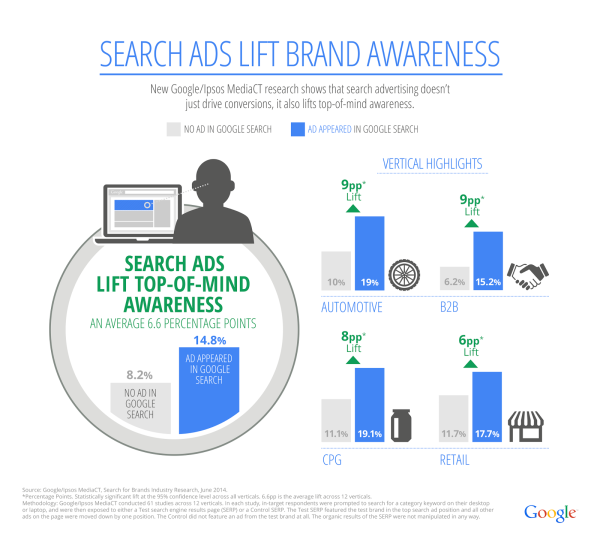
Google announced the results of an interesting study this week that proclaims “Search Ads Lift Brand Awareness“. By the title of the announcement alone, it sounds like a promising reason to invest more in AdWords campaigns for your business, too bad the information is slightly misleading.

Don’t get me wrong, pay-per-click search ads can be absolutely beneficial for a business. But, it is troubling when a group misrepresents their findings to a more positive spin when it clearly benefits their own business.

Ginny Marvin was one of the first to point out the misleading nature of the Google report, and sums up the issue quite well by offering the alternate title “The Top Search Ad Lifts Brand Awareness”.

Search_For_Brands_Infographic_AW_Blog_Post-600x542

The Google meta-study reviewed several studies conducted by Google and Ipsos MediaCT across a set of verticles including CPG and automotive. A total of 800 consumers were asked to search for a category specific keyword. Across those searches, the results showed that the test brands saw increases in awareness across all verticles.

When respondents were asked what brand first came to mind when thinking about a specific category keyword, an average of 14.8% in the Test group named the test brand, while just 8.2% of the Control group named the same brand. That’s a 6.6 percentage point increase or an average 80% lift in top-of-mind awareness.

That is all well and good, but the problem is Google only tested the brand impact for brand’s appearing in the top spot. None of the other ad positions were evaluated at all.

The Test SERP featured the test brand in the top search ad position, with all other ads on the page moved down by one position. The Control did not feature an ad from the test brand at all. The organic results of the SERP were not manipulated in any way.

Marvin is much more precise with her deconstruction of the flaw in Google’s study, but simply put: all ad spots are not made equal. In fact, like ranking positions, ad spots are highly inequal. The ads in the second and third positions are likely to experience in awareness, but the nature of the study makes that impossible to verify. Almost certainly, any awareness lift they see is modest compared to that found in the first position.

In the end, Google’s recommendations based on their findings are probably still solid and no online marketer will argue about the value of branded paid advertising. Still, Google should be more careful with their words next time. Intentional or not, misrepresenting findings never looks good.

welcome-to-google-my-business

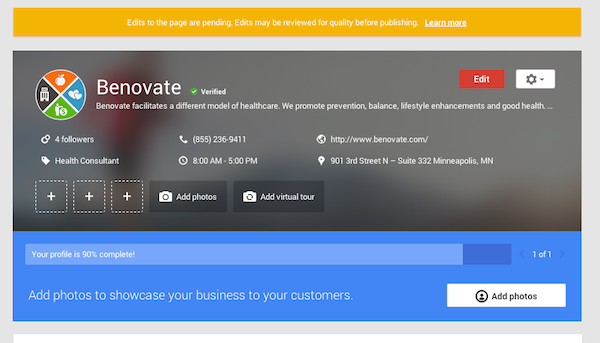
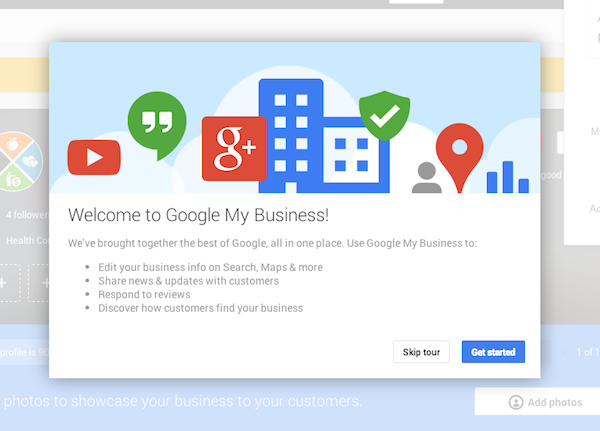
Google has been making some big changes to help businesses increase their visibility on Google Search, Google Maps, and Google+ by connecting business information across all of Google’s services. Google is calling the interconnected service Google My Business, which is set to be a one-stop shop which will allow users to access all their applications in one place.

The service will help deal with duplicate entries across Google products by asking users to entire their information one initial time, then populating it into all of Google’s services at once. TechCrunch also reported that “owners can post news events, photos, and other updates they want shared with customers” in an apparent bid to rival Facebook.

google-my-business-home-screen

Once you’re signed in and Google has guided you through a tour of the platform, you’ll see a screen that houses your basic information that will appear on Google+, Google Places, and Google Search. From now on, you’ll be able to update business information such as store hours, phone number, or your website URL in one easy to access location.

google-my-business-dashboard

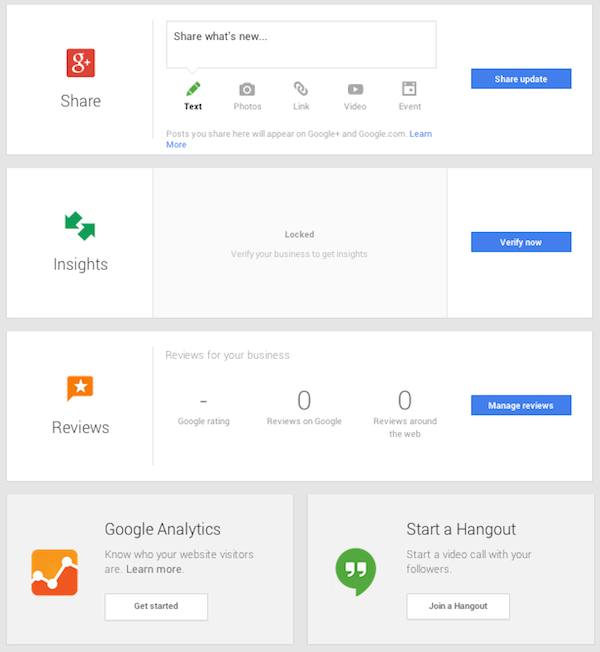
Beyond that page, you’ll be given access to the the really meaty parts of the update. From one screen, you’ll have control of your Google+ profile, from which you can share new text, photos, links, and events. You can also explore Insights, which will help you analyze your visibility, engagement, and audience. This screen also lets you manage your reviews, quickly access your Google Analytics dashboard, and even start a Hangout with the click of a button.

google-my-business-android

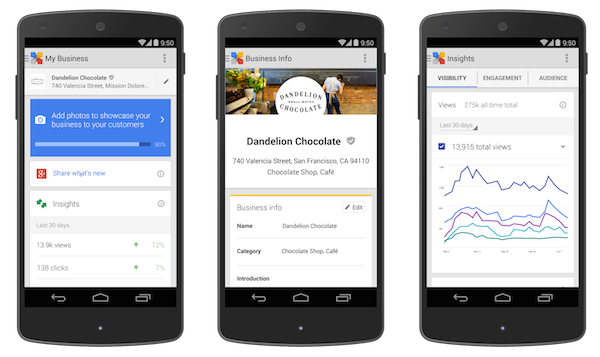
Notably, this update has already gotten a mobile launch on Android, and it appears the iOS version of Google My Business will be released n the near future.

Google My Business makes it easier than ever for small businesses to take control of their own online presence and helps level the playing ground so that any company can benefit from being online. You don’t have to be a well-established brand to make yourself visible online.

Social Media FailSocial media is one of the best tools modern marketers and business owners have to connect with their demographic and build their brand. But, social media can also be a bit fickle or harsh. You can spend months or even years creating your brand’s online presence and building up an audience, only to create a massive PR problem with a single post.
As the saying goes, the bigger they are the harder they fall. Whether it’s on Facebook, Twitter, Pinterest, or Google+, having a big audience only means you have more eyes scrutinizing your every Tweet and Pin for a potential scandal or brand breakdown.

You don’t have to get too worried though. Nearly every big social media mistake can be avoided by following some simple rules. Search Engine Journal shared a list of 30 ways you can make a mistake on social media. While the list may seem long, it provides a complete guide to social media – from building an audience to avoiding any meltdowns or missteps in the future.

We are just a day away from the start of World Cup 2014, and this year’s competition will be the most socially connected yet. Social media use is at an all-time high, and Twitter and Facebook are locked in a battle for the place as the dominant platform users turn to for keeping up to date with scores, game times, and fan response.

Though soccer is often treated like a novelty in the US, the sport actually has a strong and passionate audience across the country – not to mention the unbelievably large fan base around the world. FIFA claims that around 3.2 million people watched at least one game of the last World Cup in 2010, and this year seems likely to get even more viewers.

As Twitter and Facebook made clear with announcements yesterday, both platforms are hoping to get a piece of the action by rolling out campaigns aimed at promoting soccer and encouraging fans to turn to their specific platforms.

Facebook’s Trending World Cup Page

trending-world-cup-facebook-600x398

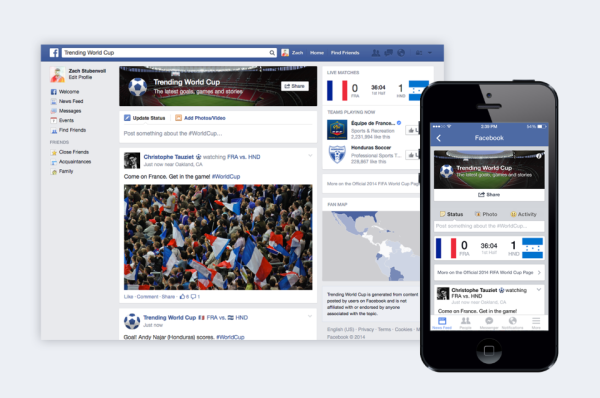
Facebook’s News Feed algorithm isn’t exactly well-suited for keeping up with real-time conversation like Twitter is, but it is offering a Trending World Cup page designed to help fans follow the latest scores, match highlights, and conversation. The page will even allow users to click through a global map which displays the Facebook popularity of top World Cup players.

Several people, including Marketing Land, have already used the global map to discover some fairly interesting statistics, such as England’s Wayne Rooney being strangely popular in Namibia.

As with all of Facebook’s trending pages, the World Cup page will also show the latest posts from friends, players, teams, and the media making sure you never miss a spectacular goal or scandalous foul.

Facebook users will be able to filter conversations based on the specific match they are watching as well, once the games have started.

Twitter’s World Cup Landing Page and Hashflags

twitter-worldcup-hub-600x258

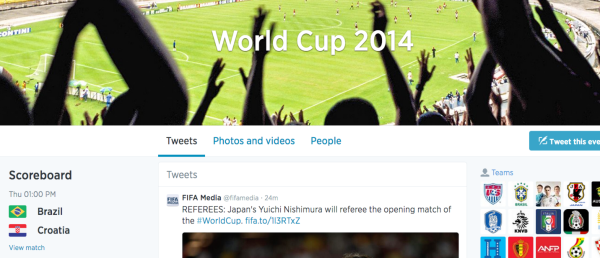
Twitter users can already access a dedicated World Cup landing page via the hashtags #WorldCup and #WorldCup2014, which offers a scoreboard and updates with conversation about the event and games. Similar to Facebook, Twitter will also allow users to organize what content they are seeing by selecting “match timelines” that only show tweets about specific games.

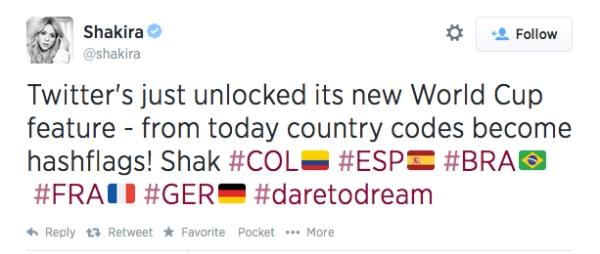
This is fairly standard for users, but Twitter users from the last World Cup may be excited to see that “hashflags” are returning for the latest competition. Introduced for the 2010 World Cup, the feature displays flag icons of people who include appropriate three-letter hashtags in their tweets. Before the games kick off on Thursday, Twitter will also unveil “The World Cup of Tweets” bracket.

Shakira Twitter

The social platform is also acting to retain new users who choose Twitter for their World Cup 2014 social needs by adding soccer suggestions to the sign-up process throughout the games.

“After you sign up and choose your username, you can select the team you’re supporting,” Twitter’s Xiaolei Li wrote in a blog post. “Then you can choose from a number of profile and header photos that represent your country. (Of course, you can upload your own photos too.)”

http://youtu.be/62NnPg2Ds5w

hijackblogHave you ever had to deal with a sudden significant drop in the effectiveness of your pay-per-click advertising? Usually, those types of issues are the result of a bad change with how you are bidding or possibly the failure to adapt to changes on advertising platforms. However, it could also be the result of a concentrated fraudulent effort, as the discovery of a large PPC fraud ring in May shows.
This wasn’t just an issue of click fraud, either. The newer tactic being deployed by the ring of con artists is both serious and hard to detect. Lori Weiman reported that a PPC fraud ring used a tactic called PPC ad impersonation to pose as over 300 advertisers, as well as how they were brought down.

PPC ad impersonation, also sometimes called URL Hijacking, is when a scammer impersonates an advertiser by using the advertiser’s URL as the display URL in PPC ads. But, the scammer then links the ad to the real advertiser’s site through an unauthorized link such as an affiliate link, a phising link, or a cookie-stuffing URL.

Weiman’s report shows exactly how the most recent large-scale PPC ad impersonation ring was brought down, but the issue is far from resolved. Just as with every form of fraud, there are plenty of others out there willing to fill the place of the group that was recently detected.

Normally, these types of fraud are relatively limited, only affecting about 5% of the effected advertiser’s ads, but the recent attack was so bold that between 20% to 100% of ads being shown for some large companies were fraudulent. It is a worrisome sign for the future of these types of attacks, but thankfully this one was resolved rather quickly.

All week we try to keep you up to date with the most important SEM news across the web, but inevitably there are smaller stories that fall through the cracks. That’s why we compile all the most important news we missed this week all in one convenient place every Friday. After a quiet week before, nearly all of the major platforms have made announcements this week. Let’s start with Google and work our way down.

Google Starts Warning Searchers About Mobile URL Redirects

search+result+redirect+annotation

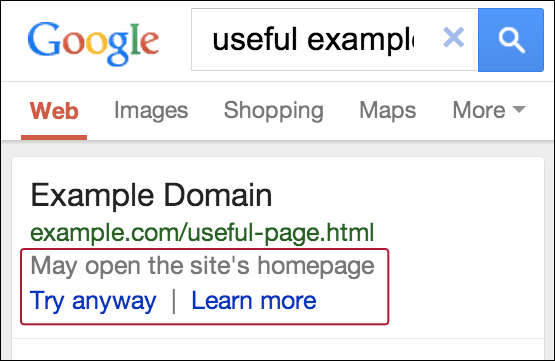
Google has been warning webmasters about faulty mobile redirects for months, including suggesting they may one day start receiving penalties for sending mobile searchers to the front page of a site rather than the content relevant to their search. It appears Google has opted for another solution, which allows mobile searchers to decide if they want to proceed.

Google alerted webmasters this week that smartphone searchers will begin seeing warnings for sites with redirects that don’t take them where they want to go. An example of how these warnings will appear is above. On a Webmaster Central blog post, Google stated:

We’d like to spare users the frustration of landing on irrelevant pages and help webmasters fix the faulty redirects. Starting today in our English search results in the US, whenever we detect that smartphone users are redirected to a homepage instead of the page they asked for, we may note it below the result. If you wish to proceed to the page, you can click ‘Try Anyway.’

Google Adds World Cup Street View Tours and a Loch Ness Easter Egg

street-view-world-cup

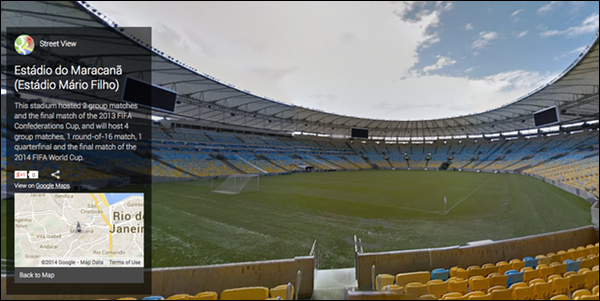
Just a week before the World Cup kicks off, Google has added street view images that will allow users to tour all 12 stadiums that will be used for the tournament. Whether you want to stand in the middle of the field and do a little spin, or preview the view from the stands, you’ll be able to give a look from anywhere within the stadiums.

Google has also added significantly more images from Brazil’s painted streets and other sites across the country, but perhaps one of the most popular finds on Google Maps this week is an Easter Egg found far away from Brazil.

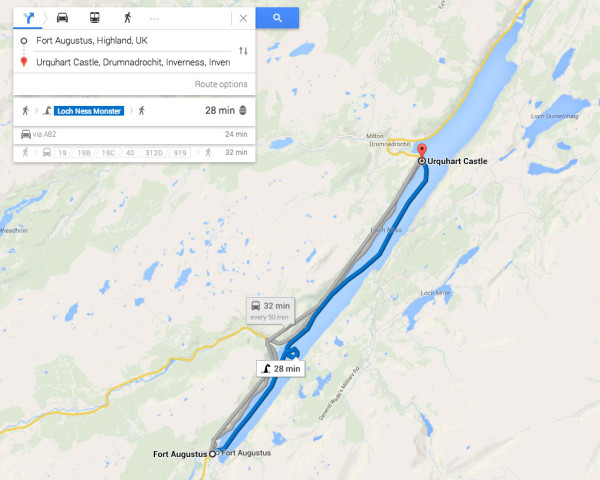
If you’d rather hunt legendary monsters than watch soccer, Google Maps is able to give you directions to Loch Ness. If that isn’t enough for you however, Google says you can always catch a ride on Nessy.

google-maps-loch-ness-monster-600x480

If you get directions from Fort Augustus to Urquhart Castle in Google Maps, you will get the option to travel via Loch Ness Monster. You just have to click on ‘Route Options’ and then choose ‘Fewer Transfers’ or ‘Less Walking.’ Though you have to wonder how no one has managed to get a picture of Nessy while hopping a ride down the Loch.

Bing Celebrates Its 5th Birthday With Some Memories

Bing turned five earlier this week, and to celebrate it has posted a retrospective of the last five years. Bing is also offering Bing Reward credit perks to any user who searches on the site before June 9th.

The retrospective covers all of the ways Bing’s appearance has changed over the past five years, but it also covers how it has worked to achieving its initial goals of leveraging semantic search, introducing new verticals, and generally expanding how search could function in our lives.

Bing Shows Off New Dynamic Carousel For Music Video Searches

bing-music-video-carousel

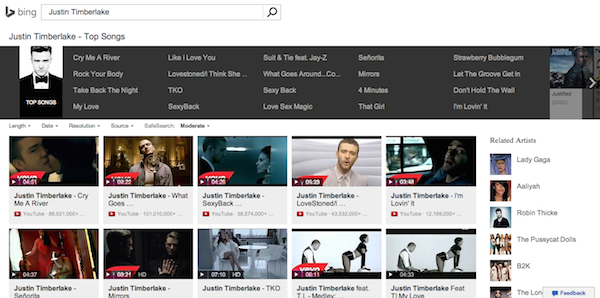
Bing has prided itself on being ahead of the curve in respect to music and music video searching and discovery, and its latest feature continues to expand on the functionality it previously offered for music video searches.

Bing has recognized that people search for music videos very differently than they do other video content. By exploring these changes in user behavior, Bing was able to determine that music video watchers wer significantly more likely to hang around and check out other content instead of moving on once they found the video they were looking for.

To give users easier access to all the music videos they may be interested, Bing has implemented instant access to an artist’s top hits as soon as you search only the artists name. Bing describe this as a dynamic carousel, because it allows you to open up songs and videos from teh carousel and play it within the same window. You will never have to keep going back and forth between choosing the video you want to watch and actually watching it.

The carousel also allows you to view all of an artist’s albums and watch the videos for those songs as well.

Pinterest Continues To Work Towards An Actual Ad Platform

Pinterest Promoted Pins DIY

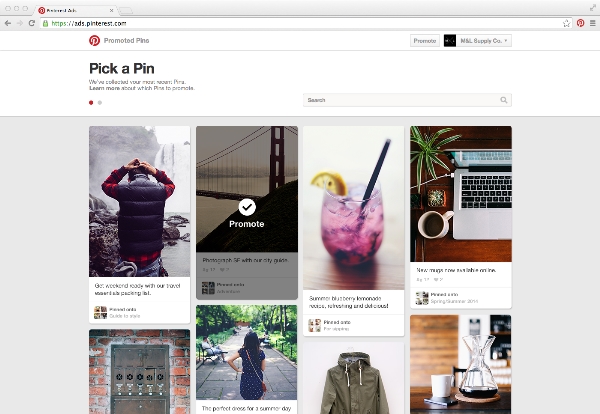
Pinterest has made its intention to establish an ad platform for their social network very clear ever since it unveiled Promoted Pins. However, Pinterest is working slowly to guarantee that the ads shown on their platform won’t stick out or detract from the experience, and as such it has been very hands on and selective about who it allows to run ads.

Now, businesses of all types have been given access to a do-it-yourself Promoted Pins tool that allows them to promote their own pins to more people and increase visibility. Similar to most other social ad platforms, these will work on a cost-per-click basis through ads.pinterest.com.

Pinterest also announced they would be expanding the analytics tools offered to users, giving them more insight into who is clicking and re-Pinning your content. You can get more information from their announcement.

LinkedIn Joins The “Large Cover and Profile Photo” Club

linkedin-600x282

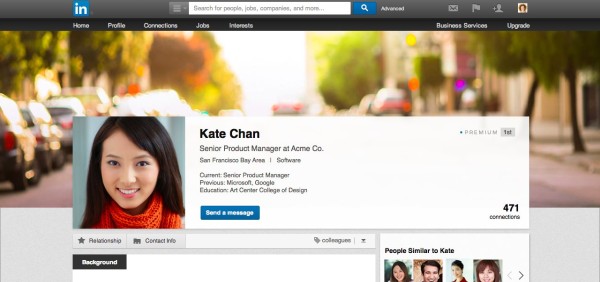
LinkedIn announced earlier this week it would be making a major design update to user profiles, which will feel very familiar to anyone who uses Facebook, Google+, or Twitter. Currently, the layout is only available to premium users, but LinkedIn says it will be available for all users after a short period. It isn’t entirely clear why LinkedIn would stagger the rollout of this layout change, but you can add it to the list of social media sites that are beginning to look very, very similar.

Negative SEONone of the big search engines like to talk about it, but negative SEO has been a problem for years. By Google’s admission, negative SEO has been occurring since 2007 – though they claim it is rare.
As “rare” as negative SEO may be, it has managed to cause serious problems for sits as large as Expedia, and it has been enough of an issue for Google to have to reword their own documentation on the subject.

If you’ve yet to run into any cases of negative SEO, it is a practice of using purposefully bad SEO against a competitor. For example, it is possible to point huge numbers of low-quality links towards a competitor’s site and potentially cause the competitor to be punished by Google’s Penguin algorithm. Penguin is designed to take down sites who build backlink profiles filled with low-quality links in order to cheat the search engine for high rankings.

You would think search engines would be actively trying to fight the possibility of SEO companies using their skills against competitors or former clients, but according to Search Engine Roundtable, it is only getting easier.

Barry Schwartz reported on a conversation occurring over at WebmasterWorld, where a site administrator going by Engine said “negative SEO is now much easier to do than it was prior to google’s latest updates.”

It turns out, the majority of webmasters and SEOs seem to agree. The overwhelming response to the question on WebmaserWorld agreed with Engine’s statement, and over 70% of the respondents to a poll on Search Engine Roundtable sided with those who believe negative SEO is getting easier.

Considering the latest algorithm updates from Google are receiving the majority of the blame for this trend, it isn’t particularly surprising they remain relatively mum on the issue. But, business owners have every right to be concerned. Hopefully, Google’s next big algorithm they unveil will be aimed at protecting innocent webmasters from the “black hat SEOs” who use such destructive practices.

With each new study focusing on consumer behavior, smartphones are proven to be even more integral to our purchasing habits than many of us may realize. I think everyone is aware of the increased importance of smartphones and mobile browsing in the market, but it may still be surprising that the majority of consumers (up to 60 percent) exclusively rely on mobile for purchasing decisions within the categories of telecom, restaurants, auto, and entertainment.

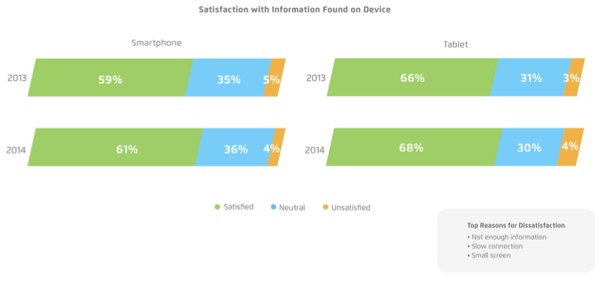
Numerous analysts suggest the rise shown in the third-annual Mobile Path-to-Purchase report from xAd and Telemetrics could be partially caused by an increase in consumer satisfaction in mobile devices and tablets, both rising 2 percent from 2013. Smartphone satisfaction grew to 61 percent, with tablets increasing to 68 percent.

satisfaction-mobile-xad-telmetrics

According to the study, the most common reasons for dissatisfaction included not enough information, slow connection, or a small screen. While website owners can’t control the size of screen their users have, they can improve the amount of information on their site, increase load speeds, and optimize their design for smaller mobile screens.

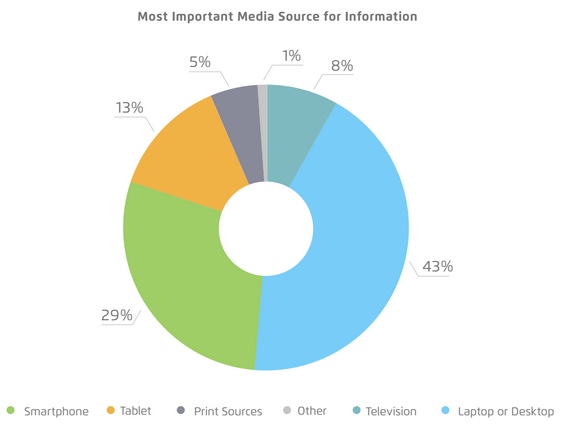
More than 40 percent of consumers cited mobile as the most important media source for information as well. Print industry continues its march towards complete irrelevance as it was called the most important source by only 5 percent of those surveyed.

media-source-of-info-xad-telmetrics

The increasing relevance of smartphones in shopping habits continues, with smartphones showing a 26 percent increase from 2013, with 29 percent citing it as the most important shopping tool in 2014. A quarter of users also said they utilized mobile devices on the entire path to purchase, from research, to comparison, to conversion.

“Capturing consumer engagement points throughout the mobile path to purchase is essential to optimizing mobile ad programs to reach consumers when they are most open to options for fulfilling their purchase needs,” said Bill Dinan, president of Telmetrics.

Source: Jason Howie

Source: Jason Howie

Marketers have overwhelmingly confirmed that social media is a highly valuable target for campaigns of all shapes and sizes, but you have to be able to effectively aim your message. If your social marketing strategy is out-dated or unfocused, then it will never gain traction on any of the major social platforms.

Social Media Examiner recently released its annual Social Media Marketing Industry Report, based on surveying more than 2,800 marketers. If you want to make sure you are up to date with the state of social media and guarantee you are sending out the right message to the right people, you’ll want to know these important trends highlighted by this year’s report.

1. Blogging is Back – It should be obvious by the widespread cries of “Content is King!” over the past year, but blogging is all the rage yet again. The report shows this blogging is only going to get more popular looking forward as 68 percent of marketers said they would be increasing their blogging efforts. That is the most attention blogging has received since 2010 according to the report.

2. Facebook is Showing Its Age – Compared to the relatively short lifespans of popular social media platforms like Myspace, Facebook’s reign at the heights of social media has been extremely long. But, the report supports numerous claims over the past year that Facebook is beginning to lose users and marketers alike. Despite still being the most important social network overall, by a significant amount, only 43 percent of marketers feel their efforts are effective and 7 percent intend to decrease their use of Facebook this year.

3. Google+ is Finally Getting Some Attention – Despite still being the source of plenty of derisive jokes, Google+ is finally seeing some light on the horizon. The report explains, “While 54 percent of marketers are using Google+, 65 percent want to learn more about it and 61 percent plan on increasing Google+ activities in 2014.”

4. Is Podcasting the Next Big Thing? – Only 6 percent of marketers are currently involved in podcasting, but expect to see efforts skyrocketing soon. The report says 21 percent of marketers are planning on increasing their podcasting activities this year. Many also showed heightened interest in podcasting, with 28 percent saying they wanted to learn more.

Are you trying to stay on the cutting edge of social media? It is hard to stay ahead of the curve, but with enough effort you can corner all the new emerging platforms while keeping up with the content trends.