Tag Archive for: Google

Google has been aggressive about encouraging webmasters to make their sites more mobile-friendly, and it appears they will only become more strict in 2015. Google has started sending mass notifications to webmasters whose websites are not appropriately optimized for mobile.

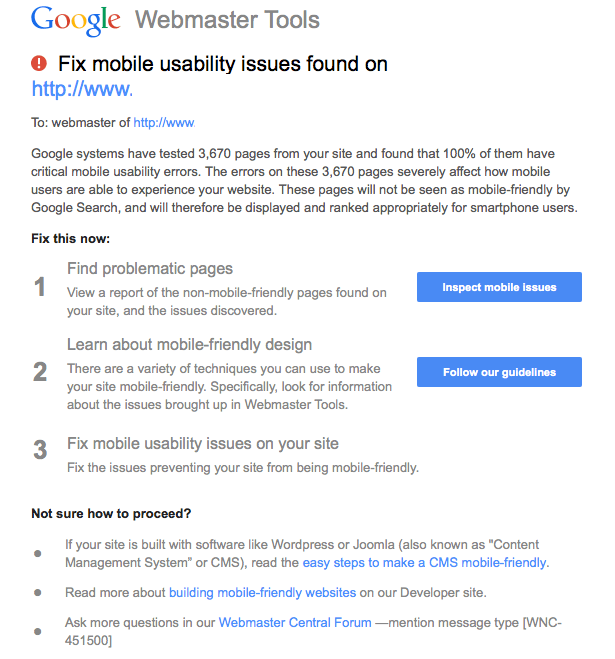
The notifications, titled “fix mobile usability issues found on…” informs webmasters that their sites have mobile usability errors on all pages and thus will be “displayed and ranked appropriately for smartphone users.”

The notifications are popping up in Google Webmaster Tools and via email. Perhaps more interesting, Google is also sending the notifications to sites that are blatantly not mobile friendly. Typically these sites already know they are not mobile-friendly, but Google is sending alerts warning these webmasters nonetheless.

This is the latest sign that Google is almost certainly going to be amping up the role mobile optimization plays in search, and many believe there may be an outright “mobile ranking algorithm” in the close future.

The increased importance of mobile to Google is little surprise as mobile gradually overtakes desktop traffic. Google wants to ensure they are directing users to sites that will fit their needs wherever they are, and sites who aren’t mobile-friendly simply don’t deliver.

Here is a copy of the notification being sent out:

google-mobile-seo-errors-1421674683

AdWords In Store Visits

Online marketers love tracking and evaluating their campaigns and business owners love knowing their marketing is successful. Unfortunately, tracking is only able to capture so much information. For example, until recently it has been nearly impossible to properly track the impact of your ads on the amount of traffic you see coming into your store.

Thankfully, Google has released a new “Store Visits” metric in AdWords that should make it considerably easier to measure the effect your ads have on real-world store traffic.

Store Visits is an enhancement for AdWords Estimated Total Conversions, which estimates traffic based on anonymized data collected from a sample set of users who have enabled Location History on their device. Using this relatively small sample, Google predicts the number for the general population.

The tool is still in the early stages, and it is important to remember the prediction is exactly that. We are still a ways away from complete ability to understand the effect your ads are having, but the additional data can still be useful in trying to ensure your ads are driving the highest conversion rates possible.

yahoo-search-appAccording to new data from web traffic analytics provider StatCounter, Yahoo has reached its highest share of the U.S. search market in more than five years thanks to a recent agreement with Mozilla.
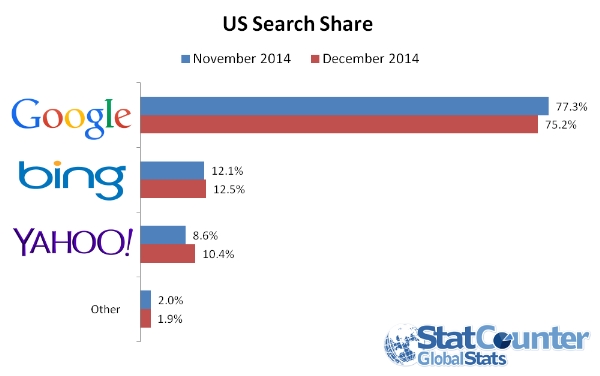
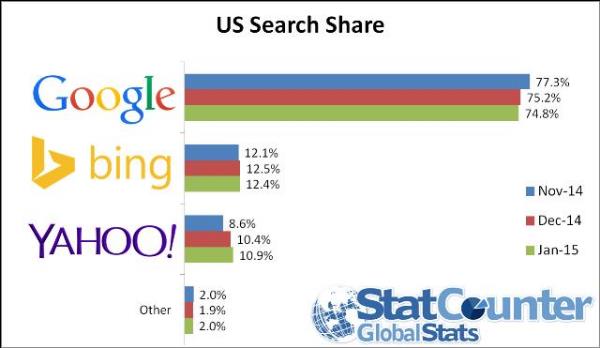
In December, Yahoo’s search share jumped to 10.4 percent, up from 8.6 percent in November. The new share of the search market came at the expense of Google, who was previously the default search engine for Mozilla’s web browser Firefox.

In late November, Mozilla agreed to a five-year partnership with Yahoo, breaking a 10 year partnership with Google. December marked the first full month during which Yahoo was the primary search engine on Firefox.

The drop brought Google to its lowest share ever recorded by the analytics firm, falling from 77.3 percent to 75.2 percent.

SearchShareDec2014

“The move by Mozilla has had a definite impact on U.S. search,” says Aodhan Cullen, chief executive at StatCounter. “The question now is whether Firefox users switch back to Google.”

Bing also saw an increase in their share of the search market last month, though not nearly as significant of an increase as Yahoo. From November to December, Bing’s share rose from 12.1 percent to 12.5 percent. The “other” category stayed practically the same, fluctuating from 2 percent to 1.9 percent.

Google Authorship

It can seem like the entire world hates Google+ sometimes, but in reality the social media platform has carved out a niche audience that has stayed loyal over several years, and recent changes have given the platform a strong presence in local search results.

As Google has upped the presence of “local packs” or groups of local results on searches that appear to be geographically linked and this has given businesses with Google+ profiles a big step up in visibility.

Google+ gets beat on for not having near the number of daily active users as sights such as Facebook, Twitter, or Pinterest, but it is not going anywhere soon simply because of how useful the site can be. Now Google+ has made it even easier to keep the most useful information in a prominent location on your page by pinning the most important posts at the top of your feed.

You can use this to keep business information such as contact numbers or location info in a highly viewable place, but this can also be extremely useful for bringing attention to sales, special promotions, or any other big events coming up for your business that you want the public to know about.

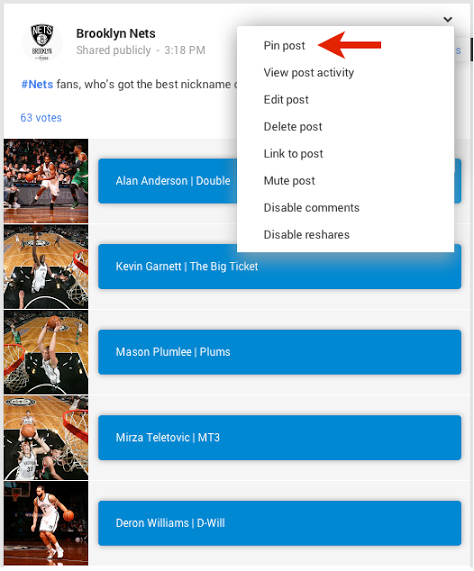
To pin posts, just click the drop down arrow at the top-right corner of your published updates and select ‘Pin post’ as in the example below.

pinning

The feature has already rolled out on desktop and Android but, in typical Google fashion, iPhone users will have to wait until they decide to share the feature with iOS.

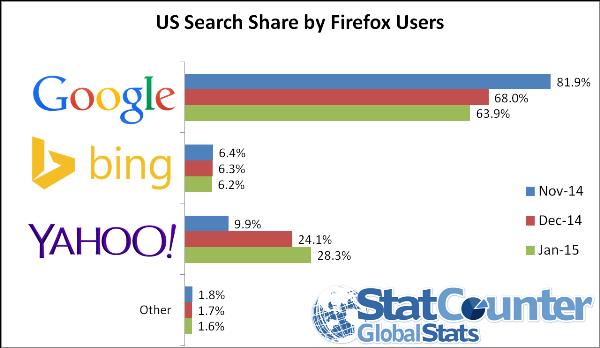
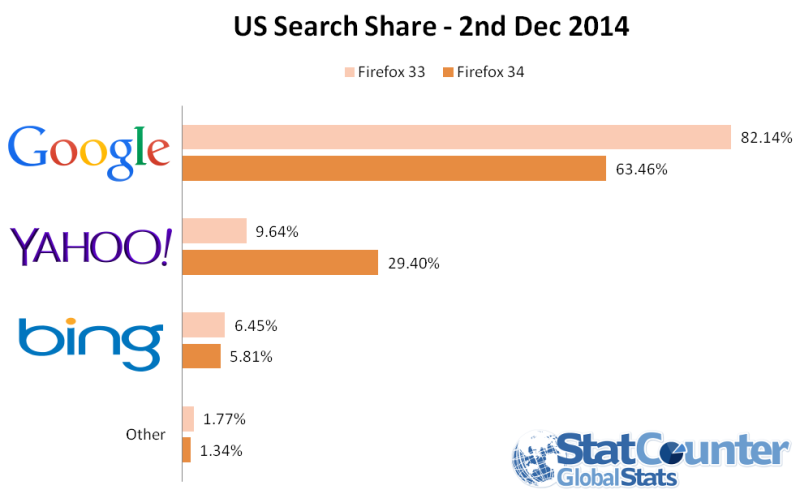
Google has had a strong grip on the vast majority of web traffic, but a new report suggests they are losing their grasp. In just two weeks since Yahoo replaced Google as the default search engine in Firefox’s latest version, the search engine has experienced a 29.4 percent growth in usage, while Google has experienced a significant drop.

Analytics firm StatCounter said that “Yahoo search was used three times more on Firefox 34 than on Firefox 33.”

It should be noted, the user base of Firefox 24 is relatively low as many users haven’t upgraded yet and Firefox’s US market share overall is only about 15 percent. However, StatCounter still showed that Yahoo has benefited a fair amount from this deal, growing from 9.6 percent to 29.4 percent. In comparison, Google usage in the latest version of Firefox fell from 82.1 percent to 63.5 percent.

Screen-Shot-2014-12-03-at-3.38.35-PM-800x494

In the big picture it is clear that Google still has a massive lead on other search engines, but that lead doesn’t seem near as solid as it once did. This report shows that “default” search engines still hold a lot of influence over how users interact with the web. With Google’s agreement with Safari also coming to an end in the near future, there is a large chance that Yahoo or Bing could continue to make significant gains.

Google-Maps-being-offline-doesnt-mean-being-lost-300x252Last night, Google Maps released massively revamped quality guidelines for local pages which could have a heavy impact on businesses who don’t ensure their pages conform. Jade Wang from Google shared the news in the Google Forums stating:
We’ve updated and clarified our quality guidelines for local pages. Please read the new version here, and, as always, feel free to contact our support team with any specific questions about your account.

You can see a screenshot of the old guidelines here courtesy of Barry Schwartz, but the most important revisions to the guidelines are highlighted below:

  • Descriptors of any sort are NOT allowed
  • Categories should be the more specific category and NOT the overarching, general category
  • Increased name and category consistency amongst multi location chains
  • Two or more brands at the same location must pick one name
  • If Different departments are to have their own page they must have unique categories
  • Practitioner’s pages, in multi-location practices should have their name only and not the name of the practice
  • Solo Practitioners only can use the format of Practice: Practitioner
  • Virtual Offices are NOT allowed unless staffed.

Many aren’t taking the update seriously as Google Maps local pages are far too often neglected, but the updated rules may be a sign that Google intends to clean up the mess in the near future. It is always better to be proactive than to find yourself smacked with a penalty.

Google has been emphasizing the importance of mobile design and usability over the past year and now the search giant has added mobile usability reports to Webmaster Tools. Many believe this could be a sign that Google may be making mobile usability a ranking factor sooner rather than later.

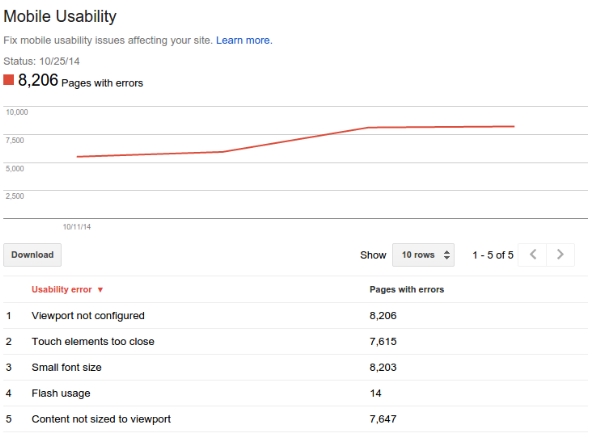
The tool is intended to show whether your mobile site has any of the common usability issues that degrade a user’s mobile browsing experience.

Currently, the tool included specific errors for showing flash content on mobile (which can also result in a warning on mobile search results for your site), missing viewport meta-tag for mobile pages, improperly small fonts which are hard to read on mobile, fixed-width viewports, content not sized to viewport, and clickable links and buttons spaced too closely together.

John Mueller from Google’s Webmaster Trends Analyst team based in Zurich said they “strongly recommend you take a look at these issues in Webmaster Tools.”

Of course, Mueller could simply be encouraging this because it improves user experience, but there is strong evidence to suggest Google will eventually make mobile user experience a ranking signal within search engine algorithms.

You can see an example of the reports below:

Mobile Usability Reports

Image source: Lin Padgham

Image source: Lin Padgham

If you thought Google might be slowing down on updating their most well-known search algorithms, the past month may have been a bit of a shocker for you. First, Google rolled out the latest update to their Panda algorithm in late September, and less than a month later they have released the first update to their Penguin algorithm in over a year.

If Penguin and Panda aren’t familiar terms to you, they are the names of two major algorithms which determine what Google’s search results will look like for a given search. They help evaluate websites and reward those who are following guidelines while punishing those who bend or break the rules.

While the Panda algorithm mostly relates to the content directly on webpages, Penguin aims to take down those who try to cheat Google by creating unnatural backlinks to try to gain higher rankings. Both often these algorithms penalize webmasters and the businesses who run these pages when there was no malicious intent.

Unfortunately, with the complex system that makes up Google’s search algorithms and their ever-changing guidelines and many business owners have been shocked to discover their site is no longer appearing in the search results after an algorithm update.

While site owners can frequently bounce back after these penalties, they can also destroy any momentum you had and lose you potential customers. That’s why it is always important to have someone who is consistently up-to-date on all of Google’s latest policy changes to make sure your site is staying within the rules.

It isn’t a reality quite yet, but image reading and object recognition are likely to change the search game in a big way before long. Razvan Gavrilas has spent the past few months researching the advancements Google is making in the fields of “reading” and indexing images and not only does it appear these types of systems and algorithms are closer than previously believed. There are steps you can take to be prepared right now. Find out more in Gavrilas’ article for Search Engine Journal here.

Panda

Webmasters using “thin” or poor quality content may have seen a drop in traffic this week, as Google has announced that the release of the latest version of its Panda Update.

According to a post on Google+, the “slow rollout” began early this week and will continue into next week before being complete.

While those trying to do the bare minimum to improve rankings may have reason for concern, the new update could also be a relief to many who say they were improperly affected by previous updates as this update is intended to be more precise. As the announcement says:

Based on user (and webmaster!) feedback, we’ve been able to discover a few more signals to help Panda identify low-quality content more precisely. This results in a greater diversity of high-quality small- and medium-sized sites ranking higher, which is nice.

Those who were affected by previous updates may also welcome the latest release, as it means anyone who has made the right changes since the last update finally have a chance to bounce back.