As a business owner with an eye on your company’s online marketing success, you have likely heard about Google’s search engine algorithms. You may even have a general idea of how they function and effect your business’s online presence and marketing strategies.
But, unless you spend your free time reading all the SEO blogs, you probably have some questions about some aspects of how these algorithms work. If your business does international business, one of those questions is very likely if Google’s algorithms work the same around the world.
While the algorithms largely tackle the same issues, the short answer is that they do not all work the same on an international scale.
As Barry Schwartz recently highlighted, you can find specific examples of when algorithms vary across borders by looking at the Google Panda algorithm. The algorithm was initially launched for English language Google engines in February 2011, but the rest of the globe didn’t see the algorithm roll out for quite some time. Notably, it took 17 months for Google to release Panda in Korea and Japan to target Asian languages.
However, the Google Penguin algorithm didn’t have nearly the same delay. Penguin rolled out globally and impacted sites in any language.
What’s the reason for the difference? It all boils down to purpose. The Panda algorithm focused on language and content, and those algorithms have to be customized and focused based on the wide variety of languages found around the world. Meanwhile, algorithms like Penguin target off-page technical factors like links, which raises less of an issue customization.
00Taylor Ballhttps://www.tulsamarketingonline.com/wp-content/uploads/2018/07/TMO-Logo.pngTaylor Ball2014-07-24 13:15:442014-07-24 13:15:44Do Google’s Algorithms Work The Same Around The World?
Duplicate content has been an important topic for webmasters for years. It should be absolutely no secret by now that duplicate content is generally dangerous to a site and usually offers no value, but there are occasional reasons for duplicate content to exist.
Of course, there are very real risks with hosting a significant amount of duplicate content, but often the fear is larger than the actual risk of penalties – so long as you aren’t taking advantage and purposely posting excessive duplicate content.
Google’s John Mueller puts the risk of using duplicate content in the best context,. According to John, there are two real issues with duplicate content.
The first issue is that Google’s algorithms typically automatically choose one URL to show for specific content in search, and sometimes you don’t get to choose. The only way you can effectively let Google know your preference is by using redirects or canonical tags, and that isn’t foolproof.
Secondly, if you are hosted a ton of duplicate content it can actually make the process of crawling to overwhelming for the server, which will slow new content from being noticed as quickly as it should be.
Still, John said that in most cases, “reasonable amounts of duplication […] with a strong server” is not a huge problem, as “most users won’t notice the choice of URL and crawling can still be sufficient.”
00Taylor Ballhttps://www.tulsamarketingonline.com/wp-content/uploads/2018/07/TMO-Logo.pngTaylor Ball2014-07-21 14:07:152014-07-21 14:07:15Why Is Duplicate Content a Problem?
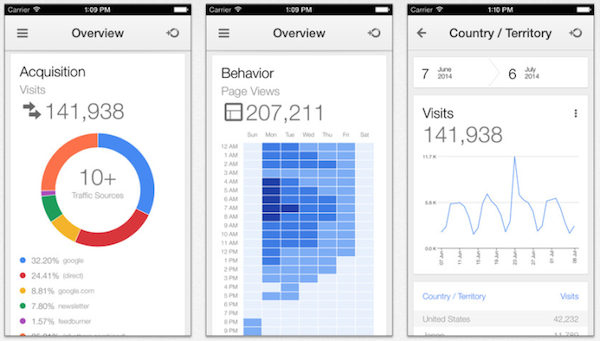
It’s been a long time coming, but starting yesterday you can download the official Google Analytics app for iPhone and iPod Touch. The Android version of the app has been available for quite a while, but naturally there was a delay before Google pushed it out to Apple devices.
While the app can run on the majority of Apple mobile devices, it is optimized for the iPhone 5 and requires a device running iOS 6.0 or later.
There aren’t a bunch of new features, but the app opens the opportunity for webmasters to keep up to date with Analytics on the go. You’ll find features such as sources, page views, visits, and TechCrunch says users will even have access to Real Time reports, which will allow you to monitor data as it occurs.
00Taylor Ballhttps://www.tulsamarketingonline.com/wp-content/uploads/2018/07/TMO-Logo.pngTaylor Ball2014-07-18 14:23:582014-07-18 14:23:58Google Analytics Comes to iOS
Google Analytics is easily one of the most trusted analytics platforms out there, but new findings are suggesting it may not be as accurate as once thought. Most recently, Groupon published a study which indicates that as much as 60% of what Google Analytics calls “direct traffic” is actually from organic search.
The study was conducted by Groupon’s Director of Product Management, who manages their organic search. While not entirely scientific, his study involved completely deindexing Groupon from Google for 6 hours.
Deindexing means absolutely no traffic would be coming from Google for the duration of the study, which allowed the study to calculate roughly what percent of traffic is coming from organic search.
During the six hours the site was deindexed, Groupon’s direct visits dropped by 60%, which led Groupon to believe that 60% of what is called direct traffic is actually coming from organic search traffic.
Groupon isn’t the only site to conduct a study like this. Not long ago, Conductor, a well-respected internet marketing firm, released a similar study which led them to the conclusion that 47% of traffic came from organic search. Nearly a third of that was attributed to direct visits.
Conductor Corroborates Groupon’s Findings
After Groupon released their findings, Conductor decided to revisit their initial study to see what would happen to the results if included the conclusions from Groupon’s study into their own data.
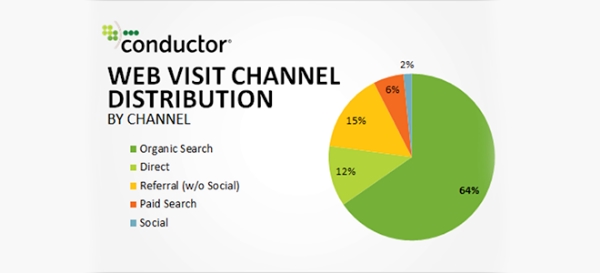
By taking 60% of visits originally attributed to ‘direct’ and reallocating them to ‘organic search’, organic search went from 47% of all visits to 64%. Direct visits dropped from 29% of visits to 12%. This significant discrepancy—17% separates the ‘before’ and ‘after’ allocations should be enough to give marketers pause—and question the assumptions on which their digital strategy lies.
While none of this means you should give up on Google Analytics (it is the best insight you have to website performance and how Google views your site), it does suggest that it is entirely possible that a much larger percentage of traffic is coming from organic search than previously thought.
00Taylor Ballhttps://www.tulsamarketingonline.com/wp-content/uploads/2018/07/TMO-Logo.pngTaylor Ball2014-07-16 12:19:542014-07-16 12:19:54Recent Studies Suggest Organic Search Is Responsible For More Traffic Than Previously Thought
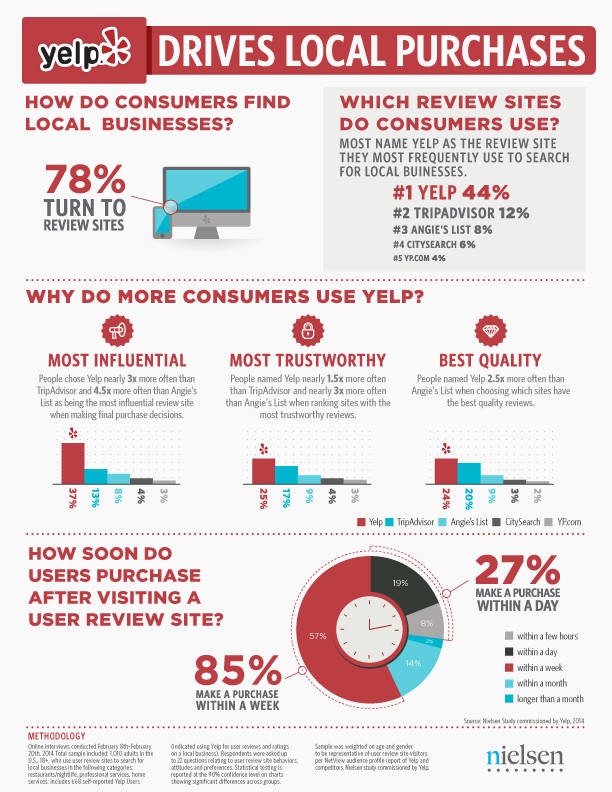
Earlier this week we reported on a recent study highlighting the growing influence of online reviews, and there is no service as closely associated with online reviews as Yelp. Of course, Yelp agrees and they’ve commissioned a new study from Nielsen survey data to show it is the most frequently used, most trusted, and even the highest quality local reviews site. But, many are skeptical of their findings.
The study used a sample of just over 1,000 US users of review sites, including competitors such as Angie’s List, Citysearch, OpenTable, TripAdvisor, YP, and Zagat. The survey consisted of 22 questions in all and the sample was weighted for age and gender to be representative of Nielsen’s NetView audience. In a blow to the credibility of the survey however, it seems only a few of the results were released – presumably the results which favored Yelp.
Out of what was released, the survey showed that 78 percent of consumers use review sites to find local businesses and help make purchase decisions, with Yelp taking the lead in several categories such as “most influential,” “most trustworthy,” and “best quality reviews.”
Another source of apprehension for this study was the decision not to include Google or Facebook. When asked, Yelp told Greg Sterling:
Our findings specifically around review sites came after we included Google and Facebook in a question on what sites people use to find local businesses, but those sites aren’t solely focused on local business discovery. We dug deeper into those sites that are.
That led Sterling to the conclusion that Google and Facebook likely exceed Yelp as a source for local business information, but it isn’t dishonest to exclude them from a study focusing specifically on “local business discovery” because both platforms have such broad usage.
The study isn’t completely invalid because of these inconsistencies. It goes without question that Yelp is at the forefront of local business discovery and reviewing and several other studies show that Yelp is in fact influential in local purchasing decisions. This study reinforces the fact that Yelp is a major player in these categories, but obviously it should be taken with some skepticism.
You can see the graphic displaying Yelp’s findings below:
00Taylor Ballhttps://www.tulsamarketingonline.com/wp-content/uploads/2018/07/TMO-Logo.pngTaylor Ball2014-07-10 13:28:222014-07-10 13:28:22Yelp’s Study Says Yelp is the Most Influential Local Review Site
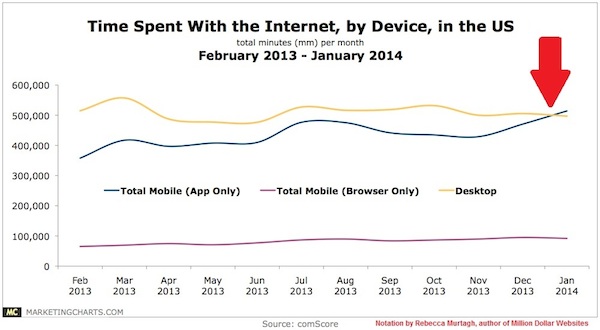
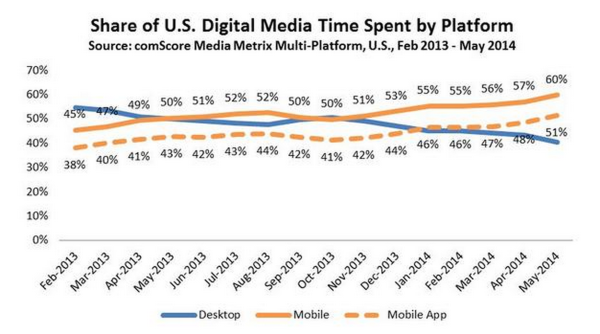
With how much the online marketing industry loves to make sweeping proclamations such as “content is king” and “links are dead”, you would think someone would have been there to declare that mobile now rules the internet, or some similar claim. But, somehow no one has made a big deal out of the fact that mobile devices accessing the internet now exceeds desktop devices as of early this year. Rebecca Murtagh explores what this means and how mobile devices are using the internet over at Search Engine Watch.
Reviews have always been important for reaching and maintaining success as a business, but since the rise of Yelp reviews have become essential. With the increased popularity of rating platforms and our rising reliance on them for online purchases, it is clear we are also beginning to put more trust in online reviews as well.
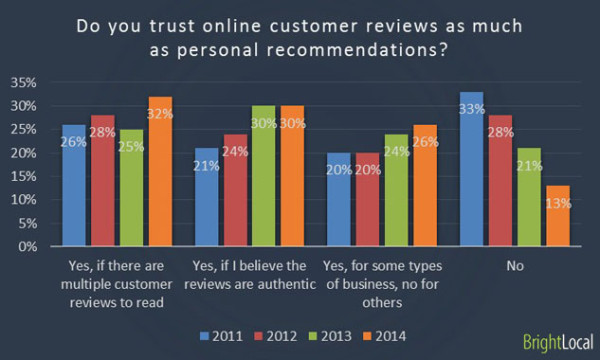
That is the finding of a new study from BrightLocal which highlights how consumers respond to reviews. This report makes the 4th year BrightLocal has conducted a study on consumer usage and attitudes toward online reviews and the findings overwhelmingly show that we trust online reviews now more than ever.
Myles Anderson shared the findings from the study on Search Engine Land, but the biggest highlight is the finding that 88% of consumers trust online reviews as much as personal recommendations. This is great news for businesses with primarily positive reviews, but that means negative reviews have more weight as well.
In the end, the findings just confirm what we’ve all suspected for quite some time. Finding ways to stimulate positive reviews is essential to increasing your online presence and driving new business. Otherwise, you might wind up with poor reviews and dwindling business.
Smaller local businesses are overwhelmingly lagging behind the rest of the market when it comes to getting online and increasing visibility and audience outreach through optimization and search engine marketing. Unfortunately the longer these companies wait to expand their business online, the further they fall behind the curve. Thankfully, Trond Lyngbø created a comprehensive article exploring the most important information anyone running a smaller local business needs to know about SEO and online marketing.
00Taylor Ballhttps://www.tulsamarketingonline.com/wp-content/uploads/2018/07/TMO-Logo.pngTaylor Ball2014-07-03 13:15:562014-07-03 13:15:56Everything Local Businesses Need to Know About SEO and Online Marketing
Social media is typically thought of as where all the cool kids hang out. Fast food, clothing, and entertainment all have it easy when it comes to making friends and getting retweets, but businesses in seemingly boring industries frequently settle for mediocrity out of the belief they can’t keep up with the “cooler” industries. But, Uri Bar-Joseph showed us five companies that shrug off the assumption that “boring” businesses can’t be exciting online.
00Taylor Ballhttps://www.tulsamarketingonline.com/wp-content/uploads/2018/07/TMO-Logo.pngTaylor Ball2014-06-30 13:41:202014-06-30 13:41:20Boring Companies Can Still Be Exciting On Social Media
Every week we try to keep you updated with all the SEM news from around the web, but the Google I/O event this week was packed full of so much information there was bound to be some stuff we didn’t get to cover. Today, we’re going to cover all the latest news from I/O and everywhere else. We’ll start with Google, but there is also some interesting Facebook news to discuss near further down.
Android Reaches 1 Billion Active Users Per Month
To open the annual I/O developers conference, Google rattled off an impressive list of statistics, as large tech companies tend to do. Of these statistics, there is one that was noteworthy and shows just how prominent smartphones have become throughout the world.
At last year’s conference, Sundar Pichai told the audience that Android had around 530 million active users per month. Over the past year, that number has almost doubled, surpassing one billion active users every month.
Other interesting stats include:
Android users send 20 billion texts per day.
They take 93 million selfies per day.
Android users take 1.5 trillion steps each day.
They check their phones 100 billion times per day.
Android tablets represent over 60 percent of all tablets shipped.
If you’re wondering what everyone is doing on their phones, you can be assured that it involves apps. comScore released a report this week showing that over half of all digital media time is now spent using apps, though its unclear whether more time is spent on Angry Birds or The Wall Street Journal’s news app.
Google Will Remove Author Images From Search Results
Google is continuing to push an emphasis on authorship authority, but don’t expect to continue seeing author images in your search results for much longer. In the next few days, Google will be stripping the author images and Google+ circle counts from desktop and mobile search results in an attempt to streamline search result appearances. In the announcement on Google+, John Mueller said:
“We’ve been doing lots of work to clean up the visual design of our search results, in particular creating a better mobile experience and a more consistent design across devices,” he wrote. “As a part of this, we’re simplifying the way authorship is shown in mobile and desktop search results, removing the profile photo and circle count.”
Danny Goodwin from Search Engine Watch shared an example showing what the results looked like before (shown above) and what they will look like in the very near future (below).
Google is Testing Their Domain Registry Service
Google has expanded into seemingly every facet of online activity, but up until now they have left domain registration to other service providers. That won’t stay the case for much longer as Google recently announced they will be inviting a limited number of people to test their new service called … wait for it… Google Domains.
As the shockingly creative name suggests, Google Domains will let users search, find, purchase, and transfer the domain or domains best representing their business. The service is still being built, which is part of why you shouldn’t expect for it to come out of testing in the close future. But, the service could potentially make the act of creating a website and establishing a company presence online much more easily understandable for the 55% of businesses that still don’t have websites.
Google My Business Comes To iOS and Android
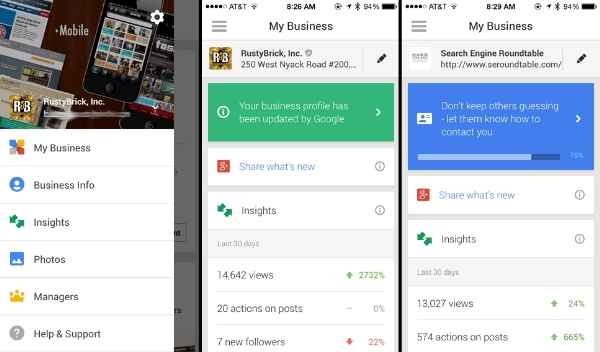
Google announced Google My Business earlier this month, and on Wednesday the official apps for the service came out on both Android and Apple smartphones. The apps offer a unified interface that will make it easier to manage your brand’s online presence on the go. App features include:
Edit the business listing by changing hours, description, etc.
View managers of the page but not manage them
Post to Google+
Add photos and update cover and profile photos
View local insights and analytics
Change business pages and accounts
Watch Now Now Influences Facebook News Feed Video Rankings
Facebook is constantly working on its News Feed algorithm and the latest update is intended to improve the quality of videos being served to users. The new video ranking takes note of how long users watch a video for and uses this information to influence content ranking. This metric will be combined with other long-standing metrics such as likes, comments, and shares.
In the announcement, Facebook said, “In our early tests, this improvement resulted in more people watching more videos that are relevant to them.” The announcement also noted that twice as many people watch videos on Facebook compared to the numbers from six months ago.
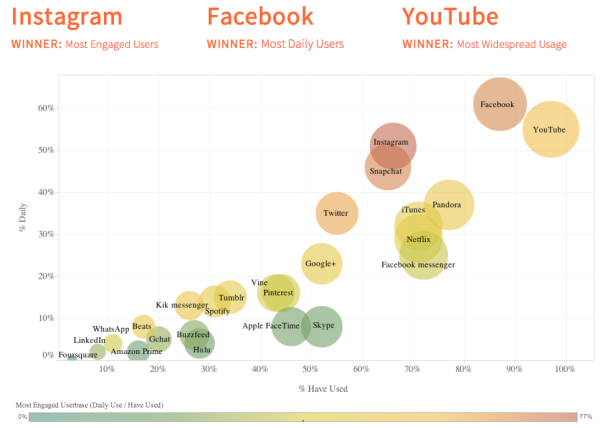
Wait, So Facebook is Still Popular With Teens?
You’ve undoubtedly heard the rumors, studies, and proclamations that Facebook is losing traction with teens like a car driving off a cliff. From what everyone wants to believe, all the young kids are moving to the burgeoning messaging apps to escape the prying eyes of their parents and lame extended family. Even President Obama has commented that kids “don’t use Facebook anymore.”
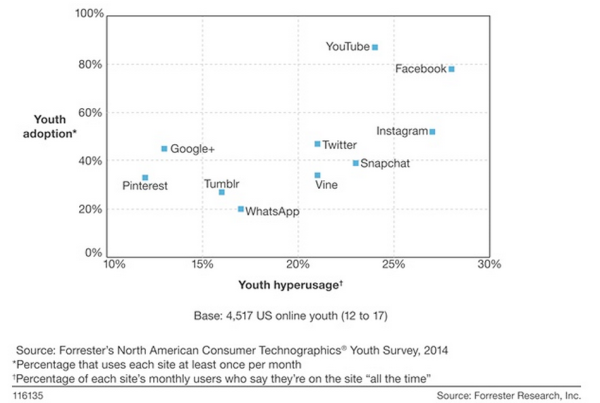
The problem with all this is, the numbers don’t entirely support that conclusion and two reports from the past week confirm that Facebook is still the most popular social site for the demographic by far.
First, Forrester Research released a report showing that more than 75% of US online youth use Facebook at least once a month. Their survey polled 4,517 internet users between the ages of 12 and 17, and that Facebook has twice as many users as Pinterest, Tumblr, Snapchat, and more than Instagram and WhatsApp combined.
The second study, from college and K-12 education review site, Niche, found similar results from a survey of 7,000 teenage users. Specifically, 87% still use Facebook “occasionally” and 61% use it daily (including the 47% who use it “a few times a day.)
00Taylor Ballhttps://www.tulsamarketingonline.com/wp-content/uploads/2018/07/TMO-Logo.pngTaylor Ball2014-06-27 12:23:202014-06-27 12:23:20Quick SEM News of the Week – June 27, 2014