Social media has undeniably become one of the strongest channels businesses can use to reach out and engage with their audience. But making social media work for you means knowing which platform works best for your business.
You might think that all social media sites are essentially the same, but making that mistake can mean squandering marketing and ad budgets trying to connect with an audience that just plain isn’t interested.
The truth is every social media platform has a unique audience who interact with each other in ways specifically molded by the site they frequent. Trying to talk to Twitter users the same way you talk to Facebook users will make your message fall flat, while Instagram, Pinterest, and Snapchat users all have their own cultures built from the platform.
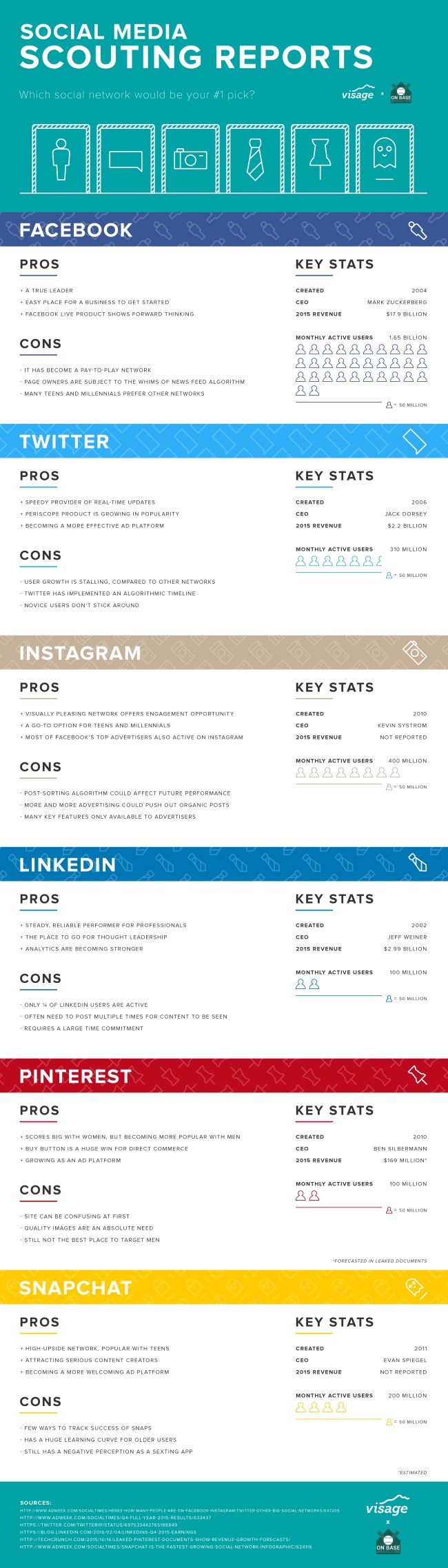
So which is right for you? It all depends on your business, your values, and who your audience is. The infographic below from Visage will walk you through the basic pros and cons of each of the most popular social media sites, along with some key stats about each social network.
Identifying the best social network for you will help you get the most out of your marketing efforts and find the most responsive audience for your brand.
00Taylor Ballhttps://www.tulsamarketingonline.com/wp-content/uploads/2018/07/TMO-Logo.pngTaylor Ball2016-05-06 14:57:042016-05-06 14:57:04What Social Network Is Right For Your Business? [Infographic]
Roughly a month after Google announced it would be completely shutting down the Google PageRank Toolbar, the service finally went dark over the weekend.
Now, those who have the PageRank toolbar installed will not be able to see the 1-to-10 rankings of sites they visit, making the toolbar officially useless. The move also cuts data from any third-party toolbar that tries to retrieve a PageRank score.
Of course, if you’ve been using the PageRank toolbar recently, you have been working from outdated data. Google hasn’t updated the public PageRank scores in years, so it makes sense to finally shut it down for good.
It must be noted that PageRank isn’t completely gone. It just isn’t available to the public anymore. Google will keep using the PageRank algorithm internally to help evaluate websites.
00Taylor Ballhttps://www.tulsamarketingonline.com/wp-content/uploads/2018/07/TMO-Logo.pngTaylor Ball2016-04-19 11:40:092016-04-19 11:40:09Raise a Glass, Google’s PageRank Toolbar is Finally Gone For Good
Google Analytics is an essential tool for making sure your website is performing as you would like and making improvements to keep growing, whether you are a high-level marketer or a business owner who just launched their site.
If you aren’t familiar with Analytics, however, or the technical jargon that fills your reports, it can be difficult to make sense of the huge amount of information available. That can make it hard for someone new to running a website for their business to make sense of the huge amount of information available in Google Analytics.
Thankfully, you don’t have to depend on analysts, marketers, or your company’s “computer guy”, to understand how your site is performing with Google Analytics. Search Engine Watch has put together an easy-to-understand glossary for all the jargon and confusing labels that you will come across, making it simple for you to know exactly what your reports are saying about your site.
00Taylor Ballhttps://www.tulsamarketingonline.com/wp-content/uploads/2018/07/TMO-Logo.pngTaylor Ball2016-04-14 11:39:382016-04-14 11:39:38Learn The Language of Google Analytics With This Handy Guide
Yesterday, we reported that a significant number of websites had been hit with Google penalties over the weekend for “unnatural outbound links.” Since then, Google has clarified that the manual penalties issued this weekend were specifically related to bloggers giving links to websites in exchange for free products or services.
Google had issued a warning a few weeks ago urging bloggers to disclose free product reviews and nofollow links in their blog posts related to these products. Now, they’ve taken action against sites who ignored the warning.
In the warning, Google told bloggers to “nofollow the link, if you decide to link to the company’s site, the company’s social media accounts, an online merchant’s page that sells the product, a review service’s page featuring reviews of the product or the company’s mobile app in an app store.”
In particular, if a post was made because of a free product (or free service, or just paid, etc.), then any links placed there because of that need to have a rel=nofollow attached to them. This includes links to the product itself, any sales pages (such as on Amazon), affiliate links, social media profiles, etc. that are associated with that post. Additionally, I imagine your readers would also appreciate it if those posts were labeled appropriately. It’s fine to keep these kinds of posts up, sometimes there’s a lot of useful information in them! However, the links in those posts specifically need to be modified so that they don’t pass PageRank (by using the rel=nofollow).
Once these links are cleaned up appropriately, feel free to submit a reconsideration request, so that the webspam team can double-check and remove the manual action.
If you are a blogger or company who has participated in an agreement to give free products to reviews, be sure to check your Google Search Console messages to see if you’ve been hit by the latest round of manual penalties.
Over the weekend, Google sent out a new wave of penalties, this time smacking down sites for “unnatural outbound links.” The majority of websites are safe from the latest round of manual penalties, but you may be in trouble if you’ve been attempting to manipulate the Google search results.
As Barry Schwartz has noted, this specific penalty appears to be taking the shape of Google deciding not to trust any links on the entire site.
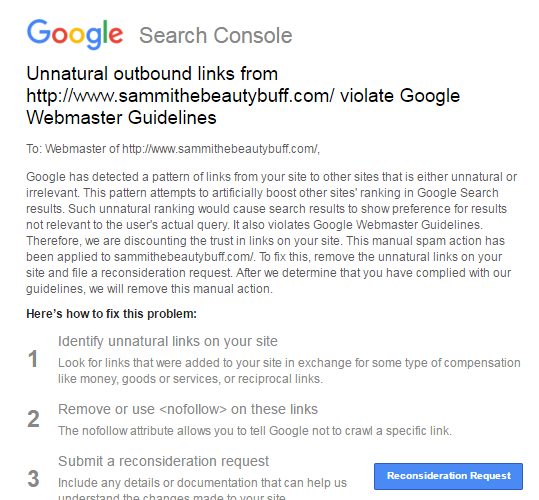
Webmasters who received these penalties were sent emails which read:
If you see this message on the Manual Actions page, it means that Google has detected a pattern of unnatural artificial, deceptive, or manipulative outbound links. Buying links or participating in link schemes in order to manipulate PageRank is a violation of Google’s Webmaster Guidelines.
As a result, Google has applied a manual spam action to the affected portions of your site. Actions that affect your whole site are listed under Site-wide matches. Actions that affect only part of your site and/or some incoming links to your site are listed under Partial matches.
Below, you can also see a copy of the message webmasters are receiving in Google Search Console about these penalties:
To make sure your site is safe, be sure to log into your Google Search Console account and check your all messages box. If you see this notification about an outbound link penalty, you can find out how to fix it and submit a reconsideration request here.
In a move that should please many online businesses, Google is making it easier to leave reviews on the platform. Finally, users can leave reviews without a Google+ account.
To clarify, while you don’t need a Google+ account, you do still need a regular old Google account. The change was first spotted by Conrad O’Connell from Serptests.com.
The difference seems small, but in this case, semantics is everything. By not requiring a Google+ account, Google is opening the door to a considerable number of reviews. Considering review counts and overall rating are top ranking signals for local search, this also means it will be easier to improve your local rankings with reviews.
This doesn’t mean you will have to do with an enormous amount of anonymous or troll reviews either. The first and last name of the reviewer will still be shown, so you shouldn’t have to worry about being flooded with one-star reviews by nameless accounts.
At the same time, Google also fixed a well-known bug which would keep reviews from being submitted from a mobile device for businesses without another pre-existing review.
Reputation is everything for local businesses, and these changes make it easier than ever for your customers to spread the gospel of your quality service or products.
00Taylor Ballhttps://www.tulsamarketingonline.com/wp-content/uploads/2018/07/TMO-Logo.pngTaylor Ball2016-04-05 13:59:472016-04-05 13:59:47Google+ Accounts Are No Longer Needed To Leave Reviews On Google
Want to know what everyone will be searching for this spring ahead of time? Yahoo claims to have the answers in their newly revealed list of top search trends for this spring. Using search data from last year and recent months, Yahoo uncovered the top trends in search to keep an eye on this season.
These are the top search trends for spring 2016, according to Yahoo:
DIY: Spring is the season of house improvement projects, which means people are searching for “how to” tips for their new venture. January, March, and April are the peak months for “how to build” searches, especially in the Southeast. In particular, Yahoo says sheds, tree houses, decks, and raised garden beds are especially popular this year.
Painting: Along with DIY projects, searches for phrases like “what paint colors go with…” are going up. Putting a new paint of coat on living rooms and kitchens are the most popular projects for many searchers this year, according to Yahoo.
Organization: As people are making the switch from their winter clothes to their warm-weather wardrobe, there’s going to be a big increase searches for closet organization.
Outdoors: Searchers are also getting ready for the warm weather by searching for outdoor equipment and furniture like patio furniture, outdoor furniture, lawn mowers, and spring sets.
BBQs: Unsurprisingly, searches for “grills” go way, way up from March to May.
Chairs: Adirondack chairs are a big item this year, looking to peak in April. Interestingly, Yahoo says people searching for this style of chair are also 98% more likely to drive a luxury SUV.
Allergies: Allergy season is just getting started, but clearly people are already ready for it to be over. From February to June there is a large increase in searches asking “when do seasonal allergies end.”
Taxes: Up until Tax Day, this is going to be a popular topic for searchers every year. However, this year has some noteworthy changes from the past. Over a quarter of searches for “tax prep” are expected to come from mobile devices, and those looking for tax prep advice are skewing younger than 35 years-old with an annual income below $75k.
Yahoo is offering this information to help search marketers and seasonal businesses refine their content strategies and get ahead of the trends this year. If you act now, you can take advantage of the insight to make yourself the first choice as this year’s hot searches heat up.
00Taylor Ballhttps://www.tulsamarketingonline.com/wp-content/uploads/2018/07/TMO-Logo.pngTaylor Ball2016-03-25 11:44:032016-03-25 11:44:03Yahoo Predicts The Hottest Search Trends For Spring 2016
Google has always kept it search engine ranking algorithm a closely guarded secret, but it is finally letting webmasters and online marketers in on the three most important factors for ranking well. Google has confirmed the top three ranking factors are links, content, and RankBrain.
The news isn’t much of a surprise. Links have long been one of the most important signals for websites, and content has become an essential cornerstone of SEO in recent years.
Google said RankBrain was the third most important ranking signal last year, but its inclusion is still a little puzzling. RankBrain is technically a part of the Google algorithm, but it is hard to call it a search signal so much as an artificial intelligence system which informs Google’s main search algorithm.
Andrey Lipattsev, a Search Quality Senior Strategist at Google, confirmed the top two are links and content during a Google hangout yesterday. Lipattsev was asked what the top search signals are, to which he told SEOs:
I can tell you what they are. It is content and links pointing to your site.
Of course, there are over 200 search signals and Lipattsev suggested “there is no order” to the most important search signals, so don’t expect a complete ordered list of search factors anytime soon.
You can see the video of the Google hangout below, with Lipattsev responding to the question around the 30:20 point.
00Taylor Ballhttps://www.tulsamarketingonline.com/wp-content/uploads/2018/07/TMO-Logo.pngTaylor Ball2016-03-24 16:21:162016-03-24 16:21:16Google Finally Tells Us The Three Most Important Ranking Factors
Google Analytics is an essential tool for webmasters and marketers looking to take control of their marketing efforts and increase both revenue and engagement. Now, Google is taking the platform even further with the introduction of the new enterprise-oriented measurement platform, Google Analytics 360 Suite.
In an announcement posted this week on the blog Inside Adwords, Vice President of Analytics, Display, and Video Products Paul Muret said:
“Sophisticated marketers who use analytics platforms are 3X more likely to outperform their peers in achieving revenue goals. It’s no wonder enterprise-class marketers have been telling us they need more from their marketing analytics tools. Many toolsets can’t cope: They’re too hard to use, lack sufficient collaboration capabilities, are poorly integrated, and require hard to find expertise.”
Muret also told Marketing Land that marketers are “trying to engage with brief moments of engagement” referring to so-called micro-moments. “If the value is not delivered” within the brief window of time, “consumers will quickly move on.”
The new platform is intended to deliver an enterprise-oriented analytics service that is both comprehensive and easy-to-use while focusing in on those brief moments of engagement and opportunity.
Google has remained mum on if there are any new data sources feeding into the Suite, and cross-device tracking remains the same. Rather, Google Analytics 360 Suite is intended to expand upon Google Analytics Premium, its previous enterprise-oriented analytics platform.
The suite includes four new tools, as well as two old mainstays:
Google Audience Center 360 (beta). This powerful data management platform (DMP) helps marketers understand their customers and find more like them across channels, devices, and campaigns. It offers native integration with Google and DoubleClick, plus it’s open to third-party data providers, DSPs and more.
Google Optimize 360 (beta). This website testing and personalization product helps marketers deliver better experiences. Marketers can show consumers multiple variations of their site and then choose the version that works best for each audience.
Google Data Studio 360 (beta). A new data analysis and visualization product that integrates data across all suite products and other data sources ― turning it into beautiful, interactive reports and dashboards. Built-in real-time collaboration and sharing is based on Google Docs technology.
Google Tag Manager 360. Built from our industry-leading tag management product, it empowers enterprise marketers to move faster and make decisions with confidence. It offers a simplified way to gather site information (all those tiny bits of code) and powerful APIs to increase data accuracy and streamline workflows.
Google Analytics 360, formerly known as GA Premium, will roll out exciting new capabilities throughout the next couple of months as investments continue to grow. It will serve as the measurement centerpiece by analyzing customer data from all touch-points and integrating with our ad products to drive marketing effectiveness.
Google Attribution 360, formerly known as Adometry, has been rebuilt from the ground up to help advertisers value marketing investments and allocate budgets with confidence. Marketers can analyze performance across all channels, devices, and systems to achieve their most effective marketing mix.
All these tools are available on the dashboard, and Google has said the platform also includes a broad set of integrated third-party providers, such as customer relationship management platforms.
The individual products will be offered à la carte, under to-be-announced pricing. Google Analytics Premium and Adometry will be relaunched under the Google Analytics 360 Suite platform “in the coming months.” Google Analytics Premium and Adometry customers will also be offered access to the new tools in a limited beta test in the future.
00Taylor Ballhttps://www.tulsamarketingonline.com/wp-content/uploads/2018/07/TMO-Logo.pngTaylor Ball2016-03-17 11:39:122016-03-17 11:39:12Google Announces Google Analytics 360 Suite
Despite once being the gold standard for assessing a site’s authority and optimization, Google announced this week it will be shutting down PageRank and all toolbars featuring the tool will no longer show a PageRank score.
The algorithm-based tool would assess web pages and rank them on a scale of one to ten based on numerous signals that Google uses to evaluate pages. It was an easy-to-understand way to quickly “score” a website and know if optimization, link building, or other marketing efforts were having a positive effect. However, the tool has not been updated in years.
Many webmasters have been holding onto hope that PageRank would get an algorithm update, but the company has been slowly moving away from it for some time. PageRank scores were never displayed inside Google Chrome, and the scored were dropped from Google Search Console in 2009. The Google Open Directory website, which showed PageRank metrics, was also shut down in 2010.
The last bastion of the PageRank score was the IE Google toolbar, which continued to show scores up until now.
Google has confirmed it will not be updating the tool for the public, but it will continue to be used by Google internally.
The move signals a big shift away from Google’s old way of doing things, but in practical terms it will change very little. Since PageRank hadn’t been updated since 2013, SEOs and webmasters have learned to rely on other tools and methods of assessing their marketing efforts.
00Taylor Ballhttps://www.tulsamarketingonline.com/wp-content/uploads/2018/07/TMO-Logo.pngTaylor Ball2016-03-10 16:04:422016-03-10 16:04:42Say Goodbye To Google PageRank