GoogleAdWords

Online shopping isn’t always a static process. Shoppers often hop from device to device freely as they browse and ultimately purchase. In fact, Google says 61% of internet users and over 80% of online millennials begin shopping on one device but finish their transaction from another.

To help you better keep track of these customers as they progress throughout your sales process, Google is making cross-device conversions more prominent in their online reports.

Introduced three years ago, cross-device conversions is finally becoming a default feature included in the Conversions column. According to Google, this will help businesses get the most complete view of their conversions possible and improve your ability to measure the full value of mobile ads.

Google also says that advertisers who have already gotten access to automatic cross-device conversion tracking have generated an average of 16% more conversions overall.

Beginning on August 16th, Google will make cross-device conversion a default feature listed in conversion reports.

As a business advertising on Google, this means you’ll gain easier access to information about how your ads are performing across all devices. That means you’ll be able to quickly see whether your mobile or desktop ads are failing to perform. You can also see what devices your customers are most likely to use throughout the sales process and better cater your ads and sales process to their needs.

shopping-carts

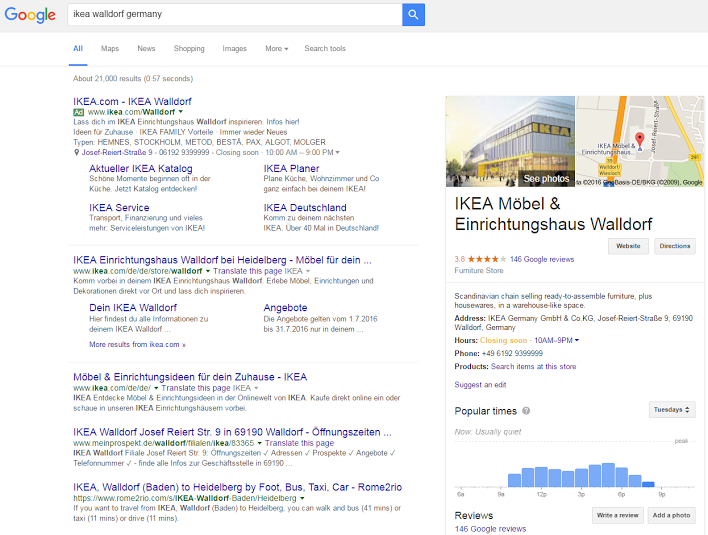
Google is rolling out a new update to its Local Inventory Ads that let allows searchers to browse in-stock products when they search for a business. That means if a users searchers for your business, they could browse your inventory straight from Google.

So far, the new features are limited to a small number of retailers, such as Macy’s and Ikea. However, it is expected to continue spreading to businesses of all sizes in the coming months.

The update is not a surprise, as Google announced the expanded features utilizing their its Knowledge Graph and Google Maps back in May. However, it was first spotted this week by Nicolai Helling who captured a few screenshots of what it looks like out in the wild.

shopping-google-my-business-web-EN

With the new features, you’ll see a new line in the Knowledge Panel underneath your NAP (name, address, phone number) information which says: “Search items at this store”. You can also find this in Google Maps underneath the store’s hours.

If a user clicks on this, they’ll be taken to a page hosted by Google where you can refine exactly what item you are looking for. If they select a specific product, they will then be directed to a dedicated page product information as well as information about where to purchase the product online or in store.

To use the feature as it rolls out, you will need to be signed up for Google’s Local Inventory Ads program and be running ads with your products and inventory information.

HTTPS

It has now been two years since Google announced it would be making HTTPS a minor ranking signal, and a recent study from Moz shows just how many sites have made the switch since then.

After Google’s announcement, there was an initial surge in sites changing from HTTP to HTTPS, but many held back to assess just how important the security protocol was to the search engine and ultimately decided it wasn’t worth the risk. Google only considers HTTPS a minor factor in their ranking algorithm and there has been concern about potential risks when making the switch.

To check up how far along the transition is, Dr. Pete Meyer from Moz compiled data to see just how close is Google is to changing the web over to HTTPS.

Before Google started including HTTPS in its algorithm, Meyer says only around 7% of all pages featured on the first page of Google search results used the more secure protocol. A week after the switch that number had climbed to 8%. Since then, the number has steadily been rising, reaching over 30% this year.

Moz reports that “as of late June, our tracking data shows that 32.5% (almost one-third of page-1 Google results now use the “https:” protocol.”

However, Meyer says he is not convinced everyone that has made the switch was motivated by algorithms and ranking signals. Instead, he believes it is a sign that Google’s PR campaign to make HTTPS more attractive and desirable for sites is working.

Meyer also says that in another 1 to 1.5 years we are likely to see 50% of the sites shown on the first page of search results to use HTTPS, which he predicts will lead Google to strengthen the ranking signal.

Ultimately, many are still hesitant about changing their entire site’s HTML structure to HTTPS and the risks that come along with site-wide changes like this. However, Dr. Meyers says it is wise to keep an eye on how many sites in your industry are using the protocol and to be watchful for any upcoming algorithm updates that may make HTTPS even more prominent in search results.

AdWords In Store Visits

It is no secret that many consumers often get annoyed with ads. Either they get worn down by sites that go overboard with ads littered across their pages or they just get tired of seeing ads that aren’t relevant or interesting to them. Thankfully, Google has found a way to give users the power to only see the ads they want.

Google is sending out notifications to users through Chrome and Gmail alerting them to a new web portal which puts the power to control ads into the users’ hands – among many other things.

The opt-in service allows you to voluntarily give Google a small number of personal details and surveys your interests to better target ads that are actually useful to users.

The feature is a part of Google’s new portal called ‘My Activity’, which displays all your activity across Google and Google devices in reverse chronological format including your past searches, visited websites, Map searches, and ads you’ve interacted with.

Obviously this might make many people nervous to see all the information Google can collect and store about their activity, but the portal also gives you the power to delete any information you don’t want to be there.

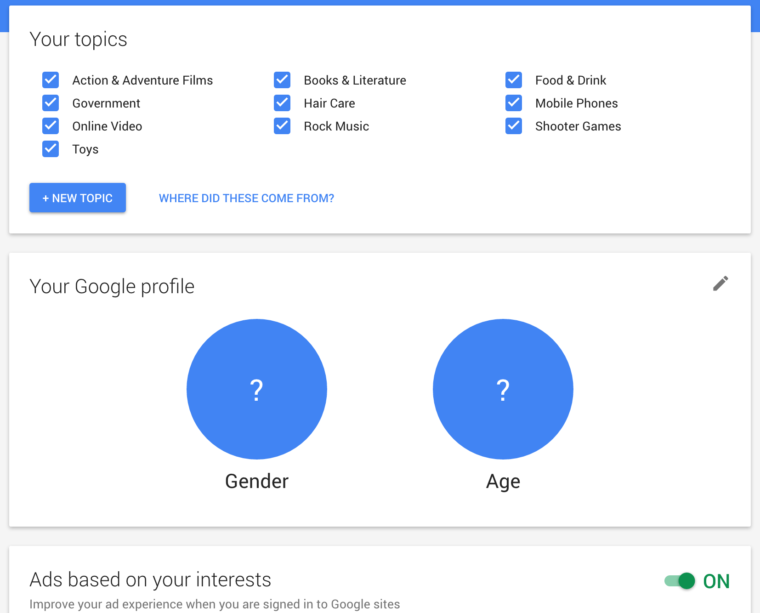
The ability to control the ads you see is specifically in a section of the portal called Ads Personalization. Here you will find checkboxes on topics you want to see ads on, along with sections to provide your age and gender.

Screen-Shot-2016-06-29-at-8.52.37-AM-760x613

If you turn on the feature, Google will use this information to serve you ads based on your previous search history, recently watched videos on YouTube, and other information you provide. Conversely, by opting in you are agreeing to provide Google with information about ads you have interacted with.

Users who don’t opt-in will be shown ads based on other more general information such as location data.

Google is far from the first company to use user data to target ads towards users. In fact, they’ve been doing this for years. However, this is possibly the first time a company has so transparently allowed users to control what information is being collected and how it is being used to serve them ads.

GoogleAdWords

As more people are searching for businesses from a variety of devices like smartphones and tablets, it is important that businesses provide a diverse number of ways to get in touch. Now Google is testing a new AdWords extension that will allow users to contact advertisers in an entirely new way.

In the past, Google has used ad extensions to make it easy for searchers to call businesses they were interested in. With the latest ad format, you can now text or SMS advertisers directly from their ad.

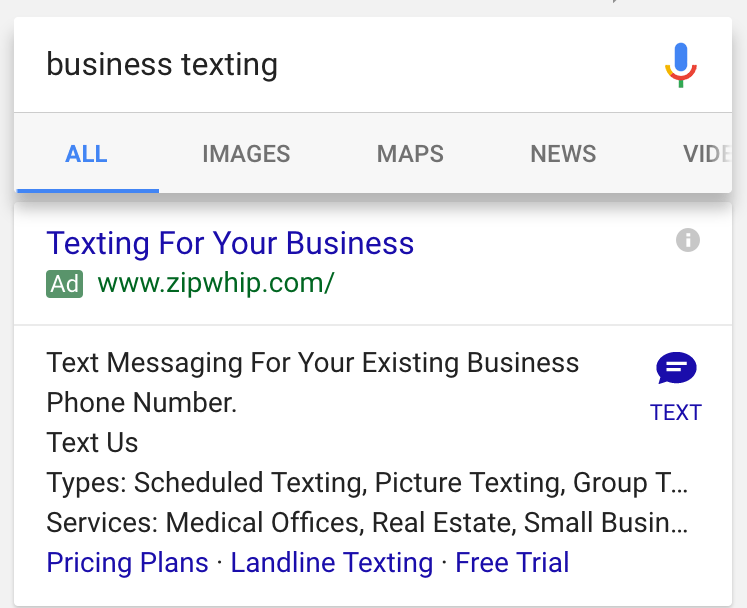
Here is an example of how the ad format looks:

TextAdExtension

By clicking the text icon, you will be taken to your default messaging app, where a prefilled text message is started with the advertiser’s information. For example, if you click the icon in the results above, the pre-filled text message reads, “[Zipwip] I’m interested to learn more about Zipwhip.”

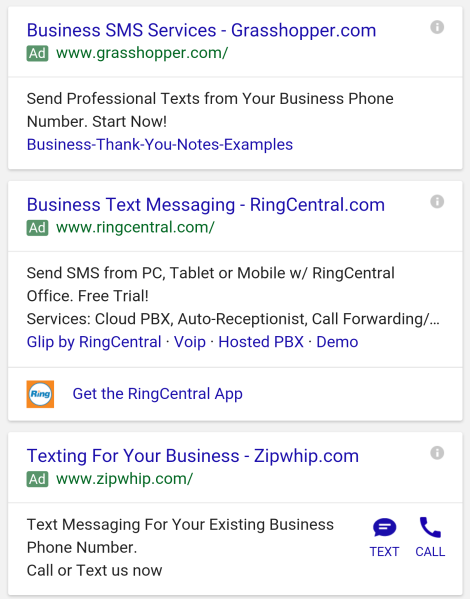
Judging by other results like the one below, the text ad extension can be combined with ad call buttons to provide a variety of ways to contact your business.

TextAdExtension2

Barry Schwarz was the first to report this new ad format. When he reached out to Google for more information, he was provided with this statement:

We’re always experimenting with new ways to connect our advertisers to customers but don’t have further details to share at this time.

Keeping a clean and orderly URL structure for your site can be more than just a helpful way of keeping your pages organized. SEO-friendly URL structure can also make your site easier for search engines to index and modestly improve how Google and Bing rank your site.

Unfortunately, establishing the absolute best URL structure can be a bit confusing. Some would have you believe it is more art than magic, while others would argue “everybody is doing it wrong”.

John E. Lincoln from Ignite Visibility and Brian Dean from Backlinko set out to clear up the confusion with a handy infographic that explains the best practices for keeping your URLs easy to index and easy for users to sort through, including the most common questions like URL length and keyword usage.

See the infographic below or at Search Engine Land.

SEOFriendlyURL

Google Logo

While loading speed is a crucial issue for most mobile internet users, Google’s “Mobile-Friendly Algorithm” isn’t currently using it as a ranking factor for mobile pages. However, that is likely to change when Google releases their next mobile-friendly update.

According to reports from the recent Search Marketing Summit in Sydney this week, Google Webmaster Trends Analyst Gary Illyes confirmed Google would be including page speed as a factor in the next mobile update. But, it may be months until that update arrives.

The inclusion of page speed seems like common sense. The majority of mobile users are likely to leave a page if it doesn’t load within five seconds, and some are even more impatient. From Google’s perspective, including page speed as a factor means they are more likely to help users find a site they will be happy with on the first click as often as possible.

It also makes sense considering Google introduced their version of Accelerated Mobile Pages recently.

Want to know how your site stacks up in terms of page speed or other mobile friendly factors? Google has also released updated versions of their mobile-friendliness and page speed tests for both desktop and mobile in one place.

The new tool, available here, combines all the free site evaluation tools Google offers in one easy-to-read report. You can also get a more extensive report emailed to you for deeper analysis.

google-animation-01-2016

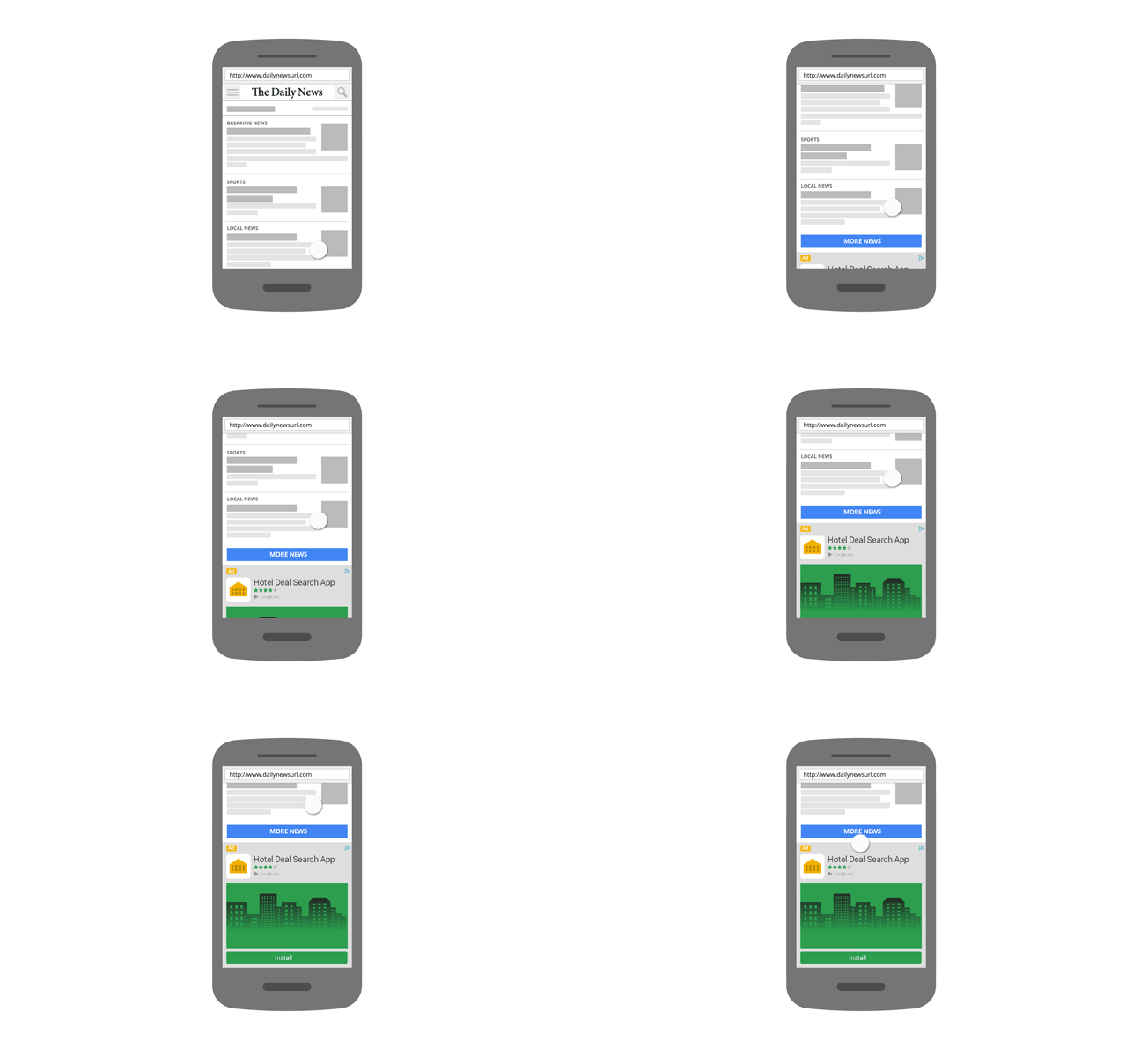
If you own a smartphone, chances are you know the frustration of accidentally tapping on an ad you had no interest in when you were trying to scroll down a page. These accidental taps aren’t just annoying to users, either. Advertisers hate these mobile clicks because they wind up paying for clicks from users who had no intention of converting.

Now, Google is stepping in to improve their mobile ad performance and user experience by altering how their ads operate on mobile devices.

Of course, Google has been trying to fight back against accidental mobile clicks for a considerable time now, but its recent announcement extends their initiative to its native ad formats. Before, their efforts were limited to just search and display ads. The search giant says they are stepping up their efforts because accidental clicks and taps are bad for everyone. Beyond simply being an inconvenience for advertisers and users, Google says accidental taps also drive down the value of ads.

“When we look at the effect for advertisers in mobile apps, we observe double the value per click,” Google said in a blog post. “We work hard to ensure that the clicks advertisers are charged for are more meaningful, and we hope sharing insight on these protections helps raise awareness and guide the wider advertising ecosystem.”

The changes being rolled out to native ads prevents accidental clicks in a few ways. First, Google ignores any clicks that are unusually fast, comparing itself to a professional baseball player having 680 milliseconds to tell whether they should swing at a pitch.

“That’s fast, even for a professional who’s paying close attention to hitting the ball,” Google said. “We think it’s virtually impossible for someone to read, understand, and take action on an ad in that amount of time.”

Additionally, Google says it will ignore when a user likely accidentally taps on an ad by excluding clicks on the edge of an ad. According to the search engine, clicks on the middle of an ad are associated with “dramatically higher” conservation rates and show much higher intentionality than those on the edge of ads.

GoogleAdWords

When it comes to search results pages, everyone wants the top spot. That goes for advertisers as well. But, a new analysis from Adobe Media Optimizer suggests the first ad on the page might not always be the best for your dollar. In fact, the 4th position may produce the best results in some situations.

The only catch is that sometimes Google doesn’t display the fourth ad.

According to the findings published in Adobe’s April 2016 Advertising Report, cost per click (CPC) is down ever since Google removed ads from the right side of the page. Meanwhile, click-through rates (CTR) has gone up.

The Adobe Advertising Report reviews three months of aggregated anonymous data from search advertising customers. The company specifically says they hoped this particular assessment would help customers understand Google’s decision to cut ads from the right-hand rail of desktop search results in February of this year.

Overall, the analysis found the changes impact smaller advertisers more because these advertisers generally depend on lower volume keywords. Due to the removal of the right-rail ads, smaller advertisers are having to pay our more to reach the top spots. They are also seeing 10% fewer clicks for less expensive keywords that appear in the lower ad spots.

The results also show that costs per click have risen for the number 1 and 2 positions by 6% and 7% respectively. Meanwhile, costs for the 3rd and 4th positions dropped by 8% and 10% respectively, showing advertisers are placing more of an emphasis on reaching the top spots.

Despite this, the lower positions are actually producing better click-through rates. CTRs for the 4th position jumped by 18% while the rates for the 1st and 3rd position rose by 13% and 2% respectively. Rates for the 2nd position have remained the same.

When all this is taken together it shows that the lowest spots on the AdWords results may provide the best value for advertisers, especially small businesses who are advertising on the platform. The results also suggest customers are responding well to the removal of right sidebar ads and engaging in ads more overall.

googladextensions

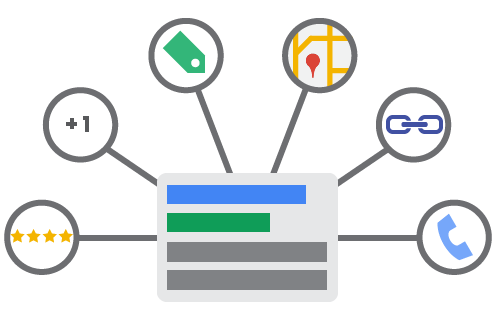
In the past, Google AdWords used a complex and confusing algorithm for deciding when to display ad extensions. Recently, the company changed this by introducing a new policy which adjusts the impact of ad formats in the ad rank formula and allows AdWords to provide an estimate of how visible an ad would be on search engine results pages (SERPs).

As of now, an ad’s visibility will depend on ad position and ad formats, meaning ads with higher positions in the SERPs will display more ad extensions than ads in lower positions. This is a shift away from past systems which allowed lower ranked ads to show more ad formats than those above them.

The term ‘ad formats’ refers specifically to visual extensions that appear on ads in search results that display extra information about a business, including phone numbers, addresses, consumer ratings, and more.

In a way, this change ads even more incentive for businesses to make sure they get the top rankings in search results pages, as they will be rewarded by having it be more likely their ad extensions are shown along with their ad. Those who are able to score the top spots will certainly be happy with the change, though, as it means they are less likely to be outshined by a lower ad on the page.