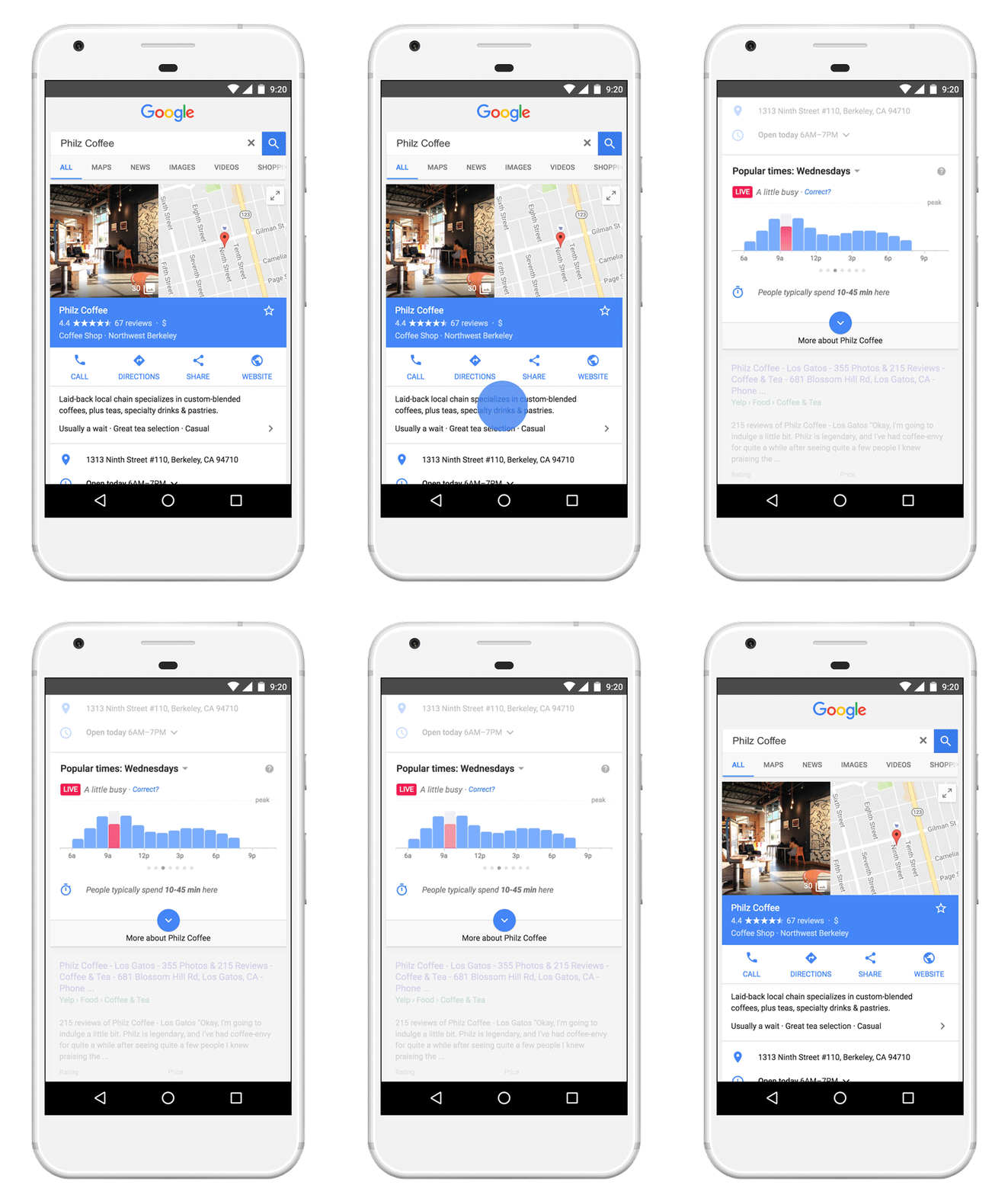
Last year, Google gave businesses the ability to list their busiest hours on Google Maps listings so that customers can better plan their shopping during the holiday season. Now, they are taking it a step further.
live-ptindevice-sf_hlgrny7

Instead of relying on businesses to update their Popular Times listings, Google Maps will use real-time data to predict just how busy a location is right now.

”Whether you’re rushing to pick up a last minute gift or seeking a lively bar for some festive spirit, check Popular Times for a sneak preview of what to expect when you arrive.”

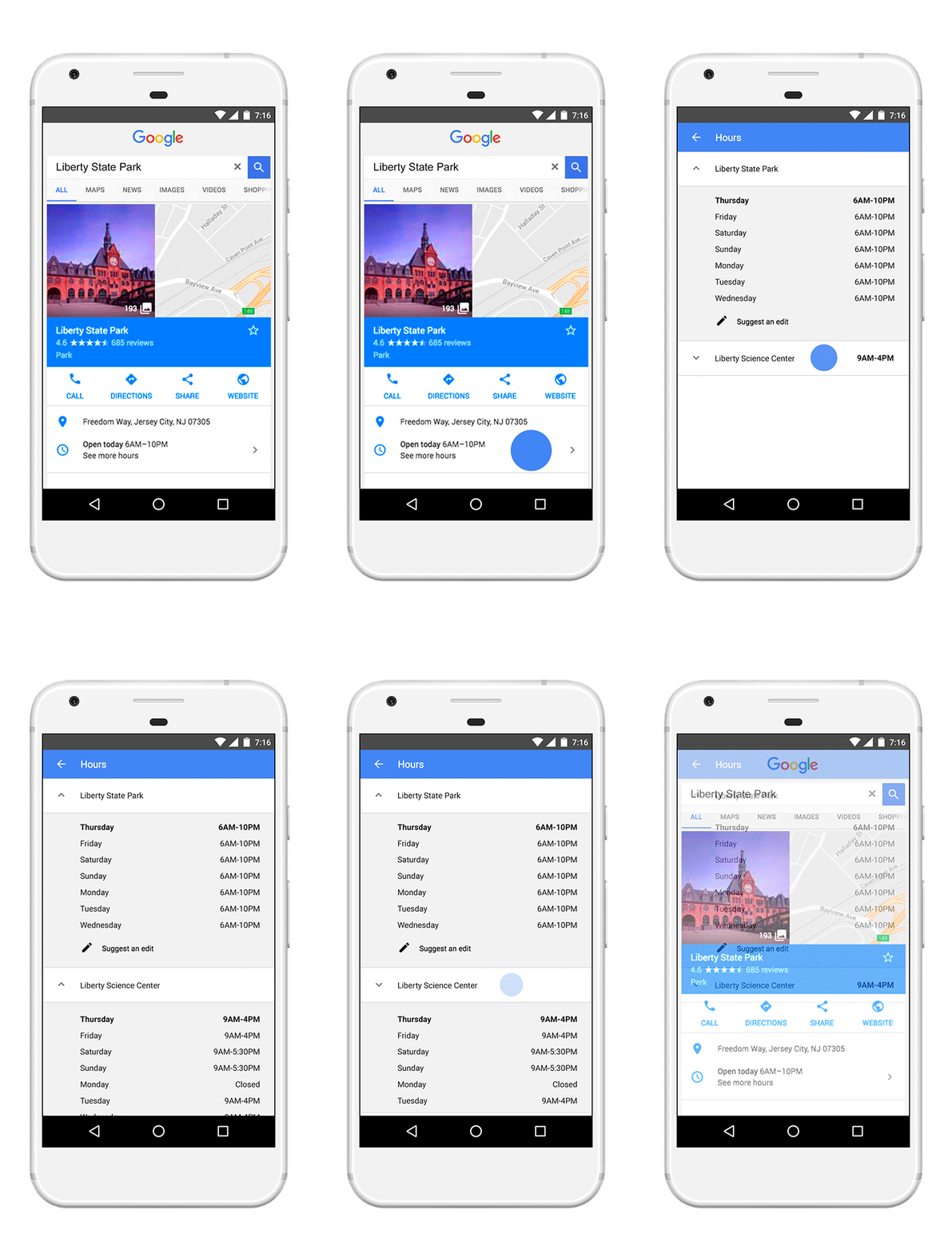
In addition to this new feature, Google is giving more flexibility to stores that operate separate departments with differing business hours. Businesses can now list separate departments and service hours in their Search and Maps listings.
servicehours-indevice-02

This new feature could be particularly useful for department stores or retail stores with pharmacy, supermarket, or automotive departments.

Google is also providing shoppers with shopping behavior data like how long people tend to spend in a store so they can make the most of their time during the holiday shopping season. Along with listing your business’s busiest hours, the search engine is also rolling out a feature that lets you tell shoppers how long the average person spends in your store.

All three new features rolled out this morning and should be live on Google Maps and Search for all users.
Google has already begun rolling out its mobile-first index to some users, but there are still a lot of questions about how exactly the search engine’s new separate index actually functions.

One such question got a surprising answer yesterday during the Google State of Search conference, as Maile Ohye told the audience that Google won’t index the AMP version of your page in the mobile search index – even when you don’t have a mobile-friendly alternative.

Google’s Gary Illyes also confirmed the news on Twitter after the conference:

That means if you’ve been using AMP pages as an alternative to making your website mobile-friendly, the search engine will skip over indexing your AMP pages in the mobile-friendly search index. Instead, it will by default choose to index the desktop version within its older index.

There is a way to force Google to index your AMP pages in this situation using a rel alternate attribute, but otherwise Google’s index will default to your desktop versions of pages.

This is particularly surprising because Google has pushed AMP as the ultimate way to deliver content to mobile users quickly and without losing ad revenue. But, in this case it seems the streamlined design of AMP pages leaves something to be desired. It may be the lack of site navigation options is what made Google decide to favor desktop over AMP in their index.

This change will most likely only affect a very small number of websites, but it is an odd choice for the search engine. The vast majority of websites who have adopted AMP also maintain a mobile version of their site.

GoogleAdWords

Google is giving AdWords’ price extensions a makeover this week to make prices even more prominent in search results, according to an announcement Monday.

Price extensions are one of Google’s many extended ad formats designed to highlight individual products and services and allow searchers to easily compare prices.

The extension was first released in July as a simple list, similar to how sitelinks are displayed. Now, Google has redesigned the extensions to appear in a card carousel near the top of search results. You can get a preview what these cards look like in the tweet AdWords released to announce the change:

The 10 languages included in the release are English, Dutch, French, German, Italian, Japanese, Polish, Portuguese, Russian, Spanish and Swedish.

While the new price extensions put the emphasis on cost, it is also useful for highlighting your brand, events, products, and related services. The ad format includes a header, description, and price.

Unlike some ad formats, price extension ads don’t direct users to a landing page. Instead, they serve as direct links to sales pages for the specific item highlighted.

The best part of this redesign is that price extension ads now take up even more valuable space at the top of search results, without costing any more than a typical ad. That means you get to make an even bigger splash without costing you anything extra.

As announced last month, Google is officially making its first step towards the launch of mobile-first indexing with the test of its mobile-first search index.

The company confirmed the testing has officially started via its company blog:

“Although our search index will continue to be a single index of websites and apps, our algorithms will eventually primarily use the mobile version of a site’s content to rank pages from that site, to understand structured data, and to show snippets from those pages in our results. Of course, while our index will be built from mobile documents, we’re going to continue to build a great search experience for all users, whether they come from mobile or desktop devices.”

This means in the future Google will increasingly prioritize crawling the mobile versions of a site’s content, rather than treating desktop as the “main” version of your site.

The company also gave some quick tips to help you make the most of this change as it is happening:

  • If you have a responsive site with identical content across mobile and desktop, you shouldn’t have to change anything.
  • If you have a site where the primary content and markup is not identical across mobile and desktop, you should consider making some changes to your site.
  • Make sure to serve structured markup for both the desktop and mobile version.
  • Google recommends using the Structured Data Testing Tool to verify the equivalence of structured markup across desktop and mobile by typing the URLs of both versions into the Structured Data Testing Tool and comparing the output.
  • When adding structured data to a mobile site, avoid adding large amounts of markup that isn’t relevant to the specific information content of each document.
  • Use the robots.txt testing tool to verify that your mobile version is accessible to Googlebot.
  • Sites do not have to make changes to their canonical links.
  • If you are a site owner who has only verified their desktop site in Search Console, please add and verify your mobile version.
  • If you only have a desktop site, Google will continue to index your desktop site just fine.
  • If you are building a mobile version of your site, do not launch it until it’s ready. Google says: “a functional desktop-oriented site can be better than a broken or incomplete mobile version of the site.”

google-mobile

Google is making a huge change to their search engine that could have huge implications for the future of search.

Until now, Google has maintained a single search index, which cataloged the entire web for Google’s algorithm to sort through. However, that will be changing soon as Google’s Gary Illyes announced the search engine would be releasing a separate mobile search index.

The new mobile index will become Google’s “primary” index that it uses to deliver the majority of search results. At the same time, the company will continue to maintain a separate desktop search index which will be slightly less up-to-date.

The announcement came last week during a keynote address at Pubcon from Gary Illyes, webmaster trend analyst with Google. While Illyes later confirmed to Search Engine Land the rollout of the new index would be coming within “months,” he was otherwise short on details of how the mobile index will work.

It is also unclear in which circumstances Google will use which search index or just how behind the desktop index is. What is clear is that Google sees mobile as the future of search despite still seeing significant desktop usage.

Most likely, the new index means Google will be switching from a system which selectively pulls information from the single index for mobile results to a new system which uses the separate index for queries coming from mobile devices.

More information is likely to come in the near future, but for now, all we know is Google is gearing up for big changes to further prioritize mobile searchers.

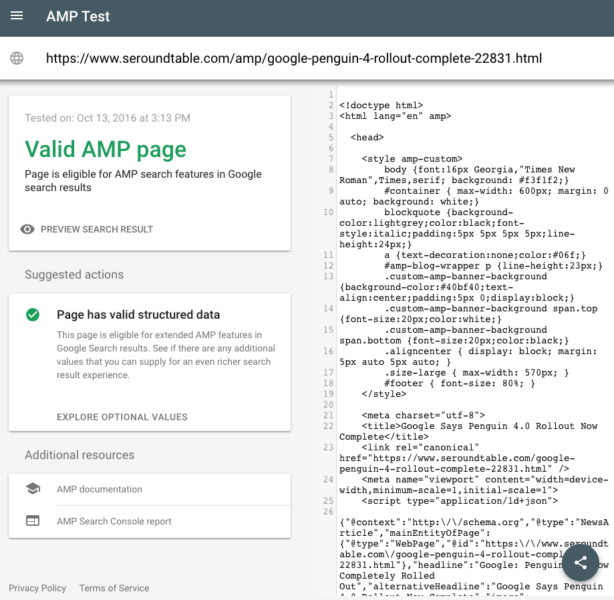
In the wake of the one-year anniversary of the release of AMP (accelerated mobile pages), Google has released a new testing tool to help content publishers ensure their AMP pages are properly set-up and displaying correctly.

The tool is directly available at https://search.google.com/search-console/amp and can be accessed through the Google Search Console.

The testing tool is designed to work on mobile devices and uses Google’s live web-search infrastructure” to assess any AMP page using real Googlebots to provide real-time evaluations.

Specifically, it checks the AMP markup and structured data on the page for issues, then highlights any part of the source-code that could be creating errors. You can then click on the issues for more details about the issue.

The testing tool also allows you to see a live preview of how the page may appear in Google’s search results.

Below you can see screenshots of the tool in action, taken by Barry Schwartz:

google-amp-testing-tool-614x600

google-amp-preview-tool

mobileonly

It is no secret that the majority of people online change devices several times a day, but new research from Google shows that a growing number of users are adopting a “mobile only” lifestyle.

The new “cross-device” research shows that while plenty of people still move from desktop to mobile to tablet as they need to throughout the day, but almost 40% of searchers have dropped desktop devices from their online search process entirely.

Google says the study is based on “behavioral measurement of a convenience sample of 11,964 opt-in Google users between January 1, 2016 and March 31, 2016,” and that the data was “calibrated to reflect a U.S. demographic of 18 to 49-year-old cross-device users.”

screen-shot-2016-10-06-at-2-43-45-pm-800x558

According to the findings, the average user spends 170 minutes on their smartphone every day, compared to 120 minutes on PC’s and approximately 75 minutes on tablets (that user owns a tablet). They most often use their smartphones at four physical locations:

  1. Home
  2. Work
  3. Stores
  4. Restaurants and Bars

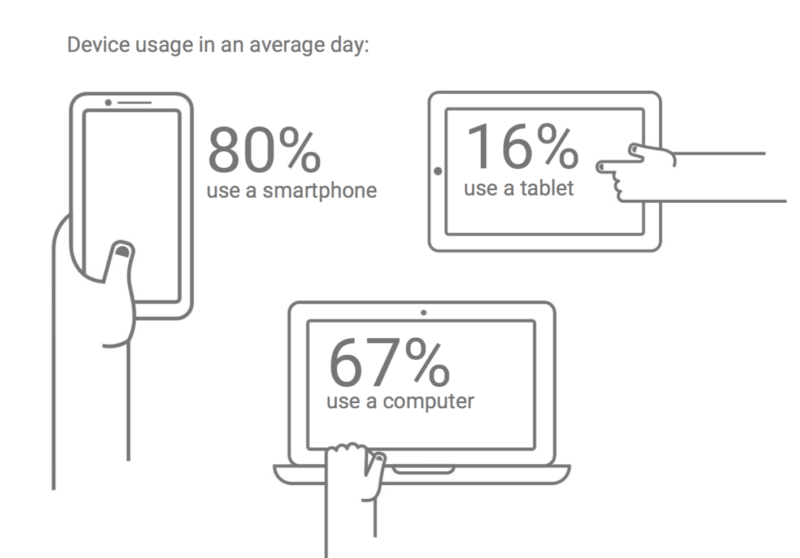
Every day, approximately 80% of users search the internet on their smartphones, while 67% use PC’s. Over half (57%) move between devices throughout the day and 21% are likely to use more than one device simultaneously.

But, perhaps the most surprising finding of the study is that approximately 39% of people who conduct searches on an average day use only smartphones, compared to 32% who search only on PC. When measuring all internet use, rather than just searches, 27% of users are smartphone-only.

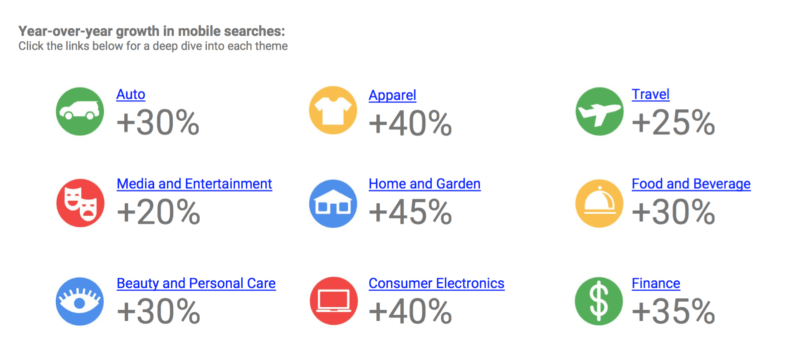
The report shows mobile usage varies by industry with year-over-year growth of mobile search for different markets.

screen-shot-2016-10-06-at-4-05-36-pm-800x353

If you want to find out more, check out the full report here.

Google is increasing its efforts to combat fraud on its search network with new verification processes aimed at weeding out scammers and con artists.

According to an email sent to several of Google’s biggest contributors, the company is testing an advanced verification process in San Diego aimed at stomping out a growing scheme in the locksmith and plumbing industries.

All locksmiths and plumbers currently verified on Google will have to go through the new verification process. If you don’t do so before November, Google will un-verify your listing and remove you from Google Maps.

New applicants hoping to be verified on Google will also have to go through the process, which Google promises is simple. Companies will go through a series of questions from Google and complete an application with a third-party verification company. In total, the entire process should take approximately two weeks to get verified.

You can find out more about the new advanced verification process being tested for locksmiths and plumbers around San Diego in the new Google My Business help article.

Now, you might be wondering why Google is targeting locksmiths and plumbers when there are so many fraudulent businesses online. This is because one of the quickest growing online scams is being conducted by people presenting themselves as locksmiths.

The scam goes like this:

  • A person is locked out of their home and turns to Google to look up local locksmiths
  • They are shown AdWords ads and Google My Business listings for businesses promising cheap and reliable services.
  • When they call one of these ads or listings, they are actually directed to an offshore call center who dispatches a local representative to your home.
  • The “locksmith” arrives and immediately chooses to drill open the lock, leaving the person with a huge bill.
  • Instead of a cheap service you are stuck with excessive costs and a busted lock.

The scam has gotten so prevalent it has even been detailed in the New York Times. A simple search for “locksmith scam” shows just how many people have already been affected by it. Similar scams have since started popping up in other home improvement sectors like plumbing and roofing, which is likely why the new process is extended to plumbers in San Diego as well.

Google is hoping the new verification process should weed out the fraudulent actors populating its search results. Currently, it is hard to predict just how effective it will be. But, if Google sees positive results you can expect to see the system roll-out to the rest of the country in the not-too-distant future.

Source: Robert Scoble / Flickr

Source: Robert Scoble / Flickr

Were you punished by Google’s Penguin algorithm? If you have, there is a good chance you’ve been waiting a year or longer to recover after taking all the necessary steps to have your site reconsidered.

Thankfully, as part of the latest update to Penguin, you won’t have to wait much longer to see if you’ve bounced back. Google’s Gary Illyes confirmed, via Twitter, that Penguin recoveries have already begun rolling out and will be finished within the coming days.

This means that sites that were penalized should start to show improvements within the next week. What it doesn’t mean, however, is that you can expect to return to your same former glory in the search engines.

Removing the penalty still leaves you without the bad links likely driving much of your high ranking, so you can’t expect them to help boost you back up to high spots in the search results. On the other hand, if you’ve taken the time while you’ve been penalized to build new, better links and further optimize your site, you may come out ahead once all the recoveries are finished rolling out.

Google’s Penguin algorithm has been a core part of the search engines efforts to fight spam and low-quality content for years, but it has always been its own thing. The algorithm ran separate from Google’s core algorithm and was refreshed periodically. But that is all changing.

Starting today, Penguin is running in real-time as part of Google’s primary algorithm in all languages.

What Does This Mean?

In the past, the Penguin algorithm has been relatively static. When it was updated or refreshed, it would dish out penalties and remove penalties from those who had gone successfully gone through the reconsideration process. The only problem was these updates were sporadic, at best. In fact, the last update was over 700 days ago.

By turning Penguin into a real-time part of its algorithm, Google is speeding up the entire system so penalties can be given when a site is flagged and those who have resolved their problems can lose their penalty more quickly.

According to Google, Penguin can now make changes in roughly the same period of time it takes the search engine to crawl and re-index a page.

What Else Is Changing?

While the speed of Penguin is the biggest change as it becomes part of the core algorithm, there are some other small tweaks to how it works.

Penguin is now more targeted, only penalizing specific pages with that break link guidelines. Google Penguin used to punish the entire site for containing pages containing spammy link building practices, but now it will only devalue the individual pages.

Google is also making some changes to how it talks about Penguin in the public. Or, as the company stated, “We’re not going to comment on future refreshes.”