Tag Archive for: YouTube

YouTube is giving creators a new tool that makes A/B testing titles for their videos easy. This means any creators with access to advanced features will be able to guarantee they are using the most engaging titles that drive the most clicks using real-world data.

YouTube announced that the feature, previously only available to a select number of channels, would be getting widely released in a video on its Creator Insider channel this week.

In the announcement, YouTube also took time to share more details about how their A/B testing works and address some questions from the community.

How It Works

The new A/B testing feature is available in YouTube’s “Test and Compare” section, alongside the tool that allows channels to test thumbnails. With the tool, you’ll be able to test up to three different titles on a single video.

Once selected, the tool will show users the video using one of the three titles and gather performance data across a period of up to two weeks. 

Once the test is complete, you will get a notification with the results. If one title drives significantly more engagement than the others, it will become the default choice for viewers. If not, YouTube will default to the first title you provided. 

Of course, creators can always choose to override the tool and select one specific title to display.

Why YouTube’s A/B Testing Prioritizes Watch Time

While the feature has largely been positively received, many have questioned why the A/B testing tool measures and optimizes titles based on watch time rather than click-through rate. 

The company addressed this in the announcement video: 

“We want to ensure that your A/B test experiment gets the highest viewer engagement, so we’re optimizing for overall watch time over other metrics like CTR. We believe that this metric will best inform our creators’ content strategy decisions and support their chances of success.”

Understanding A/B Test Results

When the test is complete, YouTube will deliver one of three results.r

If there is one title that clearly outperforms the others, it will be declared the “Winner”.

“Performed the same” means that all of your titles drove similar amounts of watch time. One may have slightly performed better, but not by a wide-enough margin for it to be statistically meaningful. 

In some cases, YouTube may declare the test “Inconclusive” if there were not enough impressions to deliver proper results within the time period.

For more, watch the full announcement from the Creator Insider channel below:
YouTube is making it easy to track mentions of your brand across its platform – including paid ads, collaborations, and organic content – all in one place. 

The new Brand Pulse report tracks brand mentions across the entirety of YouTube in real-time, giving you a full view of your brand’s presence on the platform. 

In the announcement, YouTube said this is the first time that brands can easily monitor their full presence on the platform without multiple tools or manual monitoring:

“Historically, brands have found it difficult to measure the full impact of their presence across organic touchpoints — such as their YouTube channel, user-generated content and creator collaborations — together with their paid advertising.

That’s why today we are introducing the new brand pulse report. The report provides a unified view of your brand’s presence across all of YouTube — paid and organic. You’ll be able to better measure where you’re driving impact across the platform and maximize your return on ad spend.”

What Gets Tracked

Using a new multimodal AI system, the Brand Pulse report tracks every brand mention across YouTube including logos, product shots, text mentions, and even quick name drops. 

The report also includes a number of metrics like “Total Unique Viewers” and “% Share of Watch Time” which give you a better understanding of your audience and contextualize your presence. 

Turning Data Into Actionable Steps

Brands can leverage the insights from the Brand Pulse report to boost popular organic videos with partnership ads and use the data to inform their own content, connect more authentically with their audience, and boost ROI.

The report is already available to some advertisers, and is expected to be widely available soon. 

For more, read the full announcement here.

Google is bringing its AI overviews to its sister platform, YouTube. 

In an announcement, the company said it was testing showing AI overviews similar to those already seen in Google search results. These overviews will choose the most relevant clips from videos it believes are relevant to a search.

How Will This Impact YouTube Click-Through Rates

Despite seemingly trying to avoid the issue during a recent earnings call, Google can’t hide that its AI overviews are reducing click-through rates in search results and sending less traffic to other websites. 

With this in mind, it is reasonable to be concerned that YouTube is similarly pulling users away from fully watching videos from creators in a way that may reduce viewership and revenue to content creators.

What To Expect From YouTube AI Overviews

For the current test, only a small group of U.S. YouTube premium features will be eligible to see AI overviews for English-language search results. 

When searching, these users will be shown a collection of relevant videos and highlighted clips that it believes are most relevant. The clips will be shown in a carousel within the search results, letting users quickly browse the selection. 

For now, YouTube is using AI overviews on two specific types of searches:

  • Product research (such as users looking for info about the best noise-cancelling headphones)
  • Travel and local discovery (for example, when users search for information about museums to visit in a specific city)

Throughout the test, YouTube says it will be collecting user feedback which it will use to determine whether to expand this feature to more users. 

For more, you can read the announcement for AI overviews on YouTube here.

A new nationwide survey conducted by the Pew Research Center shows that YouTube and Facebook may still be the most widely used social media platforms by adults, but TikTok is continuing to grow significantly.

Based on the survey results, YouTube and Facebook remain the most widely used social media platforms across the US. More than three-fourths of American adults (87%) reported using YouTube, with 68% saying they used Facebook.

Most other platforms have retained approximately the same level of usage from past surveys, with the largest (Instagram) seeing use from around 50% of adults.

TikTok, however, saw a jump from 21% of US adults using it in 2021 to 33% of adults in the latest survey.

Age Continues to Influence Social Media Use

Just as in past surveys, Pew found notable differences in social media use depending on age.
For example, adults under the age of 30 were significantly more likely to say they used Instagram, Snapchat, and TikTok compared to older adults.

YouTube and Facebook, however, were more likely to be used by adults of all ages – leading to their overall dominance. At the same time, Pew noted that both platforms were still more likely to be used by younger adults than older respondents.

Demographics Also Influenced Social Media Usage

  • Along with age, the Pew survey identified notable differences in the demographics that used each platform:
  • Instagram: More usage among Hispanic and Asian adults, women, and people with some college education.
  • TikTok: Increased usage rates among Hispanic adults and women.
  • LinkedIn: Most widely used among Americans with higher educational attainment.
  • Twitter (now “X”): More likely to be used by those with higher household incomes.
  • Pinterest: Still most popular among women.
  • WhatsApp: Receives more usage by Hispanic and Asian adults.

Why It Matters

As a business, you must know where to reach your audience where they are already spending time. When scrolling social media, adults tend to be more likely to engage with branded content, connect with unfamiliar brands, and discover products that they will later purchase. By making sure you’re there when your ideal audience logs on, you can give yourself the best chance to turn strangers into followers and followers into customers.

For more insights you can use to target your audience on social media, check out the full Pew report here.

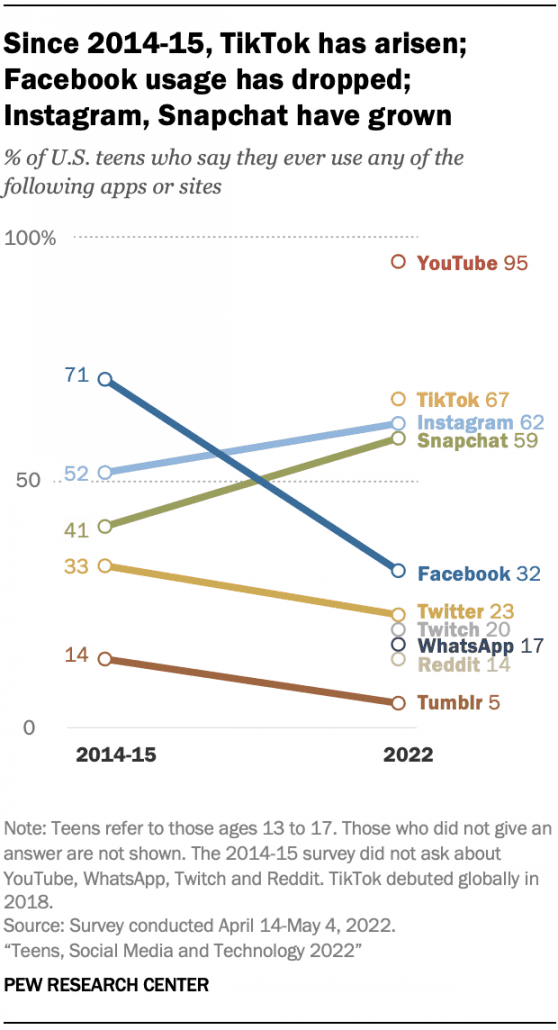
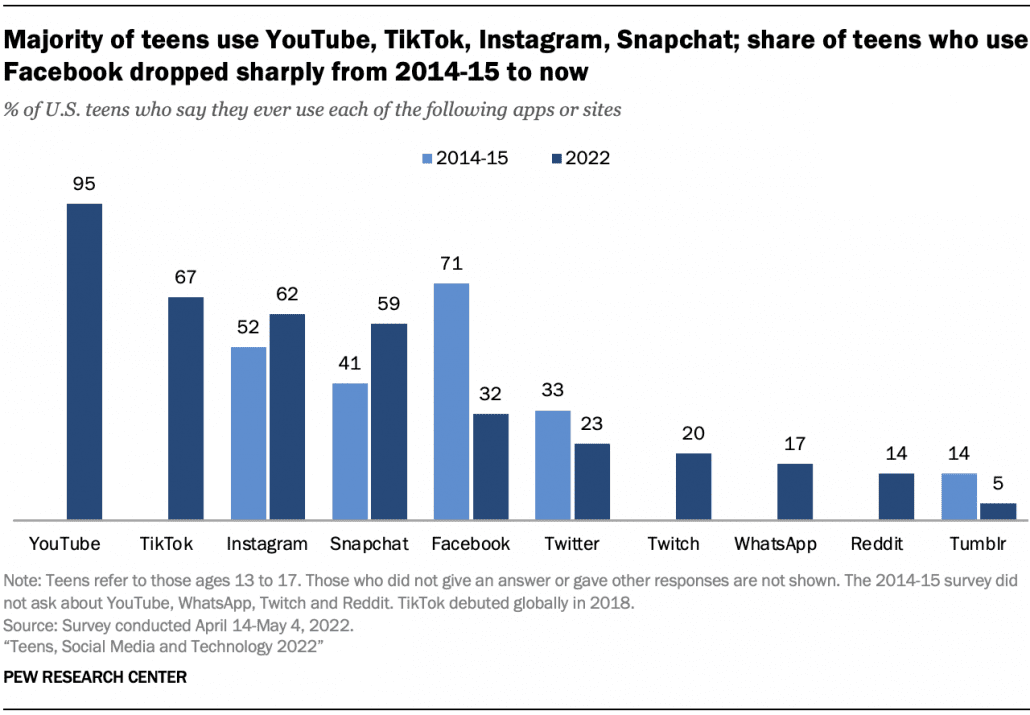
Anecdotal evidence has suggested Facebook has been losing popularity with teens for years. Now, research from Pew Research Center confirms it.

Based on a survey of American teenagers between 13 and 17, just 32% of teens are using Facebook.  For comparison, a similar survey in 2015 showed that 71% of teens were active on Facebook at the time. Meanwhile, the majority of teens are moving to newer platforms such as TikTok and Snapchat.

However, the most universally popular social network among teens remains YouTube, by a wide margin. Based on the survey results, more than 95% of American teens use the video-sharing platform regularly,

Here’s the full list of most popular social networks among US teens:

  1. YouTube (95%)
  2. TikTok (67%)
  3. Instagram (62%)
  4. Snapchat (59%)
  5. Facebook (32%)
  6. Twitter (23%)
  7. Twitch (20%)
  8. WhatsApp (17%)
  9. Reddit (14%)
  10. Tumblr (5%)

Notably, the report indicates there are some slight differences in social media between genders:

“Teen girls are more likely than teen boys to say they ever use TikTok, Instagram and Snapchat, while boys are more likely to use Twitch and Reddit. Boys also report using YouTube at higher rates than girls, although the vast majority of teens use this platform regardless of gender.”

How Often Teens Are Using Social Networks

When the survey asked teens about how regularly they use the top four platforms, here’s what they had to say:

  • Close to 75% of teens visit YouTube at least once a day, with 43% saying they visit several times daily.
  • TikTok is used daily by 58% of teens, with 32% visiting several times daily.
  • More than half (51%) visit Snapchat daily, and 29% say they visit several times daily.
  • 50%  visit Instagram daily, including 27% who visit several times daily.

Additionally, the report revealed that many teens feel attached to social media with over half (54%) saying it would be difficult to give up social media. At the same time, just 36% of teens are concerned they spend too much time on social media.

For more findings, read the full report from the Pew Research Center here.

YouTube is previewing its latest upcoming features for users, creators, and brands in a new blog post shared by the company’s Chief Product Officer Neal Mohan.

While Mohan was light with actual details – likely because these features are still in development – the post teases new shopping features, ways to share content, and more coming to YouTube this year.

New Ways To Shop On YouTube

YouTube is preparing to double down on its shopping features with a dedicated section and a number of new partnerships and features. 

For example, Mohan says the team is currently working on making videos across the platform more shoppable through user-created tags in existing content. 

YouTube Shopping Preview

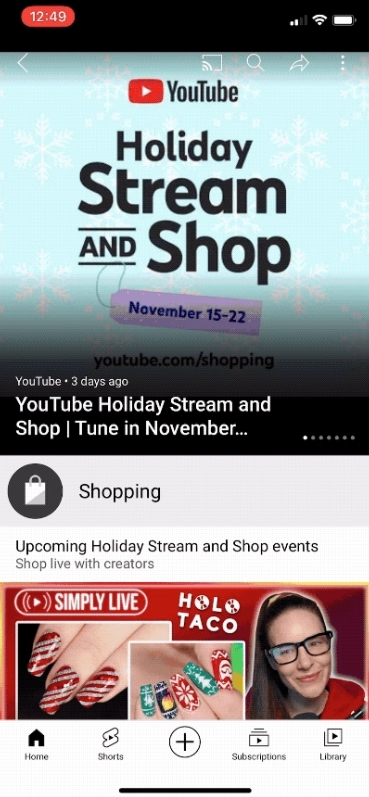
The company is also testing Live Shopping, which mixes the experience of the Home Shopping Network with a livestream hangout. For an idea of what to expect when this goes live, Mohan suggests looking to the weeklong Holiday Stream and Shop event hosted on the platform last November. 

Updates to YouTube Shorts

Unsurprisingly, Mohan says the company is planning to focus on expanding its popular Shorts format. Following the smash success of TikTok in 2021, social networks are rushing to establish their own versions of the short-video format. 

YouTube is working to improve its own take on the format with new effects, improved editing tools, better viewer engagement features, and even monetization options. The monetization features mentioned range from implementing BrandConnect with Shorts, expanding the Super Chat feature so users can stand out on live chats, and adding the ability to shop products directly from a Short.

Other Updates

Mohan also hinted at a number of other features and improvements coming to YouTube this year. 

For creators, the blog post says that new insights are coming which will help not only understand your current videos’ performance on the platform but also help “generate concrete content ideas for upcoming videos.”

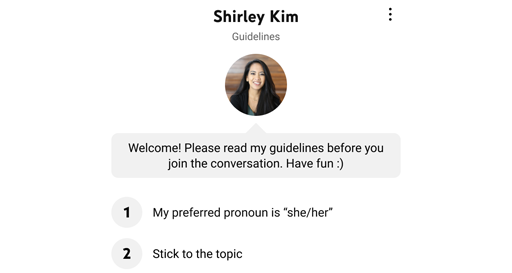
Channels will soon also be able to establish their own guidelines for community interaction, letting creators set the tone for the conversations occurring on their channel.

Meanwhile, brands may be excited to try out Collaborate Livestreaming, which allows multiple creators or partners to go live together – rather than hosting independent streams on their own channels. 

More To Come

The blog post is just a taste of the many features and updates YouTube is working on and anything previewed by Neal Mohan today could change significantly before they reach the public.

Still, these features give a clear idea of the company’s priorities for the upcoming year, including how it plans to address the continued growth of TikTok.  

YouTube is testing out a new feature that would improve synergy between brands and creators by automatically inserting visual links to businesses mentioned in videos. 

The feature, which is being called Places Mentions, was revealed during a recent video on the Creator Insider channel.

At the moment, the feature is limited to just Android and iOS devices using the YouTube app to watch content related to food or drinks.

The goal behind it is simply to streamline the process of finding out more about places mentioned in a video, such as in a review of a local eaterie. 

Before, creators had to manually add a text link if they wanted to direct people to the locations they mention in their videos. By automating this process, YouTube is making it easier for content creators to spread the word about your brand without having to establish a formal collaboration.

As the announcement says:

“This new feature, within the video description box, will give users an easy and engaging way to find out about places mentioned in a video.”

While the initial test is limited to food and drink videos, the company says it plans to expand the feature to more categories soon.

The announcement did not provide a specific date that we can expect to feature appear in search results, but it is safe to assume it will roll out for testing any day.

For more, check out the full Creator Insider video below:

YouTube recently revealed new ways to see what search queries are leading viewers to videos, including both videos on your own channel and across the wider YouTube audience through an experimental new feature called Search Insights.

Additionally, Search Insights can help creators identify content gaps where users aren’t finding content ideal for their searches, to plan your future content around.

What Is YouTube Search Insights?

As detailed on the YouTube Creator’s Insider channel last week, YouTube Search Insights allows users to explore search data across the platform from the past 28 days, provided there is enough data.

The feature is split across two tabs. The first tab focuses on your channel and how users find your content, while the second shows keyword data from thousands of topics on the platform.

Along with the expected query data, such as search volume and high volume search topics, YouTube is also experimenting with identifying “content gaps”. This is when a viewer can’t find the content they were looking for with a query.

Do You Have Access?

As an ongoing test, YouTube has not opened these new features to all users. 

To see if you have access to Search Insights, first, log into YouTube Studio and select “Analytics” from the menu on the left.

Within the Analytics tab, look for a section called “Research”. If you have access to Search Insights, you will then see three tabs: “Your viewers’ searches”, “searchers across YouTube”, and “saved searches.”

While the new feature is in its early stages, YouTube says it will have more information in the future when it expands access to more users or you can watch the full announcement below:

YouTube announced it will no longer be showing the number of dislikes videos received after experimenting with the idea earlier this year.

Though the dislike button will still be available to help users customize their feed and recommendations, the company says that removing public dislike counts helps prevent group harassment like “dislike attacks”.

As YouTube explains in the announcement:

“As part of this experiment, viewers could still see and use the dislike button. But because the count was not visible to them, we found that they were less likely to target a video’s dislike button to drive up the count. In short, our experiment data showed a reduction in dislike attacking behavior.”

This will presumably help provide creators with a more accurate view of how their community is responding to videos without interference from non-viewers. This information will still be available to creators in YouTube Studio, along with their other channel analytics.

YouTube does say the test wasn’t popular with everyone, and they expect some negative response to this decision. Still, they believe this change will be best for the site as a whole.

“We heard during the experiment that some of you have used the public dislike count to help decide whether or not to watch a video. We know that you might not agree with this decision, but we believe that this is the right thing to do for the platform.”

The number of likes a video receives will still be publicly viewable for those who previously used dislikes to decide which videos to watch.

The company says this is just one of many steps it is planning to help ensure the platform is a positive space for discussion and creativity for everyone:

“We want to create an inclusive and respectful environment where creators have the opportunity to succeed and feel safe to express themselves. This is just one of many steps we are taking to continue to protect creators from harassment. Our work is not done, and we’ll continue to invest here.”

For more, you can watch the video explaining the decision below or read the full announcement here.

YouTube is launching a series of new features which aim to make community posts more engaging and give creators data on how their community posts are performing.

Since their creation in 2019, creators have had very little information on how many people are seeing their posts, instead having to rely entirely on likes, dislikes, and comments directly on the posts. 

Along with finally providing analytics data on these posts, YouTube is adding the ability to include more images in community posts, as well as letting iOS users schedule their posts ahead of time. 

Let’s explore all these new updates in more depth:

YouTube Community Posts Get Analytics Data

Creators can finally see data on their community posts directly in YouTube Analytics, after years of waiting. 

Specifically, the analytics suite will start showing information on how many times your posts have been shown and how the content is performing without having to look at individual posts. 

For the moment, these metrics are exclusive to the desktop version of YouTube Analytics, though the company says it will be bringing them to its Studio Mobile app at some point in the future. 

As the video announcing the features explained, the company wants to help creators who have been asking for community post analytics better understand their content’s performance and use this information to help create more engaging posts in the future. 

Add Multiple Images To YouTube Community Posts

Since their launch, YouTube community posts have limited creators to just a single banner image which was used as a thumbnail for each post. Thankfully, that is starting to change.

Creators can now add up to 5 pictures per each community post, allowing you to express yourself more, better engage readers, and create an experience more in-line with other social platforms. 

For example, you can use a post to tease an upcoming project with preview images, show the process behind your videos, or even showcase your experiences interacting with fans or clients directly in your content. 

At launch, this ability will only be available to users on Android devices. Support for iOS and desktop should arrive later this year. 

Schedule Community Posts on iOS

The last update is short and simple, but it has been something Apple device users have been begging for. Creators can now schedule their community posts ahead of time from iOS versions of the YouTube app. 

This feature has been available on desktop and Android for some time, so this means post scheduling is now available to everyone with the ability to create community posts. 

How To Create YouTube Community Posts

If you’re unfamiliar, community posts are a type of social content found in a channel’s “Community” tab which creators can share between or alongside proper video uploads. 

These posts can contain images, videos, text, playlists, GIFs, and even polls – making them a great way to directly connect with your audience. 

The only requirement to be able to create community posts is having 1,000 subscribers on your channel. Once you have hit that benchmark, the process to create a post is simple:

  • Sign in to YouTube
  • Click the “Create” button
  • Click “Create Post”

Though community posts might not be the most visible content on YouTube, they allow a way to directly communicate with your community without having to stream or record a full video on your channel. Additionally, this is where many turn for information about when to expect videos, what you’re cooking up, and find out exactly what your viewers are most interested in.

That makes these new features – all of which are available now to those eligible to share community posts – a valuable tool to build a robust community around your content. 

For more, check out the creator Insider video below: