Tag Archive for: Social Media Marketing

facebook-video

In the wake of Facebook’s successful video service, the social media giant is making two big changes for advertisers and users. Facebook announced it will be adjusting its new feed algorithm to reflect interactions with videos, as well as changing how it charges advertisers for video views.

The update will be rolling out over the next coming weeks.

While Facebook has already included likes, comments, and shares on videos, the new algorithm will also consider factors such as whether a video was unmuted or viewed in full screen.

Facebook said it believes the new factors are strong indicators that users specifically chose to see a video, and it will use the factors in ranking videos within users’ news feeds in the future. This also means that those who watch a large number of videos on Facebook will likely start seeing even more in the close future and those who do not tend to engage with videos should see fewer in their feed.

While the first change relates to videos shared organically on Facebook, the social media platform is also making changes that will affect promoted videos.

Starting today, Facebook says it will charge advertisers only if a video is watched for 10 seconds or longer. In the past, Facebook charged advertisers based on video impressions, which meant advertisers were charged the second the video started played.

Advertisers who prefer to be charged based on impressions can do so if they wish, but the new system provides a better guarantee users purposefully watched the ad you were charged for. The new option is like the result of many advertisers’ complaints that they were being charged for video views only because they started autoplaying as users scrolled past them.
Facebook Beacons

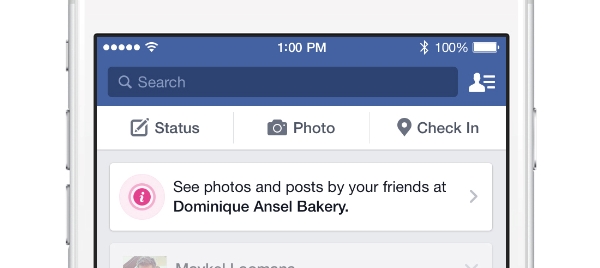
Facebook is expanding its Place Tips program, and that means retailers will finally have access to free beacons that push posts and photos related to their business when someone accesses Facebook in or near that location.

For example, if you are checking your Facebook quickly while you are waiting in line at a participating retailer you will see “more info about places you visit, including your friends’ photos, experiences and moments from that place.” Users will also be prompted to like the business’s Facebook page.

As Engadget reported, users will receive a “tip” notification for the place you are at when you open Facebook on your phone. If you tap it, you’ll be shown a series of cards related to the location. The cards will include current posts and photos from your friends who have also visited the location, as well as basic information about the business.

For now, the cards offer limited value from the perspective of the retailer, especially as advertising is not permitted. However, it gets retailers directly on users streams and is delivered based on an opt-out basis to users. That means there is still quite the potential for the program.

To make the service work, Facebook determines your location using a combination of cellular networks, Wi-Fi, GPS, and Facebook Bluetooth® beacons.

For now the Place Tips program is limited to the Facebook app for the iPhone and location services must be enabled for the tips to appear.

Mike Blumenthal did a great job explaining the importance of the announcement to small and medium businesses:

This marks the first time that beacon technology to interact with customers is being made available at scale to every business. While it might not appeal to a Macy’s that can implement their own beacon hardware and software stack, it now makes the option available for every Mom & Pop to participate with in-store customer interactions.

You can request your free beacon using this form.

Source: Shawn Campbell

Source: Shawn Campbell

Smart webmasters and marketers know analytics is the key to online success. Analytics services are the best way to know exactly how your site or content is performing and what you can do to improve it, but it has traditionally been more difficult to monitor your performance on social media through anything other than followers, likes, and retweets. Thankfully, that is all starting to change.

Twitter has operated an analytics service for users for over a year, but today they have launched a significant upgrade to its analytics tool which promises to give marketers and webmasters much greater insights into who their audience is and how to reach them.

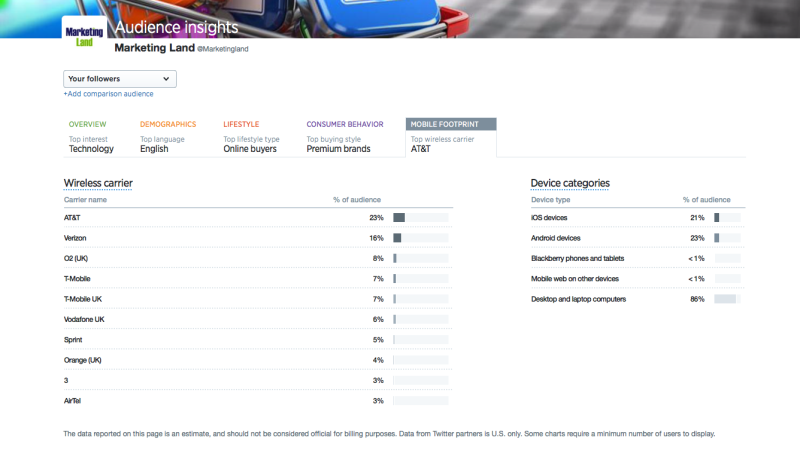
The upgraded analytics tool, called “Audience Insights” offers a much deeper analysis of demographics, interests, lifestyle, consumer purchasing behavior, television viewing preferences, and even mobile carrier and device usage. The service works by matching data from Twitter’s Marketing Platform Partners such as Datalogix.

According to Twitter, the new Audience Insights will help brands improve their paid and organic marketing strategies on Twitter, and will be especially effective for advertisers as Twitter product manager Andrew Bragdon explained.

For example, if you’re running a campaign to increase awareness about a new cosmetics line, you can use this tool to learn about your potential customers on Twitter — the beauty products they’ve recently purchased, what fashion trends they’re interested in and even TV viewing behavior. Based on this information, you can identify the best segments to target within Twitter Ads, along with which creative — such as a Vine or video clip — your audience will find most compelling.

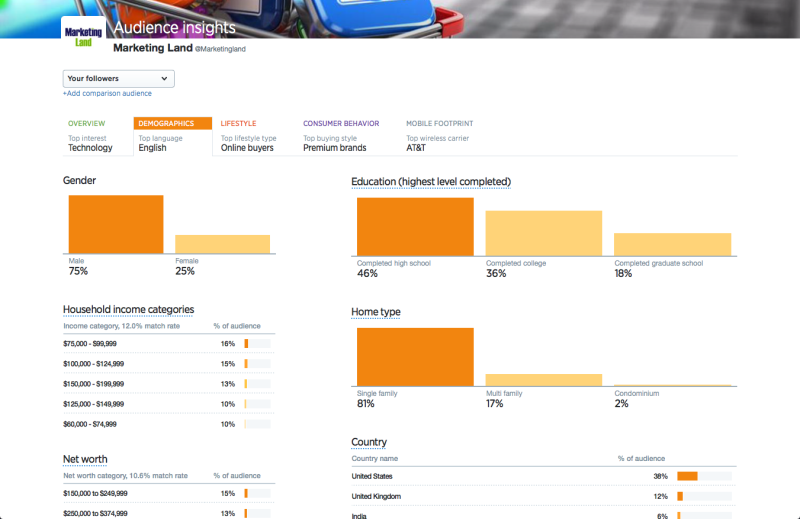
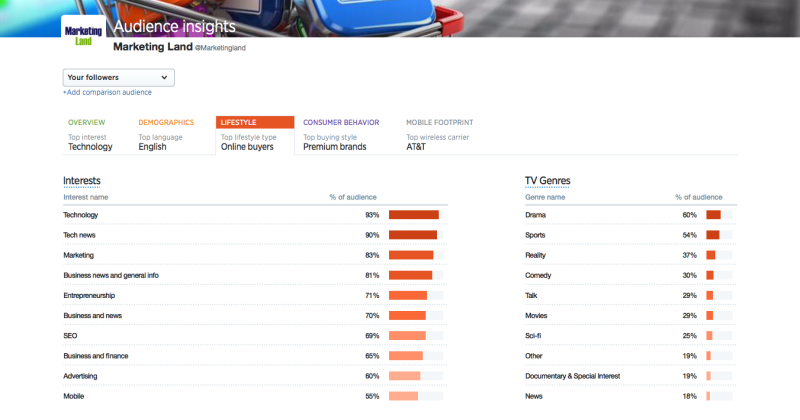
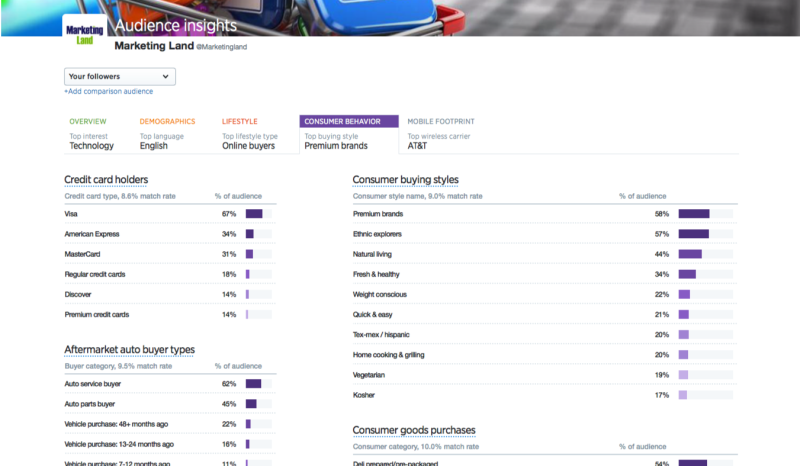
The insights dashboard offers easy and convenient tracking categories including gender, occupation, household income and net worth, home type, home value, marital status, education, consumer buying styles (premium brand vs. natural living vs. weight-conscious), favored television genre (drama vs. sports vs. comedy), type of credit card, and consumer good preferences.

The advanced analytics tool also makes it easy for marketers to compare their followers and organic audience against the full Twitter audience.

Audience Insights are already available for all Twitter advertisers and users of Twitter analytics. To access it, just visit ads.twitter.com while signed in, click on the “Analytics” menu, and select “Audience Insights”. You can also access it at analytics.twitter.com, under the “Followers” tab.

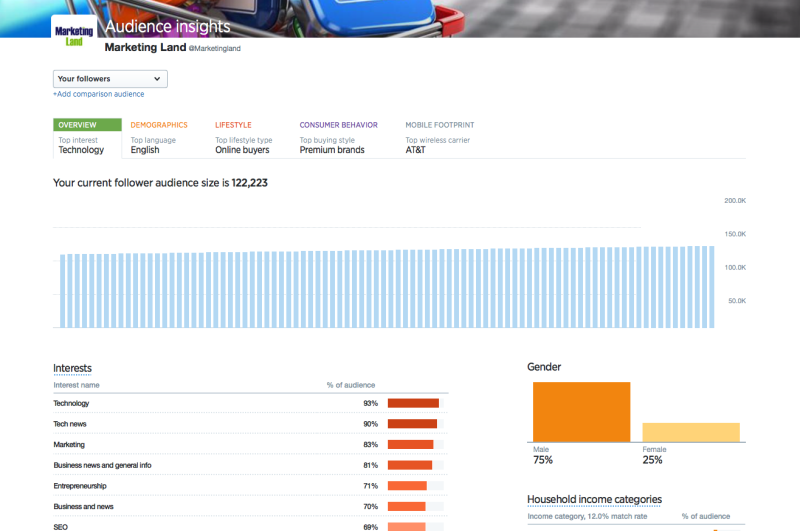
Below, you’ll find screenshots of each audience insights category as originally compiled by Marketing Land:

Overview

twitter-insights-overview-800x531

Demographics

twitter-insights-demo-800x519

Lifestyle

twitter-insights-life-800x420

Consumer Behavior

twitter-insights-consum-800x466

Mobile Footprint

twitter-insights-mobile-800x453


It is astounding just how much of an impact 140 characters can have. Twitter can be a powerful tool for reaching out and engaging with your audience or even growing a new audience that didn’t exist before, but it can also be a powerful tool for destroying your brand’s reputation.

Countless small businesses have been brought down by social media catastrophes, but it doesn’t require a large-scale meltdown to damage your brand on the social platform. All it takes is poor social media etiquette and before long you’ll find yourself facing a ghost town on your Twitter dashboard.

Thankfully, it is also incredibly easy to stay on the good side of Twitter users so long as you use a little common sense in interacting with your followers.

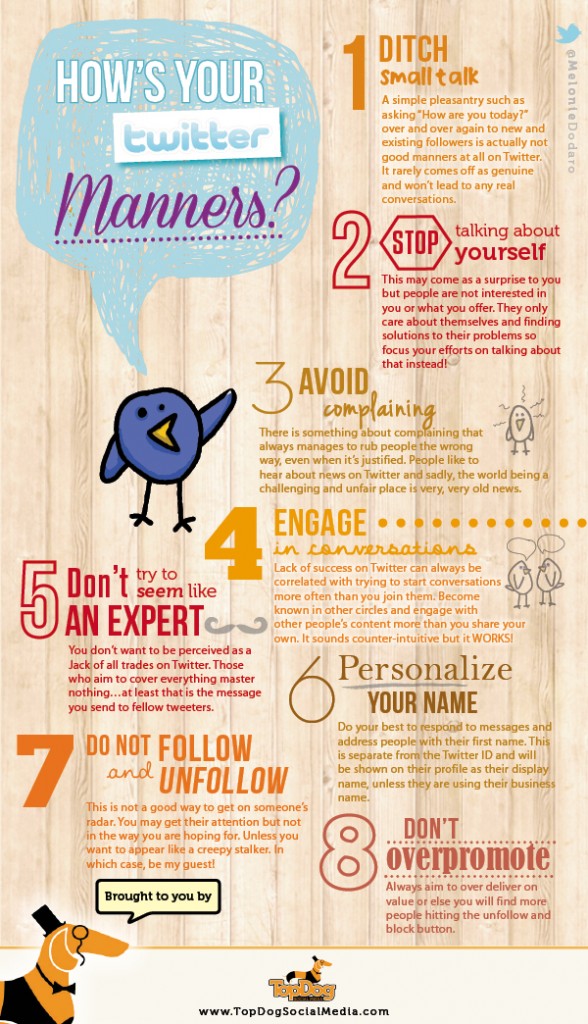
This infographic from Melonie Dodaro will help you mind your P’s and Q’s and build a positive atmosphere that will make Twitter users look forward to your every tweet.

twitter-manners

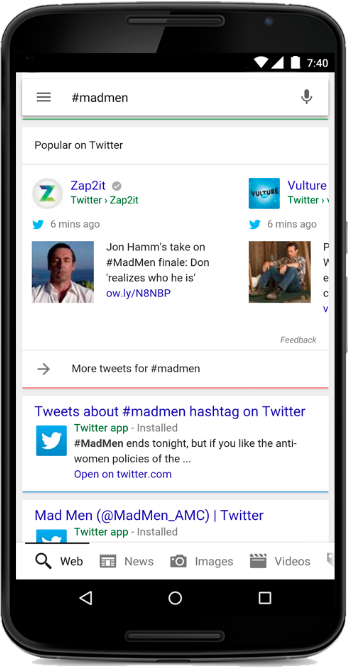
Earlier this year Google and Twitter announced a deal which promise to bring more tweets to your search results, and that promise is coming true today. Google now includes tweets in a more cohesive and graphical format on mobile devices, including a tweet carousel.

Both Twitter and Google announced the news in blog posts today, including examples of how the feature appears, such as the example below which shows how it looks if you search on #madmen.

madmen2

You can also scroll through the carousel to see more results.

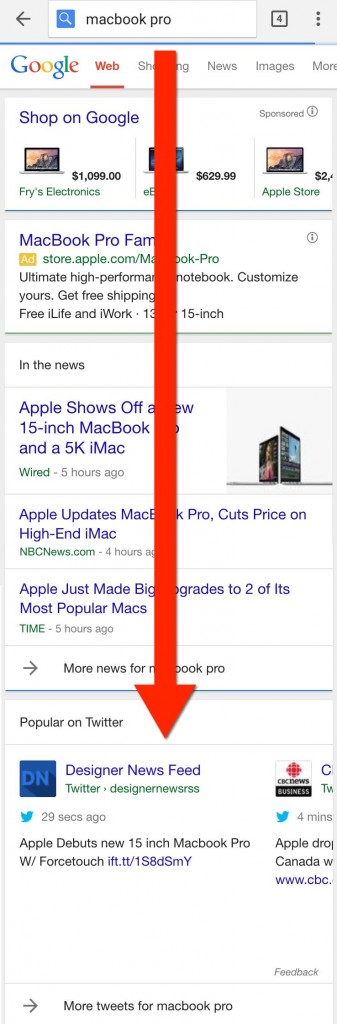
The placement of the feature isn’t always directly at the top of the page. According to Search Engine Land, the tweet carousel can appear in the middle or even the bottom of the page, as their example for “MacBook Pro” shows:

macbook-tweets1

Tweets don’t show for every search, and it is currently unclear exactly what types of searches include tweet carousels and which don’t. However, Google does say:

It’s a great way to get real-time info when something is happening. And it’s another way for organizations and people on Twitter to reach a global audience at the most relevant moments.

That suggests searches for hastags, topics, prominent figures, or trending events are most likely to include tweets.

Google has included Twitter in its search results in the past, even after their last deal ended. The new agreement simply allows for much deeper integration in the search results.

Currently, the new implementation on the search results is limited to only users in the US, in English, using either their browser in iOS or Android, or on the Google Search App. Twitter has promised further support for desktop and more languages in the near future.

 facebook-vs-youtube

Facebook’s video platform is quickly rising as one of the most popular online video services available due to statistics showing marvelously high video view counts, but experts argue Facebook’s numbers may be misleading. While Facebook claims massive view counts, it is entirely possible YouTube may have a larger lead than it appears at first glance.

What even is a video view?

A video view is the count of how many people watch a video. It can’t be all that complicated, right? Wrong. Online, there is a surprising amount of contention over what exactly constitutes a video view.

For Facebook, a video view is counted every time any video plays for only 3 seconds. On the other hand, YouTube does not consider a video to be “viewed” until it has played for at least 30 seconds.

These contrasting metrics raise numerous questions about the accuracy of view statistics and the efficiency of online videos. Making issues more complicated is autoplay. On YouTube, you have to at least click one video before you are shown an endless feed of autoplaying videos, but you can view a video on Facebook by simply not paying attention when you are scrolling.

View statistics have long been an important metric for display ads, but these factors suggest the advertising industry may need to agree upon a set viewing metric, or turn to other types of data entirely, to accurately gauge the impact of video ads.

Are a few seconds enough?

Think about the last commercial you saw. How long did it take before you knew what the commercial was for? One of the biggest benefits of video advertising is the ability to tell a story with your ad, but this also means it is often not immediately clear what the product being advertised is.

Problematically, both The Media Rating Council and IAB side closer with Facebook’s metric. These organizations define a video ad as viewable “when at least 50 percent of the ad’s pixels are visible on a screen for at least two consecutive seconds.”

Now consider the average length of the Top 10 Best Video Ads of 2014 compiled by AdWeek is 2 minutes and 17 seconds.

It’s time for a new video view standard that reflects the actual impact videos are having. Facebook’s numbers sound amazing on paper, especially in light of how new this incarnation of the video platform is. But, they are less impressive when you consider many of those “views” can occur just because you got distracted with Facebook open.

Videos can be an immensely powerful online advertising tool, but don’t be fooled by misleading numbers. Use analytics to make sure views are turning into clicks and conversions, or consider using a video platform with slightly more strict view counts.

Here’s a rundown of how the biggest video services count views, compiled by Marketing Land:

  • YouTube: The Google-owned video network counts a view after a user has watched a video for “around” 30 seconds.
  • Facebook: Facebook videos automatically play without audio on users’ News Feeds. Views, which are displayed publicly, are triggered when someone watches for at least 3 seconds.
  • Instagram: Facebook’s photo and video sharing network doesn’t display video view counts publicly, but the company uses the same 3-second standard to count them. Instagram video also loops automatically while a video post remains on users’ screens, so instead of total video views, the stat Instagram sends to advertisers is views by “unique users.”
  • Twitter: Unlike Facebook and YouTube, Twitter doesn’t currently serve autoplay video (although it is testing the feature for some iOS users), so a view is counted when a user clicks on a video within a tweet. Video view counts are not publicly displayed. Advertisers can view stats within the Twitter ad platform, or for organic tweets from within the analytics dashboard.
  • Vine: The Twitter-owned video network autoplays looping video with a maximum length of 6 seconds. Views on the Vine network are called loops, which are publicly displayed and triggered after a user watches the entire video. Vine doesn’t sell ads.

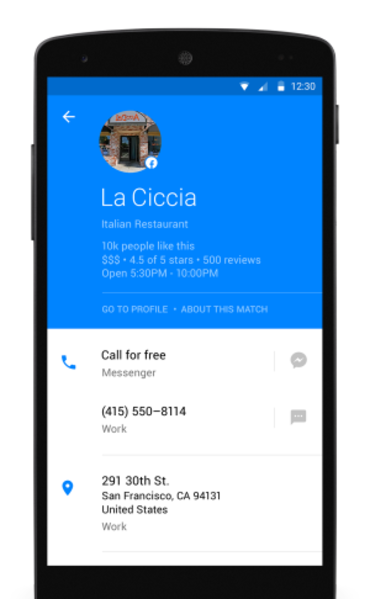
Facebook has been slowly but steadily making strides into the domain of local search, and their latest app in testing called “Hello” makes this clearer than ever.

facebook-hello-business-image-370x599

Hello claims to allow mobile users to search for other people or businesses on Facebook using either specific names or business categories, making Hello Facebook’s answer to the phone book. Once you’ve found the person or business you’re searching for, it just takes a single tap to get directions or make a phone call.

“So if a friend tells you about a new restaurant in your neighborhood, you can use Hello to find their hours, make a reservation, and get directions, all without leaving the app,” explains Facebook in a blog post.

Facebook also says the app will use Facebook profiles information to display relevant info about callers onscreen with incoming calls, including a profile picture, name, and number of contacts in common.

The app will also include a privacy feature which allows users to block commonly blocked numbers or specific numbers. Blocked calls will be automatically directed to voicemail, but still appear in the call log.

The test version of the app is available for Android users in the Play Store.

facebook-video

If it seems like your Facebook feed is becoming flooded with videos, it is no coincidence. Since Facebook video launched, it has rapidly become a staple of the staple of the social network and it shows no sign of slowing down in the future.

The service hit a new milestone recently, as CEO Mark Zuckerberg announced that Facebook now serves more than 4 billion video views every day, adding a full billion views to the stats announced in January.

It is no surprise that Facebook video is such a hit, as the platform offers the perfect opportunity for users to view and share video without having to leave the network. With the latest numbers many are suggesting Facebook video may pose a real threat to YouTube in the near future.

YouTube reported reaching 4 billion daily views the last time it reported those statistics in January 2012, but they have likely added a fair number of views since then. However, actually comparing the views across either service is complicated because the two services count views differently. Facebook counts any playing three seconds on its autoplay videos as a view, while YouTube has a higher duration requirement to be included in its count.

During the company’s first quarter earnings call, COO Sheryl Sandberg also pointed out that a vast majority of Facebook’s video views come from mobile, and the ubiquity of videos on the service has primed users for video ads. “We’ve always believed that the format of our ads should follow the format of what consumers are doing on Facebook,” she said.

Sandberg also said brands are already taking advantage of Facebook video.

“Brand marketers particularly but I think all marketers have the opportunity to do video,” she said. “And that’s pretty exciting, even SMBs who never would be able to hire a film crew and buy a TV ad. Over 1 million SMBs have posted videos and done really small ad buys around them. And that’s pretty cool because I don’t think there are 1 million advertisers who have bought TV ads in that same period of time.”

tumblr_2

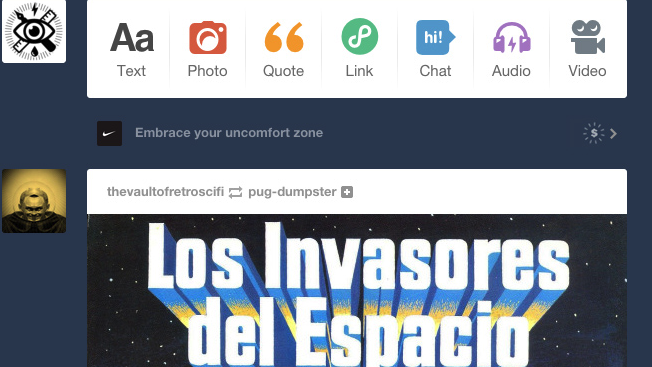
Do you ever wish your company could just take over the web for one day? Well Tumblr will help you do the next best thing with its new ad product Sponsored Day. It doesn’t let you rule over the entire internet, but it does allow you to “take over” Tumblr in a way, by showing small, non-obtrusive ads to all users around the entire world, or within a single country.

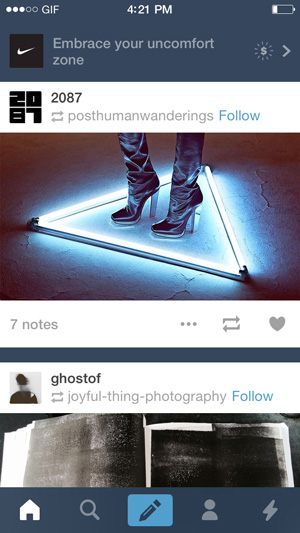
According to AdWeek, the new ads will include a company icon accompanied by text and a dollar sign to signify the placement was paid for. The ads go live at midnight ET and run for the entire day. Perhaps best of all, the ad service is open to everyone, not those with a Tumblr page.

“It’s the single biggest and boldest way for marketers to make a statement on our platform,” David Hayes, head of creative strategy at Tumblr, told Adweek.

tumblr-ads-01-2015

Nike is setting the trend with the ad type by running a global buy campaign for their “Better for it” Tumblr campaign. The campaign pushes to sell the company’s line of women’s workout gear with a cohesive, integrated media push.

If desktop users click the Sponsored Day ad, they are led to a short video for the sneaker company. Mobile users will instead be shown a static image.

Tumblr claims the Sponsored Day ads can have a worldwide reach of 460 million consumers, and several companies are already lining up to follow Nike’s lead.