
Tag Archive for: News

Derek MullerDo any reading about online marketing, and you will almost certainly be told how important social media is to your brand’s online presence. A great social media presence has repeatedly been shown to increase organic traffic and brand perception, but as the platforms have become more populated and competitive, there has been a large shift towards a pay-to-play business model.

Facebook is most notable for this, as they have been the largest social media platform a significant time and they have made the largest changes towards monetizing their service. Sure a business can put up a page and do the slow grind to gain followers one or two at a time through great content and engagement with their audience, but brands looking for significant visibility on the site only have a few options and they all cost money.

To get any exposure on the largest social media platform, brands have to acquire likes for their pages. There are two ways to do this. Despite being expressly against Facebook’s terms of conditions, there is still a market for people who are willing to outright pay for likes.

As Derek Muller explains, these paid likes come from “click farms” in developing countries, where people are paid to like pages by the thousands. But, they are fairly easily identifiable and can get profile owners in trouble.

Alternatively, Facebook offers advertising for your page specifically aimed at increasingly likes “organically”. The problem is, these likes don’t appear to be much different from the likes you would purchase from a click farm.

Derek Muller used his Veritasium YouTube channel to show that Facebook’s way of acquiring “legitimate” likes is actually almost identical to the click farm methods, and both are equally useless. But, paying Facebook for it might actually cost you more.

You see, Veritasium used a free Facebook advertising offer to see if it might expand their social media audience. Within hours, they had netted nearly three times the number of followers, but over time Muller noticed the engagement on Veritasium’s content hadn’t improved with the new likes. In fact, it seemed to go down.

After some research, Muller discovered the bulk of his new likes came from the same countries notorious for click farms. The “users” liking his page had also liked thousands of other pages with seemingly no logical pattern. But, there was no going back. There is no way to delete these empty likes in bulk.

If that was all the only issue, it would be a moderate annoyance and newsworthy hole in Facebook’s advertising method. But, it manages to get worse. These fake likers don’t just provide an inflated picture of how many people appreciate what you are putting out. They actually hold you back.

When you share something on Facebook, it is only shown to a small sample of your followers. Depending on how those viewers respond, Facebook might then distribute your content to even more people. But, if your content isn’t getting liked, shared, or commented on, it will usually sink out of visibility very quickly.

If you have a ton of empty likers, they make up a significant number of those seeing the initial distribution of your content. Since these profiles don’t actually engage in any meaningful way, they can actually prevent interested followers from seeing any of your content. You might as well be speaking to a comatose audience, while your actual fans wait just outside the door.

There is a solution, but of course that costs you even more. To get your content shown to the parts of your followers that are actually interested you have to pay to have your content targeted to them in ads. Facebook makes money twice off of you, and you gain very little in the long run.

Facebook has yet to comment on the issue, but these raise some big questions about the social media platform’s advertising methods as a whole. While social media can still be a great tool for those looking to grow their brands, you might look towards other sites such as Twitter. Until Facebook addresses these massive issues in their service, advertising on their platform may not be worth your resources.
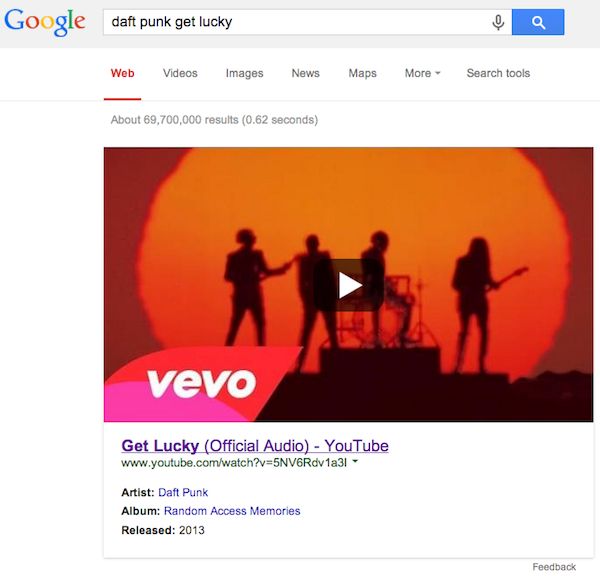
Looking for your favorite music video? Since MTV hasn’t shown music videos for the past 20 years, you will probably turn to Google. Now, Google is making it easier to find the videos your searching for by giving more prominence to the top playable music video result. So, if you’re searching for “Get Lucky” by Daft Punk, it will be hard to miss the official version of the video at the top of the page.

Daft Punk Get Lucky Google Search

The thumbnail images for the videos look like they would be playable on the page, but in actuality they link back to the page for the video. It’s possible they play icon on the image might hint towards future usability for YouTube videos, or it might just be a little misleading.

Of course, the tool isn’t perfect, and you shouldn’t expect to get the “official” video or a video from the artist’s official account every time. For example, Search Engine Watch highlights a case where searching for “Let Me Ride” by Dr. Dre doesn’t pull up a video from the DrDreVEVO account, because that video hasn’t been uploaded to the official account.

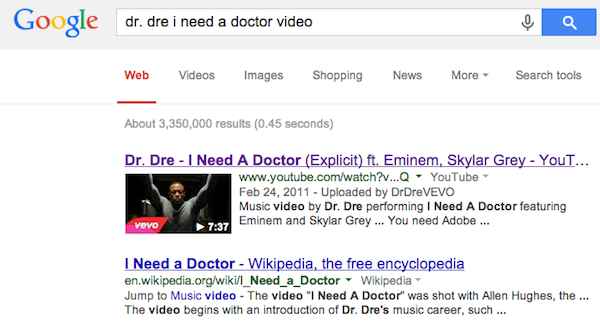
Similarly, searching for “I Need a Doctor” by Dr. Dre doesn’t trigger the new large YouTube thumbnails, even though there is an official video uploaded to the account.

dr-dre-i-need-a-doctor-google-search

“This was already available in September 2013 when you searched for an artist and then clicked on a song – you’d see a preview of the music video if it was available to display,” said a Google spokesperson. “Yesterday we made it easier to get to – you can now just search for a song directly and see the video screenshot right away.”

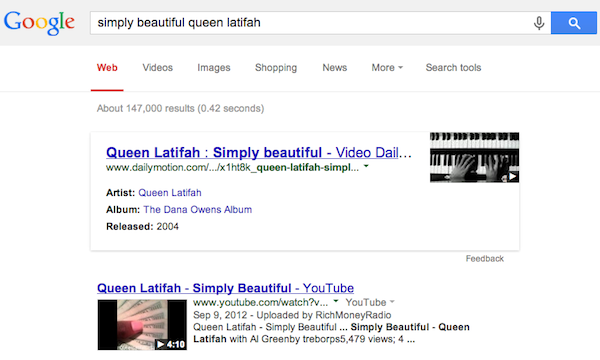
It is notable that the huge thumbnail appears to be exclusive to YouTube. When Google pulls from other sources like Dailymotion, it shows the smaller thumbnail and link layout. For example, the video for “Simply Beautiful” by Queen Latifah looks like this:

simply-beautiful-queen-latifah-google-search

seahawks-vs-broncos-us-bing-searches

No one is calling a clear winner for the Big Game Sunday Night. As numerous sports analysts have pointed out, it is rare that both of the best teams from the past season actually make it to the Super Bowl, but this year the Seattle Seahawks and Denver Broncos match-up should make for a truly exciting game.

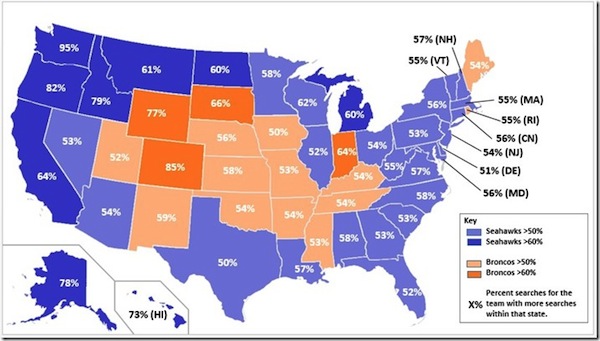
While the game will likely be close, Bing says the Seahawks have already been dominating the Broncos online. Bing examined U.S. search volume for both NFL teams, and the Seattle team has taken the lead in 33 states.

Obviously, the Seattle Seahawks absolutely dominated searches from The Evergreen State (95 percent), but they also have a clear lead in Oregon (82 percent), Idaho (79 percent), Alaska (78 percent), Hawaii (73 percent), and California (64 percent).

Of the 17 states where the Broncos held the most search volume, they had a less significant lead. Their home state of Colorado had the most significant difference with 85 percent of searches, while neighboring Wyoming had (77 percent). South Dakota and Indiana brought up the lead with 66 and 64 percent respectively.

In total, Bing users searched for the Seahawks 26 percent more often than the Broncos.
Of course, outside factors could explain the differences in search volume.

As Search Engine Watch points out, searches for the Seahawks spiked across the nation immediately following Seahawks cornerback Richard Sherman’s infamous post-game interview. The controversy and excitement surrounding the over-the-top interview made the Seahawks’ search volume jump over 80 percent.

http://youtu.be/PPD_Lgq7IyI

The Broncos have had their own moment of viral fame, with tons of clips compiling Peyton Manning yelling “Omaha”, but the larger focus after the Championship games two weeks ago was easily favoring Sherman. Without his spectacular outburst, search volume would likely have been more even across the country.

http://youtu.be/hBqwWe0S8jw

What are you thoughts? Who are you favoring in Super Bowl 48?

With Google’s constant updates, it is easy to miss some of the new features they roll out with less publicity than their biggest products receive. However, even the smaller revisions to Google Search make a huge affect on how we search and use the internet in general. Jessica Lee recently rounded up some of the less talked about changes Google has been making so you can be sure you haven’t missed anything lately.

1) Date Selector in Hotel Carousel Search Results

The Carousel results box at the top of localized searches for hotels and restaurants has only been around for a few months now, and Google is already making regular updates to the function. While most of the work has gone into normalizing what queries get carousel results.

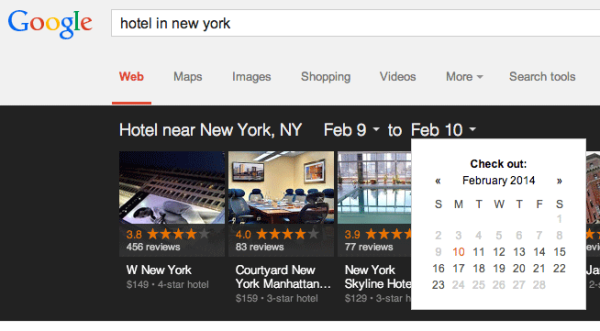
But, they’ve also implemented some new, interesting features such as a date selector for hotel searches. Now, you can easily weed out hotels that aren’t available on the days you will need lodging.

hotels-in-new-york-date-selector-google-carousel

In a statement to Search Engine Land, Google said:

We’re always adding features to search to help people find what they need and get things done faster — you can now more easily research hotels when planning a trip and filter by user ratings and hotel class, as well as select specific dates.

2) Cards for Local Results

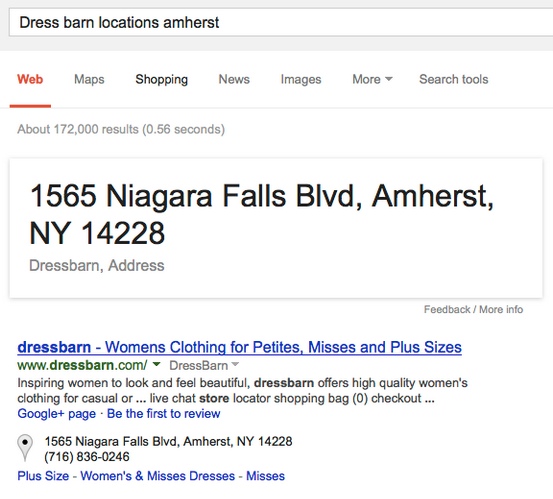
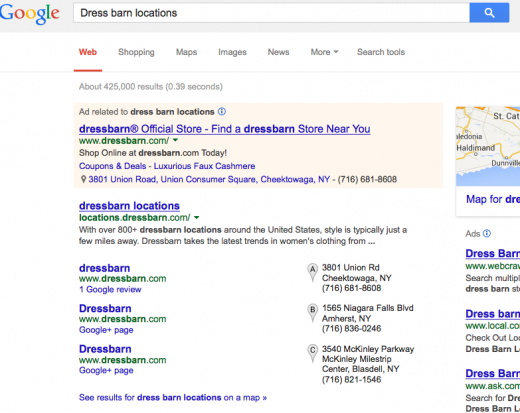
“Answer Cards” have slowly been spreading across Google’s platform for a while, but they were largely reserved for specific questions or brands. You needed a specific and targeted search to wind up with the convenient card at the top of the search results. But, lately the cards have begun to deliver more detailed answers such as the address of a nearby retailer. Mike Blumenthal highlighted the change with an example of searching for a brand name + location (Dress Barn locations Amherst):

dress-barn-amherst-answer-card

But, queries with multiple results still get the traditional pack results:

dress-barn-pack-results

3) Answers to Complex Questions

The answer cards have also gotten better at providing answers for trickier questions in general. The people running the Google Operating System spent a good amount of time trying to stump Google’s answer feature, but they’ve found the task has gotten much harder as the feature has been improved.

In their words:

Google used to only answer simple questions like “who’s the prime minister of Canada?” or “what’s the population of China?” Thanks to the Knowledge Graph project, Google can answer more complicated questions like “who played Batman?”, “what’s the latest album of Celine Dion?”, “what are the main attractions in Spain?”.

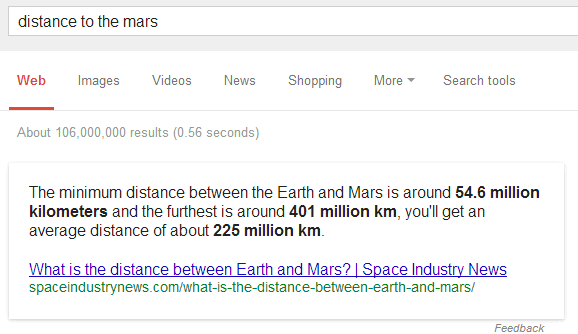
To test this out, one of the authors asked Google a question without a definitive answer: what is the “distance to Mars”.

google-direct-answer-distance-to-mars

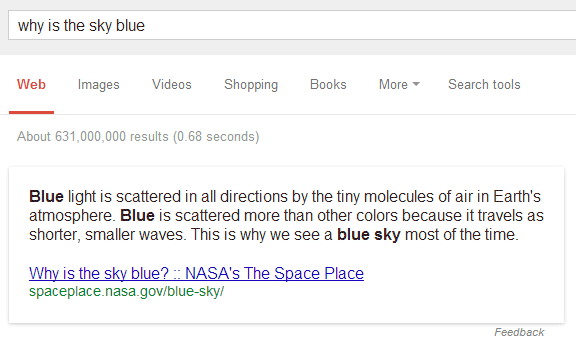
Google can even tell you why the sky is blue.

google-direct-answer-why-is-sky-blue

4) Distance Results

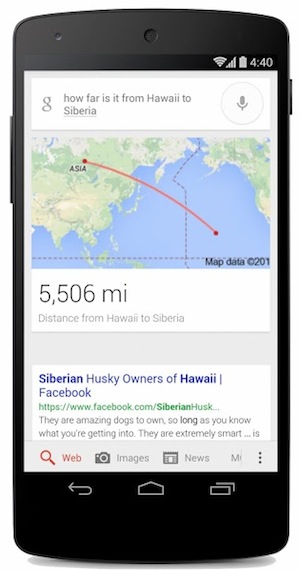
Google is able to tell the distance from most locations other than planets. In fact, Google announced on Google+ that users can now get the distance from any two locations on earth, no matter how far apart they are. The example Google offered was the “distance between Siberia and Hawaii.”

google-how-far-is-it-from-hawaii-to-siberia

5) Streamlined Search Options

The Google Operating System blog explained how they have updated search options to be more responsive to your individual search query:

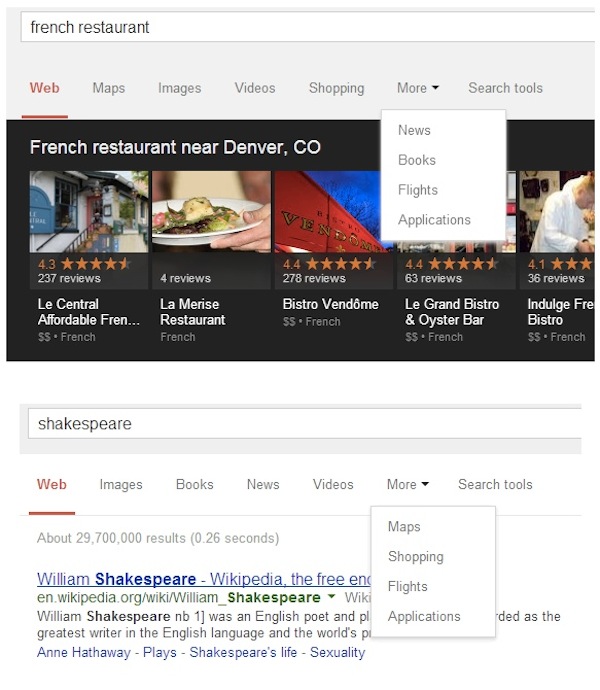
Google removed a few specialized search options that were usually displayed in the “more” drop-down: recipes, patents, discussions, blogs, places. The list of links to services like Maps, Images, News, Flights, Shopping is reordered based on your query. This isn’t a new idea, it was implemented a long time ago by Google, but now it’s used more often.

search-options-google

Keeping your website design fresh and modern is an important part of your brand, but it is also essential for SEO success. Search engines tend to favor sites which are regularly refining their site to offer new features and better user experience, as Matt Cutts recently confirmed in one of his Webmaster Chat videos.

But, there is a lot to consider before redesigning or modifying your website. A good website should be able to feel modern for at least a couple of years before needing another serious overhaul, and you are investing considerable resources into having the site designed in a way that communicates your brand well while keeping up with modern design styles.

There are also several factors behind the scenes you need to consider. Great usability and style are important, but several modern design practices seemingly go against some of the biggest search engines suggested practices. If you aren’t careful, you may do some damage to your SEO while trying to improve your site.

Kannav Chaudhary recently broke down how some of the most popular web design practices of the moment can affect your SEO. Usability and keeping your brand modern are important, but finding the right style for your brand also means choosing the paradigm which won’t hurt your other efforts.

Parallax Design

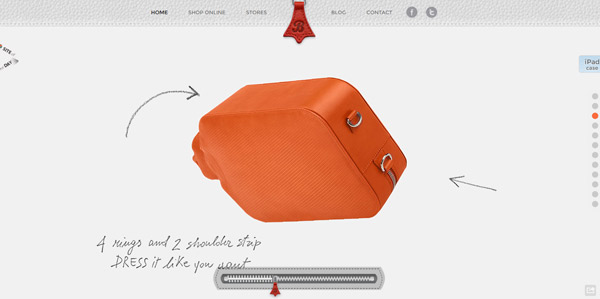
bagigia

Parallax design recently became popular with web designers for it’s unique way of restructuring a site in a visually exciting way. You build your entire website onto one page, but with responsive scrolling which delivers the content in impressive style. Sites with parallax design are incredibly easy for most users to navigate, as they simply have to scroll through the page, but it raises some issues with optimization.

Simply put, most modern SEO practices rely on creating a lot of content over numerous pages so increase the impact of keywords. You show off your skill and reputation through your content, while showing search engines you are relevant for these keywords. When all of your content is on one page, it can dilute the impact of those keywords, and Google can be unsure about how to view your site.

The key is really understanding when to use parallax design. It is great for product or contest pages, because there isn’t much content on those types of sites in the first place. Parallax design can showcase a product and rank for a few key phrases, but it will struggle with presenting a full website to the search engines.

Infinite Scrolling

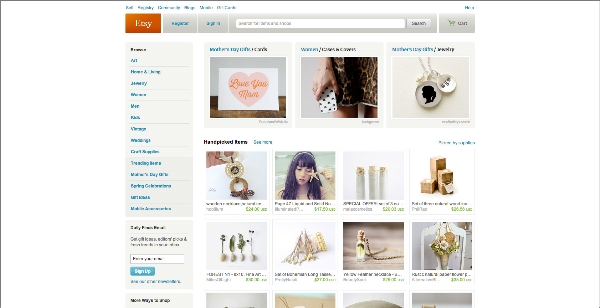
Etsy

If you are pumping out a lot of content on a regular basis, but want it to be easily available from a single page, infinite scrolling can be the perfect solution Social Media sites like Facebook and Twitter popularized the design practice, but it can be found all over the web these days, especially on blogs.

If you use the wrong method of implementation for infinite scrolling, you may run into some SEO issues, but the current practices avoid the lion’s share of drawbacks. Most web designers use frameworks such as Backbone or Bootstrap with crawlable AJAX so you can present your information on one page, while avoiding the problems of parallax design. Best of all, it loads quickly, so everyone will be happy.

Fixed Width Navigation

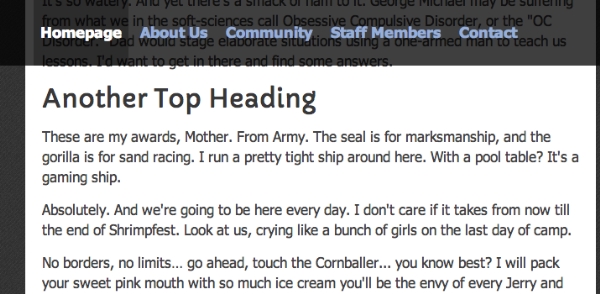
Fixed Width Navigation

Navigation will always be an important part of web design, and lately many designers have been using fixed width navigation to keep their menus in place while users move down the page. This way, you can always jump to another part of the site you want to find, even when you’re at the bottom of an article.

Thankfully, this design practice has very little effect on SEO. Your content will still be spread over plenty of pages, but you’ll want to make sure your navigation widget is indexable so that Google can also explore your site.

Conclusion

At the end of the day, you’ll always want to fully understand the new design trends before implementing them for your brand. Most of the time their SEO drawbacks can be mitigated with careful practice, but occasionally you will find one that just isn’t right for your site. As long as you keep user experience as the highest priority, you’ll be able to manage any of the SEO problems that pop up along the way.

SkeuoVsFlatBanner

As a business trying to keep up with the constantly changing internet, it can be hard to decide which trends to follow and what works best for your business. It is important to have a modern and up-to-date website, but if you chase every trend you’ll often end up falling behind and adopting practices that don’t suit your own business.

The biggest decision many web designers and business owners have had to make in recent history is whether or not they should adopt the flat design craze that has swept the web over the past year, or whether they should be using more traditional skeuomorphic design practices for their brand. As the flat design style has become a staple of many big businesses, many brands are also forced whether they run the risk of becoming cliche by picking up flat design or if they will fall behind the times with the older style.

If you aren’t familiar with the whole flat design vs. skeuomorphism debate, there has been a major shift in popular web design trends that really gained steam in 2013. Chances are, your web design has relied on skeuomorphic design principles at some point, even if you’ve never heard the word.

Skeuomorphic designs rely on recreating objects and visual styles from the three-dimensional world in order to make web design more easily relatable to users. By using stylistic cues and layouts from things such as calenders or notepads, users are immediately able to feel familiar with a website or application.

However, as computers, tablets, and smartphones have made technology a constant part of day-to-day life, flat design proponents have pushed for designs that are created “for the screen.” As a guiding principle that is understandable, but flat design activists have translated that mantra into strict stylistic principles as grounded in minimalism as they are web design.

Flat designs use simple elements and a strict two-dimensional approach that eschews all added effects such as drop shadows, bevels, and embossing. Flat design has also been heavily associated with the flourishing popularity of more complex typography.

The loudest voices for flat design have made it sound as if the new design style is a revolution in how we design, and on some levels it is. The basic guiding principles of “designing for the screen” can open up many new ways of thinking about web design which are fertile for innovation. As a style based on minimalism and strict stylistic rules however, flat design is a trend with more lasting power than some of the more fleeting crazes.

It is more important as a business owner to decide what design styles benefit your brand the most, rather than which trends are the most popular at the moment. There are numerous benefits of flat design, but skeuomorphism has been a long standing way of making products and web designs the most usable and familiar they can be for their audience. Plus, as Apple has shown, you can make your designs more flat to benefit usability without entirely going to Flat Design.

To help you understand which design style benefits your brand and business the most, WebdesignerDepot released an infographic highlighting the biggest advantages and drawbacks to skeuomorphism and flat design. It may help you find which style works for you.

New Image

Over the past year Google has been pushing to streamline the look and functionality of many of their products. They have redesigned several of their products, and replaced many tools webmasters rely on with new tools with better performance. AdWords is the next tool on their list for an overhaul, as Google announced earlier this week while highlighting “more screen real estate to the tools and reports you love.”

Their announcement also assures you, “By updating AdWords to the look and feel that we use across Google, you’ll spend less time getting where you want to go in your account, and more time focusing on growing your business.”

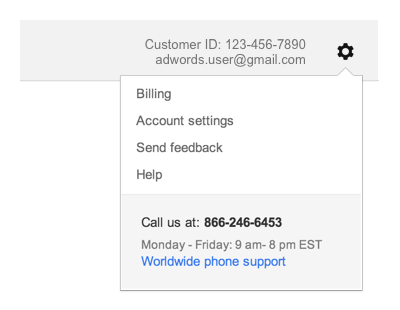
The redesigned AdWords will be implementing several stylistic and functional aspects from Google’s broader network, such as moving navigation links like billing, help, and account setting into the gear icon.

adwords-menu

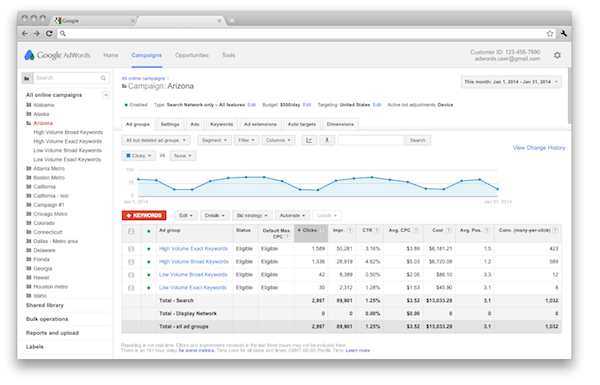
They have also shifted key campaign information above the fold in the dashboard, so you won’t have to scroll to get to the information you’re looking for. You can also quickly see who is signed in for accounts with multiple users

On the purely aesthetic side, Google has brought more white space into the page, especially within charts and tables. They also softened their color palette to make AdWords “easier on the eyes.”

adwords-charts

You can expect to see the changes appear within the next couple of weeks. In the meantime you can acclimate yourself to the updates with a short video Google released focused on navigating the redesigned AdWords.

Source: Shawn Campbell

Source: Shawn Campbell

It is no secret that nearly every big brand is on Twitter these days, and plenty of smaller businesses are learning to take advantage of the platform every day. But, there are plenty of ways you can mess up when trying to connect with your audience on one of the largest social media platforms around. As a new study on how top brands use Twitter shows, the biggest mistake you can make is simply neglecting your account.

The study from social media analytics firm Simply Measured showed that 92 percent of brands are tweeting an average of 12 times a day, and 98 percent of the top brands in today’s market are regularly active on Twitter.

In fact, consumers seem to be downright eager to follow brands on Twitter, as audiences for the top brands have grew by 20 percent in the last quarter of 2013. Over half of the brands have more than 100,000 followers each.

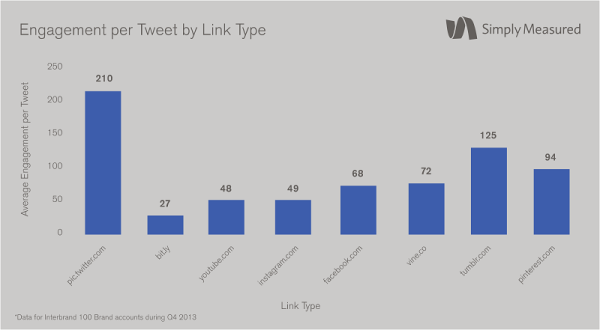
Of course, it doesn’t matter how often you tweet if you aren’t sharing things that excite the community and encourage engagement. As Marketing Land notes, the tweets with photos or links are more likely to receive activity than the traditional 140 character updates. But, it might be a surprise to see just how much better they perform. Simply Measured says tweets with photos or links see 150 percent more engagement than the brand averages.

Twitter-Links-Types-That-Generate-Engagements-Simply-Measured-600x330

Images see even more engagement than links by a large amount, with an average of 210 engagements per tweet. That absolutely dwarfs the 27 engagements on average for a bit.ly link.

You can download the full report from Simply Measured’s website.

As social media has grown there has been a consistent debate as to whether Google considered social signals when ranking websites. There have been several studies suggesting a correlation between strong social media presences and high rankings on the search engine, but there are many reasons they could be related. Well, Google’s head of search spam, Matt Cutts, may have finally put the question to rest with his recent Webmaster Chat video.

According to Cutts, Google doesn’t give any special treatment to websites based on social information. In fact, sites like Facebook and Twitter are treated the same as any other website. The search engine doesn’t do anything special such as indexing the number of likes or shares a page has.

Cutts explains that Google did at one point attempt to index social information. Barry Schwartz suggests Matt is referring to Google’s real time search deal expiring with Twitter. There was a lot of effort and engineering put into the deal before it was completely blocked and nothing useful came to fruition. Simply put, Google doesn’t want to invest more time and money into it only to be blocked again.

Google is also worried about crawling identity information only to have that information change long before Google is able to update it again. Social media pages can be incredibly active and they may not be able to keep up with the information. Outdated information can be harmful to people and user experience.

But, you shouldn’t count social media out of your SEO plan just because it isn’t directly included in ranking signals. Online marketers have known about the other numerous benefits of social media for a long time, and it is still a powerful you can use to boost your online presence and visibility.

A strong social media presence opens up many channels of engagement with your audience that can make or break your reputation. It can also drive huge amounts of traffic directly to your site and your content. By reaching out and interacting with your audience, you make people trust and value your brand, while also encouraging them to explore your site and the content you offer. Google notices all this traffic and activity on your site and rewards you for it as well.

You can see the video below:

Everyone knows that Google is a fan of hiding little easter eggs throughout their services, especially in Google Maps and Google Earth. Many of the most well known “secrets” of Google Maps involve objects that actually exist in real life, such as the popular giant pink rabbit in Italy. However, Google also creates some fun little tricks on their own. I learned of two such treasures this week and thought I would share them with you.

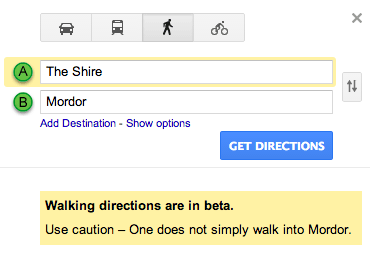
The first has been around for a few years, but it recently began making the rounds again. Michael Gray on Twitter noticed that Google Maps gives a particularly funny response if you happen to search for walking directions from The Shire to Mordor, as you can see below.

mordor-google-maps-1389877244

It is a good time for the little trick to be popping back up, considering the new The Hobbit film is just now leaving theaters, with one more on the way. Plus, many like me never saw it when it was first discovered in earlier versions of Google Maps.

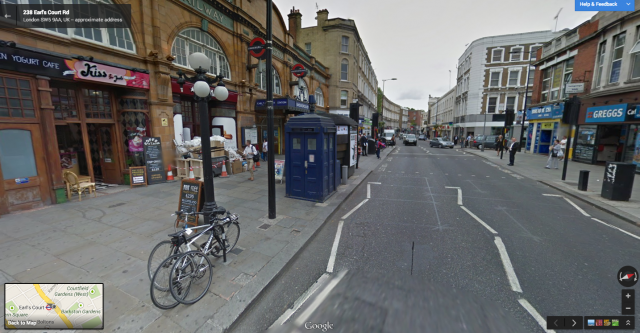
Tardis-Google-Maps-Street-View-640x333

The other secret Google Maps holds is much newer, but equally (if not more) exciting for the fans of Doctor Who. It seems the Tardis was hiding inconspicuously along Earl’s Court Road in London when the Maps team was in the area, because stepping into the blue police box sitting nearby when using Streetview.

18ww8u61d0w8ijpg

If you click on the double-white arrow, you’ll notice the police box is bigger on the inside, and you can explore the (limited) depths of the Tardis, The Doctor’s infamous time machine. Of course, it doesn’t have the endless new rooms and corridors that often appear in the show, but you get a good look at the controls and interior.

What is your favorite Google Maps easter egg?