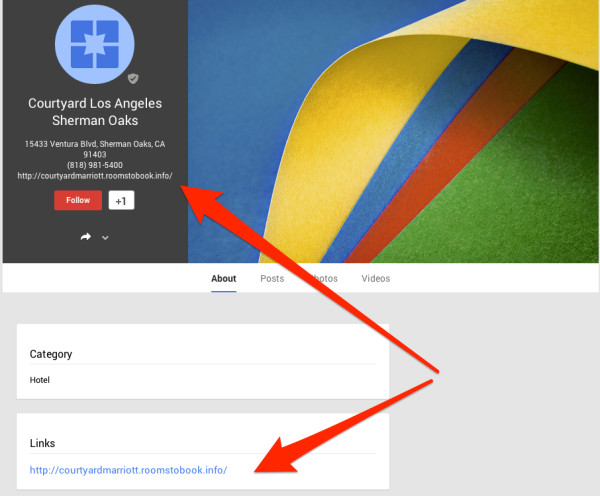
Yesterday, thousands of hotels with Google+ Local listings had their pages manipulated to replace their links to official sites with links leading to third-party booking services. Google+ Local listings are what Google uses to provide local results in Google Maps and Google Search.

It currently appears to be isolated entirely to hotels, and Google has already said they are aware of and fixing the problem, but Danny Sullivan’s research into who is responsible for the hijacking has yet to turn up anything concrete. What we do know is that thousands of listings were changed to point to either RoomsToBook.Info, RoomsToBook.net, or HotelsWhiz.com.

Source: Search Engine Land

Source: Search Engine Land

The problem is, we can’t be sure any of these companies are actually directly responsible. Only one person responded to Sullivan’s inquiries. Karim Miwani, listed on LinkedIn as the director of HotelsWhiz.com, replied saying (sic):

We have recently seen this issue and have reported to Google webmaster already. If you have seen any links please forward it to me and I will submit the request.

Our team is already in the process of blocking list of certain domains and IP addresses from back-linking us.

Thank you for pointing this out if you have any more external domains acting in aboce manner please report it to us on

You can get all the details on the hijacking from Danny Sullivan’s investigative report into the issue, but this event has a broader relevance outside of the hotel industry. The mass hijacking of Google’s local listings suggests their is a security flaw in the Google+ Local listings which needs to be addressed and resolved. It may explain why Google has largely remained mum on the subject aside from confirming that it occurred.

You most likely have nothing to worry about with your own local business’s listings, so long as you don’t work in the hotel industry. However, it could have implications about the future of Google+ Local listings. Either the security flaw that allowed this to happen will be fixed, or issues like these could affect other industries on a larger scale.

Considering how important these listings are to Google Maps and Search, a larger attack could be a serious problem for Google.

Recently Rap Genius, a popular lyric website focused on hip-hop music, became the talk of the internet as they basically disappeared from Google’s search results. They were hit with a penalty for link schemes, and the event may have been one of the most talked about SEO stories in recent history.

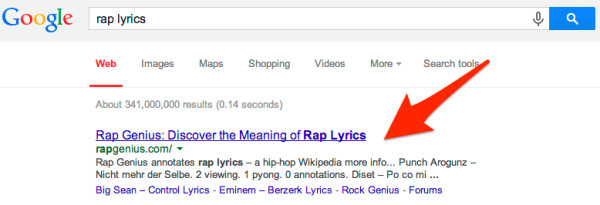
Now, 10 days after they were essentially removed from the search results, Rap Genius is ranking when searching for it on Google by name. It should be noted, the site was never completely removed from Google, but their content was showing up six and seven pages back in the results, which is pretty much just as bad.

Rap Genius

Source: Search Engine Land

We know the site lost a huge amount of traffic when they were penalized, but it is unclear how they are faring now that they are back. Most likely, Rap Genius will still struggle to regain their former foothold, at least temporarily. When searching by name, the actual website for Rap Genius is still listed below several news stories about their SEO troubles.

The site is also not ranking as well for many lyric searches they previously would have been listed for. Some lyric searches show Rap Genius, but Danny Sullivan from Search Engine Land shows they are still stuck on page seven for several searches.

Rap Genius is definitely the most publicly discussed SEO penalty so far. It has been reported on by Rolling Stone, NBC News, Huffington Post, and several other major news outlets. It is also the perfect case study for why you should never attempt to game the search engines for better rankings.

Rap Genius has been consistently transparent about the issues that occurred and what they have done to fix them, as well as what they can do in the future. You can read their initial apology here, as well as their more detailed blog post here. The blog post also concludes with an apology:

To Google and our fans: we’re sorry for being such morons. We regret our foray into irrelevant unnatural linking. We’re focused on building the best site in the world for understanding lyrics, poetry, and prose and watching it naturally rise to the top of the search results.

Rap Genius is seeing a relatively quick return to the search results, thanks to their dutiful efforts to fix the problems and their transparency. However, it will still be a long time before they reach their former status. It just shows that illegal SEO may get you results in the short-term, but you will eventually get caught.

Google Updates Banner

No matter what you personally think about Google, there are two undeniable facts about the massive company. They are the number one source of online searches by a wide margin, and they are constantly changing. Trying to keep track of all the individual updates from Google can be dizzying. It seems every time you are almost adjusted to one change, there is a new update popping up.

But, following the changes over at Google is important for anyone running a website. There are some pretty clear patterns in Google’s updates over the past year, and if you want your website to be successful through 2014, you will need to be prepared for the types of changes on the horizon.

To assist you in reviewing the changes from last year, E2M Solutions produced an infographic that covers a few of the most important updates on Google Search during 2013. As you might expect, Penguin and Panda are both big parts of the infographic. But, there are also some less known search updates such as Google Hummingbird.

The infographic isn’t perfect however. Search Engine Land points out that Hummingbird was not rolled out on August 20, 2013, as it is listed. Also, “Link Devaluation” has never been confirmed by Google, and thus it is only speculation. It is arguably pretty clear that links have lost some of their power in the past year, but it can be debated how that was actually implemented.

You can view the infographic below, or over at E2M’s website.

 11-Most-Important-Google-Algorithm-Changes-2013

2014The New Year is here and many are already looking forward, making resolutions and formulating predictions about the year to come. But, we can’t know what is going to look for in the future without looking back at 2013. The past year brought big changes to online marketing thanks to some big revisions in Google’s policies and the ever-changing world of design.

Whether you spent the past year doing the Harlem Shake or actively following all the notable blogs to keep your site up to the latest standards, you might want to refresh yourself on the big events and articles from the past year. With that in mind, we thought we would share our most popular posts from 2013. You can remind yourself what mattered in 2013, and see what might be important in 2014.

Our Most Viewed Posts

More and more businesses are attempting to establish themselves online, but when you’re working with limited resources it can be tempting to cut corners. It can sound easy to manage the basics of SEO with some cursory searching, and many SEO guidelines are either woefully out of date or simply preach bad practices which can lead to short-term success.

Experienced SEO professionals have learned how to keep up to date with the latest changes in search and avoid being smacked with a huge penalty, but those who are new to the industry or are trying to handle SEO as a hobby can end up walking their site right into the fire. If you don’t believe bad SEO can be so dangerous, just look at the recent headlines about the lyric website Rap Genius.

Rap Genius is similar to any other website you’ve gone to for the lyrics to your favorite songs, but (as the name suggests) it is almost entirely focused on hip-hop music. What made it distinct from the other lyric resources out there was the ability for community members to annotate the lyrics with context or explanations which can make more abstract songs easier to understand.

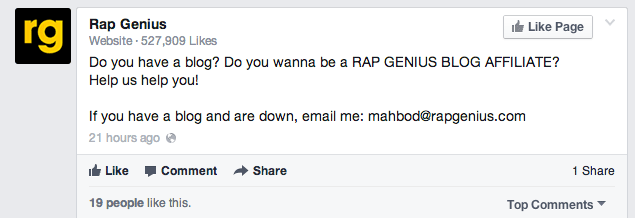
Rap Genius Affiliate Post

Over Christmas, Rap Genius also became notable for being the first popular lyric website to be hit with a massive Google penalty which has wiped their website off of the search results almost entirely. If you Google any for of Rap Genius related topics right now, you won’t find any results from rapgenius.com anywhere on at least the first four or five pages. You can still find links to their Twitter account, Facebook profile, and Wikipedia page, but the majority of the results at this point ironically focus on the SEO scandal.

Rap Genius has been using link schemes to manipulate Google’s rankings, and it appears they have been for a while. It could explain their quickly growing popularity up until this point, but their tactics were brought to the attention of Google’s search spam team, and soon after they were gone from the listings. It appears the scheme that got them into trouble was an “affiliate” program which encouraged bloggers to share  links with keyword heavy anchor text directing to Rap Genius in exchange for tweets from the lyric site.

The founders of Rap Genius issued a (sort of) apology, saying:

We effed up, other lyric sites are almost definitely doing worse stuff, and we’ll stop. We’d love for Google to take a closer look at the whole lyrics search landscape and see whether it can make changes that would improve lyric search results.

Rap Genius Traffic Lost

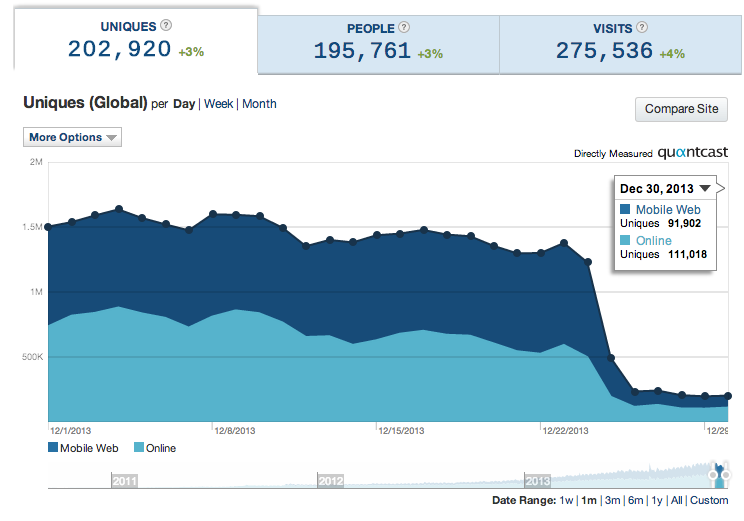
They still defend their actions, though they have sworn not to continue them, so it can be hard to take their resolve all that seriously. Even if they haven’t learned from their SEO problems, the stats since the penalty should be enough to convince you not to follow in their footsteps. Since the outage, Rap Genius has lost 80% of their traffic, and they are down in search visibility by 92%.

Simply put, shady SEO tactics might find you short term success like what Rap Genius enjoyed, but you will also suffer the same downfall for not following the latest guidelines or trying to game the system.

Keymaster

Source: Jason Tamez

Does Google control the internet? Of course no one has control over the entire existance of the internet, but the major search engine has a huge influence in how we browse the web. So, it is interesting to hear a Google representative entirely downplay their role in managing the content online.

Barry Schwartz noticed the statement in a Google Webmaster Help forums thread about removing content from showing up in Google. It’s a fairly common question, but the response had some particularly interesting information. According to Eric Kuan from Google, the search engine doesn’t play a part in controlling content on the internet.

His statement reads:

Google doesn’t control the contents of the web, so before you submit a URL removal request, the content on the page has to be removed. There are some exceptions that pertain to personal information that could cause harm. You can find more information about those exceptions here: https://support.google.com/websearch/answer/2744324.

Now, what Kuan said is technically true. Google doesn’t have any control over what is published to the internet. But, Google is the largest gateway to all that content, and plays a role in two-thirds of searches.

This raises some notable questions for website owners and searchers alike. We rarely consider how much of an influence Google has in deciding what information we absorb, but they hold some very important keys to areas of the web we otherwise wouldn’t find.

As a publisher, you are obliged to follow Google’s guidelines in order to be made visible to the huge wealth of searchers. It is an agreement which often toes uncomfortable lines as the search engine has grown into a massive corporation encompassing many aspects of our lives and future technology.

When you begin marketing and optimizing your site online to become more visible, you should keep this agreement in mind. A lot of people think of Google as a system to take advantage of in order to reach a larger audience. While you can attempt to do that, you are breaking the agreement with the search engine and they can penalize your efforts at any time.

As part of their year-end wrap up, Bing posted some of their highlights from the past year in the form of an infographic on the Bing Search Blog. The infographic summarizes some interesting facts and statistics from 2013 that mostly puts a spotlight on their recent growth. But, there are some parts of the infographic marketers and business owners might take interest in.

Bing Social GraphicFor one, you have probably heard how important social media is to establishing a brand online and engaging internet users, but you might not know that Bing is often more attentive to social media than Google. While Google’s rankings may factor in social media data for website owners, actual users see very little social media presence outside of YouTube and Google+.
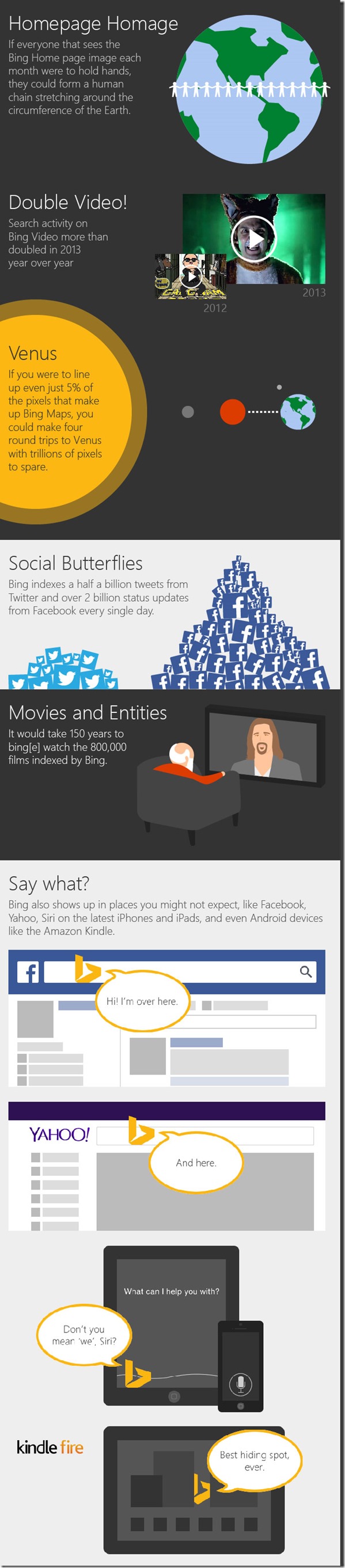
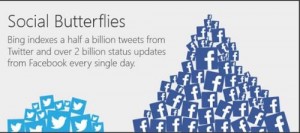
Meanwhile, Bing has been actively attempting to make Twitter and Facebook a significant part of their search engine. According to their end of the year stats, Bing indexes up to half a billion tweets from Twitter every day and over 2 billion Facebook status updates every single day. You might keep that in mind when considering which search engine you want to cater your social media efforts to.

You might also be surprised by where Bing is being used. Google is almost ubiquitous with web search, but you use Bing more often than you might think. The search engine is used on Facebook, Yahoo, Siri, and even some Android devices.

Other facts from the infographic include:

  • If everyone that sees the Bing Home page image each month were to hold hands, they could form a human chain stretching around the circumference of the Earth.
  • Search activity on Bing Video more than doubled in 2013.
  • If you were to line up even just 5% of the pixels that make up Bing Maps, you could make four round trips to Venus with trillions of pixels to spare.
  • It would take 150 years to watch the 800,000 films indexed by Bing.

The infographic is below:

Bing Year End InfographicaQQQQQQQQQQQ

The holiday shopping season is currently at a fever pitch, where it will likely stay until Dec. 26th, and more and more consumers are using the internet to aid their purchases. Online shopping isn’t new, but the prevalence of smartphones has made it easier than ever to turn to the internet to find what you need and shoppers aren’t shy about consulting the web before any purchase.

But, how does this affect shopping patterns and what are these consumers looking for exactly? If your brand is online, chances are you want to capitalize on the huge amount of online shoppers both at home and those using their smartphones while they shop. Unfortunately, a new survey from Search Engine Land and SurveyMonkey suggests this may be harder for smaller brands to do than anticipated.

It shouldn’t come as any surprise that many online shoppers are looking for well known brands, but it might raise your eyebrows to learn it is the most important factor to many shoppers. The survey conducted on November 21-22 of this year shows that 70% of shoppers are focused on finding brands they are already familiar with. The only other factor which received over 50% of the response was free shopping.

The good news is this doesn’t spell the end for local businesses trying to grow their brand during the commerce season. Location and reviews still made a strong showing in the results, as did sales. Many shoppers also focused on retailers who offer images and easily viewable prices for their products.

Smaller brands can also take some solace in knowing the survey was limited to a relatively small sample size of roughly 400 Americans using SurveyMonkey Audience. You can see a chart of the results below.

Online Shopping Survey Graphic

Source: Search Engine Land / SurveyMonkey

Google has been making a move towards providing searchers more lengthy and thorough content in recent history. They estimate that roughly 10 percent of all searches call for in-depth article information and they have been aiming to make those types of sources more available, especially when it may be more relevant for users.

The first big move came a couple months ago, back in August. The search engine launched an update to include in-depth articles for relevant searches, with a special block of articles at the bottom of the search results page.

Now, Google has expanded the in-depth articles section so that users can view even more comprehensive articles by adding a new link which reads “More in-depth articles” beneath the initial selection of sources. Clicking that link shows 10 more articles on the same page. A screenshot of the update is below:

In-Depth Article Update Screenshot

The latest update also implemented the ability to explore related topics with an explore section next to articles which may be connected to other keywords. Search Engine Land notes that you can also search exclusively for in-depth articles by adding &ida_m=1 to the end of your search URL.

Currently this new feature doesn’t have much impact on the content your brand creates, but the trend could have huge implications for the future of search and Google’s focus. For now the majority of searches call for less extensive results, but eventually longer and more detailed content could be hugely rewarding for those willing to put in the effort.

Google is attempting to bridge the gap between apps and normal internet use, and it appears their first step is to make apps part of the search results for Android users. When logged in, you will also be able to see what apps you have and search the content within them.

“Starting today, Google can save you the digging for information in the dozens of apps you use every day, and get you right where you need to go in those apps with a single search. Google Search can make your life a little easier by fetching the answer you need for you – whether it’s on the web, or buried in an app,” Scott Huffman, VP of engineering, announced on Google’s Inside Search blog.

Google App Search Graphic

These results won’t be ads for apps. Instead, when the best results for a query come from an app, Google Search will include the app in the result and make it easy to download or access. If you already have the app, you will just have to touch “Open in app” and you will be taken to the relevant content.

The app results will be grouped together, so don’t expect them to hurt many sites’ rankings or visibility. These results are just another option added for user convenience.
Currently only a few apps are compatible with the Open in App feature, including:

  • AllTrails
  • Allthecooks
  • Beauytylish
  • Etsy
  • Expedia
  • Flixster
  • Healthtap
  • IMDb
  • Moviefone
  • Newegg
  • OpenTable
  • Trulia
  • Wikipedia

“This is just one step toward bringing apps and the web together, making it even easier to get the right information, regardless of where it’s located,” Huffman wrote.

Search Engine Watch reports the new ability is currently limited to English version users of Android 2.3 or higher within the United States.