
Search engines have been attempting to get local search right since the invention of the internet, but they have only managed to make local search a major player as smartphones have allowed us to take the internet everywhere we go. Now that we can search for locations nearby, or double-check the time of the next bus from a bench outside, local SEO has gained real importance in how we organize use the web.

That also means it is more important than ever for businesses to make the leap into establishing an online presence. With the high level of connectivity in the modern day, not having an online presence for your business is becoming more and more like not existing. Searchers may be standing right in front of your business and decide not to come in simply because they can’t find anything about you online.

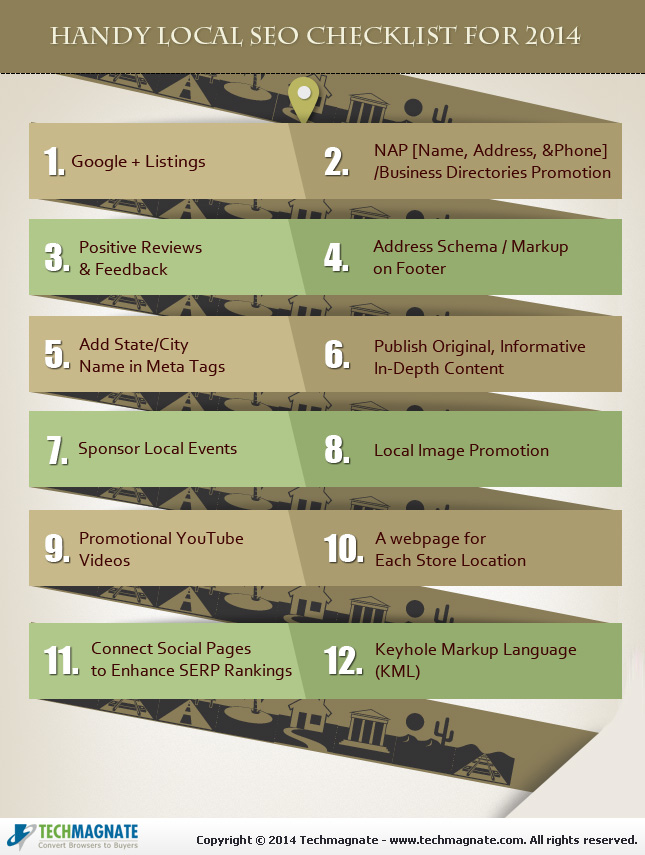
To really get your business cemented online, you need to do more than put a site online and wait for visitors. But, many places will barrage you with a million optimization techniques you can use to raise your visibility all at once, so it can be hard to know exactly where to start. Sarvesh Bagla made a checklist specifically so you know what you need to have done right now to expect your local business to have any online success.

Each step is laid out and explained in Bagla’s article on Tech Magnate, but they also created a nice graphic that you can keep close by, which can be seen below or printed off and hung by your computer to keep you on track.
handy-local-seo-checklist-2014

It is no secret that our use of the internet is becoming more and more mobile, but the day when we actually favor mobile search over desktop connections may be sooner than previously thought.

While speaking at SMX West last week, Google’s Matt Cutts told the crowd he “wouldn’t be surprised” if mobile search exceeded desktop queries by the end of this year. Another Google speaker during an informal round-table gave a similar comment at the International Franchising Association conference in New Orleans earlier this year.

Screen-Shot-2014-03-17-at-6.49.09-AM-600x347

Google refused to give an official statement, but it makes sense. Google doesn’t want anyone to be picking sides. Instead, they want to focus on cross-platform experience and marketing so that we can make the internet equally efficient and useful on every platform.

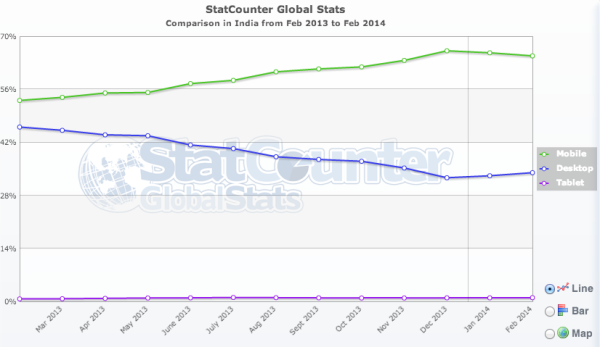
The comments are assumed to be referring to the global query volumes rather than the US or North America. Globally mobile traffic lies around 30 percent of all internet traffic, and North America has relatively similar ratios. However, many developing countries, such as India, already use mobile search far more often than desktop.

It is inevitable that one day mobile and desktop traffic will either reach a stalemate, or mobile traffic will begin to eclipse home desktop use. But, whether it will be this year is anyone’s guess. Personally, I’d be wagering on sooner rather than later.

By now you’ve probably noticed your search results don’t look like they used to. Google told the public their new look was just an experiment earlier this week, but now everyone is getting to see Google’s search results pages with the new design.

Jon Wiley, Google’s lead designer for Google Search basically made the announcement the new style was rolling outto desktop when he said on Google+. “you may have noticed that Google Search on desktop looks a little different today.” He specifies desktop users because the style was showing up much more prominently on mobile before the full roll-out.

As many have noted, the new SERPs have much larger titles and the underlines have been removed. Jon also notes that Google “evened out all the line heights,” which he claims “improves readibility and creates an overall cleaner look.”

Most of those changes won’t have a huge impact on the usability of the search engine, but visitors will have to become accustomed to a different way of marking ads. Google has used smaller yellow tags to pinpoint which results were part of ads on mobile, but desktop users have still been relying on the lightly colored boxes Google has relied on for years to mark ads. Google says the change is intended to unify the mobile and desktop search experience. Jon explained:

Improving consistency in design across platforms makes it easier for people to use Google Search across devices and it makes it easier for us to develop and ship improvements across the board.

There are bound to be plenty of complaints about the redesign. I personally don’t enjoy it as much as the old style, but most will acclimate to it fairly quickly. But, it isn’t a high-profile site redesign unless people initially throw a small tantrum in the meantime.

You can compare the old and new designs below.

Google Search Results New Design


Matt Cutts SquareThink Google’s attack on unnatural links and link spammers is limited just to the US? Think again. Google has made it clear they are targeting spammy practices from around the world, by attacking Polish and German link spammers over the past month, and now Matt Cutts has announced Spanish and Italian webmasters breaking guidelines will be the next to get taken down. For more information, you can check out the report from Search Engine Land.

Matt CuttsGoogle has been bringing down the hammer on spammy websites quite a bit recently with more specific penalties for sites that aren’t following guidelines. There have been several high-profile cases such as the Rap Genius penalty, and several attacks on entire spammy industries. But, if you are responsible for sites with spammy habits, a single manual action can hurt more than just one site.

It has been suggested that Google may look at your other sites when they issue manual actions, and Matt Cutts has all but confirmed that happens at least some of the time.

Marie Haynes reached out to Cutts for help dealing with a spammy client, and his responses make it clear that the client appears to be linked to “several” spammy sites. Over the course of three tweets, Cutts makes it obvious that he has checked out many of the spammer’s sites, not just the one who has received a manual action, and he even tells one way Google can tell the sites are associated.

Of course, Google probably doesn’t review every site penalized webmasters operate, but it shows they definitely do when the situation calls for it. If your spammy efforts are caught on one site, chances are you are making the same mistakes on almost every site you operate and they are all susceptible to being penalized. In the case of this client, it seems playing against the rules has created a pretty serious web of trouble.

John MuellerThere is no escaping a Google penalty without following the rules and doing the hard work to clear your name. It is old news that if you have suffered a penalty on your site and you moveto a new domain and redirect the URLs to that new domain, the penalty stays around thanks to the redirects.
However, some SEO’s may attempt to escape the penalty by moving their site to a new domain without redirecting the URLs. That way, theoretically Google can’t follow you and put the penalty on your moved site too. Unfortunately, Google’s John Mueller has quashed the notion pretty thoroughly.

In a recent Google Webmaster Hangout, Mueller explained that even if you move the site and don’t redirect, Google may still find you and apply the penalty again. Roughly 23 minutes into the video below, John answers Barry Schwartz’s question on the topic by explaining that if you just copy and paste the pages onto a new site without many changes, Google may still be able to pick up on the site move. Even if you do not set up 301 redirects or use the change address tool in Google Webmaster Tools, Google could potentially still know you moved domains and pass along the penalty.

John does explicitly explain in the video that Google doesn’t rely on their signals alone to pass along the penalty. But, if they receive signs that you are trying to hide the same site elsewhere under a new URL without fixing the core issues with your site, they will investigate and likely apply the penalty.

In the end, you will have to do the hard work you are avoiding to ever get rid of the penalty completely. It may sometimes be better to completely tear down a site and start from scratch to fix the issues that earned you the penalty to begin with, but you can’t just run away from it forever.

You can view the video below or here.

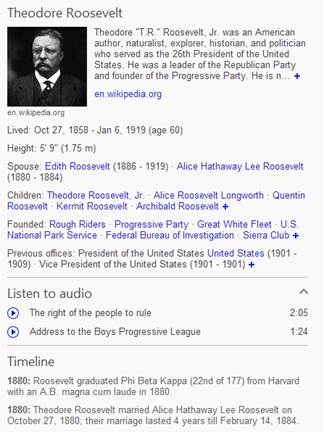
bingtimelineteddyrBing is quickly expanding their new timeline feature for celebrities and historical figures. Just a few weeks after premiering the feature for athletes participating in the Sochi Olympics, Bing has added the feature to searches for about half a million famous people.

If you haven’t seen the timeline feature, it is similar to Google’s Knowledge Graph, as both highlight important information on figures in a concise column. For example, the column includes standard information such as height, spouse, children, and parents. But, with the timeline feature, Bing also includes a chronological list of important events or dates in the life of the figure you searched for.

The timeline includes footnotes for all the major events, as well as listing the year they occurred. But, don’t expect to get those results for every celebrity. Bing says that in some cases where “you would be more interested in another type of information” about the celebrity, the timeline information won’t be shown in favor of more relevant data.

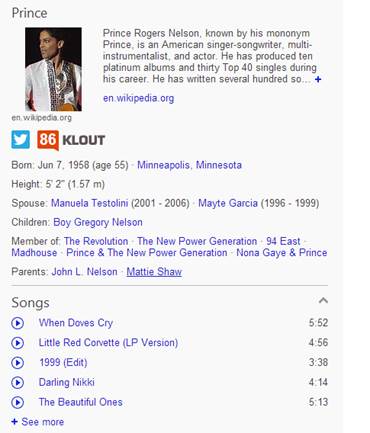
Search Engine Watch points out that this is most true for actors and singers. When you search for Prince, you won’t be shown a timeline. Instead, you will be shown information about his most popular sings, albums, and even romantic interests.

bingtimelineprince

If you use Bing and haven’t run into one of these timelines yet, just keep searching for celebrities or historically important people. Bing has made it clear the half a million celebrities with timeline featured are just the start of an even more robust search result system.

The biggest question this raises is whether the timeline will always be exclusive to celebrities, or whether Bing’s relationship with Klout may indicate an intention to expand their Klout-verified snapshots with features similar to timeline. Would you want searchers to be able to automatically see a timeline for you in a search engine?

SpellingPretty much anything Google’s most popular engineer Matt Cutts says makes headlines in the SEO community, but often his Webmaster Chat videos and advice aren’t mind-blowing by any stretch of the imagination. For instance, we recently covered a video where Cutts explained that bad grammar in the comment section most likely won’t hurt your ranking (unless you allow spam to run rampant).

For content creators, it was a legitimate concern that poorly written contents might negate the hard work putting into writing legible and well-constructed content. However, many used this to run headlines that Google doesn’t care about grammar, which is not even close to being confirmed.

As Search Engine Land points out, way back in 2011, Cutts publicly stated that there is a correlation between spelling and PageRank, but Google does not use grammar as a “direct signal.” But, in his latest statement on the issue Cutts specifies that you don’t need to worry about the grammar in your comments “as long as the grammar on your own page is fine.” This suggests Google does in fact care about the level of writing you are publishing.

It is unclear exactly where the line is for Google at the moment, as they imply that grammar within your content does matter, but they have never stated it is a ranking signal. Chances are a typo or two won’t hurt you, but it is likely Google may punish pages with rampant errors and legibility issues.

On the other hand, Bing has recently made it pretty clear that they do care about technical quality in content as part of their ranking factors. Duane Forrester shared a blog post on the Bing Webmaster Blog which states, “just as you’re judging others’ writing, so the engines judge yours.”

Duane continues, “if you [as a human] struggle to get past typos, why would an engine show a page of content with errors higher in the rankings when other pages of error free content exist to serve the searcher?”

In the end, it all comes down to search engines trying to provide the best quality content they can. The search engines don’t want to direct users to content that will be hard to make sense of, and technical errors can severely impact a well thought-out argument.

As always, the best way to approach the issue is to simply write content for your readers. If your content can communicate clearly to your audience, the search engines shouldn’t have any problems with it. But, if a real person has trouble understanding you, the search engines aren’t going to do you any favors.

bing-2Google isn’t the only search engine waging a war on black hat or manipulative SEO. Every major search engine has been adapting their services to fight against those trying to cheat their way to the top of the rankings. This week, Bing made their latest move against devious optimizers by amending their Webmaster Guidelines to include a stern warning against using keyword stuffing to try to rank highly.

The warning cuts the cheating SEOs no slack, cautioning that Bing may demote or entirely delist sites caught using keyword stuffing. The change wasn’t officially announced, but Barry Schwartz says it appeared in the guidelines sometimes yesterday.

The new section on keyword stuffing reads:

When creating content, make sure to create your content for real users and readers, not to entice search engines to rank your content better. Stuffing your content with specific keywords with the sole intent of artificially inflating the probability of ranking for specific search terms is in violation of our guidelines and can lead to demotion or even the delisting of your website from our search results.

Internet commenters aren’t quite known for their excellent grammar or insightful conversation. While there are plenty who contribute and expand on content with helpful information in the comments, there are also more than a few who struggle with language or actively try to troll other users with garbled borderline nonsense.

For most users, these types of commenters are a simple annoyance at most. But, for those who spend long hours crafting grammatically correct and easily-readable content, the less readable comments can cause some worry. While quality content is most important for users, content creators also aim for high legibility because it can affect rankings.

It is no secret that nonsensical or poorly written content doesn’t tend to perform well on search engines, but what about those comments that aren’t so carefully put together? Can comments with bad grammar or readability hurt your content’s rankings? According to Matt Cutts, Google’s most popular spokesperson, the answer is not really.

“I wouldn’t worry about the grammar in your comments. As long as the grammar on your own page is fine … there are people on the Internet and they write things and it doesn’t always make sense,” Cutts said in a recent Webmaster Chat video. “You can see nonsense comments on YouTube and other large properties and that doesn’t mean that YouTube video will be able to rank.”

The primary exception to this rule is spam comments. While nonsense comments or poorly written comments aren’t much of a problem for you, spam comments should still be removed to protect your SEO and generally improve user experience and site quality.

“Just make sure that your own content is high-quality. You might want to make sure that people aren’t leaving spam comments, if you’ve got a bot, then they might leave bad grammar,” Cutts said. “But if it’s a real person and they are leaving a comment and the grammar is not slightly perfect, that usually reflects more on them than it does on your sites, so I wouldn’t stress out about that.”

So breathe easy content creators of the internet; so long as you keep putting effort into making great content, you should be safe from any trouble with Google.