Google Product Ratings

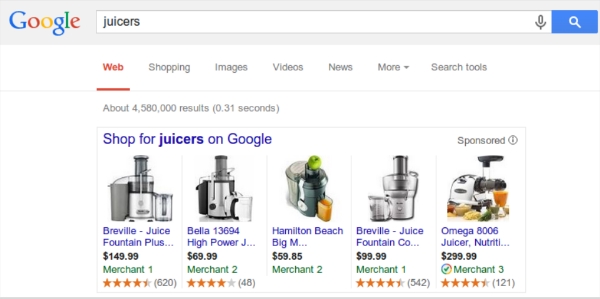
Google has been working hard to expand their reviews and ratings systems, and yesterday they made a big step by announcing that they will be introducing product ratings for Product Listing Ads (PLAs).

The announcement, which appeared on the Inside Adwords Blog, stated:

Product reviews provide critical information to shoppers making purchase decisions. To help shoppers easily find this information when searching for products, we’re introducing product ratings on Product Listing Ads.

Shoppers browsing on Google will see the typical product listings they have become accustomed to, but beneath the listings product ratings will also be shown in the shape of stars and review counts. For now it appears the changes will only be seen on search results within the United States.

The data used for these review listings will be gathered from multiple sources, such as merchants, third party aggregators, and editorial sites.

If reviews for businesses are any indication of what this change will bring, it seems very likely that businesses offering products with largely positive reviews will be able to leverage the updated listings to not only increase their click-through rates, but to also increase conversions overall.
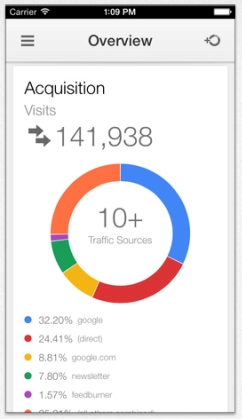
iOS MobileA few weeks ago Google finally got around to releasing the iOS version of Google Analytics. The app had been available for Android for quite some time, but the release to iOS makes website data available to webmasters at any time and it is fair to assume some business owners and webmasters may be trying to use Google Analytics for their first time.

While Analytics is without a doubt one of the most powerful tools for analyzing your website and how others are accessing it, it can also be a bit overwhelming for those who aren’t familiar with the layout and aren’t well versed in the terminology.

To help familiarize new and inexperienced webmasters with Google Analytics, Emma Barnes, who offers training on Google Analytics from Branded3, reviewed many of the most common questions she receieves and the terminology you can expect to run into when using Analytics.

Once those questions are out of the way, you may find yourself tasked with another question: “just what am I supposed to do with all this information?” For that, you may want to browse the recent article titled “11 Things You Should Be Doing With Google Analytics” from Search Engine Journal.

If you want to be in control of your website, you need all the information possible to make the right choices. Google Analytics can give you the numbers you want, but these resources will help you know what to do with it.

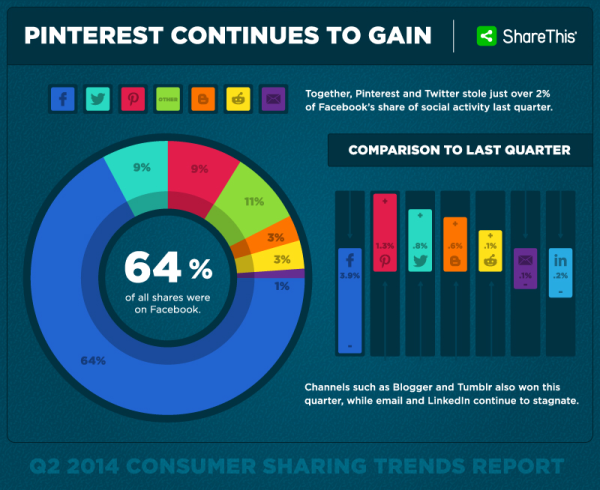
Facebook MobileThe majority of reports about Facebook this year would suggest the largest social media platform is about to crumble under its own weight. But, all the latest data from their Second Quarter 2014 Financial Summary indicates otherwise.

The report includes a ton of positive statistics for the social media leader, but the biggest findings are about how we use Facebook. Specifically, there has been a 19% increase in daily active users, suggesting that most people are including Facebook as a part of their daily lifestyle. Most likely, the ability to access Facebook on the go is responsible for a significant amount of the growth.

The total number of daily active users now sits around 829 million users.

Facebook also saw a significant jump in revenue, growing 61% compared to last year. Unsurprisingly, mobile also played a huge role in the jump, as it is responsible for 62% of overall ad revenue for the second quarter.

The report also included some other statistics which highlight the important role of mobile for Facebook.

  • Mobile daily active users were up 39% year-over-year, reaching an average of 654 million on for June 2014.
  • Monthly active users were up 14% over last year, reaching 1.32 billion as of June 30, 2014, an increase of 14% year-over-year.
  • Monthly active mobile users went up by 31% compared to last year, reaching 1.07 billion as of June 30, 2014.

local-business

Last night Google breathed new life into a forgotten algorithm by updating their local search algorithm to provide more useful, relevant, and accurate local search results that are more closely linked to traditional web search ranking signals.

While Google has remained mum on a large amount of the details, we do know the changes can be visible within Google Maps search results as well as traditional search results. From the online discussion, it also local businesses are also getting significant ranking and traffic boosts as most responses have been positive.

Most of the changes are behind the scenes, which Google doesn’t want to share with the world. However, Barry Schwartz shared that the new algorithm ties deeper into web search than previously by linking it to search features such as Knowledge Graph, spelling correction, synonyms, and more.

Google also says the new algorithm improves their distance and location ranking parameters.

The algorithm is already rolling out for US English results, but Google wouldn’t say when to expect it to roll out for other regions and languages, nor would they comment on what percent of queries have been effected or if web spam algorithms were included in the update.

As a business owner with an eye on your company’s online marketing success, you have likely heard about Google’s search engine algorithms. You may even have a general idea of how they function and effect your business’s online presence and marketing strategies.

But, unless you spend your free time reading all the SEO blogs, you probably have some questions about some aspects of how these algorithms work. If your business does international business, one of those questions is very likely if Google’s algorithms work the same around the world.

While the algorithms largely tackle the same issues, the short answer is that they do not all work the same on an international scale.

As Barry Schwartz recently highlighted, you can find specific examples of when algorithms vary across borders by looking at the Google Panda algorithm. The algorithm was initially launched for English language Google engines in February 2011, but the rest of the globe didn’t see the algorithm roll out for quite some time. Notably, it took 17 months for Google to release Panda in Korea and Japan to target Asian languages.

However, the Google Penguin algorithm didn’t have nearly the same delay. Penguin rolled out globally and impacted sites in any language.

What’s the reason for the difference? It all boils down to purpose. The Panda algorithm focused on language and content, and those algorithms have to be customized and focused based on the wide variety of languages found around the world. Meanwhile, algorithms like Penguin target off-page technical factors like links, which raises less of an issue customization.

Duplicate content has been an important topic for webmasters for years. It should be absolutely no secret by now that duplicate content is generally dangerous to a site and usually offers no value, but there are occasional reasons for duplicate content to exist.

Of course, there are very real risks with hosting a significant amount of duplicate content, but often the fear is larger than the actual risk of penalties – so long as you aren’t taking advantage and purposely posting excessive duplicate content.

Google’s John Mueller puts the risk of using duplicate content in the best context,. According to John, there are two real issues with duplicate content.

The first issue is that Google’s algorithms typically automatically choose one URL to show for specific content in search, and sometimes you don’t get to choose. The only way you can effectively let Google know your preference is by using redirects or canonical tags, and that isn’t foolproof.

Secondly, if you are hosted a ton of duplicate content it can actually make the process of crawling to overwhelming for the server, which will slow new content from being noticed as quickly as it should be.

Still, John said that in most cases, “reasonable amounts of duplication […] with a strong server” is not a huge problem, as “most users won’t notice the choice of URL and crawling can still be sufficient.”

Adobe Flash and mobile devices go together like oil and water. Since the release of the first iPhone it was clear that Flash, Adobe’s multimedia based web site technology, would not be coming to cell phones any time soon.

Years later, after the release of several generations of smartphones and the release of tablets, and it is even clearer that Flash is all but dead and will never be a part of the modern ‘device agnostic’ approach to web design. Unfortunately many webmasters still use it.

flash-serp-note-border-300x107That may not be the case for long, as Google has stepped up their fight against the technology. Google announced that starting today they will be warning mobile searchers when the search engine’s algorithms detect a web site is not supported on the device they are using due to Flash.

Rather than outright omit sites utilizing Flash from the search engine – which would garner heavy criticism – those using smartphones and tablets to search may see a warning that allows the user to attempt to view websites using Flash or to look for alternate search results.

The warning reads “Uses Flash. May not work on your device. Try anyway | Learn more.”

It seems pretty unlikely that many users will choose to press on knowing that the site likely won’t work for them.

In lieu of using Flash, Google highly recommends updating to HTML5 and upgrading sites to support that technology because it works in mobile devices and desktop browsers alike.

Google’s Keita Oda, Software Engineer, and Pierre Far, Webmaster Trends Analyst said, “fortunately, making websites that work on all modern devices is not that hard: websites can use HTML5 since it is universally supported, sometimes exclusively, by all devices.” Google simultaneously launched two new resources to help webmasters make the upgrade:

  • Web Fundamentals: a curated source for modern best practices.
  • Web Starter Kit: a starter framework supporting the Web Fundamentals best practices out of the box.
Source: Wikimedia Commons

Source: Wikimedia Commons

Brands have been complaining for quite some time that their Facebook engagement has been plummeting, especially for smaller brands who rely on organic reach to connect with their audience. Of course, plenty of analysts and SEO “gurus” have offered their fair share of strategies for increasing engagement, but most of these can be very expensive. Some would even cost more than giving in and using Facebook’s paid ad platform.

Don’t let that get you down though. Organic reach and engagement may be nosediving, but there are still free ways you can boost your page’s engagement. Just ask a few members of the Young Entrepreneur Council. Or don’t, because 10 founders from YEC already shared their suggestions on Search Engine Journal.

We may eventually reach a point where organic reach is effectively dead on Facebook, but there are always tactics available to negate some of the drop in engagement and get the most possible out of the free side of the largest social media platform available.

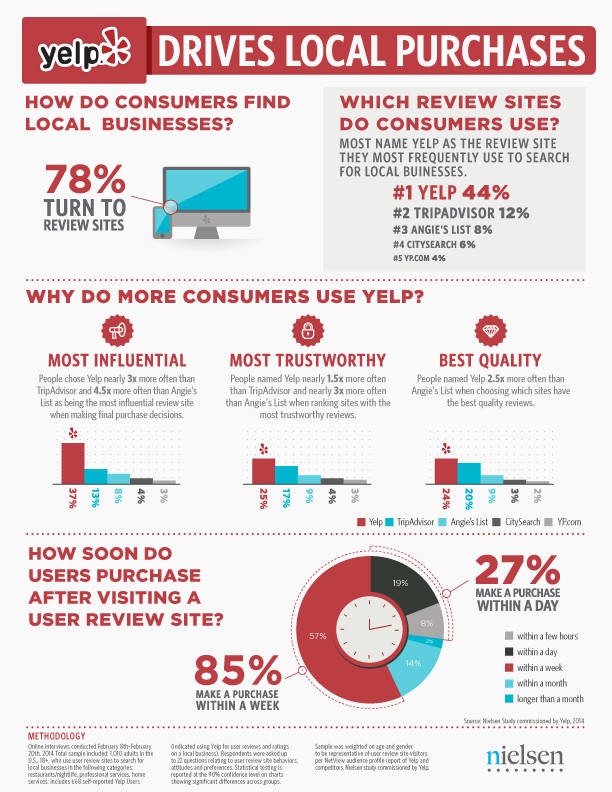
Earlier this week we reported on a recent study highlighting the growing influence of online reviews, and there is no service as closely associated with online reviews as Yelp. Of course, Yelp agrees and they’ve commissioned a new study from Nielsen survey data to show it is the most frequently used, most trusted, and even the highest quality local reviews site. But, many are skeptical of their findings.

The study used a sample of just over 1,000 US users of review sites, including competitors such as Angie’s List, Citysearch, OpenTable, TripAdvisor, YP, and Zagat. The survey consisted of 22 questions in all and the sample was weighted for age and gender to be representative of Nielsen’s NetView audience. In a blow to the credibility of the survey however, it seems only a few of the results were released – presumably the results which favored Yelp.

Out of what was released, the survey showed that 78 percent of consumers use review sites to find local businesses and help make purchase decisions, with Yelp taking the lead in several categories such as “most influential,” “most trustworthy,” and “best quality reviews.”

Another source of apprehension for this study was the decision not to include Google or Facebook. When asked, Yelp told Greg Sterling:

Our findings specifically around review sites came after we included Google and Facebook in a question on what sites people use to find local businesses, but those sites aren’t solely focused on local business discovery. We dug deeper into those sites that are.

That led Sterling to the conclusion that Google and Facebook likely exceed Yelp as a source for local business information, but it isn’t dishonest to exclude them from a study focusing specifically on “local business discovery” because both platforms have such broad usage.

The study isn’t completely invalid because of these inconsistencies. It goes without question that Yelp is at the forefront of local business discovery and reviewing and several other studies show that Yelp is in fact influential in local purchasing decisions. This study reinforces the fact that Yelp is a major player in these categories, but obviously it should be taken with some skepticism.

You can see the graphic displaying Yelp’s findings below:

6a00d83452b44469e201a73de98db6970d-800wi