Twitter Banner

The magic number for Twitter appears to be 140. The social network built its platform around 140 character tweets, and now it is taking a similar approach with its video service by limiting videos to 140 seconds, according to a recent announcement.

Twitter has allowed users to share videos on its network since last year, but the videos have been limited to 30-seconds maximum until now. The only exception was for a select number of advertisers who could post videos up to 10 minutes long. Now, users are getting a taste of that creative freedom with videos that go slightly beyond 2 minutes long.

The change will also be having an impact on the Twitter-owned Vine, which is known for looping 6-second-long micro-videos. Now, Vines can be used to preview or promote twitter videos which can be viewed by clicking the new “Watch more” button.

According to the company’s announcement, video tweets have gone up by over 50% since the start of this year and these new changes will allow more flexibility for users.

Along with this news, Twitter also announced that iOS and Android users are getting a new viewing mode which shows Vines or Twitter videos in a full-screen mode along with suggested videos.
PinterestLogo1

Pinterest may be one of the leading social platforms around, but its forays into advertising have been slow. The company took its time testing “Promoted Pins” to make sure they didn’t negatively impact users. When the ads finally were rolled out to all, they were also incredibly simple, with limited targeting and customization.

The company is finally expanding its ad platform with new targeting features that will give advertisers entirely new ways to connect with Pinterest’s more than 100 million monthly active users, according to a recent announcement.

Now, you can focus your ad efforts to make sure you are only targeting users who are likely to be interested in your brand and your products, improving the ad experience for both users and advertisers at the same time.

Customer List Targeting

Much like Facebook’s Custom Audiences, Pinterest’s custom list targeting is designed to help you connect with your existing customers on the social image board by targeting users from a list of your customers using email addresses or mobile ad IDs. Pinterest will then match your list with its own user database so you can serve them ads directly.

Visitor Retargeting

Retargeting is a great way to keep potentially interested visitors to your site engaged with your company even if they don’t initially make a purchase. With Pinterest’s visitor retargeting option, you can tag users that come to your site and serve them ads that are particularly suited to their interests and needs.

According to Pinterest, visitor retargeting has increased click-through rates (CTR) by as much as 3x for those who were granted early access to the option.

To use visitor retargeting, you will have to add Pinterest’s conversion tag to your site, which will allow you to tag or exclude users who have:

  • Landed on your homepage
  • Signed up for something
  • Added an item to their cart
  • Checked out

Lookalike Targeting

You might be familiar with this targeting option thanks to the version of it in use at Facebook called Lookalike Audiences. Lookalike targeting lets you reach out to groups of people based on their behaviors and interests specifically based on the activities of your customers.

Pinterest reports that this option increased CTRs for early-access users by up to 65% and increased reach for ads by nearly 30x.

iphone-410324_640

Since its launch in 2010, Apple’s ad service known as iAd has seemed largely like an afterthought. In fact, the company had announced earlier this year that iAd’s services were being discontinued. This all makes the iPhone maker’s latest announcement a bit of a surprise.

Ahead of this year’s Worldwide Developer Conference (WWDC), Apple announced it is revamping its App Store. One major part of this reworking is the introduction of paid search ads for apps in the company’s app store.

Apple is starting small by adding a single paid ad to the top of search results within the App Store for users in the US. However, there already appears to be pushback from users and developers who say they would prefer improvements to the organic search results before including paid ads.

In an interview with the Telegraph, Apple’s senior vice president of marketing, Phil Schiller, explained that the company believes paid search ads will allow developers to focus their marketing budgets specifically in places where people are most likely to download their apps.

“There are hundreds of millions of searches on the App Store every week, and 65pc of app downloads are driven by search,” he said. “It’s a very valuable tool for users and developers. For developers, this will be very efficient marketing.”

The ads will be available in a self-serve auction-based platform similar to Google’s AdWords with no initial minimum spends.

To prepare for the revamp of the app store, Apple is adding ad features like its Search Match feature, which is comparable to Google AdWords Universal App Campaigns. The feature allows advertisers who aren’t familiar with the platform or are limited on time to create an ad campaign in as few steps as possible.

Apple Search Ads will not officially launch until the fall, but the company is allowing developers and marketers to get familiar with the platform through an opt-in beta from Apple’s developer portal.

InstagramBanner

The algorithmic timeline is starting to take over.

For the longest time, the algorithmic timeline was a defining characteristic of Facebook, while sites like Twitter and Instagram used chronologic timelines to keep people up to date as things happened in real time. However, Twitter made the controversial decision to implement an algorithmic timeline earlier this year and Instagram has officially announced they will be making the change next month.

Of course, this isn’t a total surprise. The Facebook-owned platform was bound to implement the algorithmic timeline sooner or later. In March, Instagram started testing an algorithmic which sorts user’s feed based on their interests and activity instead of sorting feeds by the most recent posts.

The announcement of the algorithm tests prompted a collective panic attack among many who bemoaned the loss of one of Instagram’s defining features and worried their posts would be seen by fewer people. However, Instagram says switching to an algorithmic timeline will actually increase exposure for posts, especially from influencers and brands.

According to the photo-and-video social platform, people miss 70% of the posts from people they follow when they use a chronologic timeline. The company says their tests showed the new timeline increases exposure and engagement, which is a win-win for users and brands.

“We found that people are liking photos more, commenting more and generally engaging with the community in a more active way,” Instagram wrote in a company blog post announcing the official rollout.

It is no secret that visual content is more engaging to readers. Whether you use infographics, social media images, video content, or just creating ads that are visually attractive, users will always react more to content that is more than just text on a screen.

But, just because you are using more visuals in your content and doesn’t mean they automatically work. Aesthetically pleasing content can be a great way to engage users, but you can still lose a huge amount of visitors if your content isn’t compelling and exciting.

To help you guarantee your visual ads are truly visually compelling and engaging, Bannersnack recently shared an infographic breaking down everything you need to know about visual ad creation. If you want to guarantee your visual ads are killing it every time, check out the infographic below or at Bannersnack.

The-ABC-of-Visual-Ads-That-Work.png

As smartphone internet use has exploded in the past few years, mobile-friendly pages and search engine optimization have become the standard, but new statistics from Bing suggests the future of SEO may be all about voice search.

During the Search Insider Summit last week, Bing representatives told the crowd that a quarter of all searches performed on Bing are voice searches and the trend looks keep increasing for the foreseeable future.

Additionally, as users get more accustomed to voice search, it is changing how they are performing searches entirely. Voice searches are notably longer, tending to fall between six and 10 words, compared to just one to three words for text searches.

Part of this notable rise of voice search on Bing is likely because the company powers three of the leading voice assistants in the world. Apple’s Siri, Microsoft’s Cortana, and Amazon’s Alexa are all reliant on Bing to answer voice search queries. However, that shouldn’t discount these findings entirely.

While Google hasn’t released any statistics on voice searches performed on their platform, the company has taken clear steps to invest in voice search for future growth – such as using Google’s AI to recognize conversational speech in voice searches by having it read romance novels.

Clearly, the two largest search engines recognize that voice search will only become more prominent in the future. Likewise, marketers, SEOs, and businesses should start preparing now by investing in long-tail keywords and voice search optimization.

Social media has undeniably become one of the strongest channels businesses can use to reach out and engage with their audience. But making social media work for you means knowing which platform works best for your business.

You might think that all social media sites are essentially the same, but making that mistake can mean squandering marketing and ad budgets trying to connect with an audience that just plain isn’t interested.

The truth is every social media platform has a unique audience who interact with each other in ways specifically molded by the site they frequent. Trying to talk to Twitter users the same way you talk to Facebook users will make your message fall flat, while Instagram, Pinterest, and Snapchat users all have their own cultures built from the platform.

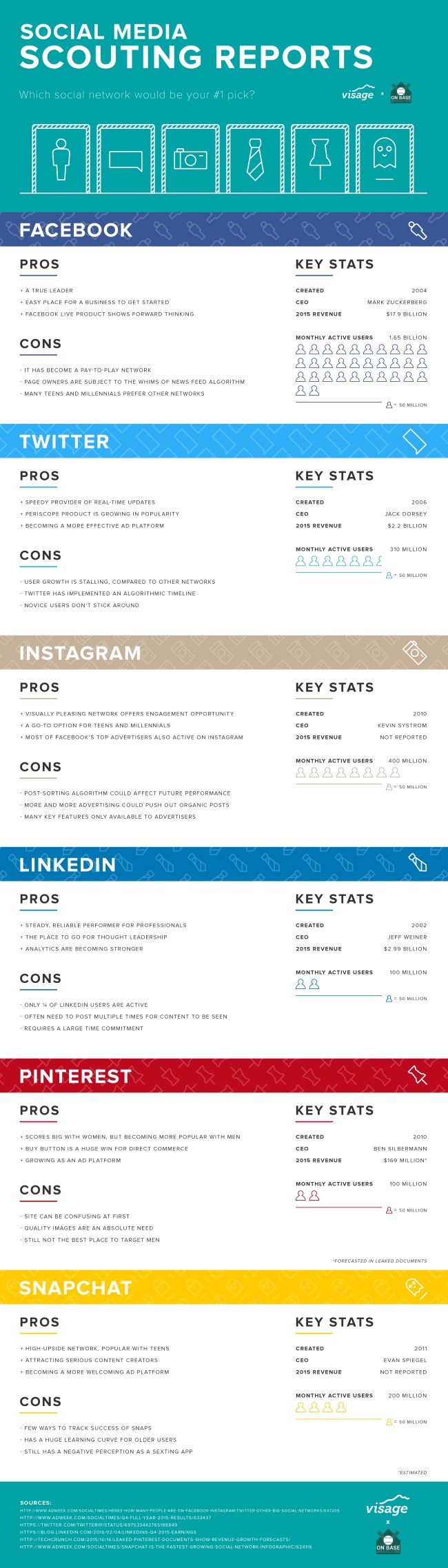
So which is right for you? It all depends on your business, your values, and who your audience is. The infographic below from Visage will walk you through the basic pros and cons of each of the most popular social media sites, along with some key stats about each social network.

Identifying the best social network for you will help you get the most out of your marketing efforts and find the most responsive audience for your brand.

pros-cons-social-networks-infographic

Snaochat

A new type of ad has arrived at Snapchat. The social imaging platform has recently been diving into monetizing content on its platform. Their latest venture allows retailers to share ‘shoppable ads’ on the app, which allow users to shop for products without ever leaving Snapchat.

The ads appeared for the first time recently within Cosmopolitan’s Discover channel. Both Target and Lancome launched shoppable Snapchat ads that run 10 seconds and are shown between Cosmo’s normal article and video content.

If users are interested in the products or services shown in these ads, they can swipe up at any time to be taken to an in-app mobile site to purchase the featured products.

Just as with normal Snapchat content, shoppable ads are limited to 10 seconds long. Longer ‘snaps’ and ads are likely on the horizon as Snapchat has recently been experimenting with longer video formats.

To help drive excitement for the social ad platform, Snapchat also announced that users watch over 10 billion videos every day, with 60 percent of daily active users creating and sharing their own content every day.

ad quality lookback

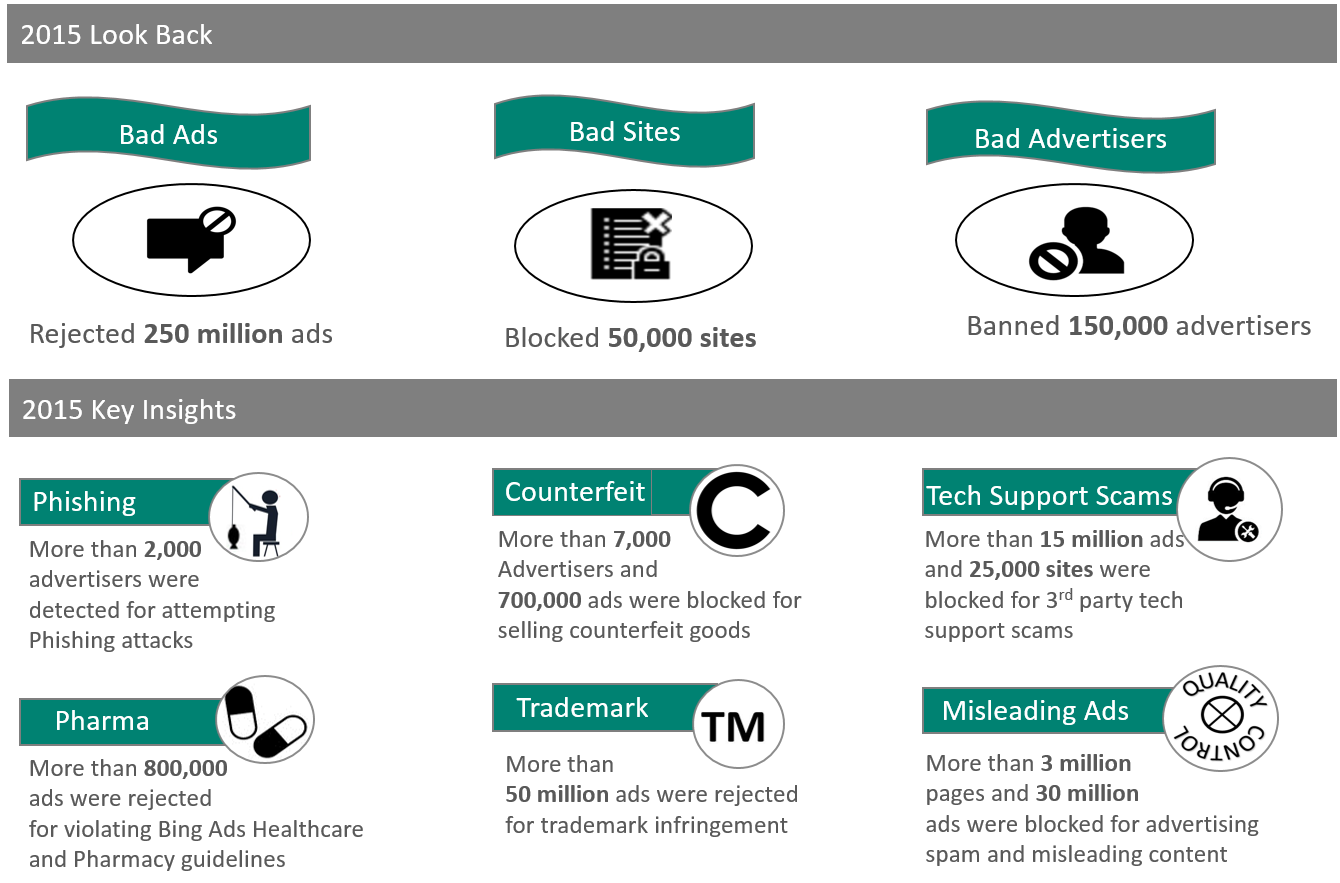
Every year Bing likes to highlight its efforts to keep the web safe with its “Bad Ads Report” and this year shows that the endless war against online scammers and hackers has remained largely consistent recently.

Despite constant efforts to derail the malicious actors on their platform, tech support scams and purposely misleading ads remain the biggest problems on Bing Ads. The company blocked over 15 million ads for running tech support scams alone.

Overall, Bing says it has rejected over 250 million ads in the past year, as well as blocking 50,000 sites, and banning 150,000 ads for breaking their guidelines.

Considering Bing’s trademark usage policies are relatively loose compared to competitors like Google, it comes as a surprise that the company says it dismissed more than 50 million ads in 2015 for trademark infringements.

The rest of the report is less surprising. Phishing attacks remain a relatively minor issue, and pharma and counterfeit goods are still being delisted by the hundreds of thousands.

Find out more from Bing’s ad report here.