If your brand has a LinkedIn page, you are undoubtedly trying to amass followers to grow your company’s profile and expand your reach. 

Now, you can learn from the best. LinkedIn revealed the top 10 most followed pages across the platform this week, along with some added insight into why these pages have been so popular. 

The Top 10

  1. TED Conferences (12.5M followers): Few pages so completely sum up LinkedIn’s audience like TED Conferences, where business leaders share insight, motivation, and inspiration to other professionals. Specifically, the page consistently shares a mix of videos, articles, and images all aimed at business professionals. 
  2. Google (12.1M followers): While Google’s name recognition can’t be ignored, the brand keeps users engaged with its page through steady new content centered on themes of corporate social responsibility, innovation, and by prioritizing the real people behind the scenes at the company. 
  3. Amazon (8.6M followers): This shopping giant places a heavy emphasis on its employees, including frequent videos and articles highlighting the stories of their workers. In this vein, the company also shares inside looks at its company events, and even offers professional advice like job interview tips.
  4. LinkedIn (8.2M followers): Unsurprisingly, the platform’s own page is high in the rankings. Still, the page strives to keep users interacting with their company page through regular content aimed at a wide audience of business professionals, employers, and job-hunters.
  5. Microsoft (7.8M followers): Microsoft doesn’t just use its page to publish branded content about its latest events and products. It also helps share outside content from other business leaders, and promote content created by its employees.
  6. IBM (6.4M followers): IBM takes an appropriately tech-focused angle, but with a distinctly personal edge. The company promotes diversity and inclusion by promoting employees in the news, as well as highlighting its latest innovations in AI, cloud computing, and blockchain.
  7. Unilever (6.2M followers): Curious how this relatively low-profile consumer goods company has gotten this high on the list? Just scroll through their page. You’ll find tons of high-quality, concise content including short videos with clear messages that can be understood even without audio. 
  8. Nestlé (6.0M followers): While Nestlé does create and share content aimed at a wide-swath of business professionals, the main locus of its LinkedIn page is driven by recruiting and hiring workers interested in pioneering the “future of food.”
  9. Accenture (4.4M followers): This multinational marketing firm has grown a massive audience through a steady feed of high-quality content including short videos and business-centric podcasts.
  10. Facebook (4.4M followers): Similar to Nestlé’s page, Facebook uses its presence on LinkedIn to drive recruitment with content focused on career development and professional opportunity. 

What You Can Learn

While these pages cover a wide range of industries and content strategies, there are a few clear commonalities across the most followed pages on LinkedIn:

  • All of these pages create and share original video content.
  • They also use a significant amount of their content to highlight socially responsible initiatives and company values. 
  • Many of these pages put the spotlight on their own employees and their unique stories or talents. 

If you’ve been trying to grow your follower count on LinkedIn, you can definitely take a few pointers from these leaders on the platform.
In a post to the company’s business-focused blog, Twitter revealed this week that Tweets including videos generate 10-times the engagement compared to posts without video.  

Most importantly, the pot highlights the fact that you don’t need a Hollywood-sized budget or cutting-edge cameras and microphone to attract this level of engagement. You just need an average smartphone. 

“Your phone is a fully capable multimedia studio in your pocket, giving you everything you need to create compelling content on the go.”

To help get you started, the company also provided a few ideas to spark your creative side. 

GIF It Up

Using existing GIFs you’ve found around the internet can be a tempting way to connect with your audience and show your pop-culture savviness. Instead, however, Twitter recommends creating your own, original GIFs.

Creating GIFs is also easier to do than most people realize. There are countless apps available for Android devices to help you create GIFs, but iOS users have it even easier. The iPhone’s Photos app includes a built-in GIF mode which can convert any video into a GIF. 

If you need more motivation to start using GIFs more often, Twitter also says tweets with GIFs generate up to 55% more engagement than those without. 

Record Your Screen

Another feature included in most phones is the ability to record your own screen and turn it into content. 

This is especially useful for more technical how-to’s or guides, though you can also find ways to show off your online shopping process, highlight your products, or easily turn a photo slideshow into a video. 

Use Stop Motion

via GIPHY

On the note of image-based slideshows, another type of video content you can easily create with your phone is a short stop motion video. 

If you aren’t familiar with the term, stop motion is the very foundation for all animation. The process simply includes taking a series of photos and playing them quickly enough to show action or movement. 

On your phone, the process is typically as easy as taking a photo, moving your position or the object you are photographing slightly, and taking another photo. Then, repeat. .

You can use these ideas to get started making stop motion videos to share:

  • Move the camera around the object
  • Keep the camera on a tripod and move the object instead
  • Add details to the object like drawings or text
  • Take the object apart to show how the parts fit together

For more tips on creating videos, check out Twitter’s best practices for videos.

It is no secret that our relationship with telephones and marketing calls has drastically changed over the past 5 years. There are mountains of anecdotal evidence that the vast majority of people have stopped answering phone calls from numbers they don’t know – even in the B2B space. 

However, it has been surprisingly hard to find reputable data on the matter, until now. This week, Zipwhip published a new survey which provides some insight into exactly how effective (or ineffective) cold-calling, outcalls and other forms of marketing calls are in 2019. 

People Aren’t Answering Calls

Unsurprisingly, the findings are not particularly positive for phone-based marketing or sales. The survey showed that more than 85% of people say they ignore phone calls from unknown numbers “often” or “very often”. 

What might surprise you, however, are the reasons why so many people are avoiding phone calls. 

The most obvious contributing factor would be the rise of robocalls over the past decade, with nearly half of all mobile calls in the U.S. this year predicted to come from mobile-phone spam. 

Despite several efforts to slow the tidal wave of phone spam, the FCC still says the best way to avoid these spam calls is “don’t answer calls from unknown numbers.”

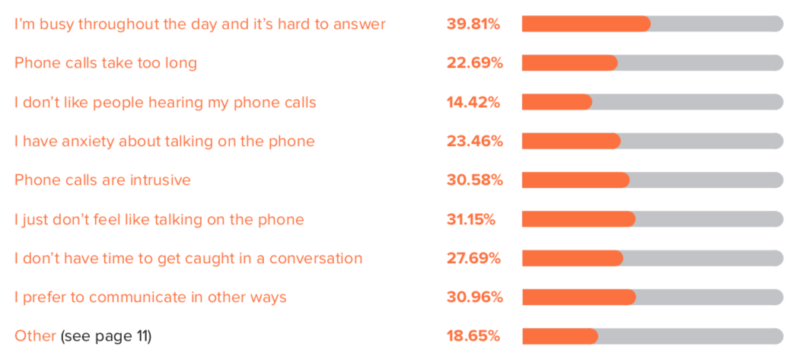
Still, respondents to the survey cited several other reasons they prefer other forms of communication.

The reasons vary, but they all come back to a few central issues – talking on the phone is public, time-consuming, and disruptive.

In fact, when asked directly “how often do you find calls to be disruptive”, less than 4% of respondents said calls were never disruptive. The breakdown of answers was:

  • Always — 27.69%
  • Sometimes — 68.5%
  • Never — 3.65%

What This Means For Your Business

If you feel like your cold calls have been less effective in driving leads, you aren’t alone. As Zipwhip’s findings show, just getting people to answer unsolicited calls can be a big ask for today’s consumers and businesses. 

However, there is still one essential way phone calls should be a part of your business operations. Consumers may not like unsolicited calls, but they still widely agree that calls are the preferred way to contact local businesses or receive customer service for issues they are facing. 

When it comes to outbound marketing, phones are quickly becoming a pariah and those who refuse to adapt to the latest methods of contacting cold prospects will likely get left behind with the spam callers.

Twitter is launching a new video ad option which allows advertisers to create and run short video ads (under 15 seconds) and only be charged if the ad is viewed for at least six seconds. 

The company describes the new ad unit as a “flexible option for advertisers who care about the completed view metric, but are ready to lean into the mobile-first paradigm and develop short-form assets optimized for in-feed viewing.”

What You Should Know

The new ads are similar to YouTube’s short bumper ads which typically run before pieces of content or as an ad-break during videos. As such, the ad is believed to be highly effective for driving high view rates.

For example, Alice Oliveira, the CSB Brazil marketing director for Dell, says “this six-second video ad solution, paired with compelling creative, increased our view rate by over 22%.”

Oliveira and Dell were one of the select few given early access to the ad bid option. 

Last Notes

  • The new video ad option began rolling out on Monday and is expected to be live by the end of the week. 
  • It is available for Promoted Video, In-Stream Video Sponsorships, and In-Stream Video Ads that are 15-seconds long or less.
  • Instagram considers a video to be viewable if at least 50% of its pixels are on-screen.

Google has started automatically adding a large “Request a Quote” button to eligible business listings in its local search results.

The button appears to be limited to just businesses who have opted into the Google My Business messaging feature, which would allow customers to directly message a company representative. However, it is unclear what specific industries the button is being added to.

With the new feature, users can now immediately request a quote from your company directly from the local search results – without ever visiting your website. 

While that means less traffic to your website – and potentially less informed leads – it also makes it more convenient than ever for potential customers to initiate the sales process.

While we can’t guarantee your listing will be given the “Request a Quote” button, we do know that being signed up for GMB’s messaging feature is a requirement for the new feature. 

To turn on messaging for your own listing, just follow these steps:

  • Download and open the Google My Business app
  • Log in with the credentials for the account associated with the listing
  • Open the location you’d like to manage
  • Tap Customers
  • Tap Messages
  • Tap Turn on

Once this is done, you will be able to receive messages from customers within the app. Users will receive their responses through their Google Maps app.

Facebook is changing how videos and photos appear on mobile devices, with new aspect ratios for visual posts and less accompanying text in the mobile news feed. 

This means you’ll have to make some changes when optimizing for Facebook’s mobile news feed if you want everything to appear properly in your posts.

What’s Changing

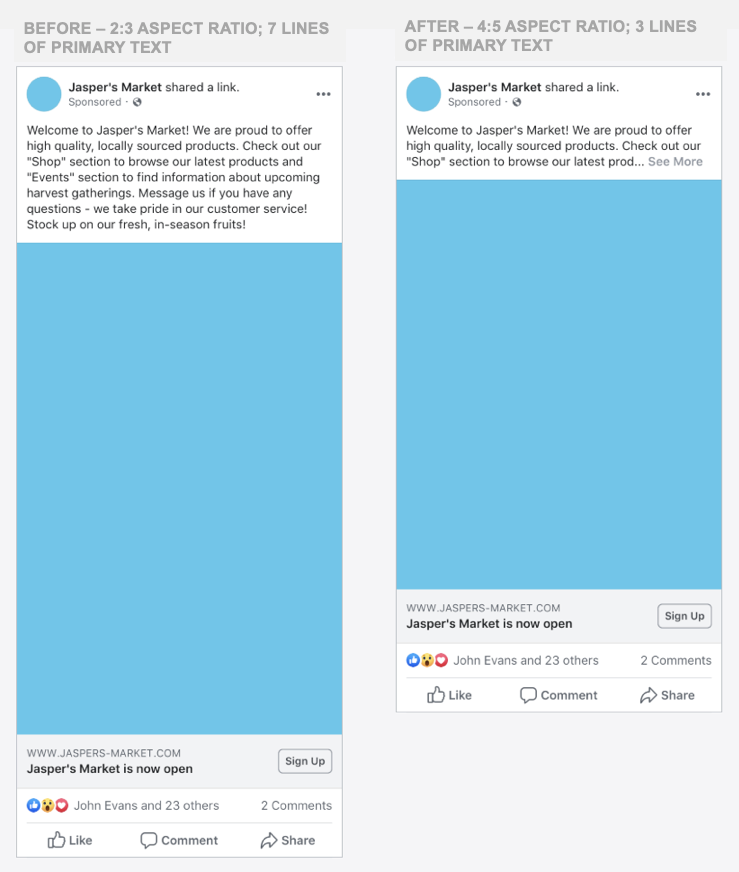
In the past, images on Facebook were optimized for a taller 2:3 aspect ratio to a more square 4:5 aspect ratio. 

Anything taller than that will be cropped out in preview images within the news feed, only actually viewable to those who tap to see the full image. 

At the same time, the platform is reducing the lines of text accompanying these posts – going from 7 lines of text to just 3 lines. 

Anything longer than that will be hidden behind a prompt to show additional text. 

Both of these changes will be put into effect starting on August 19th, giving you a few weeks to make adjustments to your upcoming posts. 

According to a spokesperson from the company, the tweaks are “designed to simplify our formats and improve the consistency of our mobile experience.”

In turn, the company says the new post format will increase the impact of mobile ads and make it easier to use the same content across both Facebook and Instagram.

When it comes to growing your business on social media, everyone automatically starts thinking about Facebook. That’s great if you have a brand which suits that platform, like a clothing brand, athletic equipment company, or content publishing website. 

For B2B companies, though, it may not be the most useful. 

In fact, you might be better served by another platform entirely: LinkedIn.

Despite its reputation as an “online resume site”, LinkedIn has proven itself as a powerful platform for connecting businesses, finding leads, and increasing sales. 

It is so powerful that one study found that 92% of B2B marketers agree that LinkedIn is the best place to win leads and 64% of corporate website visits come from the platform. 

If this has got you intrigued, I want to share a few quick tips you can use to start improving your LinkedIn presence today:

1) Your Personal Profile is as Important as Your Business Profile

This one might seem a little odd to those coming from other social networks like Twitter or Facebook. 

On those sites, you can typically keep your personal profile completely separate from your professional pages without any issue. 

On LinkedIn, you are expected to interact as a representative of your current company. As such, it is important for you to put just as much, if not more, effort into maintaining your personal profile compared to your company’s profile. 

2) Share Content

If you want to engage with the community on LinkedIn and make a name for yourself, you have to start speaking their language. Coincidentally, the language of LinkedIn is content. 

Passionate business owners and representatives use the site to talk about their experiences, share tips, and otherwise “talk shop”. 

If you want to stick out, you have to start sharing your own tips and information, commenting on theirs with your own thoughts, and start being a part of the conversation. 

3) Follow Up With Real-World Connections

How often do you meet someone who seems like a great prospect, exchange business cards, and then let that person disappear into the ether – never to be heard from again? 

Whether it’s a guest at a networking event you recently attended, a friend-of-a-friend, or a prospect you spoke to the other day, there is always a good chance you can find them on LinkedIn. 

This will not only give you the ability to touch base with a prospect you let fall away not too long ago, but it will help you constantly prove your value to potential customers until they eventually need you. 

Make a practice to connect with any professional acquaintances you make to keep in touch with them and keep your brand in their mind. 

4) Join or Start Groups

Another great way to get in on the discussion with other people interested in your industry is with LinkedIn Groups. 

This is where people have a more focused conversation, asking for help with problems or sharing the latest news in your market. There are tons of groups out there for you to join in with pre-established audiences of other professionals in your industry, or you can always choose to start your own group and really position yourself as an authority. 


LinkedIn has grown a long way from the small little resume listing site it may have started as. These days, it is a central hub for both businesses and professionals from all industries around the world to connect and establish their reputation. Most importantly, it has also shown that it can be a reliable source of leads and revenue.

A recent study from BrightLocal highlights exactly how powerful Google My Business is for helping local companies get found by local consumers and increase their sales. 

The findings are the result of research from 45,000 businesses using GMB from 36 different industries from 4 countries. 

Based on the findings, it seems that GMB not only helps improve search engine visibility, but phone calls, store traffic, and more. 

GMB Gets Your Business Found Over 1,000 Per Month

On average, the study says an individual business gets found in Google My Business listings in 1,009 searches each month – or approximately 33 times a day. 

Importantly, more than 80% of those searches are “discovery” searches which seek out a business category rather than a specific business name. 

The findings also revealed that three-quarters of these searches were done using Google Search, while the other 25% was done on Google Maps. 

5% of GMB Listing Views Convert

Local businesses receive an average of 59 actions each month from their Google My Business listing, according to the report. 

When you compare that with the 1,009 views each month, that suggests roughly 5% of GMB listing views directly lead to a website click, call, or direction request. 

Compared to BrightLocal’s findings from 2017 to the most recent study, that is a 25% improvement in conversion rates – rising from 3.87% to 4.83%.

Specifically, businesses received approximately 29% more website clicks from their GMB listings and 22% more calls. 

Other Findings

The study noticed that listings with more images received more views compared to those with fewer photos. 

Overall search volume also increased from 2017 to 2018, with direct searches up 38% and discovery searches rising by 6%.

To see the full report on the performance of GMB listings, click here.

Pinterest has launched several new features aimed at making it easier for businesses to share and manage their videos on the platform. 

Businesses now have access to a new video upload tool which simplifies the upload process, a new tab within their profile solely dedicated to videos, and a new analytics tool which gives a long-term view of how your videos are performing. 

On top of all of this, Pinterest has also expanded its Pin Scheduler tool to allow businesses to schedule posting video content in advance. 

The Big Picture

While these new tools signal Pinterest’s devotion to improving its video offerings, it also signals a larger shift for the company. 

Pinterest has typically lagged behind other social networks when it comes to tools or features aimed at businesses. Over the last year, however, the company has paid significantly more attention to these areas by expanding its advertising tools, launching new e-commerce features, and, now, making video content more feasible. 

In the announcement of the new features, CEO and founder of Tastemade, Larry Fitzgibbon echoed this sentiment and expressed just how effective sharing videos on the platform can be:

“As early adopters to video on Pinterest, Tastemade has successfully driven over one billion video views and 200 million engagements year-to-date, while growing our following 100% year-over-year,” said Tastemade CEO and Founder Larry Fitzgibbon, “It’s clear that Pinterest users are hungry for videos that are both entertaining and actionable.”

Pinterest also says that videos on the site outperform videos on other social networks because their platform is more likely to resurface content over time.

If you have claimed a short name for your Google My Business listing, you may want to be on the watch for a new bug which is causing some GMB listings to be suspended. 

Short Names for GMB were first introduced back in April as a way for businesses to create unique URLs for their Google My Business listings and easily differentiate individual locations in search results. 

However, a wave of reports suggests that some who claimed a short name for their legitimate listings are being suspended and removed from search results entirely. 

It is important to note that the issue does not seem to be affecting all Google My Business listings with short names. Still, the issue is widespread enough for many agencies to be sounding the alarm. 

Specifically, Joe Youngblood started alerting others about the issue last week, including sharing screenshots from a Facebook group where those affected were speaking out. 

As you can see, the issue only affected 2 of more than 10 listings the person above manages, with other listings using short names being entirely unaffected. 

The initial reports of the issue began early last week, but new cases are still being reported this week. SEO professional Lily Ray says one of her listings was suspended yesterday, almost immediately after adding a short name to the listing. 

While Google has not officially confirmed the problem, many say they have been able to get their listing successfully reinstating when notifying the search engine. 

With all this in mind, you might consider holding off on adding a short name to any of your Google My Business listings until the bug is fixed. If you already have a listing with a short name, it would be worthwhile to check that it is still properly showing in search results and has not been suspended.