Getting online is only half of the battle to actually expanding your brand via the internet. Once your website and profiles are all set up, you have to start leveraging them to interest and excite your audience. The only way to do this is by actually understand who you are trying to connect with and their habits.
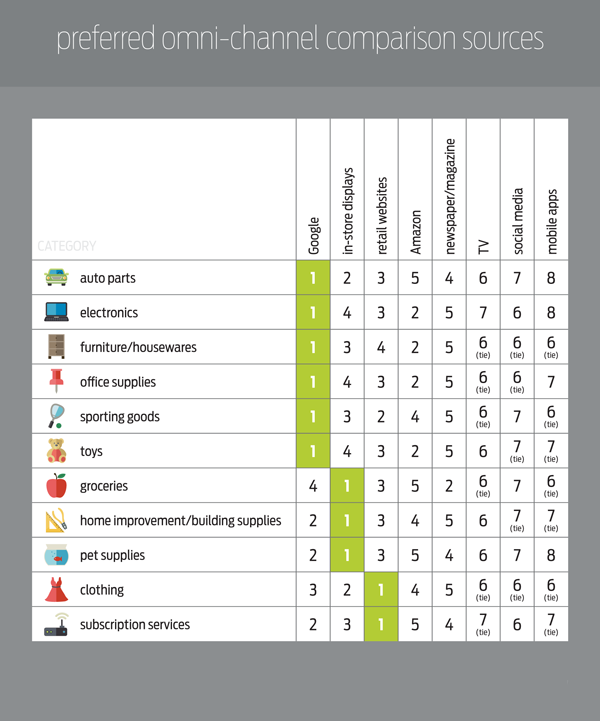
A new study recently released by retail engagement firm Parago offers just that type of insight, as it explores how consumers research and buy across several product categories. The entire report can help you more deeply understand how people buy online and in-person.
Nathan Safran from Search Engine Land also took the study even further, by putting a magnifying glass onto the portion of the study that examined consumer behavior once the buyer is already in purchase mode.
There is a ton to be gained from the full report, and Safran’s work takes it a step further. The findings also break many of the misconceptions held by online marketers, especially when it comes to social media’s role in purchasing.
The graphic below breaks down where people prefer to look for certain types of goods, but it is just the tip of the iceberg contained in Parago’s report.
00Taylor Ballhttps://www.tulsamarketingonline.com/wp-content/uploads/2018/07/TMO-Logo.pngTaylor Ball2014-04-07 15:16:312014-04-07 15:16:31Understanding Consumer Behavior Online and Off
It was difficult to trust most tech news early this week, as April Fools’ Day pranks went live across the web, and all sorts of joke announcements were published. But, now the laughter has died down and the employees at Google and Bing have returned to work. We’ve gathered up their latest changes and (real) announcements, so you can be caught up going into the weekend.
Bing Testing New SERPs Layout
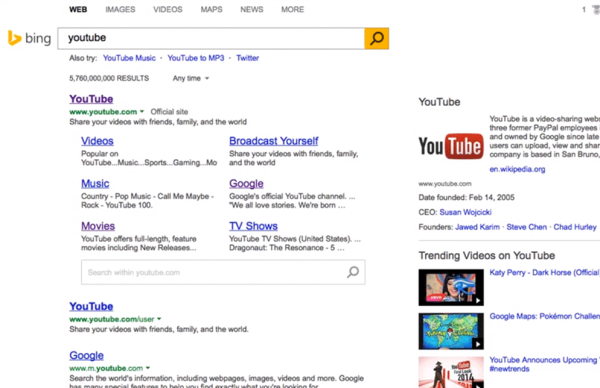
Bing is ending the week by following Google’s most talked about recent change. Barry Schwartz and other prominent members of the SEO community began reporting that Bing is showing a new search results layout earlier today, but it currently appears to just be a test.
The new design changes the color of the logo from gray to the more familiar golden yellow, and the search button has been colored to match. Bing has also removed the gray background from the right side column. The interface is notably cleaned up, but overall the design won’t feel like as drastic of an update when it goes live as Google’s did.
Google Gets Another Privacy Fine From Europe
Not long ago, Google was forced to pay a 145,000 EUR (approximately $189,000) to Germany for privacy violations associated with their Street View program, a Reuters story reports the search engine has now been issued a fine in Italy. The roughly $1.4 million (1 million EUR) fine also related to Street View, though this time it appears to deal with a failure to clearly mark cars used for Italian street photography in 2010.
When announcing the fine, Italian authorities acknowledged that Google has already remedied the problem and is no longer in violation.
Google Adds More Apps To Its Index
Late last year, Google announced that they would begin allowing Android users to click on a Google result and open the page directly within an app, if it is already installed on the users smartphone. The first wave of apps being indexed by Google went live in December, and it would appear the test has been a success so far.
The search engine has now announced that they would be including 24 more apps in their indexing program. You can see which apps have been added in the image below.
00Taylor Ballhttps://www.tulsamarketingonline.com/wp-content/uploads/2018/07/TMO-Logo.pngTaylor Ball2014-04-04 14:47:142014-04-04 14:47:14Quick News of the Week – April 4th 2014
Online video has reached a new level of importance in our lives over the past few years. YouTube is still the dominant service for free online video hosting and sharing, but several other platforms have taken YouTube’s lead and expanded on it in numerous ways.
Instagram and Vine have imposed limits on their video lengths to make them as sharable as possible, while Vimeo has focused its efforts on hosting primarily high-quality and visually stunning videos instead of the shaky cell-phone footage so prevalent on YouTube.
The question remains, which services do you invest your energy and resources into? If you are hoping to use the social video site to increase your brand’s visibility, you want to tailor the content you are creating to the platform most suited to your demographic.
You can get a complete breakdown of all of the major services in the infographic below.
The graphic was created by Russel Cooke, and explains what makes each service unique, as well as how each could benefit a business. If you know your market, you should be able to identify which service is most likely to connect you with your audience. From there, it’s just a matter of making content that will excite them.
00Taylor Ballhttps://www.tulsamarketingonline.com/wp-content/uploads/2018/07/TMO-Logo.pngTaylor Ball2014-04-03 15:27:122014-04-03 15:27:12The Comprehensive Social Video Infographic
It’s no question that social media has become one of the most prominent aspects of online marketing. As Facebook and Twitter have become ingrained in the public consciousness, companies and search engines alike have recognized the value and social media marketing has become intertwined with SEO and advertising to the point that it can be hard to tell where one stops and another begins.
But, as with any new field of marketing, there are bound to be plenty of missteps, gaffes, and wildly ill-advised attempts. For every brand that is killing it on Instagram and Twitter, there are just as many who have found that social media can also magnify your mistakes and make a PR issue into a complete catastrophe.
Thankfully, there is always something to be learned from the mistakes of others. Search Engine Journal recently shared a list of 35 of the most remarkable social media failures in recent history. As they explain, the point isn’t to laugh at those who have made huge mistakes on social media (though it is hard not to laugh at some of the entries). Instead, you should take note of how fine the line is between viral and bad taste, as well as how important it is to keep your cool in times of crisis.
00Taylor Ballhttps://www.tulsamarketingonline.com/wp-content/uploads/2018/07/TMO-Logo.pngTaylor Ball2014-03-28 14:25:032014-03-28 14:25:03The Worst Social Media Mistakes in Recent History
We try to keep our readers and clients updated with all of Google’s biggest news, whether it be redesigns, guideline changes, or newsworthy penalties. It makes sense, as Google currently receives over half of all searches made every day.
But, even those of us who keep a careful eye on the best guidelines and policy trends of the biggest search engine can end up outright confused by Google occasionally. A story reported by Danny Sullivan yesterday happens to be one of those situations.
Google has been outspoken against guest blogging or guest posts being used “for SEO purposes”, and they have even warned that sites using these questionable guest posts could be subject to penalties. However, the latest story claims that Google has penalized a moderately respected website for a single guest post. Most interesting, the post was published well before the guidelines were put into place and seems to be relevant to the site it was posted on.
The penalty was placed against DocSheldon.com, which is run by Doc Sheldon, a long-time SEO professional. Recently, Sheldon was notified that a penalty was placed against his entire site. The penalty report informed Sheldon that Google determined there were “unnatural links” from his site.
So far, this is the typical penalty put against those who are attempting to run link schemes of some form. But, obviously someone who has been around as long as Sheldon knows better than that. So what were the “unnatural links”?
It took an open letter from Doc Sheldon to Google, which he then tweeted to Matt Cutts, one of Google’s most distinguished engineers, to get some answers.
@DocSheldon what "Best Practices For Hispanic Social Networking" has to do with an SEO copywriting blog? Manual webspam notice was on point.
Cutts mentions one blog post published to Sheldon’s site, which appears to have been written in March 2013.
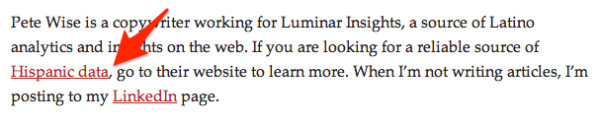
The post is exactly what the title suggests it would be (“Best Practices for Hispanic Social Networking”), but it contains two links at the end, within the author’s bio. One of the links takes you to the author’s LinkedIn page. The other, however, claims to take people to a “reliable source for Hispanic data”, which leads to a page that appears to be closer to a lead-generation pitch about big data.
Source: Search Engine Land
Now, there are a few issues with the link. The page it leads to is suspect, and some would say that the words “Hispanic data” in the anchor text could be potentially too keyword rich. But, Cutts seems to imply that the content of the blog post was as much an issue as the links. As Sullivan puts it, “Apparently, he fired up some tool at Google to take a close look at Sheldon’s site, found the page relating to the penalty and felt that a guest post on Hispanic social networking wasn’t appropriate for a blog post about SEO copywriting.”
That would be a fair criticism, but if you take a closer look at the top of Sheldon’s site, he doesn’t claim the site to be limited to SEO copywriting. In fact, the heading outright states that the site relates to “content strategy, SEO copywriting, tools, tips, & tutorials”. You may take note that social practices for any demographic could certainly be relevant to the topic of content strategy.
So, as the story stands, Google has levied a large penalty against an entire site for a single blog post with one questionable link, all because they decided it wasn’t on-topic. Does that mean Google is now the search police, judge, and jury? Sadly, it appears so for the moment. Little appears to have changed since the story broke yesterday. DocSheldon.com is still dealing with the penalties, and Google hasn’t backed down one bit since the penalty was sent.
It goes without saying, the events have sparked a large amount of debate in the SEO community, especially following the widely followed penalty placed against the guest blog network MyBlogGuest. The wide majority agree this penalty seems questionable, but for the moment it appears it is best to stay under the radar by following Google’s policies to the letter. Hopefully they will become a bit more consistent with their penalties in the meantime.
00Taylor Ballhttps://www.tulsamarketingonline.com/wp-content/uploads/2018/07/TMO-Logo.pngTaylor Ball2014-03-27 15:18:242014-03-27 15:18:24A Single Guest Blog Post Gets Long-Time SEO Site Penalized
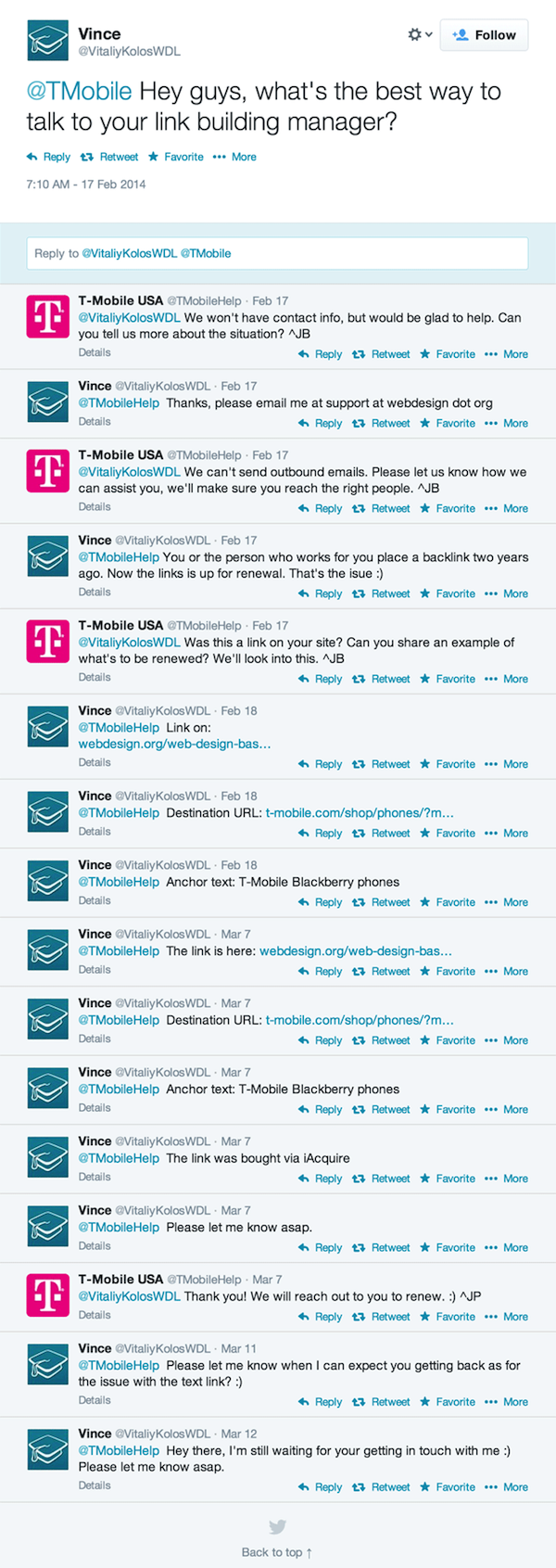
Late last week the SEO community had a good laugh at the expense of a self-proclaimed SEO expert who openly tweeted at major brands about renewing link buys. It appears the links were initially bought through iAcquire shortly before the service was penalized for participating in link buying schemes, and now that they are expiring, a former client is attempting to reach out directly to the link buyers.
The conversation that caught the eye of the SEO community was a long and outright discussion between “Vince” (@VitaliyKolosWDL) and T-Mobile. Search Engine Roundtable managed to screenshot the entire conversation before T-Mobile wisely began deleting their responses. Interestingly, “Vince” hasn’t deleted any of his tweets despite openly talking about selling links and even linking to the page being used to sell links.
Obviously, if the SEO media noticed the conversation, it didn’t take it long to reach Matt Cutts from Google, who probably summed up the situation in the shortest way possible:
Cutts wasn’t the only member of the webspam team to notice, either. Brian White also tweeted at “Vince” with a mocking photo of himself using an Android cookie jar like a phone.
While the person tweeting to companies hasn’t deleted anything, it does appear their website has been penalized already. It took five days since the first tweets started to appear, but unsurprisingly Web Design Library has tumbled down the search results. Search Engine Watch says the site was appearing on the 8th page on a search for [web design] on Monday, but come Tuesday the site didn’t pop up until the 48th page of results.
If you haven’t gotten the notice that selling links can get you in trouble, take this opportunity to look up the numerous other sites that have learned the hard way. Google is treating both those who buy and sell links harshly, and they show no sign of stopping. If “Vince” was as educated in SEO as he claimed, he would have already known this and he definitely wouldn’t have been using an open forum like Twitter to talk about it.
00Taylor Ballhttps://www.tulsamarketingonline.com/wp-content/uploads/2018/07/TMO-Logo.pngTaylor Ball2014-03-26 14:38:162014-03-26 14:38:16Selling Links? You Probably Shouldn’t Be Tweeting About It
Still hesitant about finally making the leap and getting your business online? There are countless business owners who find themselves still on the fence about expanding your brand’s business on the internet. Some are worried about the resources available, the skills needed to make their business shine, or whether their business will actually benefit from going online, but all of those questions can be easily addressed. You just have to be ready to really invest in expanding your brand in a new way.
Today marks the start of Get Your Business Online Week, so there is no better time to make the leap to the internet. Every year Google partners with local businesses and partners to provide free virtual workshops for business owners and anyone else with an internet connection.
You will be able to speak with businesses that have already prospered online such as Barkbox, GoldieBlox, and Dollar Shave Club, and full tutorials and demos will be offered throughout the week to help you understand all the steps of building a website and establishing your brand.
Best of all, Google is doubling down on the direct link to speak to their experts with their Helpouts by Google.
If you still can’t decide whether now is the time for your business to take charge of their online presence, consider that Green Mountain Bee Farm in Fairfax, CT. experienced a five-fold increase in sales by simply expanding their business online. Meanwhile, Christine Fitzpatrick Hair and Makeup in Birmingham, Mich. managed to attract 50 percent more clients than they had before getting online.
00Taylor Ballhttps://www.tulsamarketingonline.com/wp-content/uploads/2018/07/TMO-Logo.pngTaylor Ball2014-03-24 14:31:152014-03-24 14:31:15Celebrate Get Your Business Online Week
Big may not get all the praise and attention of Google, but they have been steadily growing their audience for years. They still have a ways to go in search traffic to be realistic competition for Google, but Bing has expanded their search abilities and community to the point where it is a mistake to completely neglect the search engine.
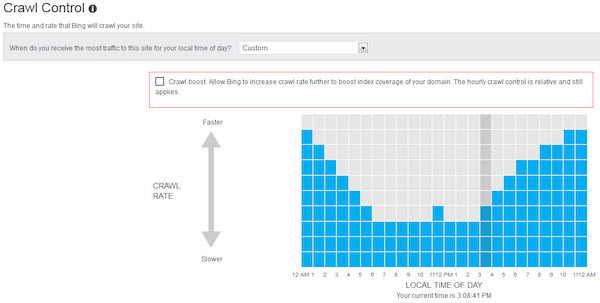
If you are a webmaster, chances are you already use Google’s Webmaster Tools, but it is shocking how many don’t bother to signup for a Bing’s Webmaster Tools at the same time. Just like Google’s tools, Bing’s Webmaster Tools make a huge variety of data available to you to help inform your SEO practices and identify any potential issues.
Most importantly, Bing’s Webmaster Tools are the primary line the search engine uses to communicate about issues with site owners.
If you’ve used Google Webmaster Tools, you probably already have a good idea of what you can accomplish with Bing’s and you can probably make your way around the tools on your own. But, if you’re new to webmaster tools or want to know all the cool things Bing’s Webmaster Tools can do, Simon Heseltine has shared a guide to the tools at Search Engine Watch. Get yourself familiar with the tool, then make sure you sign up. There is no reason you should be missing out on such a free, versatile and important set of tools for your website.
00Taylor Ballhttps://www.tulsamarketingonline.com/wp-content/uploads/2018/07/TMO-Logo.pngTaylor Ball2014-03-19 12:09:382014-03-19 12:09:38Why Should You Be Using Bing’s Webmaster Tools?
Search engines have been attempting to get local search right since the invention of the internet, but they have only managed to make local search a major player as smartphones have allowed us to take the internet everywhere we go. Now that we can search for locations nearby, or double-check the time of the next bus from a bench outside, local SEO has gained real importance in how we organize use the web.
That also means it is more important than ever for businesses to make the leap into establishing an online presence. With the high level of connectivity in the modern day, not having an online presence for your business is becoming more and more like not existing. Searchers may be standing right in front of your business and decide not to come in simply because they can’t find anything about you online.
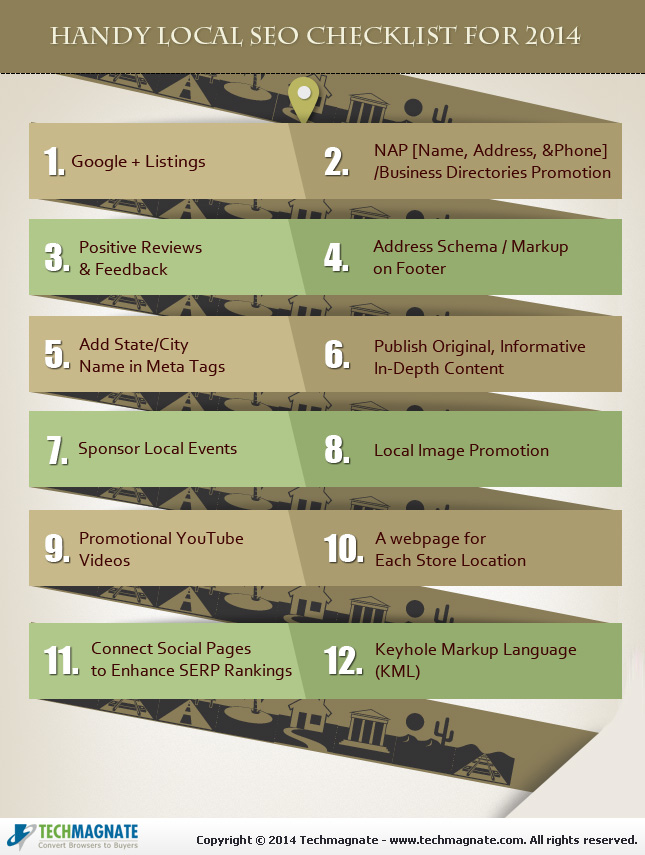
To really get your business cemented online, you need to do more than put a site online and wait for visitors. But, many places will barrage you with a million optimization techniques you can use to raise your visibility all at once, so it can be hard to know exactly where to start. Sarvesh Bagla made a checklist specifically so you know what you need to have done right now to expect your local business to have any online success.
Each step is laid out and explained in Bagla’s article on Tech Magnate, but they also created a nice graphic that you can keep close by, which can be seen below or printed off and hung by your computer to keep you on track.
00Taylor Ballhttps://www.tulsamarketingonline.com/wp-content/uploads/2018/07/TMO-Logo.pngTaylor Ball2014-03-18 13:09:192014-03-18 13:09:19The Only Local SEO Checklist You Will Need For 2014
It is no secret that our use of the internet is becoming more and more mobile, but the day when we actually favor mobile search over desktop connections may be sooner than previously thought.
While speaking at SMX West last week, Google’s Matt Cutts told the crowd he “wouldn’t be surprised” if mobile search exceeded desktop queries by the end of this year. Another Google speaker during an informal round-table gave a similar comment at the International Franchising Association conference in New Orleans earlier this year.
Google refused to give an official statement, but it makes sense. Google doesn’t want anyone to be picking sides. Instead, they want to focus on cross-platform experience and marketing so that we can make the internet equally efficient and useful on every platform.
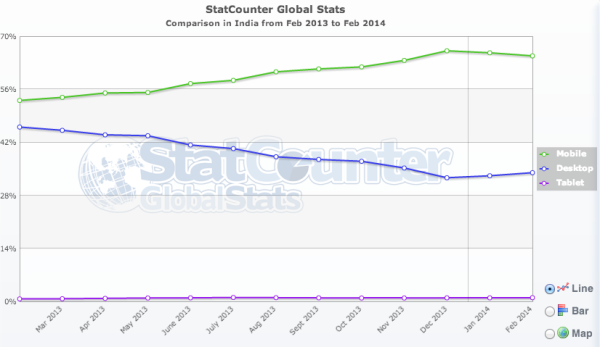
The comments are assumed to be referring to the global query volumes rather than the US or North America. Globally mobile traffic lies around 30 percent of all internet traffic, and North America has relatively similar ratios. However, many developing countries, such as India, already use mobile search far more often than desktop.
It is inevitable that one day mobile and desktop traffic will either reach a stalemate, or mobile traffic will begin to eclipse home desktop use. But, whether it will be this year is anyone’s guess. Personally, I’d be wagering on sooner rather than later.
00Taylor Ballhttps://www.tulsamarketingonline.com/wp-content/uploads/2018/07/TMO-Logo.pngTaylor Ball2014-03-17 13:40:012014-03-17 13:40:01Will 2014 Be The Year Mobile Overtakes Desktop Search?