As Google rolls out more mobile ad formats and targeting measures for marketers, the customers seeing the ads appear to be more readily engaging advertisements from their smartphones and tablets.
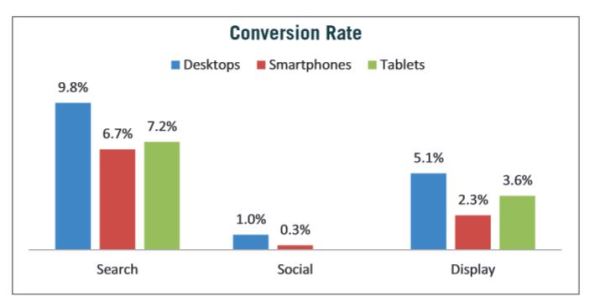
Marin-2014-Ad-Conversions

A new study from Marin Software shows that consumers are starting to use mobile ads to complete purchases, but desktop is still the dominant platform for conversions. Other interesting facts from Q3 of 2014 included in Marin’s report are:

  • Mobile devices comprised 31% of paid search impressions and 38% of search ad clicks on Google.
  • Mobile accounted for 30% of ad conversions with mobile conversions increasing 2.4% quarter-over-quarter and nearly 11% year-over-year.

Facebook:

  • 1 out of every 3 ad conversions on Facebook took place on a mobile device with mobile ad conversions increasing 16% quarter-over-quarter.
  • Mobile ads on Facebook accounted for 52% of ad impressions and 63% of clicks.

The findings also make it clear that Search ads are performing miles better than Display or Social ads. More-so, while smartphones may not be the most prominent medium for conversions, they consistently gain the highest rate of clicks.
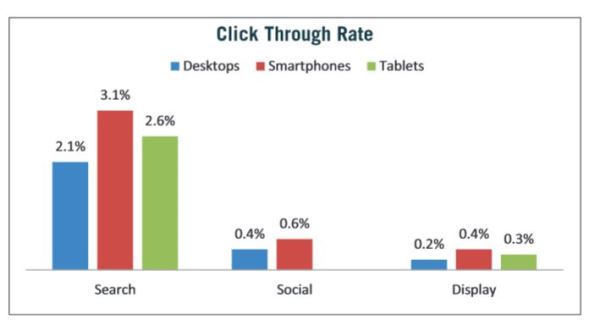
Marin-2014-Ad-CTR

Marin says the large difference between Search CTE and Social or Display CTR can be attributed to intent. Searchers tend to be actively looking for something, meaning ads will be more tightly focused. On the other hand, those on social sites or Display ads which appear while users are already engaged with something else are less attention getting.
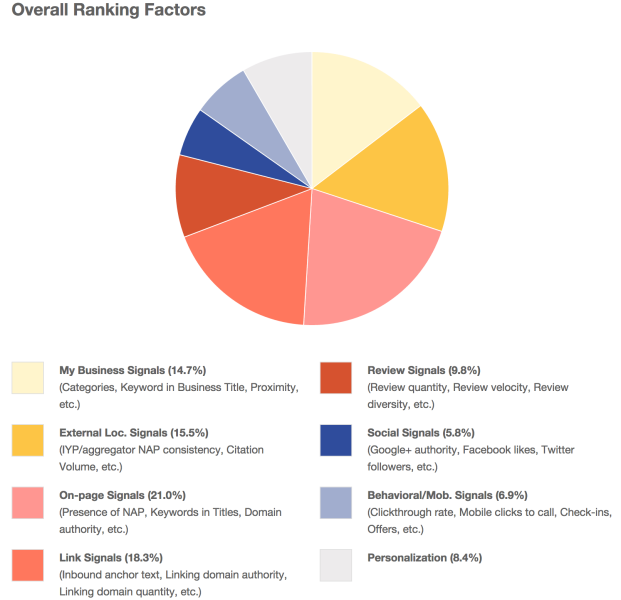
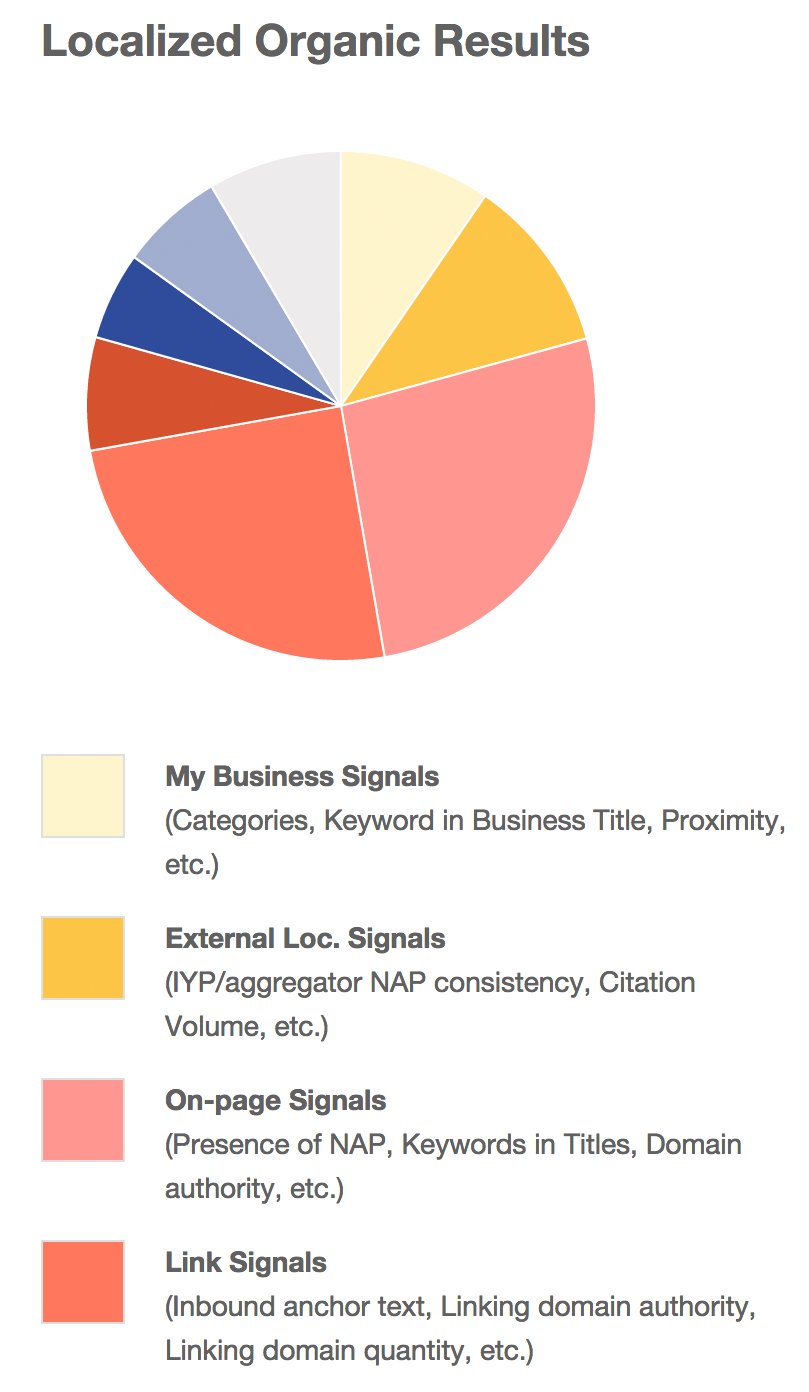
Every year, Moz details the local ranking factors they can identify in Google’s algorithm to help small businesses get a foot up in the listings. Earlier this week they announced the release of this year’s findings and everything seems… surprisingly the same.

Analysts have only found a few notable changes, but the findings are largely the same as last year’s. However, David Mihm did highlight a few important things to notice in the findings, including:

  1.  Behavioral signals such as click through rate, are more of a factor this year that others.
  2. With Pigeon‘s release, experts are saying Domain authority is more of a signal today.
  3. Google may have tuned up the proximity to searcher factor as well.

You can see the charts from the study below, or you can get more details from the results over at Moz.

moz-local-ranking-factors-2014-621x600

moz-local-ranking-localized-2014

Google Ecity Tulsa

To those who have never been here, Tulsa might not seem like the most technologically innovative city, but anyone who has lived in Tulsa knows otherwise. Tulsa’s companies leverage the internet to grow their businesses in inventive and practical ways every day, and the city is finally getting some recognition for their efforts.

Google named Tulsa as Oklahoma’s eCity for 2014, recognizing the city for having the strongest online business community in the state and celebrates those who have embraced the internet and its multitude of ways to connect with new and existing customers alike.

“Our eCity Awards recognize the new ‘digital capitals’ of America,” said Dave Barr, Google’s hardware operations manager for the Oklahoma data center. “We’re proud to recognize this growing entrepreneurial spirit—and the role that it plays in both creating jobs and sustaining local economies. With 97 percent of Internet users looking for products and services online, it’s clear that success is about being connected.”

“Tulsa is honored to be named the Google eCity of Oklahoma, the digital capital of our state,” said Mayor Dewey F. Bartlett Jr. “This award speaks to the strength of Tulsa’s online business community, as organizations are embracing the power of the Internet to find new customers, connect with existing clients, and create twice as many jobs with their online presence.”

“Already recognized by Forbes as the nation’s top city for young entrepreneurs, Tulsa has quietly become a nationally-recognized hub of innovation — a place where fresh ideas thrive and businesses find success in embracing the future,” said Mike Neal, president and CEO, Tulsa Regional Chamber. “Tulsa’s new distinction as Oklahoma’s ‘digital capital’ is further proof that its enterprising small business community has set the standard for how to grow business in a new era.”

Not only have Tulsa’s startups and young entrepreneurs been using the internet to expand their businesses and reach out to where customers are, we are using the internet in new ways never previously imagined to connect with audiences in more meaningful ways than ever before.

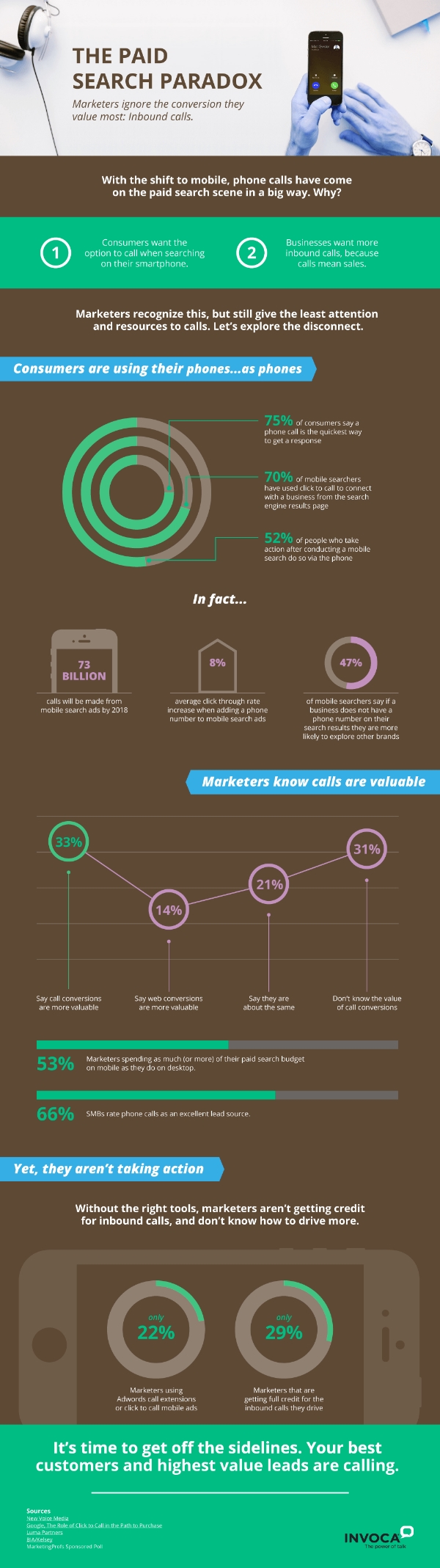
Tulsa Marketing Online has always believed tracking data is one of the most essential steps to running an informed marketing campaign, but apparently many search marketers are opting out of comprehensive tracking when it comes to phone conversions from search campaigns.

A new survey from Invoca has found that just 36 percent of respondents reported using call extensions or click-to-call ads in their search campaigns. Of course, call conversions aren’t a major metric for some campaigns, but the survey shows that isn’t the whole story. The results also show that 63 percent of those surveyed said phone leads are equally or more valuable than web conversions.

It is surprising that such only a relatively small percentage of marketers may not be tracking phone call conversion data, especially in light of the wealth of studies showing the value of phone calls to search marketers. Google’s numbers say that 70 percent of mobile searchers have called a business directly from the search results page and BIA/Kelsey estimates inbound calls from mobile search is going to almost double between now and 2016.

The only real explanation is that a fair portion of marketers simply aren’t considering the value of call conversions and how search marketing may be driving calls.

Without data on call conversions, it is hard to get the full picture of how campaigns and marketing strategies are performing and budgets may be getting misplaced or outright wasted. When you have all that information at your fingertips, it is easier to make truly informed decisions about your future strategies and ensure that marketing budgets are being used to their full potential.

You can read Invoca’s full report here and see their related infographic below.

Call Tracking Infographic


SEO and social media marketing have been interconnected for several years, but they are also typically treated like separate efforts that influence and benefit from each other rather than being entirely coupled. That is why one of the most neglected features of Pinterest is Guided Search.

It is no secret that Pinterest is quickly becoming an upper tier player in social media and marketing because it touches on our aspirations and desires. To paraphrase Tailwind CEO Daniel Maloney during SMX East this week, Pinterest is about who you want to be.

Pinterest_Sticker_Icon1“When you look at what people are pinning, it’s more about who they want to be in the future,” Maloney said, “which from a marketer’s perspective is a dream come true.”
That made the social media platform ripe for harvest then when they introduced Guided Search early this year, but surprisingly few marketers took advantage of the opportunity to optimize their presence on the site.

Was Guided Search forgotten because it wasn’t high enough on the list of marketing priorities or because it slipped through a crack directly on the line between SEO and social media marketing? It is hard to tell, but Anna Majkowska, a software manager on Pinterest’s search team, has been encouraging brands to optimize for the platform so that they are able to get their content in front of the more than 50 million users who frequent the site.

Majkowska shared tips for optimizing your site on Search Engine Land, but the important thing is to not be intimidated. Pinterest SEO isn’t near as complicated as trying to optimize for Google, so the learning curve is notably less steep.

Facebook-for-Small-BusinessIf you believe everything you read online, you might believe Facebook is only a viable marketing platform if you’re already a big brand. But, a new report suggests small businesses across the country recognize the potential in advertising themselves across the site.

The study from advertising research firm BIA/Kelsey says small businesses are marketing on social media more than any other form of advertising. Specifically, their data suggests nearly three-fourths of all small and medium-size businesses are investing in some form of social media marketing, whether it be paid advertising or organic outreach.

For small businesses, Facebook was easily the most popular choice for social media marketing. More than 55 percent of the businesses surveyed reported having a dedicated business Facebook page, and another 20 percent have run a Facebook ad or promoted post.

Many businesses showed that social media marketing doesn’t have to be restricted to just one platform, as several businesses also cited using other sites including LinkedIn, Pinterest, Instagram, and Twitter. Notably, the researchers did say LinkedIn is likely not being used for promotion but for recruiting and general HR purposes.

“We were impressed with the strength of the whole social media category, not just Facebook,” Steve Marshall, director of research for BIA/Kelsey, said in a statement.

The study, originally published on Business News Daily, was based on surveys of 546 small businesses with less than 100 employees.

The phrase “content marketing” is thrown around all over the place, but marketers seem to be forget that content can mean more than blog posts. While blogs can play a big role in online marketing and catching the attention of your audience, there are several other tools at our disposal that are often more effective.

Audiences almost always respond better to visual marketing better than text, so long as your visual content reaches the same level of quality. Market Domination Media wanted marketers to know that visual content packs a heavy punch that makes the heightened investment more than worthwhile.

To do so, MDM published an infographic which highlights the reasons why visual content consistently performs so much better.

The-Power-of-Visual-Content

facebookadvertising

For many advertising platforms, the rising use of mobile devices to browse the internet has been both a boon and a relief.

While the greater number of people accessing the internet on-the-go means advertisers have a better chance of connecting with potential customers close to the point of sale, but it has also created a schism where online advertising is either mobile or desktop based.

Some advertising platforms such as Google have been able to unify their platforms in many ways, but other services are still struggling to come together. Soon however, Facebook will be making big moves to bring their advertising into a cohesive platform.

The Wall Street Journal reports that Facebook is closing in on the launch of an entirely new advertising platform which will allow marketers to more effectively reach target audiences across the plethora of different devices used to surf the web today.

The new platform is rumored to be a reworked adaptation of the Atlas Advertising Suite, an ad-serving platform purchased from Microsoft last year, and will supposedly be rebranded to just ‘Atlas’.

Beyond just improving ad targeting across devices, Atlas will also supposedly be able to help marketers see which ads are being viewed and which are drawing clicks or influencing purchasing decisions.

Current reports say Atlas will work by collecting data from Facebook and other third-party applications and services that serve Facebook ads. It will also come equipped with an automated ad-bidding tool which will facilitate the ability to buy targeted advertising space.

The Wall Street Journal cites an unnamed executive who claims to know Facebook’s plans as their source. The executive is quoted as saying:

The biggest impact of this will be in mobile. People spend more time on mobile than on desktop, but marketers don’t spend there because cookies don’t work. This could finally enable us to spend more money in mobile.

The latest “audience insights” report for Q2 of this year from NinthDecimal was released this week and the findings about shopping on mobile devices could have a big influence on how marketers think about on-the-go research and conversions.

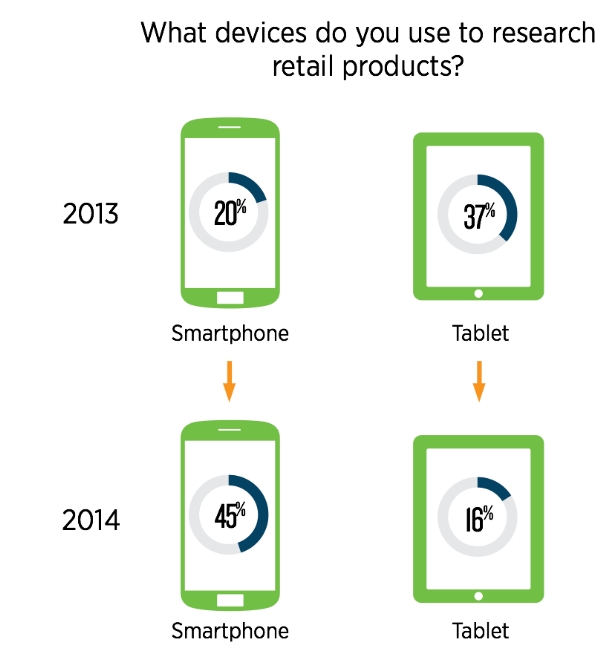
The report shows that smartphones are quickly becoming the primary way users research retail purchases, which should be of little surprise. However, the findings also show that research on tablets has been significantly declining which may suggest a troubling future for the devices.

Retail Product Research

NinthDecimal says they believe the decline is due to increasing consumer comfort with shopping on smartphones, especially as screen sizes are increasing and NFC services like the newly launched Apple Pay make it easier than ever to shop on a smartphone.

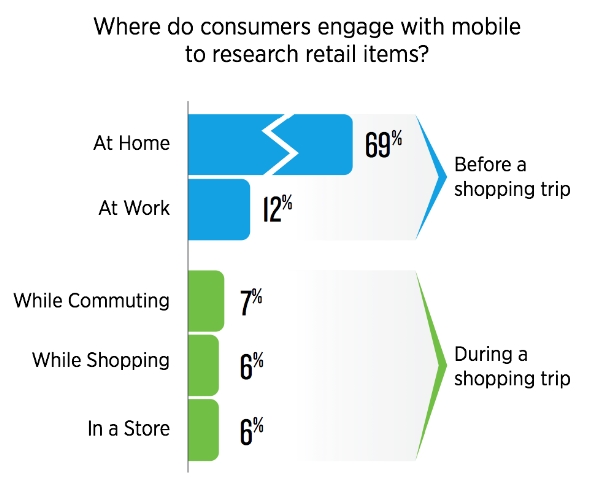
Also unsurprising is the finding that consumers tend to conduct shopping-related research before they leave the home to shop, although in-store usage is also growing. The report also shows that the length of time that consumers spent researching a purchase before buying was directly tied to cost. Products under $50 saw an average of 10 days of research or less. Meanwhile products above $1,000 days got an extensive 45 days of research lead time on average.

Product Research Time

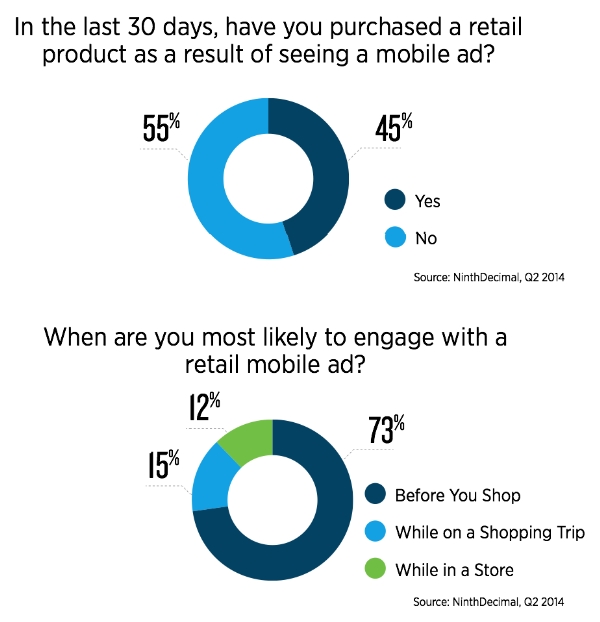
Of particular note to online marketers and businesses may be the data claiming that within the last month approximately 45 percent of consumers reported making a retail purchase after seeing a mobile ad. However nearly three-fourths of respondents said they were more likely to engage with retail-related advertising at home, before they began shopping.

Mobile Ad Response

According to the report, the types of ad content most likely to sway mobile users were (in order): product discounts/sales, reviews, product information, giveaways and store-location information

Source: Wikimedia Commons

Source: Wikimedia Commons

Facebook has become a bit of a source of conflict among many content marketers as organic reach has plummeted in recent years, however most stick around because the social media platform still has a massive impact when it works.

In an effort to satisfy content creators and marketers, Facebook has introduced a new subpage called Facebook Media that highlights how content can help public figures and organizations connect with their audiences.

Along with sharing success stories, Facebook says they will also share data and best practices which will help other content creators increase the effect of their own Facebook marketing.

The new page, located at media.fb.com, is divided into four categories built around goals typically shared by both content creators and media marketers. Here is a breakdown of each section and what you can find there:

  • Engage Fans on Facebook: Here you’ll see how public figures can use tools like Facebook Mentions to reach out to their fans on their Facebook Page. You can also get insight into different types of engaging content you can share on your own page.
  • Drive Referrals: In this section you’ll see how to drive referrals by doing things such as sharing links on your Page, adding social sharing buttons to your website, and other best practices. “After Bleacher Report increased the number of posts it shared to its Facebook Page, the site saw a 15X increase in referral traffic from Facebook.”
  • Share Videos: This contains information about how to connect with a larger portion of your own Facebook audience with video. It also highlights how using video metrics and call to actions can better engage your audience.
  • Integrate TV and Social Content: If you produce content for other mediums like television, this section has information about how to get your TV audience to engage with you on Facebook. “…like the TODAY Show, which featured trending topics on air to highlight the most talked-about news moments on Facebook”.