Tag Archive for: Social Media Marketing

Paid ads on social media are becoming more and more prevalent, to the extent that Facebook finally admitted recently that businesses will be practically forced to pay for brand outreach on their platform. Which makes it so surprising that Google+ had, until recently, strayed away from paid advertising. But, the search engine giant may have had an ace up their sleeve this entire time as they have recently unveiled their form of promoted posts, called “+Post” and it is a doozy.

Most aspects of +Post are extactly what you have come to expect from paid advertising on social networks. A brand pays for priumium placement of a post, and more users are shown the ad. It is a simple model which has worked for numerous other social media platforms. What makes +Post different is where the ads will be shown.

The majority of social media networks are only able to show promoted posts on their social media platform. Facebook promoted posts show up in your Newsfeed, “Promoted Pins” will be appearing on Pinterest soon, and Instagram is rolling out their own curated form of promoted posting to ensure ads fit their market and the style of Instagram. But, Google+ is connected to something much larger: all of Google’s network and products. So, +Post will have a massively larger reach than other social networks’ forms of paid advertising.

As Google explains:

+Post ads amplify your brand’s content by easily turning Google+ posts into display ads that run across the web. The live, social ad format allows you to go beyond clicks to live conversations with your audience. People can join a Hangout On Air, add a comment, follow your brand or give a +1, right from an ad.
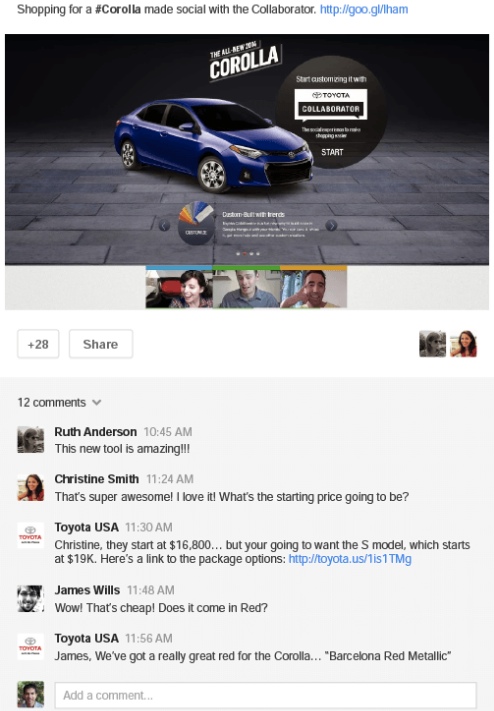
+Post Screenshot

This is an incredibly smart move for the search engine, as Google+ is still struggling to find a larger active user base, and the advertising model may drive more users to their social platform. The +Post ads act like regular posts in Google+ no matter where they are displayed, which effectively bleeds Google+ into all other aspects of Google (more so than before).

In Google’s own words:

Ads become more relevant with social context. Comments, +1s, and shares from friends can move people to engage with your ad. Social actions on ads and Google+ add up together, showing the full picture of engagement with your content. +Post ads expand in a lightbox to bring full screen social creatives across the web.

Jessica Lee from Search Engine Watch reports a few brands have gotten to try out +Post before the announcement, specifically Toyota who was used for Google’s promo video:

http://youtu.be/4yCUgx7H2zo

No More MemesYesterday Facebook announced some pretty major changed to their News Feed. Specifically, clicking an article may not show up to three related articles, and new comments on a story you’ve already seen can “bump” that story back into your feed as it is made relevant again. Lastly, they are going to begin policing the “meme” content to an extent, especially on mobile.

While the first two changes have received significantly more attention by marketers, the new meme policy will likely have the biggest immediate impact for companies still using the image marketing practices widely preached just a year ago.

Image marketing on Facebook refers to the practice of sharing content by posting a picture with a link in the comment, rather than using the more standard link post. This lead to many marketers using lighthearted and sometimes confusing memes while underhandedly also sharing their content. This type of practice has been slowly being dismantled for the past few months, ever since Facebook changed how prominently Link posts were shown in the News Feed. Before that update, image posts were shown with much more prominent display size, so it was a ripe target for abuse.

Now that Facebook is targeting memes it is pretty clear that the old image marketing practices are outdated and it makes more sense to simply follow the more common link marketing practices. Not only is it a more honest approach to serving content to your visitors, but Facebook is going to show you favor.

As Greg Finn from Marketing Land explains, Facebook has gone “all in” regarding turning their social media platform into a more focused news source. A recent study has shown that 1 out of 3 Americans now use Facebook as a news source, and Facebook seems determined to put a heavy emphasis on that mode of usage for their site. Looking forward, the only way to stay ahead of their changes is to focus on delivering your audience the best quality content you can create.

Marketing has become a holistic practice. You can’t just focus on one channel and expect to have the impact that those who are using every method to connect with the public are getting. For online marketing this means you can’t rely on just SEO or PPC to get the visibility you want. A new study from the digital marketing tech company Kenshoo proves this point by showing that marketers using social advertising and paid ads together see better conversion rates than those who only use a single channel.

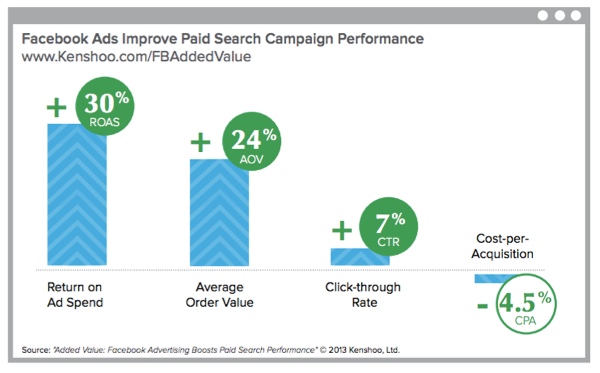
In what Search Engine Watch reports to be the first study of its kind, Kenshoo discovered that when a person was exposed to both a brand’s Facebook ads and paid search ads, there was a 30 percent more return on advertising spending than when a person was only exposed to paid search ads exclusively.

“The fact that Facebook advertising on its own during this study was declared a successful initiative and had such a strong impact on paid search is indicative of the power of the platform,” Kenshoo said in its report.

Kenshoo PPC and Social Ads Report

“If marketers only had one Key Performance Indicator (KPI) to compare media channels, the metric of choice would be ROAS [return on ad spend], which is calculated as Revenue/Cost. For example, if an advertiser spent $20 and generated $100 in sales it had a 5x ROAS. Even media with different conversion goals can be easily evaluated based on how much it returned versus how much it spent.”

Kenshoo also noted that click-through rate improved along with returns on ad spending. Paid ads saw a 7 percent increase in CTRs when a person had seen both Facebook and PPC ads, “indicating that social advertising was able to positively impact consumer awareness and perception of the brand.”

When combined, search and social advertising also resulted in 4.5 percent lower cost per acquisition, according to Kenshoo.

“On the surface, 4.5 percent may not seem significant when compared to some of the other high numbers reported in this study,” Kenshoo said, “yet ask any advertiser if they could lower their costs to bring in orders by this amount and they would all jump at the opportunity.”

Stacks of MoneySocial media has become a part of our lives whether we like it or not, and don’t expect that to change in the next year. In fact, if marketing trends are to be believed, 2014 could be the biggest year yet for social media marketing. Erik Sass reports a new study found that seven out of ten marketers expect to increase their spending on social media in the next year. The survey of 328 marketing professionals was conducted by Decipher on behalf of the Word of Mouth Marketing Association and the American Marketing Association.

While 70 percent said they plan to increase their spending on social media marketing, only 53 percent expect to do the same for their email marketing, and print, product sampling, and TV advertising were all in much worse shape with less than 20 percent planning to increase their ad spending for each category.

But, just because social media marketing is growing doesn’t mean all is well. The same survey found that 79 percent of marketing professionals struggled with measuring online social media and demonstrating return on investment. It seems that we know social media is an important part for establishing your brand online, but many are still having trouble actually measuring how effective it is.

Just a few years ago it would have been impossible to imagine how much social media has grown and become a part of our lives. Even during the heyday of Myspace and the rise of Facebook, no one could have predicted the sheer number of social media apps and websites available and popular these days. We tweet out our random thoughts, we Instagram our pictures, and using the right social media platform for your market can even help you get a job.

The big news is that social media is not slowing down. With the app store flooded by social media apps, you would think their popularity would begin to wane, but social media continues to grow in just about every market. It isn’t a fad. Social media is a part of our lives.

Just over 2 years ago Search Engine Journal published an infographic called the Growth of Social Media. Looking at the infographic now is practically nostalgic as it lists tons of platforms that have fallen entirely off the map, and it reminds us how quickly Pinterest, Reddit, and all the current sites flourished. But, the graphic is woefully out of date.

That is why SEJ decided to update their graphic to reflect the state of social media today. No surprise, the numbers are even better now than they were before. You can see version 2.0 of The Growth of Social Media below, and the original version is still available at their site.

Growth of Social Media Infographic


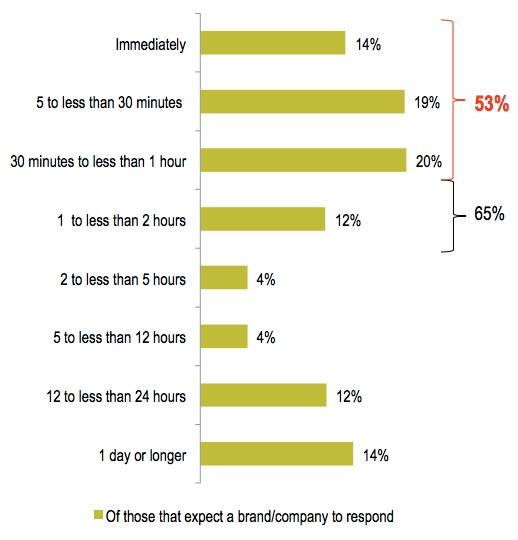
Think you can get away with not responding to tweets directed at your brand’s Twitter account? It shouldn’t come as a surprise that ignoring those tweets or even putting off responding, can be terribly damaging to your brand. Social media users have come to expect brand interaction, and Lithium Technologies has released findings that say more than 70 percent of Twitter users have come to expect a response from any brand they’re interacting with. On top of that, 53 percent expect that response within the hour.

Twitter users expect responses even more when they are complaining to a brand. When users are upset, 72 percent think it is reasonable to expect a response within the hour. On the other hand, responses are less expected when users are giving positive feedback or comments.

If you’re dealing with complaints, putting off responding can quickly turn damaging. Over half of the respondents said they would begin to create negative consequences such as telling their friends about their bad experience and expressing concerns through even more channels. One complaint on Twitter can turn into terrible word of mouth rather quickly.

Search Engine Watch has more details from the survey, but it is fairly clear that Twitter users expect interaction, and you’re hurting yourself by not engaging them back.

Everyone knows about Facebook and Twitter, and even the smallest business owners tend to feel like they have a pretty good idea what they are doing on the two biggest social media platforms. But, some social media isn’t as easy to understand as the two giants. Instagram poses an especially difficulty problem for many business owners, who haven’t been able to figure out how you can turn a pictures and hashtag only platform into brand building and customer outreach.

You can do just that, if you take the time to understand Instagram and who is using the site. Once you’ve gotten down the basic features, you’ll find yourself sharing pictures and videos to thousands of followers in no time. Alexandra Burnett has some tips to help you get started.

  1. Complete Your Profile – Just as in real life, first impressions matter. Your profile is your chance to leave a good first impression by showing viewers who you are and what you do. It also won’t ever hurt to include a link to your Facebook or Twitter page and website. This way, any prospective customers can easily find out more about what you offer.
  2. Find Your Customers – You should have a pretty good idea what your demographic is by this point. If you don’t, start basic by looking for those in your city (#Tulsa) or share interests relevant to your market (#soccer). These people are all prospective leads. It is up to you to look for them and interact with them.
  3. Be Engaging – Don’t be afraid to make the first move. Reach out to everyone you can. Tag others, talk to those who reach out to you, show support for your community, and use your location. Everything you can to flesh out your online identity will help reaffirm to your viewers that you are the real deal.
  4. Be Consistent, but Don’t Be Spammy – It is important to post regularly. If followers notice you haven’t been posting, they may be inclined to unfollow you. The catch is, you have to show some restraint. Any more than a few posts a day is overkill. Try to set a limit of 2-3 at most.
  5. Show Off Your Products – Everyone loves to window shop, and Instagram is a great platform for consumers to idly browse for things they like. Highlight new products, and show off your services. If users are following you, chances are they want to know more about your businesses and what you offer.
  6. Make It Personal – Humanize your business by showing off the people who make it all work. Introducing employees to the public puts a face to your brand and shows you care about everyone involved.

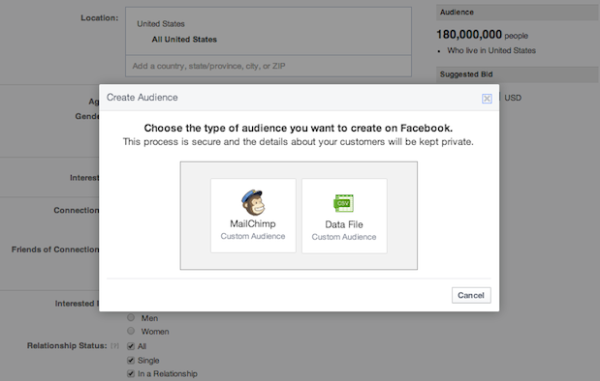
Facebook advertisers using the social platform’s API and Power Editor tool have had access to their Custom Audiences ad targeting tool for a short time. But, many advertisers have yet to get access to the targeting tool until now.

Starting yesterday, Facebook will has begun rolling out the ad targeting tool to a limited number of US advertisers, with a global roll-out beginning next week. Amy Gesenhues says all advertisers around the world can expect to see the feature by late November.

This is especially of interest to small businesses who will be able to use their own customers lists to directly reach out to people on Facebook. You will also be able to use MailChimp lists with Custom Audiences for the first time.

Facebook already claims thousands of advertisers are using Custom Audiences, but this will open the door for countless other advertisers to access the feature via Facebook’s ad interface. You will even be able to access the feature from Facebook’s mobile app, assuming you have already uploaded your contacts.

Advertisers on Facebook won’t have to go through demand-side platforms (DSPs) to manage their retargeting campaigns for much longer. According to Search Engine Watch, Facebook is creating new retargeting options that won’t force you to go through FBX (Facebook Ad Exchange) or any other platform other than Facebook’s own interface.

Up until now, Advertisers using FBX have only been able to serve their ads on desktops within the news feed or right sidebar and they must buy their ad space through separate DSPs. Considering how many Facebook users are accessing the social media platform via smartphones or tablets, it is surprising it has taken this long for Facebook to allow advertisers to target individuals on mobile devices.

What’s New?

The big new feature will be Custom Audiences, which will allow advertisers to set up their retargeting campaigns directly through Facebook’s interface. That will include the ability to overlay standard Facebook targeting options as well.

The ability to target mobile devices is of course another huge aspect of this update, as it is undeniable a remarkable percentage of Facebook users are primarily using mobile devices for social media.

What is FBX Still Better At?

FBX still has benefits over the options that will be available through the Facebook interface. Most important of those benefits is predictive buying. If an individual continuously browses for a certain product of type of service, FBX’s predictive buying capabilities allow advertisers to show an ad reflecting that interest.

Facebook announced yesterday via Facebook for Business News that they have created a new platform which will allow advertiser to create ads and influence their impact more easily, as Kelsey Jones reported.

The news release said that Facebook has received feedback from advertisers wanting to create ads based on their overall goal or objective, not just the type of ads that would be displayed. The company identified eight objectives as being crucial for business advertisers, specifically:

  1. Clicks to Website
  2. Website Conversions
  3. Page Post Engagement
  4. Page Likes
  5. App Installs
  6. App Engagement
  7. In-Store Offer Claims
  8. Event Responses

To help advertisers meet their goals and create advertisements more based on what they want to accomplish, they released the new platform, which will help advertisers decide how they want to best serve their advertisements. Foe example, an ad viewed on a smartphone can be set so that the users are directed to the company’s mobile site, rather than a non-optimized full desktop site.

Advertisers can also see how their ads are performing based on the objective they chose when creating a campaign. If your focus is website conversion, the highlighted metrics will reflect that. This way there is less confusion and advertisers have easy access to what they consider to be the most important metric for their efforts.

The options will be available via the Ad Create tool, the Power Editor, and the API. It will be a gradual rollout, which may take weeks, but will eventually be available to all advertisers.