Tag Archive for: Social Media Marketing

facebookadvertising

For many advertising platforms, the rising use of mobile devices to browse the internet has been both a boon and a relief.

While the greater number of people accessing the internet on-the-go means advertisers have a better chance of connecting with potential customers close to the point of sale, but it has also created a schism where online advertising is either mobile or desktop based.

Some advertising platforms such as Google have been able to unify their platforms in many ways, but other services are still struggling to come together. Soon however, Facebook will be making big moves to bring their advertising into a cohesive platform.

The Wall Street Journal reports that Facebook is closing in on the launch of an entirely new advertising platform which will allow marketers to more effectively reach target audiences across the plethora of different devices used to surf the web today.

The new platform is rumored to be a reworked adaptation of the Atlas Advertising Suite, an ad-serving platform purchased from Microsoft last year, and will supposedly be rebranded to just ‘Atlas’.

Beyond just improving ad targeting across devices, Atlas will also supposedly be able to help marketers see which ads are being viewed and which are drawing clicks or influencing purchasing decisions.

Current reports say Atlas will work by collecting data from Facebook and other third-party applications and services that serve Facebook ads. It will also come equipped with an automated ad-bidding tool which will facilitate the ability to buy targeted advertising space.

The Wall Street Journal cites an unnamed executive who claims to know Facebook’s plans as their source. The executive is quoted as saying:

The biggest impact of this will be in mobile. People spend more time on mobile than on desktop, but marketers don’t spend there because cookies don’t work. This could finally enable us to spend more money in mobile.

YouTubesYou might assume that the largest social media platform would have the most effective paid advertising platform, but Facebook’s platform doesn’t hold the title according to a report from VentureBeat.

According to the report based on a study by AoL Platforms, YouTube is actually the champion of paid social media advertising platforms in more than a few key areas, including introducing new products to customers, and helping consumers make purchasing decisions.

The report examined data found within 500 million clicks and 15 million conversions during the first quarter of 2014, using Convertro’s attribution technology to track social purchase interactions. This data was then used to determined which platforms had affected online sales and at what point in the purchasing decision they had influence on the consumer.

Jeff Zwelling, CEO and co-founder at Convertro told VentureBeat:

We believe that YouTube does well in both of these important purchase funnel areas for a number of reasons. YouTube’s own search volume and preferential positioning on Google’s results help drive large amounts of traffic, of course. But when you get to YouTube, the content is rich, descriptive, and usually helpful.

I’ve done this myself. I recently bought a coffee machine. I had the decision down to three alternatives and couldn’t decide which one was best for me. In the end, I watched videos on YouTube of people using all three machines and chose the one that matched my idea of a good coffee maker.

YouTube is the best platform for both introducing new products and helping to close sales, while Facebook comes in second in both of those areas. Google+ consistently came in third.
You can get more information from the full report available here.

Twitter has grown from a small social media platform to one of most popular ways to share and interact with everyone from friends and family to celebrities and clothing brands. But along the way Twitter also got a reputation for being one of the most highly efficient marketing tools possible.

While Twitter isn’t the first social media platform to allow brands and public figures to interact with their audiences, it has continuously been one of the most powerful and easy to use platforms available. The only thing holding it back was a lack of analytics tools.

Last month, Twitter took the first step in rectifying this issue by launching an analytics dashboard similar to Google Analytics that specifically focused on Twitter. The analytics dashboard did everything from measuring the performance of your tweets to monitoring how many people are seeing each tweet. Too bad only advertisers and verified users had access to it at the time.

Thankfully, everything changed yesterday when Twitter engineer Ian Chan announced the wide release of the analytics dashboard via a tweet.

https://twitter.com/chanian/status/504712774321074176

Twitter also added a new page to the help center which explains everything you could want to know about using the dashboard and familiarizing yourself with the layout. To get access to the analytics dashboard, you only need to have an account that has been open for more than 2 weeks and primarily tweets in English, French, Japanese, or Spanish.

With its ever decreasing organic reach, Facebook is putting a lot of attention into their paid ad platform, especially the ads shown on mobile devices. Now, the reporting side of Facebook’s paid ad is getting improved to reflect the huge increases in mobile ads in recent times.

One of these improvements is the launch of cross-device reporting for Facebook ads. Now Facebook advertisers are able to see how users move throughout their sales process, even if they move across devices. The announcement described just how advertisers may benefit:

Imagine seeing an ad for a product on your mobile phone while in line at the bank. Do you immediately make a purchase on your phone? Probably not. But perhaps you go back to your office later that day and buy on your desktop computer. Such cross-device conversions are becoming increasingly common as people move between their phones, tablets and desktop computers to interact with businesses.

Cross-device reporting allows advertisers to be able to see which devices ads were viewed on, and on which devices conversions subsequently occurred. That means you can see how many people clicked an ad on iPhone but then later finished their conversion on desktop, and vice-versa.

In a recent analysis of US Facebook campaigns, it was found that of the people who show interest in a mobile Facebook ad before converting, over 32% converted on desktop within 28 days.

You can view the cross-device conversions for campaigns by going to your Facebook Ad Reports, where you will click Edit Columns, and select Cross-Device on the left-hand menu.

New ImageCountless businesses have 90 days to make significant changes to their Facebook strategies and pages. With an update to its Platform Policy, Facebook killed the so-called “like gate” which required users to Like a Page before they could be gain access to content, apps, rewards, or be eligible for contests.
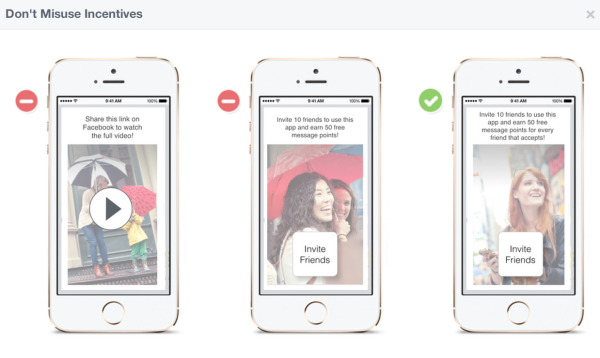
The new policy is set to take effect on Nov. 5 and any page that doesn’t comply will have the gates disabled. New apps made after the announcement will also be unable to create new like gates.

Here’s the explanation from the latest developer blog from Facebook:

You must not incentivize people to use social plugins or to like a Page. This includes offering rewards, or gating apps or app content based on whether or not a person has liked a Page. It remains acceptable to incentivize people to login to your app, checkin at a place or enter a promotion on your app’s Page. To ensure quality connections and help businesses reach the people who matter to them, we want people to like Pages because they want to connect and hear from the business, not because of artificial incentives. We believe this update will benefit people and advertisers alike.

Like gating isn’t as popular as it used to be, but it is still a relatively common Facebook fan-building strategy.

It is important to note that it is still acceptable to use incentives. You simply can’t use incentives that require a user to Like a page to gain access to content.

faceboo-like-gate-600x358

Facebook MobileThe majority of reports about Facebook this year would suggest the largest social media platform is about to crumble under its own weight. But, all the latest data from their Second Quarter 2014 Financial Summary indicates otherwise.

The report includes a ton of positive statistics for the social media leader, but the biggest findings are about how we use Facebook. Specifically, there has been a 19% increase in daily active users, suggesting that most people are including Facebook as a part of their daily lifestyle. Most likely, the ability to access Facebook on the go is responsible for a significant amount of the growth.

The total number of daily active users now sits around 829 million users.

Facebook also saw a significant jump in revenue, growing 61% compared to last year. Unsurprisingly, mobile also played a huge role in the jump, as it is responsible for 62% of overall ad revenue for the second quarter.

The report also included some other statistics which highlight the important role of mobile for Facebook.

  • Mobile daily active users were up 39% year-over-year, reaching an average of 654 million on for June 2014.
  • Monthly active users were up 14% over last year, reaching 1.32 billion as of June 30, 2014, an increase of 14% year-over-year.
  • Monthly active mobile users went up by 31% compared to last year, reaching 1.07 billion as of June 30, 2014.
Source: Wikimedia Commons

Source: Wikimedia Commons

Brands have been complaining for quite some time that their Facebook engagement has been plummeting, especially for smaller brands who rely on organic reach to connect with their audience. Of course, plenty of analysts and SEO “gurus” have offered their fair share of strategies for increasing engagement, but most of these can be very expensive. Some would even cost more than giving in and using Facebook’s paid ad platform.

Don’t let that get you down though. Organic reach and engagement may be nosediving, but there are still free ways you can boost your page’s engagement. Just ask a few members of the Young Entrepreneur Council. Or don’t, because 10 founders from YEC already shared their suggestions on Search Engine Journal.

We may eventually reach a point where organic reach is effectively dead on Facebook, but there are always tactics available to negate some of the drop in engagement and get the most possible out of the free side of the largest social media platform available.

It has become a truism that “Facebook is losing organic reach,” almost like it is widely accepted that teens are leaving Facebook in droves. While the matter of teens leaving Facebook is up for some debate, the social media platform has even acknowledged that organic reach across the site is dropping and they explained why.

However there is more to the story. It is widely agreed upon that Facebook’s dropping organic reach is inherently bad, because the majority of businesses and marketers are getting the bad end of the deal. Those succeeding with the new algorithms are probably quite happy though.

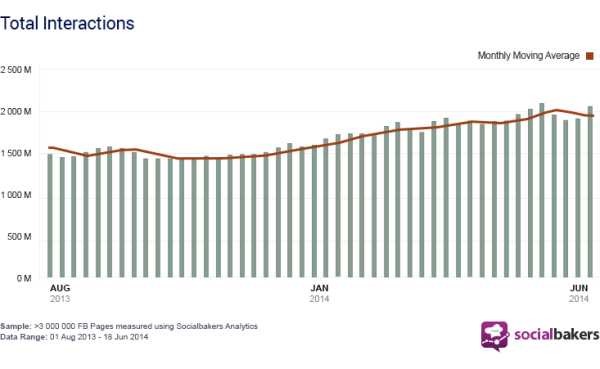
A new study from Socialbakers shows that page engagement for successful Facebook Pages has risen 30% since January. That means that although many of us are losing reach, those who have mastered the are of Facebook marketing are seeing more success than ever.

socialbakers-facebook-reach-600x369

Socialbakers analyst Phillip Ross wrote:

The conversation that seems to be dominating the Facebook marketing community is all about how algorithmic changes to Facebook’s News Feed are hurting organic reach. Our numbers say the opposite; brands have never had a better opportunity to have their best content placed in front of so many people.

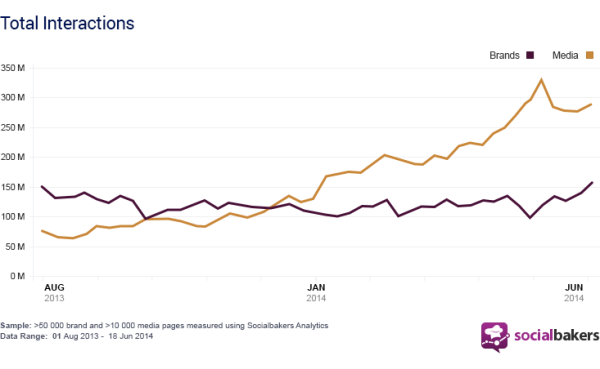
To be clear, Socialbakers’ numbers aren’t refuting the common knowledge that Facebook’s organic reach is losing ground quite fast. This study focused specifically on the 3 million largest Pages, but there are over 30 million active small business pages that weren’t included.

socialbakers-media-interactions-600x369

Still the numbers show the other side of Facebook’s marketing results and helps explain why they continue down this path. With such a huge amount of content being shared every day, Facebook wants to focus on quality rather than quantity. Those with great content and quality marketing are still seeing strong results, but it is undeniably getting harder for the small guy to find some ground to expand with.

Social media is typically thought of as where all the cool kids hang out. Fast food, clothing, and entertainment all have it easy when it comes to making friends and getting retweets, but businesses in seemingly boring industries frequently settle for mediocrity out of the belief they can’t keep up with the “cooler” industries. But, Uri Bar-Joseph showed us five companies that shrug off the assumption that “boring” businesses can’t be exciting online.