Tag Archive for: SEO

Google has officially begun rolling out the intrusive mobile interstitial penalty yesterday after months of warnings the penalty would be launched on January 10, 2017.

The roll-out was confirmed by both John Mueller and Gary Illyes yesterday.

The penalty is specifically designed to target intrusive interstitials that pop-up immediately after landing on a page from a Google mobile search result. However, it does not affect pages with delayed interstitials triggered by a click or action on the website.

Google specifies this means “pages where content is not easily accessible to a user on the transition from the mobile search results may not rank as highly.”

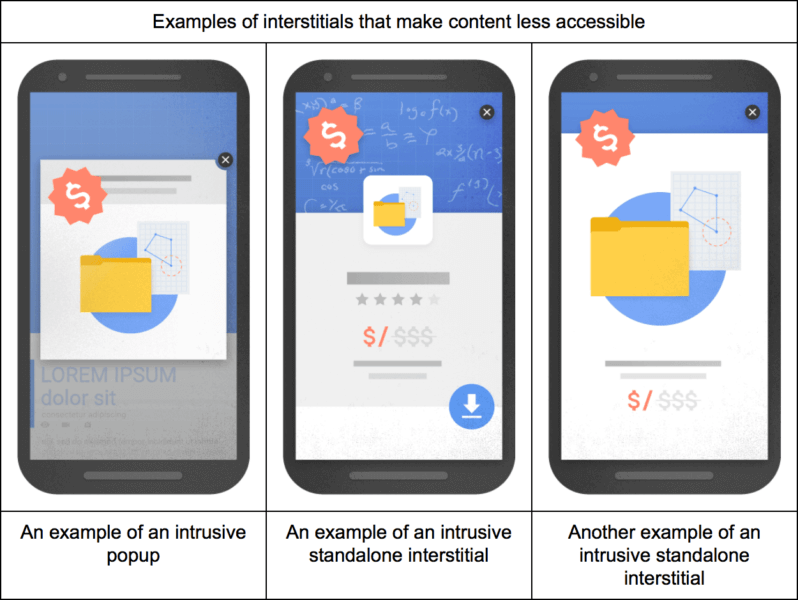
Google also detailed three specific types of interstitials it deems as problematic:
google-mobile-interstitials-penalty-bad-798x600

  • showing a popup that covers the main content, either immediately after the user navigates to a page from the search results or while they are looking through the page.
  • displaying a standalone interstitial that the user has to dismiss before accessing the main content.
  • using a layout where the above-the-fold portion of the page appears similar to a standalone interstitial, but the original content has been inlined underneath the fold.

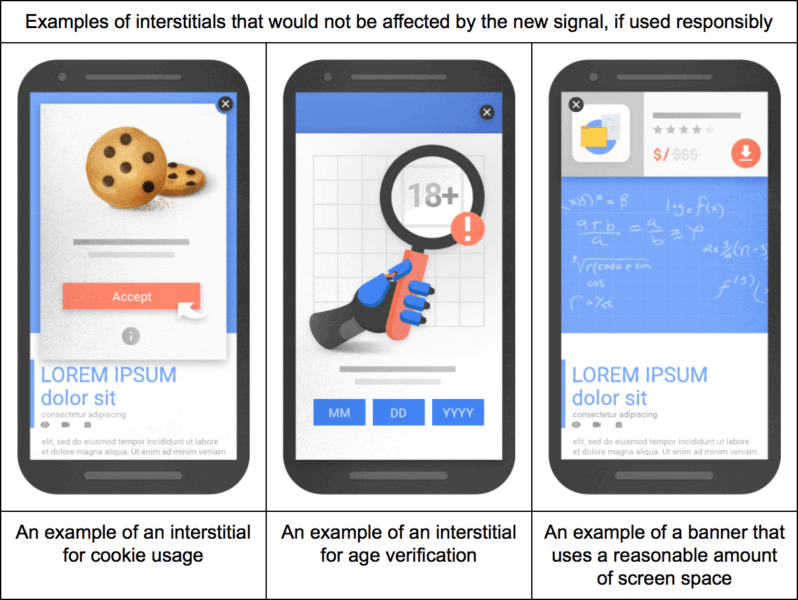
The company also detailed three types of interstitials that would not be affected by the penalty, so long as they are “used responsibly”:
google-mobile-interstitials-penalty-good-798x600

  • Interstitials that appear to be in response to a legal obligation, such as for cookie usage or for age verification.
  • Login dialogs on sites where content is not publicly indexable. For example, this would include private content such as email or unindexable content that is behind a paywall.
  • Banners that use a reasonable amount of screen space and are easily dismissible. The app install banners provided by Safari and Chrome are examples of banners that use a reasonable amount of screen space.

google-mobile

Google is making a huge change to their search engine that could have huge implications for the future of search.

Until now, Google has maintained a single search index, which cataloged the entire web for Google’s algorithm to sort through. However, that will be changing soon as Google’s Gary Illyes announced the search engine would be releasing a separate mobile search index.

The new mobile index will become Google’s “primary” index that it uses to deliver the majority of search results. At the same time, the company will continue to maintain a separate desktop search index which will be slightly less up-to-date.

The announcement came last week during a keynote address at Pubcon from Gary Illyes, webmaster trend analyst with Google. While Illyes later confirmed to Search Engine Land the rollout of the new index would be coming within “months,” he was otherwise short on details of how the mobile index will work.

It is also unclear in which circumstances Google will use which search index or just how behind the desktop index is. What is clear is that Google sees mobile as the future of search despite still seeing significant desktop usage.

Most likely, the new index means Google will be switching from a system which selectively pulls information from the single index for mobile results to a new system which uses the separate index for queries coming from mobile devices.

More information is likely to come in the near future, but for now, all we know is Google is gearing up for big changes to further prioritize mobile searchers.

mobileonly

It is no secret that the majority of people online change devices several times a day, but new research from Google shows that a growing number of users are adopting a “mobile only” lifestyle.

The new “cross-device” research shows that while plenty of people still move from desktop to mobile to tablet as they need to throughout the day, but almost 40% of searchers have dropped desktop devices from their online search process entirely.

Google says the study is based on “behavioral measurement of a convenience sample of 11,964 opt-in Google users between January 1, 2016 and March 31, 2016,” and that the data was “calibrated to reflect a U.S. demographic of 18 to 49-year-old cross-device users.”

screen-shot-2016-10-06-at-2-43-45-pm-800x558

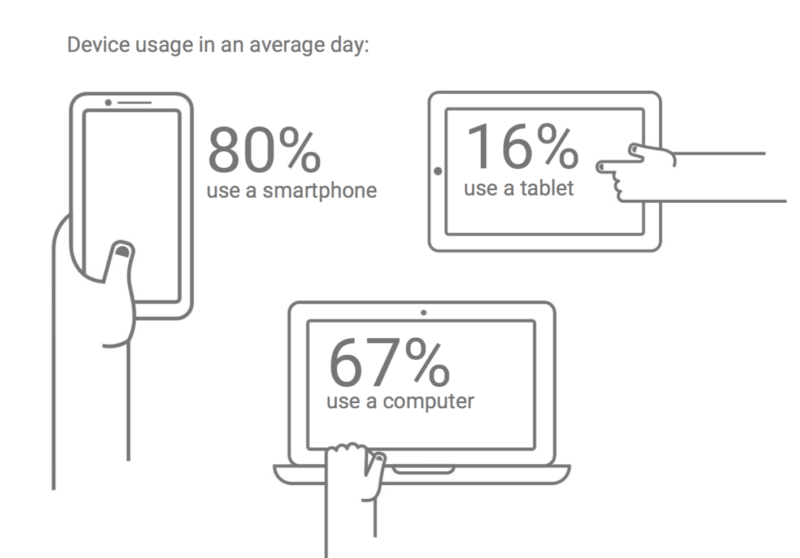
According to the findings, the average user spends 170 minutes on their smartphone every day, compared to 120 minutes on PC’s and approximately 75 minutes on tablets (that user owns a tablet). They most often use their smartphones at four physical locations:

  1. Home
  2. Work
  3. Stores
  4. Restaurants and Bars

Every day, approximately 80% of users search the internet on their smartphones, while 67% use PC’s. Over half (57%) move between devices throughout the day and 21% are likely to use more than one device simultaneously.

But, perhaps the most surprising finding of the study is that approximately 39% of people who conduct searches on an average day use only smartphones, compared to 32% who search only on PC. When measuring all internet use, rather than just searches, 27% of users are smartphone-only.

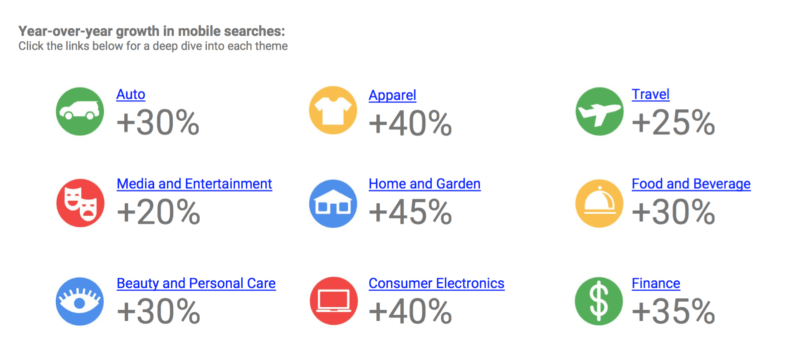
The report shows mobile usage varies by industry with year-over-year growth of mobile search for different markets.

screen-shot-2016-10-06-at-4-05-36-pm-800x353

If you want to find out more, check out the full report here.

Google’s Penguin algorithm has been a core part of the search engines efforts to fight spam and low-quality content for years, but it has always been its own thing. The algorithm ran separate from Google’s core algorithm and was refreshed periodically. But that is all changing.

Starting today, Penguin is running in real-time as part of Google’s primary algorithm in all languages.

What Does This Mean?

In the past, the Penguin algorithm has been relatively static. When it was updated or refreshed, it would dish out penalties and remove penalties from those who had gone successfully gone through the reconsideration process. The only problem was these updates were sporadic, at best. In fact, the last update was over 700 days ago.

By turning Penguin into a real-time part of its algorithm, Google is speeding up the entire system so penalties can be given when a site is flagged and those who have resolved their problems can lose their penalty more quickly.

According to Google, Penguin can now make changes in roughly the same period of time it takes the search engine to crawl and re-index a page.

What Else Is Changing?

While the speed of Penguin is the biggest change as it becomes part of the core algorithm, there are some other small tweaks to how it works.

Penguin is now more targeted, only penalizing specific pages with that break link guidelines. Google Penguin used to punish the entire site for containing pages containing spammy link building practices, but now it will only devalue the individual pages.

Google is also making some changes to how it talks about Penguin in the public. Or, as the company stated, “We’re not going to comment on future refreshes.”

Google Logo

While loading speed is a crucial issue for most mobile internet users, Google’s “Mobile-Friendly Algorithm” isn’t currently using it as a ranking factor for mobile pages. However, that is likely to change when Google releases their next mobile-friendly update.

According to reports from the recent Search Marketing Summit in Sydney this week, Google Webmaster Trends Analyst Gary Illyes confirmed Google would be including page speed as a factor in the next mobile update. But, it may be months until that update arrives.

The inclusion of page speed seems like common sense. The majority of mobile users are likely to leave a page if it doesn’t load within five seconds, and some are even more impatient. From Google’s perspective, including page speed as a factor means they are more likely to help users find a site they will be happy with on the first click as often as possible.

It also makes sense considering Google introduced their version of Accelerated Mobile Pages recently.

Want to know how your site stacks up in terms of page speed or other mobile friendly factors? Google has also released updated versions of their mobile-friendliness and page speed tests for both desktop and mobile in one place.

The new tool, available here, combines all the free site evaluation tools Google offers in one easy-to-read report. You can also get a more extensive report emailed to you for deeper analysis.

As smartphone internet use has exploded in the past few years, mobile-friendly pages and search engine optimization have become the standard, but new statistics from Bing suggests the future of SEO may be all about voice search.

During the Search Insider Summit last week, Bing representatives told the crowd that a quarter of all searches performed on Bing are voice searches and the trend looks keep increasing for the foreseeable future.

Additionally, as users get more accustomed to voice search, it is changing how they are performing searches entirely. Voice searches are notably longer, tending to fall between six and 10 words, compared to just one to three words for text searches.

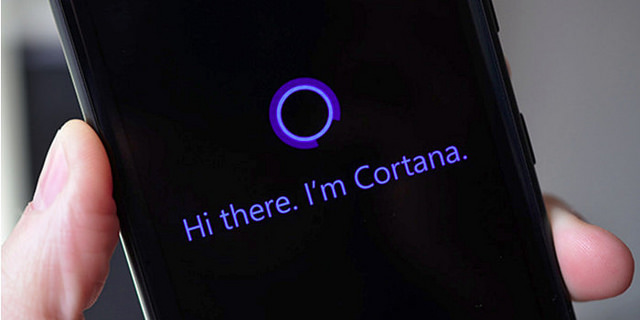
Part of this notable rise of voice search on Bing is likely because the company powers three of the leading voice assistants in the world. Apple’s Siri, Microsoft’s Cortana, and Amazon’s Alexa are all reliant on Bing to answer voice search queries. However, that shouldn’t discount these findings entirely.

While Google hasn’t released any statistics on voice searches performed on their platform, the company has taken clear steps to invest in voice search for future growth – such as using Google’s AI to recognize conversational speech in voice searches by having it read romance novels.

Clearly, the two largest search engines recognize that voice search will only become more prominent in the future. Likewise, marketers, SEOs, and businesses should start preparing now by investing in long-tail keywords and voice search optimization.

Google Mac Search

Roughly a month after Google announced it would be completely shutting down the Google PageRank Toolbar, the service finally went dark over the weekend.

Now, those who have the PageRank toolbar installed will not be able to see the 1-to-10 rankings of sites they visit, making the toolbar officially useless. The move also cuts data from any third-party toolbar that tries to retrieve a PageRank score.

Of course, if you’ve been using the PageRank toolbar recently, you have been working from outdated data. Google hasn’t updated the public PageRank scores in years, so it makes sense to finally shut it down for good.

It must be noted that PageRank isn’t completely gone. It just isn’t available to the public anymore. Google will keep using the PageRank algorithm internally to help evaluate websites.

For more about the legacy of PageRank and the PageRank toolbar, I recommend reading Danny Sullivan’s RIP Google PageRank score: A retrospective on how it ruined the web.

GoogleAnalytics.png

Google Analytics is an essential tool for making sure your website is performing as you would like and making improvements to keep growing, whether you are a high-level marketer or a business owner who just launched their site.

If you aren’t familiar with Analytics, however, or the technical jargon that fills your reports, it can be difficult to make sense of the huge amount of information available. That can make it hard for someone new to running a website for their business to make sense of the huge amount of information available in Google Analytics.

Thankfully, you don’t have to depend on analysts, marketers, or your company’s “computer guy”, to understand how your site is performing with Google Analytics. Search Engine Watch has put together an easy-to-understand glossary for all the jargon and confusing labels that you will come across, making it simple for you to know exactly what your reports are saying about your site.

You can see the handy guide from Search Engine Watch here.

Yesterday, we reported that a significant number of websites had been hit with Google penalties over the weekend for “unnatural outbound links.” Since then, Google has clarified that the manual penalties issued this weekend were specifically related to bloggers giving links to websites in exchange for free products or services.

Google had issued a warning a few weeks ago urging bloggers to disclose free product reviews and nofollow links in their blog posts related to these products. Now, they’ve taken action against sites who ignored the warning.

In the warning, Google told bloggers to “nofollow the link, if you decide to link to the company’s site, the company’s social media accounts, an online merchant’s page that sells the product, a review service’s page featuring reviews of the product or the company’s mobile app in an app store.”

As Barry Schwartz reports, John Mueller from Google explained the penalties in several threads on the Google support forums, telling people to look at the warning Google published recently named Best practices for bloggers reviewing free products they receive from companies. In one comment, Mueller went on to say:

In particular, if a post was made because of a free product (or free service, or just paid, etc.), then any links placed there because of that need to have a rel=nofollow attached to them. This includes links to the product itself, any sales pages (such as on Amazon), affiliate links, social media profiles, etc. that are associated with that post. Additionally, I imagine your readers would also appreciate it if those posts were labeled appropriately. It’s fine to keep these kinds of posts up, sometimes there’s a lot of useful information in them! However, the links in those posts specifically need to be modified so that they don’t pass PageRank (by using the rel=nofollow).

Once these links are cleaned up appropriately, feel free to submit a reconsideration request, so that the webspam team can double-check and remove the manual action.

If you are a blogger or company who has participated in an agreement to give free products to reviews, be sure to check your Google Search Console messages to see if you’ve been hit by the latest round of manual penalties.

Google Authorship

In a move that should please many online businesses, Google is making it easier to leave reviews on the platform. Finally, users can leave reviews without a Google+ account.

To clarify, while you don’t need a Google+ account, you do still need a regular old Google account. The change was first spotted by Conrad O’Connell from Serptests.com.

The difference seems small, but in this case, semantics is everything. By not requiring a Google+ account, Google is opening the door to a considerable number of reviews. Considering review counts and overall rating are top ranking signals for local search, this also means it will be easier to improve your local rankings with reviews.

This doesn’t mean you will have to do with an enormous amount of anonymous or troll reviews either. The first and last name of the reviewer will still be shown, so you shouldn’t have to worry about being flooded with one-star reviews by nameless accounts.

At the same time, Google also fixed a well-known bug which would keep reviews from being submitted from a mobile device for businesses without another pre-existing review.

Reputation is everything for local businesses, and these changes make it easier than ever for your customers to spread the gospel of your quality service or products.