
Tag Archive for: News

Twitter has grown from a small social media platform to one of most popular ways to share and interact with everyone from friends and family to celebrities and clothing brands. But along the way Twitter also got a reputation for being one of the most highly efficient marketing tools possible.

While Twitter isn’t the first social media platform to allow brands and public figures to interact with their audiences, it has continuously been one of the most powerful and easy to use platforms available. The only thing holding it back was a lack of analytics tools.

Last month, Twitter took the first step in rectifying this issue by launching an analytics dashboard similar to Google Analytics that specifically focused on Twitter. The analytics dashboard did everything from measuring the performance of your tweets to monitoring how many people are seeing each tweet. Too bad only advertisers and verified users had access to it at the time.

Thankfully, everything changed yesterday when Twitter engineer Ian Chan announced the wide release of the analytics dashboard via a tweet.

https://twitter.com/chanian/status/504712774321074176

Twitter also added a new page to the help center which explains everything you could want to know about using the dashboard and familiarizing yourself with the layout. To get access to the analytics dashboard, you only need to have an account that has been open for more than 2 weeks and primarily tweets in English, French, Japanese, or Spanish.

A little over a year ago, Google brought apps into advertising through the use of app install and app re-engagement ads, which made their way to Google’s mobile AdMob Network this June. Today, these ads also became available on Google Search and YouTube globally.

If you haven’t gotten familiar with app install and app re-engagement ads, Ginny Marvin gives a great explanation in her article for Marketing Land.

ransomLast week, many webmasters and SEO’s received a scare in the form of extortion emails from a supposed SEO threatening to plague a site with negative SEO if they do not pay a ransom of$1,500.

It seems the emails concerned even the most prominent members of the SEO community such as Dan Petrovic and Steve Webb. Even more interesting, despite assurances from Google that they would investigate the threats, a fair portion of the community appears to be at least moderately troubled by the threats. This gives an indication of just how easy people perceive negative SEO to be.

The email cuts straight to the point opening with, “This is an extortion email.” It then goes on to explain exactly how the individual(s) will enact specific tactics which can hurt a site’s performance in Google and potentially cause a site to be deindexed by the search engine.

The full text of the emails is as follows:

Hello,

Read this email very carefully.

This is an extortion email.

We will do NEGATIVE SEO to your website by giving it 20,000 XRumer forum profile backlinks (permanent & mostly dofollow) pointing directly to your website and hence your website will get penalised & knocked off the Google’s Search Engine Result Pages (SERP) forever, if you do not pay us $1,500.00 (payable by Western Union).

This is no false claim or a hoax, download the following Notepad file containing 20,000 XRumer forum profile backlinks pointing to http://www.negativeseo.cn.pn/ (this is our website and go and see on this website, you will find our email address [email protected] from which this email right now is being sent to you) :

http://www.mediafire.com/download/eizjwnpq2rsrncu/20000-XRumer-Forum-Profile-Backlinks-Dofollow.txt

Just reply to this email to let us know if you will pay just $1,500.00 or not for us to refrain or not from ruining your precious website & business permanently. Also if you ignore this email and do not reply to this email within the next 24-48 hours, then we will go ahead and build 20,000 XRumer forum profile backlinks pointing directly to your website.

We are awaiting your wise decision.

RS

Thankfully, it appears the entire situation has been nothing more than empty threats. Despite several credible SEO figures reporting the extortion emails, no one has reported paying the extortion amount and there are no signs that negative SEO is being put into action against these sites.

With its ever decreasing organic reach, Facebook is putting a lot of attention into their paid ad platform, especially the ads shown on mobile devices. Now, the reporting side of Facebook’s paid ad is getting improved to reflect the huge increases in mobile ads in recent times.

One of these improvements is the launch of cross-device reporting for Facebook ads. Now Facebook advertisers are able to see how users move throughout their sales process, even if they move across devices. The announcement described just how advertisers may benefit:

Imagine seeing an ad for a product on your mobile phone while in line at the bank. Do you immediately make a purchase on your phone? Probably not. But perhaps you go back to your office later that day and buy on your desktop computer. Such cross-device conversions are becoming increasingly common as people move between their phones, tablets and desktop computers to interact with businesses.

Cross-device reporting allows advertisers to be able to see which devices ads were viewed on, and on which devices conversions subsequently occurred. That means you can see how many people clicked an ad on iPhone but then later finished their conversion on desktop, and vice-versa.

In a recent analysis of US Facebook campaigns, it was found that of the people who show interest in a mobile Facebook ad before converting, over 32% converted on desktop within 28 days.

You can view the cross-device conversions for campaigns by going to your Facebook Ad Reports, where you will click Edit Columns, and select Cross-Device on the left-hand menu.

Now that we’ve all hopefully gotten over the “links are dead” hysteria, SEOs and webmasters are beginning to worry about their backlink profiles again. In the past it was easy. You could buy links or make enact one of the many now-banned tactics to try to artificially inflate your backlink profile and it seemed like no one was the wiser.

Of course things have changed quite drastically, as you should know by now. Backlinks need to be earned, and they need to be quality. As many analysts will tell you, building backlinks these days is more about relationship building than it is about farming as many links as possible. But how are you supposed to earn these prized high quality links?

SEOChat asked a long list of SEO experts where their most valuable links came from, and each gives an example of how you can earn links yourself by simply providing a service to your users and important figures related to your industry.

New ImageCountless businesses have 90 days to make significant changes to their Facebook strategies and pages. With an update to its Platform Policy, Facebook killed the so-called “like gate” which required users to Like a Page before they could be gain access to content, apps, rewards, or be eligible for contests.
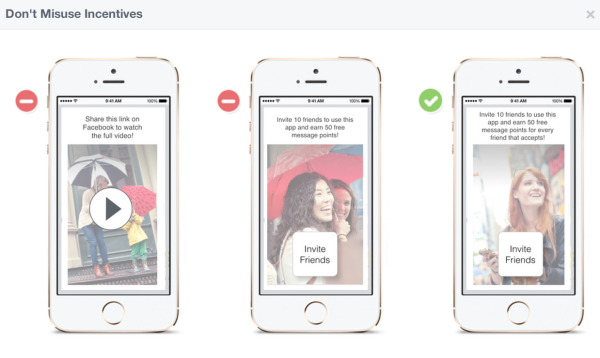
The new policy is set to take effect on Nov. 5 and any page that doesn’t comply will have the gates disabled. New apps made after the announcement will also be unable to create new like gates.

Here’s the explanation from the latest developer blog from Facebook:

You must not incentivize people to use social plugins or to like a Page. This includes offering rewards, or gating apps or app content based on whether or not a person has liked a Page. It remains acceptable to incentivize people to login to your app, checkin at a place or enter a promotion on your app’s Page. To ensure quality connections and help businesses reach the people who matter to them, we want people to like Pages because they want to connect and hear from the business, not because of artificial incentives. We believe this update will benefit people and advertisers alike.

Like gating isn’t as popular as it used to be, but it is still a relatively common Facebook fan-building strategy.

It is important to note that it is still acceptable to use incentives. You simply can’t use incentives that require a user to Like a page to gain access to content.

faceboo-like-gate-600x358

Merlin2525_Paid_Business_Stamp_2As online optimization and marketing become more and more essential to the success of smaller businesses, many small businesses are trying to manage as much online marketing on their own as they can manage with limited time and resources.
Most often, this results in the company taking on relatively small SEO responsibilities which can give a slight boost to their online visibility and performance while missing out on the larger benefits of hiring professionals. With limited resources, this may sometimes be the best option, although it doesn’t pack anywhere near the punch.

One of the biggest problems with trying to pickup SEO as a part-time strategy for your business is that SEO is only a part of the equation. These days online marketing is only truly effective when you use a holistic approach that combines social media marketing, SEO, paid search, and even traditional marketing.

Many smaller businesses employ someone savvy enough to even contribute to social media marketing efforts, but typically the do-it-yourself approach results in paid search getting neglected and you missing out on some of the most successful parts of a successful online marketing strategy.

You don’t have to leave all your pay per click (PPC) efforts to the professionals however. If you can’t afford to hire someone to take on your paid search marketing, you can still gain some humble improvements and increase your conversions with some beginner level SEO. Huffington Post shared a list of 8 things anyone can do to improve your PPC efforts, and you might be surprised at what you can accomplish by just sticking your toes into the pool.

If you are pleased with the results, it might even be the push you need to invest serious resources into a strong online presence in all areas.

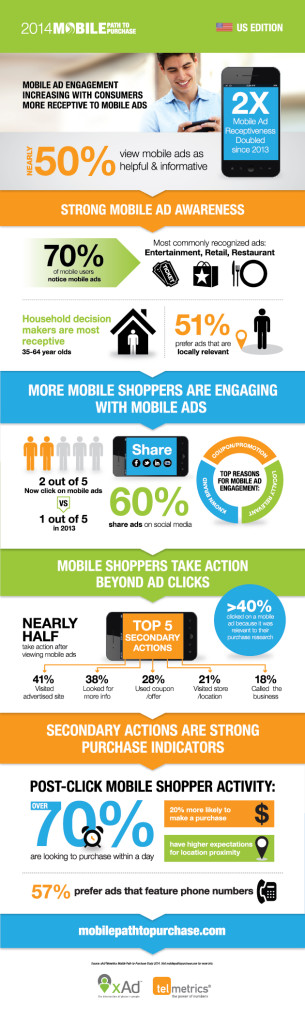
The report from the 3rd Annual U.S. Mobile Path-to-Purchase Study conducted by xAd and Telmetrics shows that as consumers mobile shoppers are increasingly receptive to relevant mobile ads, reflecting the increasing trust in mobile browsing.

The report, published earlier this week, shows that nearly 50 percent of mobile shoppers reported they felt mobile ads are informative or helpful, up 113 percent from 32 percent last year.

Even more, 40 percent of those surveyed said they have clicked on ads and nearly half of those have taken secondary actions such as viewing the referring website and searching for additional product information.

Clearly, mobile advertising is a blossoming target as the internet becomes increasingly mobile. In a market where mobile use has begun outpacing desktop access, it makes sense that users would become equally interested in relevant ads for their mobile devices.

You can get more information in the infographic shared below, or you can view the report in full here.

MP2P_2014_USR2_AdReceptiveness-305x1024

Facebook MobileThe majority of reports about Facebook this year would suggest the largest social media platform is about to crumble under its own weight. But, all the latest data from their Second Quarter 2014 Financial Summary indicates otherwise.

The report includes a ton of positive statistics for the social media leader, but the biggest findings are about how we use Facebook. Specifically, there has been a 19% increase in daily active users, suggesting that most people are including Facebook as a part of their daily lifestyle. Most likely, the ability to access Facebook on the go is responsible for a significant amount of the growth.

The total number of daily active users now sits around 829 million users.

Facebook also saw a significant jump in revenue, growing 61% compared to last year. Unsurprisingly, mobile also played a huge role in the jump, as it is responsible for 62% of overall ad revenue for the second quarter.

The report also included some other statistics which highlight the important role of mobile for Facebook.

  • Mobile daily active users were up 39% year-over-year, reaching an average of 654 million on for June 2014.
  • Monthly active users were up 14% over last year, reaching 1.32 billion as of June 30, 2014, an increase of 14% year-over-year.
  • Monthly active mobile users went up by 31% compared to last year, reaching 1.07 billion as of June 30, 2014.

local-business

Last night Google breathed new life into a forgotten algorithm by updating their local search algorithm to provide more useful, relevant, and accurate local search results that are more closely linked to traditional web search ranking signals.

While Google has remained mum on a large amount of the details, we do know the changes can be visible within Google Maps search results as well as traditional search results. From the online discussion, it also local businesses are also getting significant ranking and traffic boosts as most responses have been positive.

Most of the changes are behind the scenes, which Google doesn’t want to share with the world. However, Barry Schwartz shared that the new algorithm ties deeper into web search than previously by linking it to search features such as Knowledge Graph, spelling correction, synonyms, and more.

Google also says the new algorithm improves their distance and location ranking parameters.

The algorithm is already rolling out for US English results, but Google wouldn’t say when to expect it to roll out for other regions and languages, nor would they comment on what percent of queries have been effected or if web spam algorithms were included in the update.