The Super Bowl is advertising’s biggest day of the year with brands spending millions to get their products in the spotlight. Many tune in just to enjoy the biggest ads of the year and this year commercials gave audiences a fair share of laughs, pangs of nostalgia, and surprises – though maybe not anything as shocking as the Patriot’s comeback.

Of course, these days you don’t have to sit through the big-game (and insanely long pre-show) to see the ads. Several advertisers shared their campaigns early on YouTube, and the others were uploaded as they aired for you to watch and re-watch.

To make sure you catch the best and biggest ads of this year’s Super Bowl, I collected five of the most unforgettable commercials you’re likely to hear people talking about:

Snickers Live Commercial

https://youtu.be/_9M_wQDTTdk

Most brands spend weeks shooting and editing their commercials ahead of the game to make sure everything is absolutely perfect. Snickers took a different route this year with a live commercial starring Adam Driver which ends in a (perfectly orchestrated) catastrophe. It’s a novel twist on the typical Super Bowl ad in a way that perfectly ties into the message, and I predict other brands may follow their lead in the future.

Avocados From Mexico

https://youtu.be/VneoEvAJX0g

Comedy in Super Bowl ads usually boils down to celebrities doing zany things (and yes, we will get to one of those soon). But, the funniest ad in this year’s game is almost entirely celebrity free – aside from SNL’s Jon Lovitz, if you consider him a celebrity.

Instead, it sets up a simple premise of a secret society gathering to discuss their recent leaks, including all the most well-known conspiracy theories. Even better, the brand took a risk and slipped in a “Deflategate” joke knowing there was a good chance the Patriots would make it to the Super Bowl – and it payed off beautifully.

T-Mobile – #NSFWireless

https://youtu.be/pNCG9fHGXB0

T-Mobile went with the “celebrities doing zany things” angle this year, with mixed results. While the dancing Justin Bieber ads were eye-rollingly awkward, two hilarious commercials starring comedian and actress Kristen Schaal more than make up for their missteps.

Schaal, playing a Verizon customer addicted to being treated poorly by her service provider, perfectly sells the message that only a masochist would enjoy the customer experience of T-Mobile’s competitors.

It’s a 10 – Four Years

Perhaps unsurprisingly, politics also played a major role in ad campaigns from several advertisers including Budweiser and Audi. While those ads were beautiful, my favorite political ad of the night took a lighter tone. Opening with “America, we are in for at least four years of awful hair,” It’s a 10 urges viewers to “do your part by making up for it with great hair.”

Understated and smart, the brand left a mark on their night with a truly bipartisan message urging everyone to take pride in their hair.

Tide Cleans Terry Bradshaw’s Shirt

https://youtu.be/jF3otdfvSBQ

Terry Bradshaw and Tide teamed up last night to tear down the walls between reality and advertisements like never seen before. Many viewers noted that Bradshaw returned from commercial in the second quarter with a conspicuously large stain on his shirt, which prompted mass ridicule on social media.

But, the joke was on us. Bradshaw’s stain was setting up a Tide ad telling an epic journey from the broadcasting booth to actor Jeffrey Tambor’s house to clean out the stain and do some quiet sitting in front of the TV. The ending is enjoyable enough on its own, but the creative breaking of the fourth wall makes Tide’s campaign a standout ad of the night.

YouTube Ads

YouTube may be one of Google’s largest platforms, but it gets treated a bit like the black sheep when it comes to Google’s ad services. Targeting has been limited compared to typical AdWords options, and ad options have been built around desktop functionality first.

This is all starting to change, as Google says it is rolling out several updates aimed to make advertising on YouTube better on both mobile and desktop. The announcement also mentioned that over 50% of YouTube videos are now happening on mobile, which likely motivated the change in how they think about ads on the platform.

Target Advertising

Google is now allowing YouTube ads to utilize information associated with users’ Google accounts like their search history, demographic information, and whether the viewer has engaged with an advertiser in the past to better target who sees your ad.

More Focus on Mobile

In response to the increasingly mobile viewership of YouTube, Google is shifting away from a desktop-first mindset. To do this, they are moving from using cookies and pixels because they were not designed for targeting users on YouTube’s mobile, TV, and set-top box apps. The hope is to make tracking and ad functionality more accurate across all devices.

Better Control of What Ads You See

Not all of the new changes are limited to advertisers. Google is also introducing the option for users to device what ads they see on both Google and YouTube from one location. For example, if a user mutes a specific advertiser in Search, the advertiser will also be muted for the user when they watch videos on YouTube.

Before long, Facebook’s video service is going to look a lot like YouTube. Facebook announced several new features to their mobile app that will seem very familiar to YouTube users and will make videos an even larger part of the Facebook platform than before.

Among the features is the new ability to collapse videos into a floating window, so you can browsing your Facebook seamlessly while you watch a video. The change will make watching videos on the platform less of an interruption and more a part of the experience.

Facebook is also testing implementing a new list of recommended videos to watch next after users finish watching a video. If you don’t see something that piques your interest, you can also look in the all new dedicated Facebook video feed, where you’ll find nothing but user shared videos.

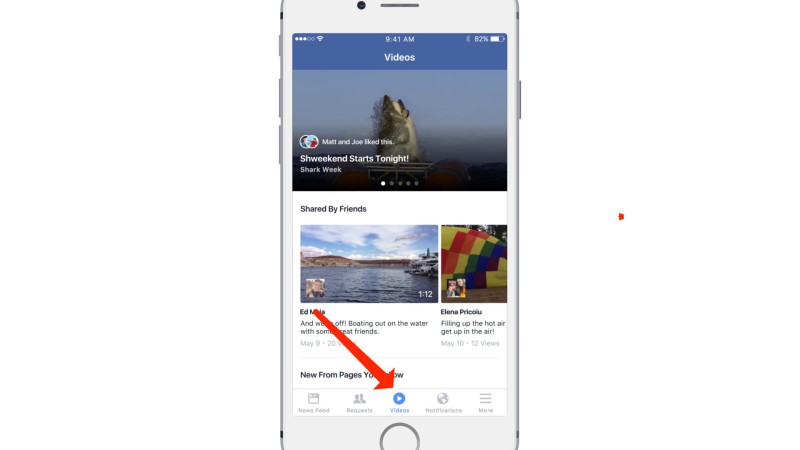
The dedicated video feed acts much like your normal News Feed, but exclusively for video and can be found by tapping the “Videos” icon along the bottom navigation menu of the Facebook app.

Videos-section-800x450

If you see something you think you might want to watch, but can’t at the immediate moment for some reason, you can now save it for later, allowing you to easily return when you are someplace more suitable for watching video. All your saved videos can be easily found in the “Saved” bookmark in the menu.

Facebook is still working out the kinks on most of these new features, so don’t expect them to be rolled out too soon. Instead, it appears the new features will see a slow testing and rollout phase, with no telling when we will see a full launch.


Google has made a big deal about its ability to prevent advertisers from paying for ads that aren’t seen by real human eyes, including on YouTube’s ad network, but a new study by a team of European researchers suggests something is amiss. According to their findings, advertisers are still being forced to pay for ads despite YouTube’s systems flagging the view as “suspicious” or fraudulently coming from a bot rather than a human.

The experiment from researchers at NEC Labs Europe, UC3m, Imdea, and Polito, was conducted in three stages. First the researchers uploaded videos to YouTbe and set up an AdSense account to monetize them. Then, the team set up AdWords accounts to run ads against the video, before creating and deploying bots designed to specifically view the videos with the ads.

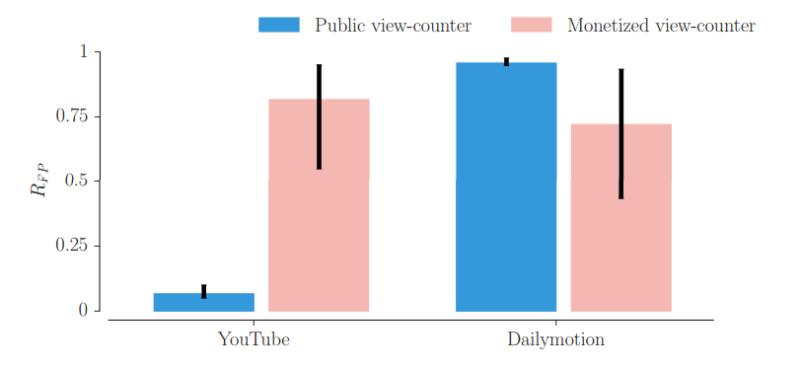
While the researchers concluded that “among the studied online video portals, YouTube is the only one implementing a sufficiently discriminative fake view detection mechanism,” they also found “that YouTube only applies this mechanism to discount fake views from the public view counter and not from the monetized view counter.”

That means that YouTube filters out views it deems as fraudulent for the public view counter, but they are still charging advertisers for those views.

Throughout their experiment, the group observed the number of monetized views was consistently larger than the number of counter views and came to the realization that “views considered suspicious are removed from the public view counter, but monetized.”

public-viewcounter-v-monetized-youtube-dailymotion-e1443113264182-800x372

This isn’t the first time Google has been accused of charging for fraudulent clicks. When similar situations were brought up with YouTube, the company said the discrepancies are likely due to users watching the video ad, but not the video itself. That would lead to the view to be monetized but not included in the public counter.

However, the researchers say that cannot be what happened here because the bot was designed to “view” both the ads and the accompanying video all the way through.

The team also took the fact that YouTube performs part of its view validation after the fact into consideration, however after six months the team saw no compensation adjustments. That happened even after YouTube suspended the AdSense account due to the bots’ suspicious activity.

The team also found YouTube is vulnerable to relatively simple attacks. They say they have given their findings to Google and will continue to refine the tools used for the study and potentially make them widely available.

A Google spokesperson said, “We’re contacting the researchers to discuss their findings further. We take invalid traffic very seriously and have invested significantly in the technology and team that keep this out of our systems. The vast majority of invalid traffic is filtered from our systems before advertisers are ever charged.”

YouTubesThe Financial Times is reporting that YouTube will begin allowing third-party verification of ad viewability by the end of the year following major pushback from major advertisers.

Until now advertisers have had to rely fully on YouTube’s viewership metrics to gauge how their ad efforts are working, but third-party authentication could potentially provide a less biased and full understanding of how your ads are being viewed and it may even help finally settle the dispute between which video platform is more popular.

The report claims Unilever and Kellogg’s are the key instigators for a move to enable independent viewability measurement. Kellogg’s is especially notable as it has even stopped its ad buys on YouTube due to lack of third-party verification.

Google does allow advertisers to buy ads on a viewable impression basis, but the verification is reliant on the company’s own Active View measurement tool.

Using its own measurement tools, Google has boasted of incredibly high viewability rates. In one study this year, Google said 91 percent of ads served on YouTube were found to be viewable using Active View.

Google declined to comment specifically, but told The Financial Times, “We’re committed to meeting all of our clients’ measurement needs” and “are taking our clients’ feedback into account as we continue to roll out new solutions”.

 facebook-vs-youtube

Facebook’s video platform is quickly rising as one of the most popular online video services available due to statistics showing marvelously high video view counts, but experts argue Facebook’s numbers may be misleading. While Facebook claims massive view counts, it is entirely possible YouTube may have a larger lead than it appears at first glance.

What even is a video view?

A video view is the count of how many people watch a video. It can’t be all that complicated, right? Wrong. Online, there is a surprising amount of contention over what exactly constitutes a video view.

For Facebook, a video view is counted every time any video plays for only 3 seconds. On the other hand, YouTube does not consider a video to be “viewed” until it has played for at least 30 seconds.

These contrasting metrics raise numerous questions about the accuracy of view statistics and the efficiency of online videos. Making issues more complicated is autoplay. On YouTube, you have to at least click one video before you are shown an endless feed of autoplaying videos, but you can view a video on Facebook by simply not paying attention when you are scrolling.

View statistics have long been an important metric for display ads, but these factors suggest the advertising industry may need to agree upon a set viewing metric, or turn to other types of data entirely, to accurately gauge the impact of video ads.

Are a few seconds enough?

Think about the last commercial you saw. How long did it take before you knew what the commercial was for? One of the biggest benefits of video advertising is the ability to tell a story with your ad, but this also means it is often not immediately clear what the product being advertised is.

Problematically, both The Media Rating Council and IAB side closer with Facebook’s metric. These organizations define a video ad as viewable “when at least 50 percent of the ad’s pixels are visible on a screen for at least two consecutive seconds.”

Now consider the average length of the Top 10 Best Video Ads of 2014 compiled by AdWeek is 2 minutes and 17 seconds.

It’s time for a new video view standard that reflects the actual impact videos are having. Facebook’s numbers sound amazing on paper, especially in light of how new this incarnation of the video platform is. But, they are less impressive when you consider many of those “views” can occur just because you got distracted with Facebook open.

Videos can be an immensely powerful online advertising tool, but don’t be fooled by misleading numbers. Use analytics to make sure views are turning into clicks and conversions, or consider using a video platform with slightly more strict view counts.

Here’s a rundown of how the biggest video services count views, compiled by Marketing Land:

  • YouTube: The Google-owned video network counts a view after a user has watched a video for “around” 30 seconds.
  • Facebook: Facebook videos automatically play without audio on users’ News Feeds. Views, which are displayed publicly, are triggered when someone watches for at least 3 seconds.
  • Instagram: Facebook’s photo and video sharing network doesn’t display video view counts publicly, but the company uses the same 3-second standard to count them. Instagram video also loops automatically while a video post remains on users’ screens, so instead of total video views, the stat Instagram sends to advertisers is views by “unique users.”
  • Twitter: Unlike Facebook and YouTube, Twitter doesn’t currently serve autoplay video (although it is testing the feature for some iOS users), so a view is counted when a user clicks on a video within a tweet. Video view counts are not publicly displayed. Advertisers can view stats within the Twitter ad platform, or for organic tweets from within the analytics dashboard.
  • Vine: The Twitter-owned video network autoplays looping video with a maximum length of 6 seconds. Views on the Vine network are called loops, which are publicly displayed and triggered after a user watches the entire video. Vine doesn’t sell ads.

FBVidVsYouTube

Facebook has made a big deal of highlighting the strengths of the Facebook Video platform, but a new study from Visible Measures shows there is no clear-cut winner between YouTube and Facebook. The data collected by the company adds context to earlier numbers and demonstrates how both platforms have their own strengths and weaknesses.

Facebook isn’t being dishonest when they highlight their statistics for views, but Facebook’s video platform has a difficult time maintaining momentum with popular videos. The platform excels at launching videos and gathering early velocity, but YouTube still has the clear lead when it comes to long-term value.

To come to these conclusions, Visible Measures studied 82 randomly chosen video campaigns launched by brands within the month of March and found that YouTube generated more views (65%-35%). While Facebook trails behind YouTube, the younger platform has made incredible strides in the span of a single year. Facebook only had a single digit share of brand video in last year’s study.

Only 53 of the campaigns included in the study posted natively to Facebook, perhaps contributing to YouTube’s lead in total views in 66% of campaigns.

The most striking difference between the platforms is the contrasting trajectories of videos on each platform. Facebook videos tended to accelerate quickly before peaking and gradually fading away. In fact, Facebook videos typically reached 85 percent of their total views in only the first week after launch. To contrast, YouTube only received 63% of its total viewership within the first seven days after launch.

These results were backed up by longer-term comparisons. Visible Measures points to findings that Facebook had 25% of total viewership of Super Bowl ad campaigns, but that number had dropped to 18.5% just two months later.

Visible Measure’s founder and CEO Brian Shin says these stats reflect the different natures of the platforms and noted that finding older videos on Facebook is specifically very difficult.

“If something is hot and of the moment, such as a newly released campaign, the Super Bowl, or even a cultural phenomenon like Fifty Shades of Grey, Facebook and similar social media sites are incredibly effective for driving the spread of timely content due to the trending nature of the News Feed,” Shin said in a release. “But the strength of Facebook to promote trending content also highlights how powerful YouTube remains as a platform for continued viewership.”

YouTube has long been the number one platform for video advertisers despite some recent challenges from Facebook. The top YouTube ads for last month give a good indication why so many advertisers trust the platform to help them build their brands.

The top 10 YouTube ads in March generated more than 102 million views, led by the Ad Council’s anti-discrimination spot “Love Has No Labels.” The ad shot to the top of YouTube’s most popular ads after being posted on March 3. Since then, it has garnered over 50 million views on its own.

While it can be difficult to climb to the top of YouTube’s ad charts, anyone can see a surprising amount of success by sharing their content on the platform. Let these top ads from March 2015 inspire you, and maybe you’ll be at the top of the list in the not too distant future.

Top Ten YouTube Video Ads for March 2015

1. Ad Council: Love Has No Labels

2. Durex: #Connect

3. Samsung: Galaxy 6 Official Introduction

https://youtu.be/CnYtWWDor2s

4. Samsung: Galaxy 6 Design Story

https://youtu.be/raAoYFrIm0I

5. YouTube: Music Awards 2015

6. GEICO: Family – Unskippable

https://youtu.be/pvcj9xptNOQ

7. YouTube Spotlight: #DearMe – What Advice Would You Give Yourself?

8. GoPro: Didga the Skateboarding Cat

 9. Valspar Paint: Color for the Colorblind

 10. Clean & Clear: See the Real Me

https://youtu.be/vyNZXQ136oI

FBVidVsYouTube

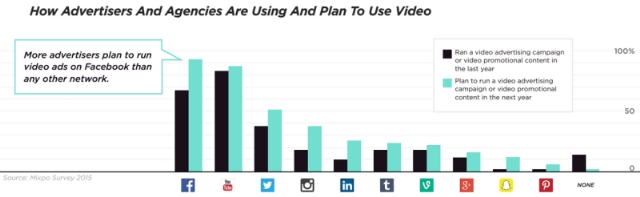
YouTube has been the prime place to be for video advertising for years, but Facebook is making a strong effort to take the throne. It also seems to be working. A new survey from video advertising company Mixpo suggests Facebook video may overtake YouTube as the number one video advertising platform as early as this year.

Facebook Video vs YouTube

The survey polled 125 agencies, brands and publishers on their plans for video advertising this year. According to their results, 87 percent said they plan to run video ad campaigns on Facebook, compared to 81.5 percent on YouTube.

Facebook video’s rise has been incredibly quick, following a revamp of the service early last year. Since then, the platform has claimed incredible viewing and sharing stats for videos which are attracting many advertisers.

The findings of the survey also show more businesses and advertisers are seeing the value in video advertising, as more marketers report planning video advertising campaigns across all platforms in 2015. Similarly, the number of advertisers without plans for video advertising this year has fallen to nearly non-existent.

YouTubesYou might assume that the largest social media platform would have the most effective paid advertising platform, but Facebook’s platform doesn’t hold the title according to a report from VentureBeat.

According to the report based on a study by AoL Platforms, YouTube is actually the champion of paid social media advertising platforms in more than a few key areas, including introducing new products to customers, and helping consumers make purchasing decisions.

The report examined data found within 500 million clicks and 15 million conversions during the first quarter of 2014, using Convertro’s attribution technology to track social purchase interactions. This data was then used to determined which platforms had affected online sales and at what point in the purchasing decision they had influence on the consumer.

Jeff Zwelling, CEO and co-founder at Convertro told VentureBeat:

We believe that YouTube does well in both of these important purchase funnel areas for a number of reasons. YouTube’s own search volume and preferential positioning on Google’s results help drive large amounts of traffic, of course. But when you get to YouTube, the content is rich, descriptive, and usually helpful.

I’ve done this myself. I recently bought a coffee machine. I had the decision down to three alternatives and couldn’t decide which one was best for me. In the end, I watched videos on YouTube of people using all three machines and chose the one that matched my idea of a good coffee maker.

YouTube is the best platform for both introducing new products and helping to close sales, while Facebook comes in second in both of those areas. Google+ consistently came in third.
You can get more information from the full report available here.