After testing the feature for much of the year, Microsoft Bing Page insights have officially launched for all Bing search results according to an announcement earlier this week.

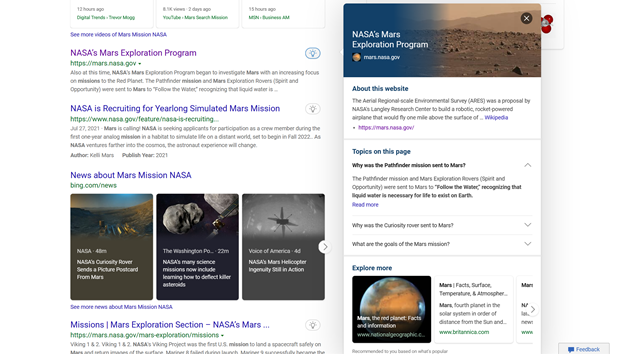
With this, users will now be able to see a small lightbulb icon on the right side of search results, which can provide additional information about the search result.

As the announcement says, Page insights “provides summarized insights from a page on your search results so you can find what you’re looking for faster.”

How It Works

The idea behind the new feature is fairly simple. Users simply click or mouse over the new lightbulb icon next to search results for more information.

According to Microsoft, this “helps you verify that the source is relevant to your needs, helps you get caught up to speed at a glance on top factoids you didn’t know about, and lets you jump straight to the relevant section of the page when you click ‘Read more’ for a specific question.”

You can see what this looks like in practice below:

Last Notes

It is important for webmasters to know this feature is currently only available on desktop search results. Microsoft is tightlipped about any possibility of bringing this to mobile search because of the “screen size required to properly display the results.”

Given that most modern search features are designed to responsively resize content based on the device being used and the importance of mobile search, this decision and statement raise more questions than they answer.

If you’d like to implement Bing Page insights for your website, simply ensure your site’s Bing snippet has the page insight feature added and that your content is accurate and relevant, or find out more from the full announcement here.

A few weeks ago, Google teased that it planned to refine its PageSpeed Insights tools to make data “more intuitive” and easy to understand. Now, that update has arrived.

What Is The PageSpeed Insights Tool?

If you’re unfamiliar, the PageSpeed Insights tool from Google evaluates your web pages to provide suggestions to improve how quickly content loads. 

The tool has been around in various forms since 2013 when it was a simple API webmaster could use to test their page speeds. Version 5, the most recent major update, arrived in 2018. However, smaller updates like this week’s happen somewhat regularly. 

Along with this new update, Google has moved the PageSpeed Insights tool to a new home at https://pagespeed.web.dev/.

What Is New In The PageSpeed Insights Tool?

The biggest focus of the new update is a change to the user interface to be more intuitive by “clearly differentiating between data derived from a synthetic environment and data collected from users in the field.”

To do this, Google has added dedicated sections for each type of data.

Where the tool used to include a label specifying which type of data you were viewing, Google has instead added information about what the data means for you and how it may be used to improve your performance.

Additionally, Google has shifted its emphasis to data collected from real users by moving field data to the top.

The Core Web Vitals assessment has also been expanded, with a label showing if your site has passed a Core Web Vitals assessment in the field and in-depth metrics from simulated environments.

Importantly, the PageSpeed Insights tool also includes details at the bottom of the page specifying how the data was collected in the field. This information includes:

  • Data collection period
  • Visit durations
  • Devices
  • Network connections
  • Sample size
  • Chrome versions

Lastly, Google has removed the previously included screenshot of the page as it indexed your content, replacing it with a series of images displaying the full loading sequence. 

For more, read the announcement for the update from Google’s Web.Dev blog.

Google’s Page Experience Algorithm update is officially coming to some desktop search results, beginning in February of next year.’

Google Search product manager Jeffrey Jose teased this news earlier this year at the annual I/O event. At the time, however, details about when it would be rolled out and how it would be implemented were scarce. Now, we have the full rundown.

What Is Google’s Page Experience Algorithm?

The Page Experience Algorithm was originally rolled out exclusively for searches coming from mobile devices earlier this year, but the search engine confirmed it will be bringing much of the algorithm to desktop searches. This includes the much-talked-about “Core Web Vitals” metrics which are intended to ensure a good user experience on sites.

As the announcement says:

“This means the same three Core Web Vitals metrics: LCP, FID, and CLS, and their associated thresholds will apply for desktop ranking. Other aspects of page experience signals, such as HTTPS security and absence of intrusive interstitials, will remain the same as well.”

However, one notable signal from the mobile Page Experience Algorithm will not be coming to desktop search results for obvious reasons: mobile-friendliness.

To accompany the new search signal, Google says it is working on a new Search Console report dedicated to showing how your desktop pages stack up when this algorithm is applied to them.; For now, the release date of that is unknown, but most believe the report will arrive before or at the same time as the algorithm update.

For more information, read the full announcement here.

When it comes to ranking a website in Google, most people agree that high-quality content is essential. But, what exactly is quality content? 

For a number of reasons, most online marketers agreed that Google defined high-quality content as something very specific: text-based content which clearly and engagingly communicated valuable information to readers.

Recently, though, Google’s John Mueller shot down that assumption during a video chat. 

While he still emphasizes that great content should inform or entertain viewers, Mueller explained that the search engine actually has a much broader view of “content quality” than most thought.

What Google Means When They Say “Quality Content”

In response to a question about whether SEO content creators should prioritize technical improvements to content or expand the scope of content, Mueller took a moment to talk about what content quality means to Google.

“When it comes to the quality of the content, we don’t mean like just the text of your articles. It’s really the quality of your overall website, and that includes everything from the layout to the design.

This is especially notable, as Mueller specifically highlights two factors that many continue to ignore – images and page speed. 

“How you have things presented on your pages? How you integrate images? How you work with speed? All of those factors, they kind of come into play there.”

Ultimately, Mueller’s response emphasizes taking a much more holistic view of your content and focusing on providing an all-around great experience for users on your website. 

There is an unspoken aspect to what Mueller says which should be mentioned. Mueller subtly shows that Google still prefers text-based content rather than videos or audio-only formats. While the company wants to integrate even more types of content, the simple fact is that the search engine still struggles to parse these formats without additional information.

Still, Mueller’s statement broadens the concept of “quality content” from what is often understood. 

“So it’s not the case that we would look at just purely the text of the article and ignore everything else around it and say, oh this is high-quality text. We really want to look at the website overall.”

It is no secret that Google knows the price you, your competitors, and even the shady third-party companies charge for your products or services. In some cases, you might even directly tell the company how much you charge through Google’s Merchant Center. So, it is reasonable to think that the search engine might also use that information when it is ranking brands or product pages in search results.

In a recent livestream, however, Google Webmaster Trends Analyst, John Mueller, denied the idea.

What John Mueller Has To Say About Price as a Google Ranking Signal

The question arose during an SEO Office-Hours hangout on October 8, which led to Mueller explaining that while Google can access this information, it does not use it when ranking traditional search results.

As he says in the recording of the discussion:

“Purely from a web search point of view, no, it’s not the case that we would try to recognize the price on a page and use that as a ranking factor.

“So it’s not the case that we would say we’ll take the cheaper one and rank that higher. I don’t think that would really make sense.”

At the same time, Mueller says he can’t speak on how products in shopping results (which may be shown in regular search results) are ranked. 

Within shopping search results, users can manually select to sort their results by price. Whether it is used as a factor the rest of the time isn’t something Mueller can answer:

“A lot of these products also end up in the product search results, which could be because you submit a feed, or maybe because we recognize the product information on these pages, and the product search results I don’t know how they’re ordered.

“It might be that they take the price into account, or things like availability, all of the other factors that kind of come in as attributes in product search.”

Price Is And Isn’t A Ranking Factor

At the end of the day, Mueller doesn’t work in the areas related to product search so he really can’t say whether price is a ranking factor within those areas of Google. This potentially includes when they are shown within normal search results pages.

What he can say for sure, is that within traditional web search results, Google does not use price to rank results:

“So, from a web search point of view, we don’t take price into account. From a product search point of view it’s possible.

“The tricky part, I think, as an SEO, is these different aspects of search are often combined in one search results page. Where you’ll see normal web results, and maybe you’ll see some product review results on the side, or maybe you’ll see some mix of that.”

You can hear Mueller’s full response in the recording from the October 8, 2021, Google SEO Office Hours hangout below:

Google says it is going to be radically updating its search engine by integrating its new “MUM” algorithm into its systems. 

This will allow Google’s search engines to better understand topics, find better answers and sources, and provide more intuitive ways to explore ideas.

Accompanying these new search systems, Google is going to be redesigning its search pages with new features that provide new ways to discover information and conduct searches that are more visual.

What is the MUM Algorithm?

Introduced earlier this year, the Multitask Unified Model algorithm, or MUM, allowed Google to better find information using images and across multiple languages. 

The main purpose of the algorithm is to improve Google’s ability to search with images and other types of visual content, rather than just text.

Three Ways MUM Is Changing Search

While it is hard to know exactly how transformative the introduction of the MUM algorithm will be before it arrives, Google did highlight three key features which will be coming with the change.

  1. “Things to know”
  2. Topic Zoom
  3. Visual Topic Exploration

Google’s “Things to Know”

Using predictive models, Google’s search engine will soon intuit the most likely steps you will take after an initial search and deliver websites that will facilitate those actions.

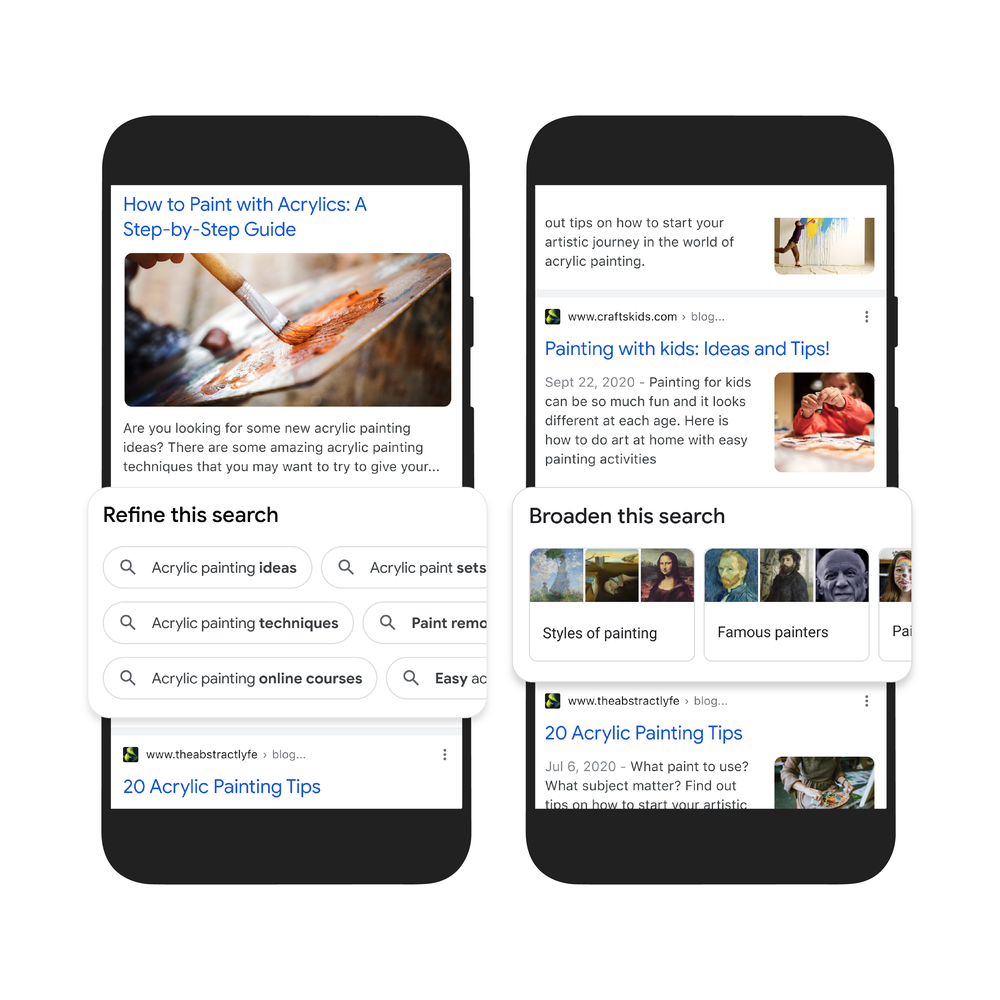
To help illustrate this process, the announcement uses the example of a user searching for “acrylic painting”.

According to the search engine’s data, there are more than 350 topics associated with that specific keyword phrase.

Using this knowledge, the “things to know” feature will then identify the most relevant or popular “paths” users are likely to take to further explore that topic and find content relating to that.

Topic Exploration

The next feature piggybacks on the last by making it easy to dive into related topics or find more in-depth information.

Using the feature, users can quickly broaden the topic they are looking at to find more general information, or zoom in to more detailed resources.

Visual Exploration

The last update enabled by MUM is actually already live on the search engine, providing a new way to visually explore topics.

Specifically, the visual search results page will appear for searches where a user is “looking for inspiration.”

As Google explains it:

“This new visual results page is designed for searches that are looking for inspiration, like ‘Halloween decorating ideas’ or ‘indoor vertical garden ideas,’ and you can try it today.”


It is likely that these new features are just the start of Google’s introduction of the MUM algorithm to revamp how it does search. Since its start, the search engine has struggled to understand visual content, but MUM finally provides a path to not only understand but deliver visual content across the entire Google platform.

Head of Instagram, Adam Mosseri, had been opening up recently in a series of blog posts about how the app surfaces content. 

First, he went in-depth on how the social app’s recommendation features find and highlight content in users’ primary feeds, as well as in stories, the explore section, and more.

Now, he is focusing on the app’s search engine, explaining how Instagram ranks search results and how to optimize content for the platform.

How Instagram Search Works

As with any modern search engine, the first and foremost goal of Instagram’s search feature is to find and return the most relevant results for an individual user’s query.

“Your search tells us what you’re looking for, and it’s noticeable when the results aren’t useful. It’s important for us to get this right, so we try to organize search results by what’s most relevant to you — whether it be a close friend, a creator you love, or ideas for vegan desserts.

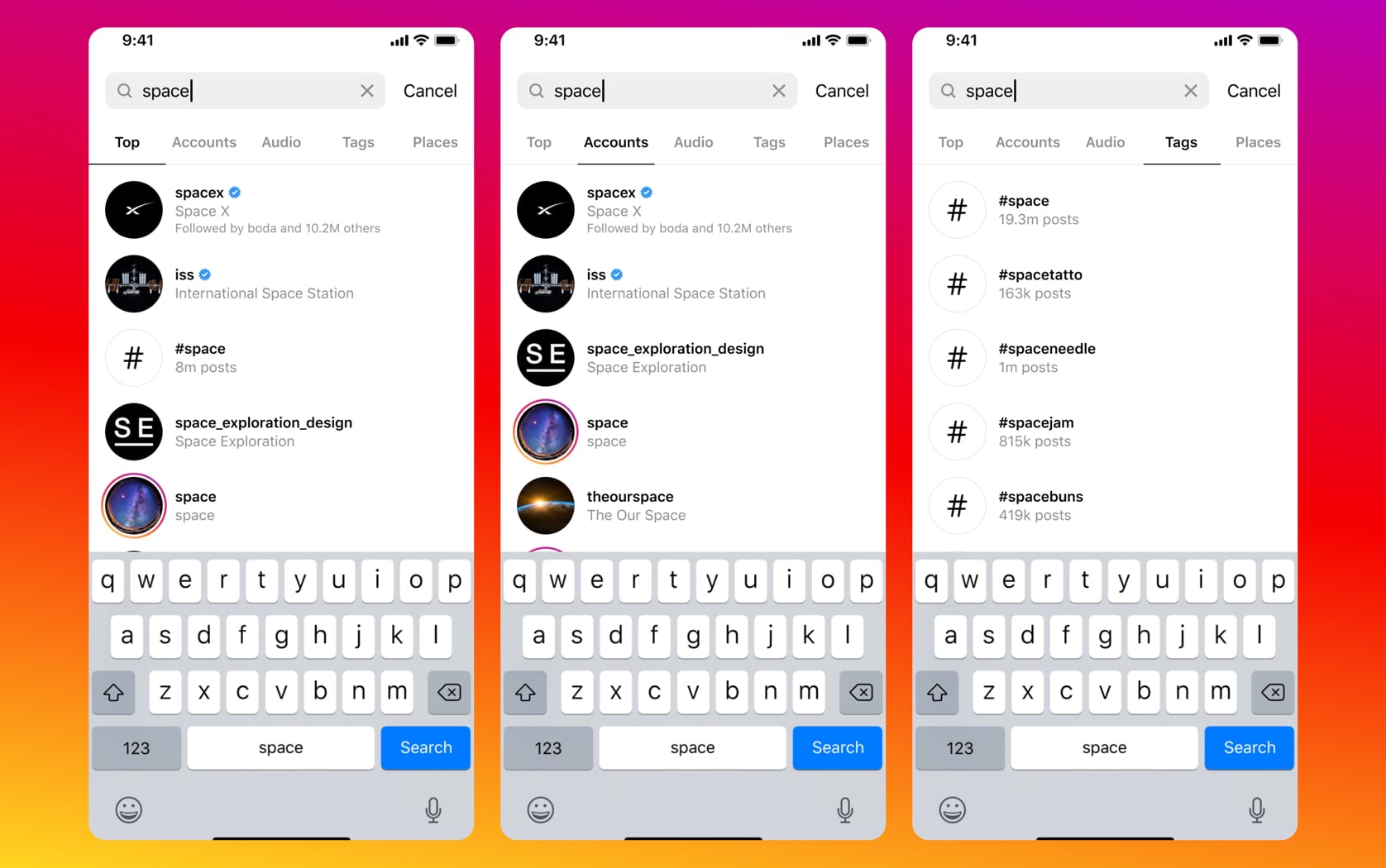
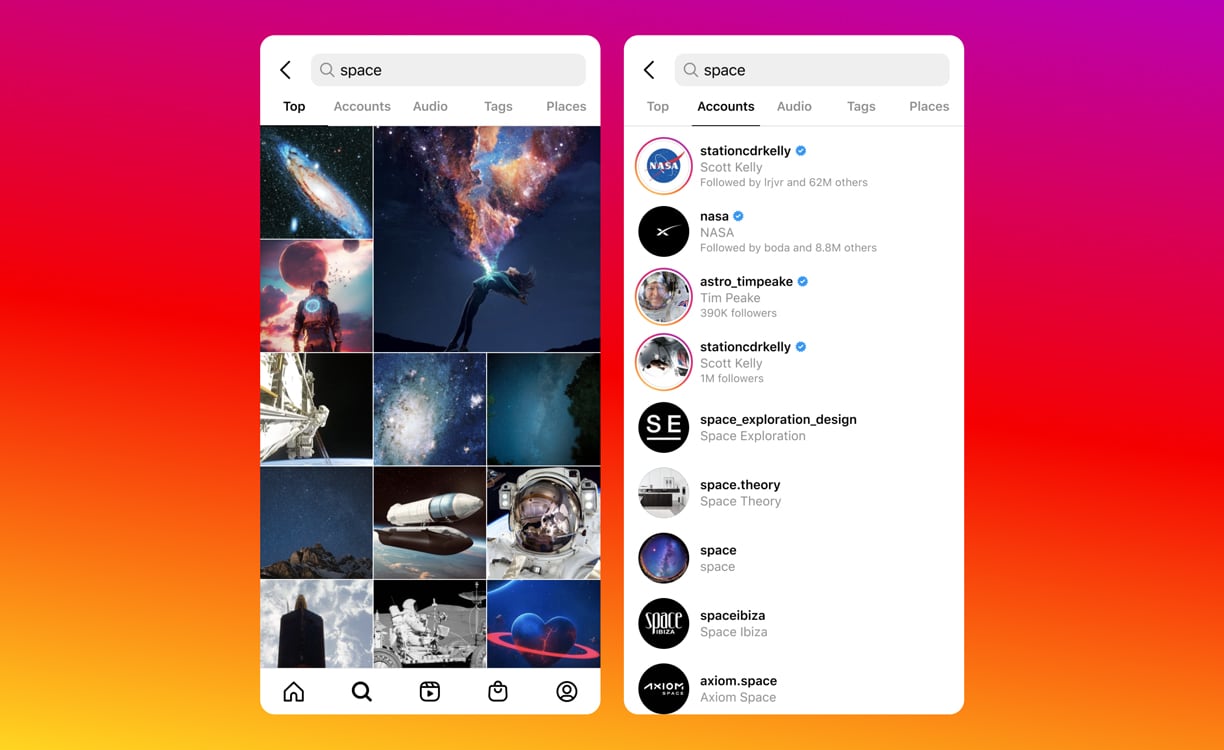
“Let’s say you’re interested in finding pictures of space after seeing the blue moon. When you tap the search bar on the Explore page, the first thing you see is your recent searches. As you begin typing “space,” we show you accounts, audio, hashtags, and places that match the text of your search. In this case, results like @space and #space show up because “space” appears in their name.”

Instagram’s Top Three Ranking Signals

To deliver these results, Instagram looks at a number of factors including account data, hashtags, user engagement, and more. Specifically, Mosseri highlights three major ranking signals to pay attention to:

  • Your text in Search. The text you enter in the search bar is by far the most important signal for Search. We try to match what you type with relevant usernames, bios, captions, hashtags and places.
  • Your activity. This includes accounts you follow, posts you’ve viewed, and how you’ve interacted with accounts in the past. We usually show accounts and hashtags you follow or visit higher than those you don’t.
  • Information about the search results. When there are a lot of potential results, we also look at popularity signals. These include the number of clicks, likes, shares and follows for a particular account, hashtag or place.

Tips for Getting Your Content in Instagram Search Results

Mosseri goes on to offer three suggestions for optimizing your profile and posts for the app’s search engine:

  • Use a fitting handle and profile name. Search results are matched by text. Using an Instagram handle or profile name that’s related to the content of your posts is your best bet for showing up in relevant searches. If your friends or fans know you by a certain name, include that name in your username or profile so that you can show up when they search for you.
  • Include relevant keywords and locations in your bio. Same principle here. Make sure your bio includes keywords about who you are and what your profile is about. If your account is location-specific, like for a small business, sharing your location in your bio can make it easier for people in your area to find you.
  • Use relevant keywords and hashtags in captions. For a post to be found in Search, put keywords and hashtags in the caption, not the comments.

How Instagram Filters Unsafe Content

Of course, Instagram has to filter out its fair share of spam, inappropriate content, and problematic pages.

This is done by penalizing specific posts, accounts, and, on some rare occasions, entire hashtags.

As Mosseri explains:

“Accounts that post spam or violate our guidelines may appear lower in search results, and you may have to search their full username to find them. We also balance searches for sensitive topics with additional safety measures to make sure we don’t show you related content that could be harmful. Accounts, hashtags and posts that violate our Community Guidelines are removed from Instagram entirely, which prevents them from showing up in Search.”

Plans for the Future

Mosseri concludes his blog post by sharing a bit about the upcoming improvements Instagram plans to make to its search results. Notably, he says the company wants to make Instagram Search “more than just a way to find accounts and hashtags” by moving towards a “full search results page experience.”

“For example, your search for “space” will show you space-related photos and videos, too. This is especially helpful when you don’t have an exact username or hashtag in mind when searching for a certain topic.”

If you want to read Adam Mosseri’s full blog post about how Instagram ranks search results, click here.

Google has confirmed that it is sometimes replacing page titles in search results with other copy it finds more relevant. As public liaison for Google Search, Danny Sullivan, explains:

“Last week, we introduced a new system of generating titles for web pages. Before this, titles might change based on the query issued. This generally will no longer happen with our new system. This is because we think our new system is producing titles that work better for documents overall, to describe what they are about, regardless of the particular query.”

In plain English, this means that Google is rewriting the title tags accompanying web pages in some search results – often replacing it with other text from your page. This is not the first time Google has made adjustments to title tags being shown in search results, but it is definitely the most extensive rewriting the search engine has done. 

According to Sullivan, the goal of this is to highlight the most relevant content for users and focus on content that users can “visually see”: 

“Also, while we’ve gone beyond HTML text to create titles for over a decade, our new system is making even more use of such text. In particular, we are making use of text that humans can visually see when they arrive at a web page. We consider the main visual title or headline shown on a page, content that site owners often place within <H1> tags, within other header tags, or which is made large and prominent through the use of style treatments.”

Does This Mean HTML Title Tags Don’t Matter?

If Google is going to just replace the tags put on pages, why should we even bother? The answer is for a few reasons. 

Firstly, the title tags will still provide their traditional SEO value by helping the search engine understand your page.

Secondly, Google is not rewriting the majority of search results titles. According to Sullivan, Google will show the original HTML title tags in more than 80% of cases. The system will only revise title tags if it believes the current tags are either too long, stuffed with irrelevant keywords, or a generic boilerplate.

“In some cases, we may add site names where that is seen as helpful. In other instances, when encountering an extremely long title, we might select the most relevant portion rather than starting at the beginning and truncating more useful parts.”

What This Means For You

Since there is no way of opting out of this system, there is nothing for brands to change moving forward. 

The biggest changes from this will instead be in reporting, where some pages may see increased or decreased click-through rates due to changed titles in search results. 

For more, read the full statement from Google and Danny Sullivan here.

In just 2020, Google has changed its search engine more than 4,500 times, according to the newly updated “How Search Works” site. 

Or, as Google puts it, “There have been 4,500 such improvements in 2020 alone.”

Whether you agree with Google’s description of their changes as “improvements”, the disclosure is interesting because it shows that the search engine continued to ramp up how frequently it updates parts of its system – even during the initial outbreak of the COVID pandemic. 

In comparison, Google made 3,200 changes to its search engine in 2019, the year before. At the same time, the company said this was nearly a 10x increase from a decade before. In 2009, the search engine reported just 350-400 changes.

What Do These Changes Include?

Google’s 2020 ‘improvements’ can include anything from updates to its user interface, changes to search results, and adjustments to how specific carousels or sub-sections like “news” function. 

As such, it isn’t all that surprising that Google is making significantly more updates to its systems than it was a decade ago. The search engine is considerably more complex and multifaceted these days compared to its 2009 counterpart. 

Still, I think many expected to see a relative slowdown to these updates as many workers began working remotely and the country braced for the spread of the novel coronavirus. 

“How Search Works” Site Gets a Redesign

This info was revealed as part of a much larger redesign of the search engine’s ‘How Search Works’ website, which “explains the ins and outs of search.”

Since 2013, Google has used the portal to help educate users about the broad principles Google uses to rank sites and filter out spam or inappropriate content. 

With the latest update, the company has “updated the site with fresh information, made it easier to navigate and bookmark sections and added links to additional resources that share how Search works and answer common questions.” 

“The website gives you a window into what happens from the moment you start typing in the search bar to the moment you get your search results. It gives an overview of the technology and work that goes into organizing the world’s information, understanding what you’re looking for and then connecting you with the most relevant, helpful information,” Google added.

Google is rolling out a new addition to its “About this result” feature in search results which will explain why the search engine chose a specific result to rank.

The new section, called “Your search & this result” explains the specific factors which made Google believe a specific page may have what you’re looking for.

This can include a number of SEO factors, ranging from the keywords which matched with the page (including related but not directly matching terms), backlink details, related images, location-based information, and more. 

How Businesses Can Use This Information

For users, this feature can help understand why they are seeing specific search results and even provide tips for refining their search for better results. 

The unspoken utility of this tool for businesses is glaringly obvious, however. 

This feature essentially provides an SEO report card, showing exactly where you are doing well on ranking for important keywords. By noting what is not included, you can also get an idea of what areas could be improved to help you rank better in the future.

Taking this even further, you could explore the details for other pages ranking for your primary keywords, helping you better strategize to overtake your competition.

What It Looks Like

Below, you can see a screenshot of what the feature looks like in action:

The information box provides a quick bullet point list of several factors which caused the search engine to return the specific result.
While Google only detailed a few of the possible details the box may include, users around the web have reported seeing information about all of these factors included:

  • Included search terms: Google can show which exact search terms were matched with the content or HTML on the related page. This includes content that is not typically visible to users, such as the title tag or meta data.
  • Related search terms: Along with the keywords which were directly matched with the related page, Google can also show “related” terms. For example, Google knew to include results related to the Covid vaccine based on the keyword “shot”.
  • Other websites link to this page: The search engine may choose to highlight a page which might otherwise appear unrelated because several pages using the specific keyword linked to this specific page.
  • Related images: If the images are properly optimized, Google may be able to identify when images on a page are related to your search.
  • This result is [Language]: Obviously, users who don’t speak or read your language are unlikely to have much use for your website or content. This essentially notes that the page is in the same language you use across the rest of Google.
  • This result is relevant for searches ih [Region]: Lastly, the search engine may note if locality helped influence its search result based on other contextual details. For example, it understood that the user in Vermont, was likely looking for nearby results when searching “get the shot”.

The expanded “About this result” section is rolling out to English-language U.S. users already and is expected to be widely available across the country within a week. From there, Google says it will work to bring the feature to more countries and languages soon.