Content creation has long been at the top of SEO, but it is leaking from the internet into the real world. One of the front runners of this change in real-life marketing is Red Bull, who has begun publishing their own magazine, The Red Bulletin, which paints a picture of a world where there are no limits.

This isn’t an isolated case. According to a recent survey, 90% of marketers believe that content marketing will only become more essential in the next year. Ronn Torossian has predictions and other instances of how companies are using content creation to reach out to their customers directly, all at Search Engine Journal.


Many local businesses want a quick and easy way to boost their local rankings. The bad news is, there isn’t really a shortcut anyone can take to better local SEO. There isn’t any way to just make a one time change and suddenly be rocking the rankings.

The good news is, there is a simple method to improving rankings, it just requires consistent output of quality content or promotional activities. This usually equates to blogging, which takes consistent effort, but is highly rewarding.

Chris Silver Smith lists all of the reasons why starting to blog can seriously help local businesses at Search Engine Land.


Every topic I cover can be as complicated as you let them be. With the focus on minute data and snippets of code, SEO could easily be intimidating for anyone trying to get started learning.

This is a problem for local SEO because most business owners aren’t experts. If they think of local SEO as a daunting field, rather than seeing the opportunities it could open up for them, they are likely to shy away.

With this in mind, I’d like to take us back to the basics. We haven’t covered local SEO here in depth, so this will serve as a great place to begin exploring the topic. But, the tips offered here are valuable for broader SEO as well.

For good local SEO, there are really three major rules.

  • Get your website up to standards
  • Spread your business details everywhere
  • Use social media to get your customers to do promotion for you

Getting your website up to standard

Google is beginning to combine regular and local search results, and your website quality helps decide where you will land in the local search results, as well as more broad searches. Making a quality site relies on you doing a few specific things. For one, your site should have a clear and functional structure with a set heirarchy of pages. This will help Google’s crawlers go where you want them too, and know what is most important.

Another, more basic step in making a good page is just filling your site to the brim with quality content. Your content makes your first impression to customers as well as search engines. Putting out continuous good content keeps bringing search crawlers back to your page, and generate backlinks to your site from other pages.

Spread your business details

This one is quick and easy, so I’m going to let Myles Anderson from Search Engine Land sum it up. “Having your correct business details widely available is positive for local SEO and sets you up nicely to take advantage of the mobile-boom. Many of the same data sources which feed the desktop internet also feed mobile sites and applications so even if your website isn’t mobile enabled your business will appear on popular mobile applications.”

This is especially true for local SEO because people are searching to be able to contact YOU. Make it easy for them. Google will reward you for it. But don’t get lazy once your information is out there. Remember where you have put it by keeping a record. If you ever move, or change phone numbers, you will need to go change it everywhere the old information is.

Be social!

Just like everywhere else online, Google is becoming more and more intertwined with social media. If you don’t have a social media account for your business, it is time to get one. Twitter, Facebook, and Google+ are all very influential in your SEO status. From there, make it easy to share your content from your site with social media buttons prominently connected with content. Once you have a following, you will notice they share content for you. You still have to be proactive by sharing your content with them on social media in the first place, but if you connect with your followers, you will be shocked to see what they do for you.

Conclusion

Of course, there are a ton more things you can do to help give yourself a boost. It is high time you have a mobile optimized page for your site, and it is important to make sure you are listed on Google and Apple Maps. But, these first three rules will help you easily expand, and see what investing in local SEO can do for you.


 

Anytime you have an industry where creativity meets business, you face the conundrum of who to target with your work. Do you want to make something exciting and fun that other people interested in design will like, or do you want to make something consumers will enjoy?

The good news is that web designers can do both. If you have just a bit of marketing knowledge and some strategy, you can make a solid design that was as fun for you to make as it is for consumers to explore.  Any good designer should already be attracting their potential audience while making interesting designs. But what do you do if you aren’t?

The first step is to identify your target audience. If you can spot who your demographic is, everything else will fall into place.

Thankfully, identifying your audience has never been easier since you have tools like Google Analytics at your disposal. This isn’t to say this is a walk in the park, but pinpointing your customer base is much more simple and precise than it used to be.

By doing a keyword search in your analytics dashboard, you can also see what people are searching for, and what kind of people they are.

Another way to identify what your visitors like is by simply asking them questions. Blogs are a great platform for this, because you should already be trying to interact with your audience, and you can leverage to ask them what they think about different topics and to offer their opinions. It is also important to note, if you are struggling to interact with commenters because of spam overload, adding a simple Captcha is easy and rids you of most spam.

Social media also offers a huge opportunity to interact with your audience. It is easier to connect with readers on Facebook than it is to interact in the comments sections of articles. Taking advantage of social media also means your content is easier to share, which will attract more readers.

Once you know who you are designing for, you can find ways to make a great site they will enjoy, and you won’t hate making. Christian Vasile has great design tips if you’re having trouble getting started.

You don’t have to sell out and make boring websites because you are designing for a company. In fact, if you do, you are just making bad websites and your clients won’t be happy anyways.


You can do a lot of different things with landing pages, be it selling something, encouraging visitors to subscribe to a newsletter, or trying to get people to sign a petition. No matter which of these goals you have, you are ultimately trying to get visitors to perform an action.

Making a great landing page seems like it should be easy, but it is more complex than you may think. This leads to poor sales because a landing page is only working if it is getting people to convert.

With that in mind, let’s examine the most common problems with landing pages.

  1. Mismatching Text Ad Copy and Landing Page Headline – There are numerous reasons you should make sure your Google AdWords text ads match your landing page headline. For users, the text ad creates an expectation, and you don’t want to confuse your visitors or make them feel mislead. The quality of your landing page also decides cost-per-click in AdWords, so if you raise your quality score, you will lower your cost-per-click.
  2. Poor Grammar and Misspelled Words – Throwing up a quick landing page is always a terrible idea because it leads to a ton of smaller problems. One of those is bad spelling and grammar. This is one of those mistakes that just shouldn’t be allowed to happen. Your visitors will take any reason you give them to not convert, and this one is a big reason to leave.
  3. No Trust Signals – To get visitors to convert, you have to establish trust. You can build this into your landing page in just a few ways. If you establish your brand’s popularity, people will view it as credible. You can also present your 3rd party certifications with organizations like Verisign or the Better Business Bureau. You can also establish trust by making positive mentions of your brand in the press easily available on the landing page.
  4. Lack of Good Call-to-Actions – You’re call to actions are important to help make people convert. They should also be compelling, with practical language, and solid, consistent design. You should also keep it short, between 90 and 150 characters. You need to make it clear what you want the visitor to do, but short enough to keep their attention.
  5. Poor Quality Videos or Images – Videos on your landing page can help boost conversion rates by about 80%. Images don’t raise conversions that much, but they still have their own positive effect on visitor activity. This doesn’t mean you can just toss up any image or video you want however. Poor quality images or videos will actually lower conversion rates rather than improve them.

Eric Siu from Unbounce has even more common mistakes, but these will help get you started with making sure users are converting. Remember, if users aren’t converting, your landing page has problems.


There are so many options to personalize and remarket ads to your potential customers online, you may actually be annoying those consumers and driving them away. No one wants to see ads tailored to them on every site they visit, all asking them to come back and buy a product they browsed for hours ago.

So, David Rodnitzky put together a list at Search Engine Land, which should help you be a fine-tuned marketer, not an annoying, stalker type. Here’s a look:

1. Attribution

Because you’re using so many vehicles to get your message across, you need to know which ones are working and how well they’re working. Attribution tracking allows you to discover how a consumer got to your site, but it’s a pricey service.

2. Frequency Caps

You can use the attribution data to find out what is superfluous in your advertising strategy. Limit the number of times users see your ads on a given channel based on how well those ads work and how they work in combination with your other campaigns.

3. Change your creative

With the data you’re collecting, you can discover what stage users typically are when they see specific ads. Use that knowledge to tailor your ads content and message. Ads for users who are early in the process can be about awareness, while ads for users later in their shopping process can be focused on conversions.

4. Risk v Reward

Consider how many consumers you will alienate with ads when looking at how many more conversions you could get. If you run some ads more to get a slight increase in conversions, you may also be increasing the number of consumers who swear off your site because of over-bearing ads.


How much should you budget for paid search? You have a lot of options, but you obviously want the one that will get you the most bang for your buck. Bill Hunt, columnist for Search Engine Land, offers three options for how to think about your budget.

How Much Could We Spend?

This budget is your “pie in the sky” option. It gives you an idea how much it would cost to have the absolute best search performance possible, and you likely can’t afford it, unless you have a magical unlimited amount of money. While most don’t want to think about the high cost options they can’t afford, this option helps understand the importance of aligning keywords to buy cycles, as well as the value of organic traffic.

How Much Would We Spend?

This budget is the amount you are already hoping to spend when you decide to invest in SEO. When you first begin improving your search performance, you come in with a preset idea of what would be optimal for your budget. Of course, this is likely not optimal for your search engine performance. This is helpful for establishing what you could get for your budget, and letting you see what you would be missing out on.

How Much Should We Spend?

This is the amount you should spend to maximize keywords and provide maximum yield of business goals. This amount is what is best for your business, though it is likely not the best for your wallet immediately. It will return the investment quickly, however. It takes into account organic performance for important and expensive keywords, making you rank highly and reducing the cost overall.

Conclusion

The importance of seeing these three options laid out in front of you is to see the full range of possibilities. Most companies don’t know what they have available to them in the search marketing arena, and you can see how you would perform in each scenario.


Adwords is making some dramatic changes once again. In October, Google brought back the ‘Rotate Indefinitely’ option for campaigns even though they didn’t recommend the option themselves. Now, Google will be making campaigns not set to ‘rotate indefinitely’ default to ‘optimize for conversions’.

As posted to the iNeedHits blog, Google estimates the change will increase conversions by 5-percent across the board. With the ‘optimize for conversions’ option, Google will dynamically change bids from advertisers to run ads with the greatest chance of creating a conversion.

Users who prefer to ‘optimize’ manually can do so by using the ‘Conversion Optimizer’ and ‘Enhanced CPC’ tools, which can track advertising bids likely to lead to conversion and ensure ads with high chances of conversion are being shown the most without an increse in budget.

Google will make the change the week of November 12th. This means that you’ll need to do your homework before then to make sure your campaigns aren’t automatically switched to something you don’t want.

It is easy to underestimate the power of emails to create conversions. However, sending the right email at the right time can actually increase sales dramatically. If done well, a single automated email can increase sales by 10%.

Here are three email remarketing tactics that can help you start driving conversions you may be missing out on.

1) Educational Email Course – While some customers that come to your site are already aware of how your product will solve their problems, many will not come equipped with a good understanding of the problem or why the solution you offer is important.

An educational email course helps walk your uninformed potential customers from understanding their problem to the checkout. It also helps build your reputation and credibility.

By showing customers why they should trust you as an expert, as well as sharing information, you help consumers progress along the The Buyer’s Journey. Once they get to the point where they are ready to purchase, they will choose to go with the company that was with them from the beginning.

Just don’t overwhelm them with emails. Six to eight emails a month will be able to drive conversion rates up, but an email a day will send potential customers running.

2) A/B Test Your Most Profitable Campaigns – We all know why you should be A/B testing your webpages, but have you thought about testing transactional and remarketing campaigns? Most don’t, but Chris Hexton from Unbounce suggests it is just as important, if not more so.

Choose your most effective email, and begin A/B testing. Change the copy, or maybe the subject line. Maybe even try different addresses to send the email from.

3) Prompt Users to Pay More When the Time is Right – If you have multiple payment tiers or annual pricing, you should really already be doing this. Take a look at your current metrics and see which segment of users are already upgrading, and create an automated email to prompt all who would be included in this group. Now, once you have begun to understand the behavior driving upgrades, find an email that will pre-empt this type of action.

By pre-empting users with a call-to-action, they are likely to respond, especially if you can circle in on users that have been paying monthly for a few months. They will likely want to upgrade to annual payments.

While these suggestions are far from a comprehensive list of solid email remarketing tactics, they are easy and can help rejuvinate your email marketing.


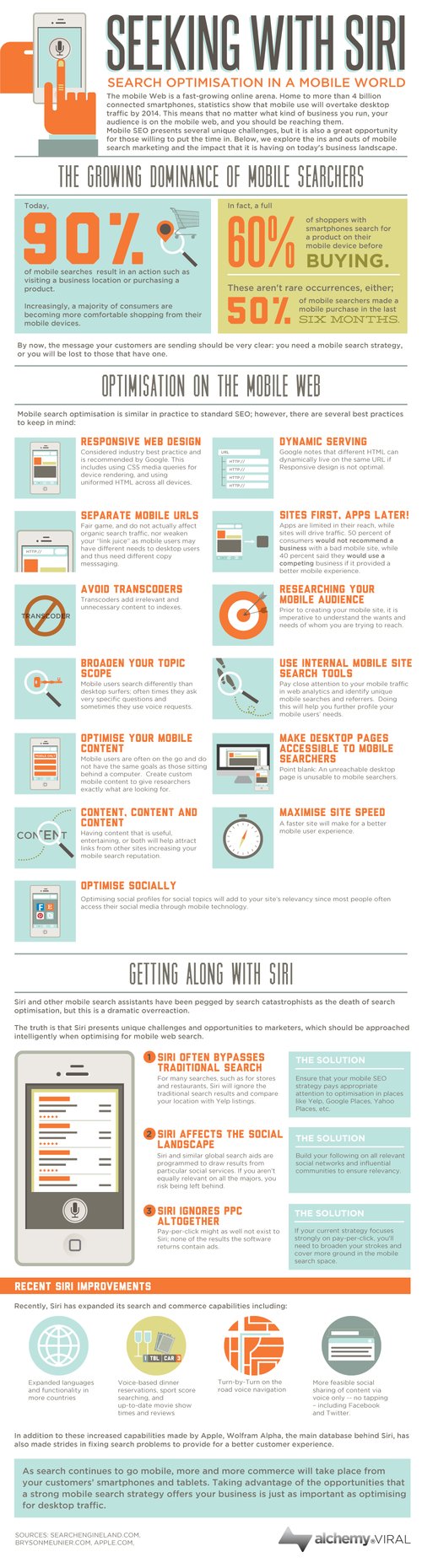
When Siri was announced with the iPhone 4S, it didn’t bring about a revolution in search activity on phones. Most still search by typing keywords into Safari or Chrome. However, gradually, Siri and mobile apps are changing search habits and creating new opportunities for search marketers.

The Alchemy Viral crew gives us an infographic which helps cover everything about searching with Siri and mobile searching in general.

There is one error, which Search Engine Land helps point out. The infographic says Siri draws from social services, but Siri can only help users post things to Twitter or Facebook. It can’t help them get information back from those social sites.

With mobile searching poised to overtake desktop within two years, this infographic can be helpful to anyone interested in mobile searching.

Oh, and the creator of the infographic isn’t bad with spelling. They are just British, hence “optimisation,” instead of the American spelling.