Just as with search, when we talk about PPC advertising, we almost naturally shift the majority of our attention to Google and their AdWords advertising platform. It makes sense on the surface, Google receives a significantly higher volume of search than other engines and even higher CTRs. But, some marketing analysts are beginning to believe it may be more effective to put an emphasis on Bing ads, especially if you are advertising for a small business.

Pricing Engine, a small business marketing platform, has found that Bing ads are “more efficient” than AdWords, as they become a lower cost source of leads for small businesses.

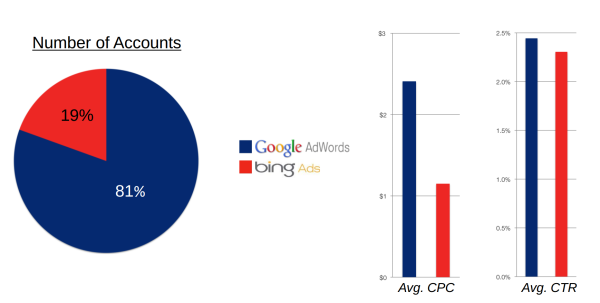
As Search Engine Land reported, Pricing Engine examined their own data from hundreds of accounts, and they found that CTRs were indeed marginally higher on Google, but CPCs were significantly higher. As such, it seems that you actually get more for your dollar with Bing ads.

Big brands will still favor the higher volume of searches on Google, but smaller businesses don’t require the same kind of scale. Investing in marketing with a better return per cost may pay off in the long run.

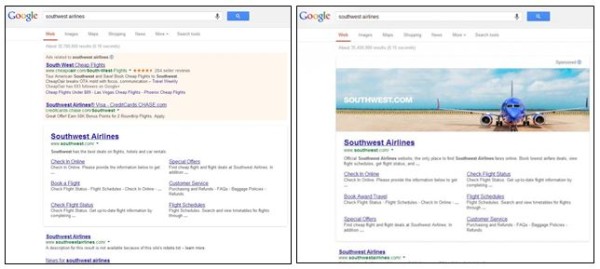
Last week some people began noticing that large banner ads were appearing on Google for a select few branded search results. This test of huge banner ads has caused quite a bit of a stir across the internet, especially because it seems to break a promise Google made all the way back in 2005.

When Google partnered with AOL eight years ago, Marissa Mayer, then Google VP of search products and user experience, issued a promise that users would never see banner ads on their results. She said:

“There will be no banner ads on the Google homepage or web search result pages. There will not be crazy, flashy, graphical doodads flying and popping all over the Google site. Ever.”

One could argue that some of the Google Doodle homepage logos commemorating special events would qualify as “crazy, flashy, graphical doodads”, those have never caused any worry because they are simply a flourish added to the homepage logo. However, it is indisputable that the new ad tests Google is running breaks their “no banner ads” promise outright. But, is it a bad thing?

The most notable aspect of the banner ads is that they only appear for branded searches. That means, if you search for Crate & Barrel, you might be shown the banner for Crate & Barrel. You won’t, however, be seeing any ads for random companies unrelated to your search, as you would normally associate with the term ‘banner ad’.

These ads are also linked to the brand’s website, providing users with an obvious, visually pleasing way to immediately find the business they are looking for. With careful moderation of banners, they could potentially allow businesses to essentially own their branded searches.

One of the biggest concerns for consumers regarding these ads is how they are used. Few users will be upset for the easily identifiable link with an aesthetically pleasing image showing when they search for a specific brand. However, if this test expands and advertisers are ever allowed to use these banners to advertise sales or other more advertising-styled banners, there may be a backlash.

Currently, it is estimated that 30 advertisers are currently being involved in the test, including Southwest Airlines, Virgin America, and Crate & Barrel. The test banner ads are also only being shown for 5 percent or less of search queries, so it is entirely possible you won’t run into one for quite a while.

Search Engine Land has created a FAQ for advertisers curious how this might affect the future of Google marketing, and Google released a statement on Friday, which read:

“We’re currently running a very limited, US-only test, in which advertisers can include an image as part of the search ads that show in response to certain branded queries. Advertisers have long been able to add informative visual elements to their search ads, with features like Media Ads, Product Listing Ads and Image Extensions.”

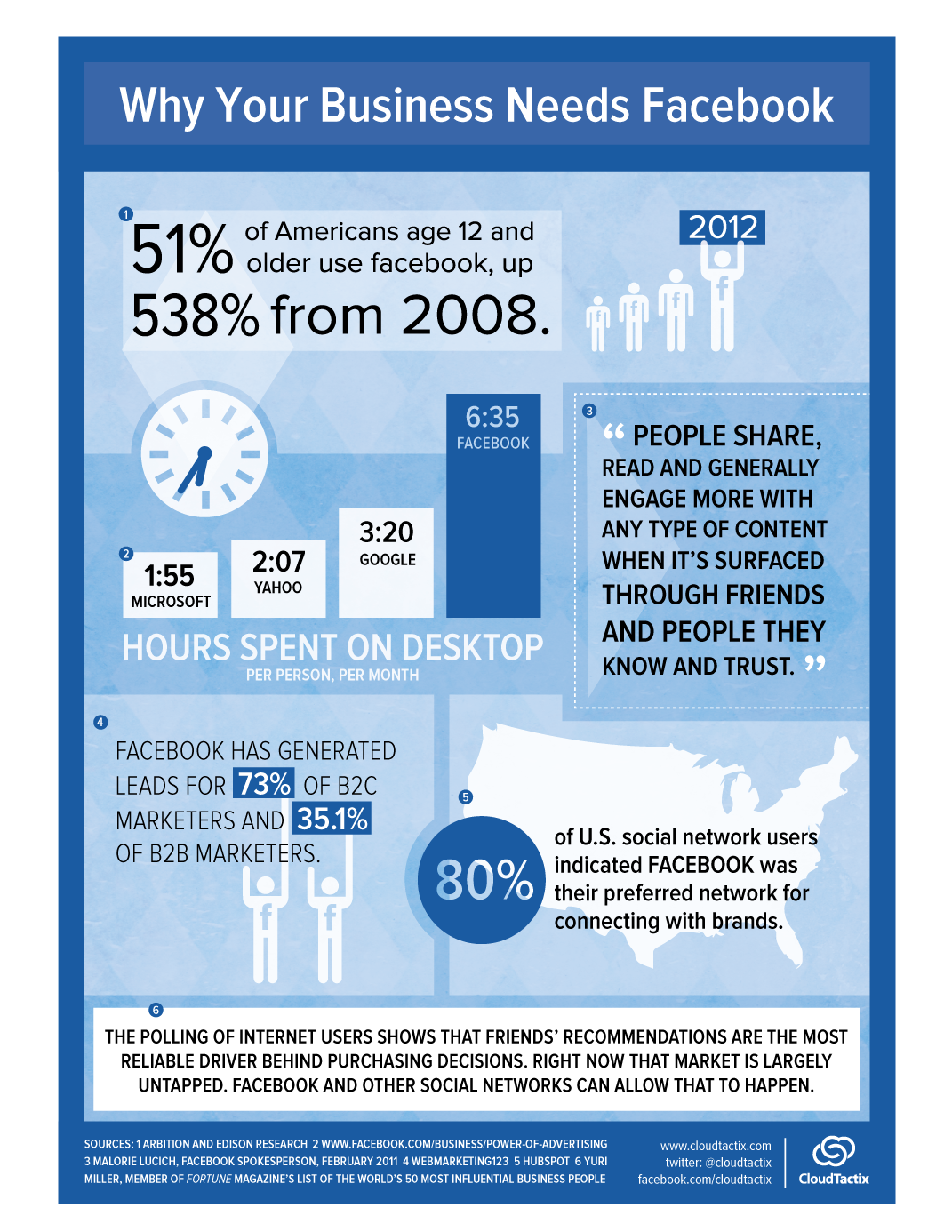
If you’ve spent much time online in the past year or two, it is almost certain you’ve come across an infographic. They are highly enjoyed by the public, as well as being educational. This is why more companies and content creators are using infographics to communicate and share knowledge with the public than ever before. Some may say it is just a trend, but either way the data shows that searches for infographics have risen over 800 percent in just two years, from 2010 to 2012.

Even if you don’t know what an infographic is, the chances still favor that you have seen one either in your Facebook feed, a news article, or maybe even your email. Infographics are images intended to share information, data, or knowledge in a quick and easily comprehensible way. They turn boring information into interesting visuals which not only make the information easier to understand, but also make the average viewer more interested in what is being communicated.

According to Albert Costill, multiple studies have found that 90 percent of the information we retain and remember is based on visual impact. Considering how much information take in on a day to day basis, and that means you’re content should be visually impressive if you want to have a hope of viewers remembering it. If you’re still unsure about infographics, there are several reasons you should consider at least including them occasionally within your content strategy.

  1. Infographics are naturally more eye-catching than printed words, and a well laid-out infographic will catch viewers attention in ways standard text can’t. You’re free to use more images, colors, and even movement which are more immediately visually appealing.
  2. The average online reader tends to scan text rather than reading every single word. Infographics combat this tendency by making viewers more likely to engage all of the information on the screen, but they also make it easier for those who still scan to find the information most important to them.
  3. Infographics are more easily sharable than most other types of content. Most social networks are image friendly, so users are given two very simple ways to show their friends their favorite infographics. Readers can share a link directly to your site, or they can save the image and share it directly. The more easily content can be shared, the more likely it is to go viral.
  4. Infographics can subliminally help reinforce your brand image, so long as you are consistent. Using consistent colors, shapes, and messages, combined with your logo all work to raise your brand awareness. You can see how well this works when you notice that every infographic relating to Facebook naturally uses “Facebook Blue” and reflects the style of their brand.

Obviously you shouldn’t be putting out an infographic every day. Blog posts still have their place in any content strategy. Plus, if you are creating infographics daily, it is likely their quality will suffer. Treat infographics as a tool that can be reserved for special occasions or pulled out when necessary. With the right balance, you’ll find your infographics can be more powerful and popular than you ever imagined.

Google is always making changes and updates, but it seems like the past couple weeks have been especially crazy for the biggest search engine out there. There have been tons of changes both big and small, but best of all, they seem to all be part of one comprehensive plan with a long term strategy.

Eric Enge sums up all the changes when he says Google is pushing people away from a tactical SEO mindset to a more strategic and valuable approach. To try to understand exactly what that means going forward, it is best too review the biggest changes. By seeing what has been revamped, it is easier to make sense of what the future looks like for Google.

1. ‘(Not Provided)’

One of the hugest changes for both searchers and marketers is Google’s move to make all organic searches secure starting in late September. For users, this means more privacy when browsing, but for marketers and website owners it means we are no longer able to see keyword data from most users coming to sites from Google searches.

This means marketers and site-owners are having to deal with a lot less information, or they’re having to work much harder to get it. There are ways to find keyword data, but it’s no longer easily accessible from any Google tool.

This was one of the bigger hits for technical SEO, though there are many work arounds for those looking for them.

2. No PageRank Updates

PageRank has long been a popular tool for many optimizers, but it has also been commonly used by actual searchers to get a general idea of the quality of the sites they visit. However, Google’s Matt Cutts has openly said not to expect another update to the tool this year, and it seems it won’t be available much longer on any platform. The toolbar has never been available on Chrome, and with Internet Explorer revamping how toolbars work on the browser, it seems PageRank is going to be left without a home.

This is almost good news in many ways. PageRank has always been considered a crude measurement tool, so if the tool goes away, many will have to turn to more accurate measurements.

3. Hummingbird

Google’s Hummingbird algorithm seemed minor to most people using the search engine, but it was actually a major overhaul under the hood. Google vastly improved their abilities at understanding conversational search that entirely changes how people can search.

The most notable difference with Hummingbird is Google’s ability to contextualize searches. If you search for a popular sporting arena, Google will find you all the information you previously would have expected, but if you then search “who plays there”, you will get results that are contextualized based on your last search. Most won’t find themselves typing these kinds of searches, but for those using their phones and voice capabilities, the search engine just got a lot better.

For marketers, the consequences are a bit heavier. Hummingbird greatly changes the keyword game and has huge implications for the future. With the rise of conversational search, we will see that exact keyword matches become less relevant over time. We probably won’t feel the biggest effects for at least a year, but this is definitely the seed of something huge.

4. Authorship

Authorship isn’t exactly new, but it has become much more important over the past year. As Google is able to recognize the creators of content, they are able to begin measuring which authors are consistently getting strong responses such as likes, comments, and shares. This means Google will be more and more able to filter those who are creating the most valuable content and rank them highest, while those consistently pushing out worthless content will see their clout dropping the longer they fail to actually contribute.

5. In-Depth Articles

Most users are looking for quick answers to their questions and needs with their searches, but Google estimates that “up to 10% of users’ daily information needs involve learning about a broad topic.” To reflect that, they announced a change to search in early August, which would implement results for more comprehensive sources for searches which might require more in-depth information.

What do these all have in common?

These changes may all seem separate and unique, but there is an undeniably huge level of interplay between how all these updates function. Apart, they are all moderate to minor updates. Together, they are a huge change to search as we know it.

We’ve already seen how link building and over-attention to keywords can be negative to your optimization when improperly managed, but Google seems keen on devaluing these search factors even more moving forward. Instead, they are opting for signals which offer the most value to searchers. Their search has become more contextual so users can find their answers more easily, no matter how they search. But, the rankings are less about keywords the more conversational search becomes.

In the future, expect Google to place more and more emphasis on authorship and the value that these publishers are offering to real people. Optimizers will always focus on pleasing Google first and foremost, but Google is trying to synergize these efforts so that your optimization efforts are improving the experience of users as well.

Advertisers on Facebook won’t have to go through demand-side platforms (DSPs) to manage their retargeting campaigns for much longer. According to Search Engine Watch, Facebook is creating new retargeting options that won’t force you to go through FBX (Facebook Ad Exchange) or any other platform other than Facebook’s own interface.

Up until now, Advertisers using FBX have only been able to serve their ads on desktops within the news feed or right sidebar and they must buy their ad space through separate DSPs. Considering how many Facebook users are accessing the social media platform via smartphones or tablets, it is surprising it has taken this long for Facebook to allow advertisers to target individuals on mobile devices.

What’s New?

The big new feature will be Custom Audiences, which will allow advertisers to set up their retargeting campaigns directly through Facebook’s interface. That will include the ability to overlay standard Facebook targeting options as well.

The ability to target mobile devices is of course another huge aspect of this update, as it is undeniable a remarkable percentage of Facebook users are primarily using mobile devices for social media.

What is FBX Still Better At?

FBX still has benefits over the options that will be available through the Facebook interface. Most important of those benefits is predictive buying. If an individual continuously browses for a certain product of type of service, FBX’s predictive buying capabilities allow advertisers to show an ad reflecting that interest.

HalloweenThere have never been more opportunities for local businesses online than now. Search engines cater more and more to local markets as shoppers make more searches from smartphones to inform their purchases. But, in the more competitive markets that also means local marketing has become quite complicated.
Your competitors may be using countless online tactics aiming too ensure their online success over yours, and to stand a chance that means you also have to employ a similarly vast set of strategies. When this heats us and online competition begins to grow convoluted, some things get overlooked. The more you have to juggle, the more likely you are to make a serious mistake.

In true Halloween fashion, Search Engine Watch put together the four most terrifying local search mistakes that can frighten off potential customers.

Ignoring the Data Aggregators

A common tactic is to optimize Google+ listings, as well as maybe Yelp, or a few other high-profile local directories. But, why stop there? Google crawls thousands and thousands of sites that contain citations every day, so optimizing only a few listings is missing out on serious opportunities.

The most efficient way to handle this and optimize the sites most visible to customers, businesses should focus on data sources that Google actually uses to understand local online markets. The best way to do this is to submit business data to the biggest data aggregators, such as Neustar Localeze, InfoUSA, Acxion, and Factual.

Not Having and Individual Page for Each Business Location

A few years ago Matt Cutts, one of Google’s most respected engineers, said, “if you want your store pages to be found, it’s best to have a unique, easily crawlable URL for each store.” These days organic ranking factors have become much more influential in Google’s method of ranking local businesses, so this advice has become more potent than ever before.

There are also numerous non-ranking based reasons you should have optimized location pages for each location. If you don’t have actual results on individual pages, Google isn’t indexing that content separately, and instead only sees the results offered in a business locator. Think of it like optimizing a product site without product pages. If the results don’t have separate pages, it loses context and usability.

Ignoring the Opportunity to Engage Your Customers

Whether you want to face it or not, word of mouth has managed to become more important than ever as consumers talk about businesses online on social media. Each opinion has an exponentially larger audience than ever in history, so a single bad review is seen by hundreds or thousands of potential customers. Thankfully, that one review doesn’t have to be your down bringing.

First, if bad reviews get seen by more people, the same can be said for good reviews. If a bad review is an outlier, it might not make such an impact on viewers. But, more importantly, every review mention or review or interaction with your business gives you the opportunity to engage them back. If you see a positive mention online, showing gratitude for the remark opens up an entirely new connection with your brand. Similarly, a bad review can be salvaged by simply asking how changes can be made to improve their experience in the future.

Not Using Localized Content

Pretty much every local online marketer has heard about the importance of using the relevant keywords in their content so their website ranks for those terms. But, they tend to only use this logic for the products or types of services they offer.

Local keywords including ZIP codes, neighborhoods, or popular attractions can do as much to help you stand out for important searches as product based keywords can. Simply including information about traffic or directions can help you start ranking for search terms your competitors are missing.

Google’s Carousel may seem new to most searchers, but it has actually been rolling out since June. That means enough time has past for marketing and search analysts to really start digging in to see what makes the carousel tick.


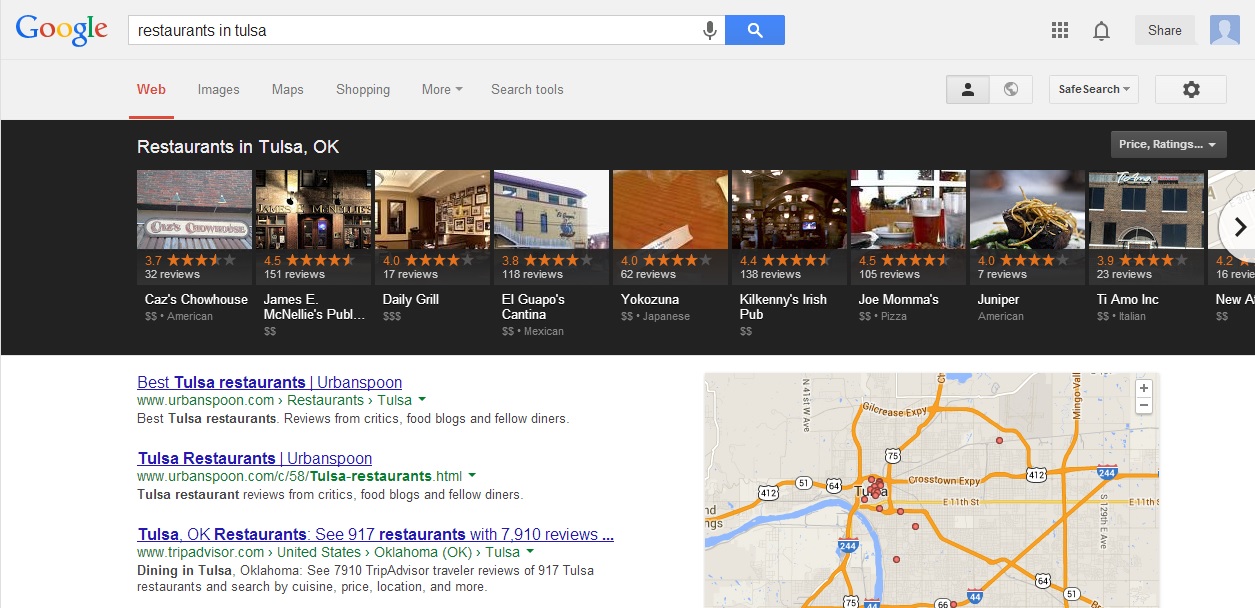
If you’ve yet to encounter it, the carousel is a black bar filled with listings that runs along the top of the screen for specific searches, especially those that are location based or for local businesses such as hotels and restaurants. The carousel includes images, the businesses’ addresses, and aggregated review ratings all readily available at the top, in an order that seems less hierarchical than the “10 pack” listings previously used for local searches.

Up until now, we’ve only had been able to guess how these listings were decided based on surface level observations. But, this week Digital Marketing Works (DMW) published a study which finally gives us a peak under the hood and shows how businesses may be able to take some control of their place in the carousel. Amanda DiSilvestro explains the process used for the study:

  • They examined more than 4,500 search results in the category of hotels in 47 US cities and made sure that each SERP featured a carousel result.
  • For each of the top 10 hotels found on each search, they collected the name, rating, quantity of reviews, travel time from the hotel to the searched city, and the rank displayed in the carousel.
  • They used (equally) hotel search terms—hotels in [city]; best hotels in [city]; downtown [city] hotels; cheap hotels in [city].
  • This earned them nearly 42,000 data points on approximately 19,000 unique hotels.
  • They looked at the correlation between a hotel’s rank in a search result based on all of the factors discussed in step 1 to determine which were the most influential.

Their report goes into detail on many of the smaller factors that play a role, but DMW’s biggest findings were on the four big factors which determine which businesses are shown in the carousel and where they are placed.

1. Google Reviews – The factor which correlated the most with the best placement in the carousel were by far Google review ratings. Both quantity and quality of reviews clearly play a big role in Google’s placement of local businesses and marketers should be sure to pay attention to reviews moving forward. However, it is unclear how Google is handling paid or fake reviews, so many might be inspired to try to rig their reviews. For long-term success, I would suggest otherwise.

2. Location, Location, Location – Seeing as how the Google Carousel seems built around local businesses, it shouldn’t be a surprise that location does matter quite a bit. Of the 1,900 hotels in the study, 50 percent were within 2 miles of the search destination, while 75 percent were within 13 minutes of travel. Businesses would benefit from urging customers to search for specific landmarks or areas of cities, as you never know exactly where Google will establish the city “center”.

3. Search Relevancy and Wording – According to the findings, Google seems to change the weight of different ranking factors depending upon the actual search. For example, searching “downtown [city] hotels” will result in listings with an emphasis on location, while “best hotels in [city]” gives results most dependent on review rankings.

4. Primary Markets and Secondary Markets – It seems both small and larger businesses are on a relatively flat playing field when it comes to the carousel. Many small hotels are able to make it into the listings, right next to huge chains. The bigger businesses may have more capabilities to solicit reviews, but no hotel is too small to be considered for the carousel.

Online advertising could possibly become even more profitable over the next few years as it appears consumers’ trust in ads that show up in search engine results, online video, and social networks appears to be on the rise. A recent report from Nielsen, Truth in Advertising 2013 found that 48 percent of consumers trust these ads, up from previous years.

The report shows that consumers around the world are gradually becoming more accepting and trusting to online media, and advertising from trusted sources is equally seen as trustworthy. Ads on branded websites are now 69 percent trusted this year, making it the second most trusted format. In 2007 it received 9 percent trusted and ranked fourth-place.

The most favorable form of advertising stays the same, with 84 percent of global respondents saying word-of-mouth recommendations from friends and family are the most trustworthy.

The survey also found that 42 percent trust online banner ads, compared to 26 percent in 2007, which may be why advertisers spent 26 more percent on this type of advertising in the first quarter of this year, according to ClickZ. Display ads on mobile devices has also gone up, with 45 percent saying they trust these ads more than text ads.

Nielsen Graph

Synergy

Often, online marketers talk about search engine optimization (SEO) and social media marketing as if they are entirely separate. However, online marketing is often better perceived as a complex interconnected system which is best met with a more holistic approach. SEO and social media are especially compatible bed fellows and if you get the two working together properly you’ll see incredible improvements to both sides that couldn’t be accomplished alone.

A well joined strategy can see huge benefits in numerous areas such as outreach and promotion, content creation, brand management, and goal tracking. In the end, this all means more dollars in the bank for everyone involved. Purna Virji has some tips to help get the two running together instead of apart.

1) Use Promoted Posts to Scale Outreach and Link Building

SEO professionals spend a lot of time attempting to earn high-quality links, while the social media team normally aims to reach out and interact with their audience to build their brand. These may seem like unique tasks, but in reality they are very similar.

Well earned links often require outreach to begin with. You can’t just buy links (well, you can but Google won’t like it) so one of the best ways to earn links in the current field requires creating and sharing content. Just about every online brand has their own blogs these days, but they often expect them to pull their weight on their own. Writers post to the blog, and expect people to simply find their content. At best they share them directly to Facebook and Twitter for free and leave it at that.

Marty Weintraub from aimClear suggests taking it further and making sure your best content gets out to the public with Paid Organic Distribution. Instead of leaving the blog content to languish on its own, you can use Facebook to search out the perfect demographic that will enjoy and respond to your content. You want to look for those who are likely to share, but also seem right for your content. Then, you target them with promoted posts.

This strategy allows you to reach out to possible customers who may have not interacted with your brand before while also offering them something of value. Then, with a well-placed call to action you encourage them to share, driving more organic traffic and scaling up your link building efforts all at once. Best of all, this traffic is more likely to convert once on your site, which can help improve profits.

2) Create More Effective Content

As I previously indicated, one of the most important efforts for SEO professionals these days is creating quality content. It improves how Google perceives your site while also opening up many doors for link building and audience outreach. But what exactly is quality content?

While there are some writers who can magically intuit what their audience wants to know, most of us are secretly writing for ourselves, even if we don’t know it. Instead, using a joint brainstorming session to go over analytics and create a specific content strategy can improve the quality of your content and increase its sharability all at once.

A community manager can offer a great deal of insight into their audience to SEOs, while community managers will appreciate the opportunity to grow and expand their audience with a regular flow of great content. Virji suggests preparing for such a brainstorming session by:

  • Have the SEOs compile a list of which audiences and types of content have resulted in the best campaigns.
  • Have the community manager pull together data on what type of content receives the most shares and audience engagement.
  • Have the SEOs bring in their outreach plan for the coming three months.

This preparation allows you to understand which audiences you should be expanding to and how to better engage the highest performing demographics and cater content to them. You will better understand what gets the best responses and be able to plan ways to create more content that performs highly and less content flops. The community manager will also be able to plan audience engagement activities relevant to your content ahead of time.

3) Engage Influencers

While you can always go straight to your audience, you’ll often see great results from reaching out to those who already have a lot of influence in your field. SEOs will do well to connect with influential bloggers or website owners. Not only can they have a huge impact on your link building efforts, but one link from them can result in a high rate of qualified leads that can lead to conversions.

There are even tools for helping to identify the biggest influencers if you aren’t sure. Klout, FollowerWonk, and Traackr all create lists which will tell you who to engage.

Be careful not to just reach out with a sales pitch. You aren’t trying to gain a link, but build a real relationship between influencer and content creator. Start by sharing their content and retweeting posts, or helping out on community and audience endeavors. Create a reciprocal relationship where the influencer will be inclined to scratch your back in return.
Once you’ve built the relationship, getting them to share links to real quality content will feel natural. Those that see the links will also perceive your brand in higher terms of credibility, as you are co-signed by a trusted influencer.

Pinterest Sticker Icon by DesignBoltPinterest may only be the fourth most popular social media platform out there, but it may become a significant part of your online marketing strategy in the near future. Last Thursday, Pinterest CEO and co-founder Ben Silbermann announced the company is beginning testing promoted pins, their version of paid advertising.

The site is primarily popular with females, but it is well loved by social media marketers because its users have shown time and time again that they are more willing to purchase than the demographics using any other social media platform. Facebook may have over eight times the traffic of Pinterest, but they aren’t purchasing at anywhere close to the same rate of the Pinners. However, in the almost four years since its creation, Pinterest has never included any paid advertising.

Silbermann discussed the decision to finally venture into paid advertising in a post titled “Planning for the Future” on the Pinterest blog. He also lays out a clear idea of exactly what this monetization will look like. They haven’t established all of the details, but Silbermann does say ads will be:

  • Tasteful –No flashy banners or pop-up ads
  • Transparent – Pinterest will “always let you know if someone paid for what you see.”
  • Relevant – Pinterest is aiming to ensure the ads you’re seeing are relevant to the content you are actually looking for.
  • Improved based on feedback – The company plans to take user feedback into heavy consideration while rolling out paid advertising, as well as working to improve the experience.

The first promoted pins are being tested in search results and category feeds. If you search for “Halloween” you might get promoted pins for costumes.

Pinterest definitely isn’t leaping into the advertising options, but they are beginning a change which could be very lucrative for enterprising social media marketers in relevant fields.