
Instagram LogoMany celebrities and popular internet figures were shocked last week when they lost thousands upon thousands of followers in the Instagram Rapture. It shouldn’t have been such a surprise, as Instagram gave warning they would be deleting fake and spammy accounts, but the purge of useless accounts still caused an uproar across the social network.

Celebrities were the hardest hit, as Justin Bieber lost over 5 million followers, or 15% of his total followers. Kim Kardashian lost 1.3 million, but rapper Mase received the most embarrassing lost as his 1.6 million followers dropped to only 100,000 in under 20-minutes. His account was deleted quickly after.

Instagram was clear the purge would be coming in their announcement they had hit 300 million active followers. They noted spammy accounts had already been deactivated for violation of community and were not included in the count.

“When we remove accounts from Instagram that don’t follow our Community Guidelines, you may see a decrease in your follower count,” the company wrote in its blog post. “This shouldn’t affect engagement from authentic accounts that like and comment on your posts.”

Celebrities may still be reeling from their large drops in followers, but most marketers are celebrating and larger brands haven’t seen much of a change. For marketers, the deletion of spam accounts means better analysis of how many people are being reached with each post.
iphone-410324_640

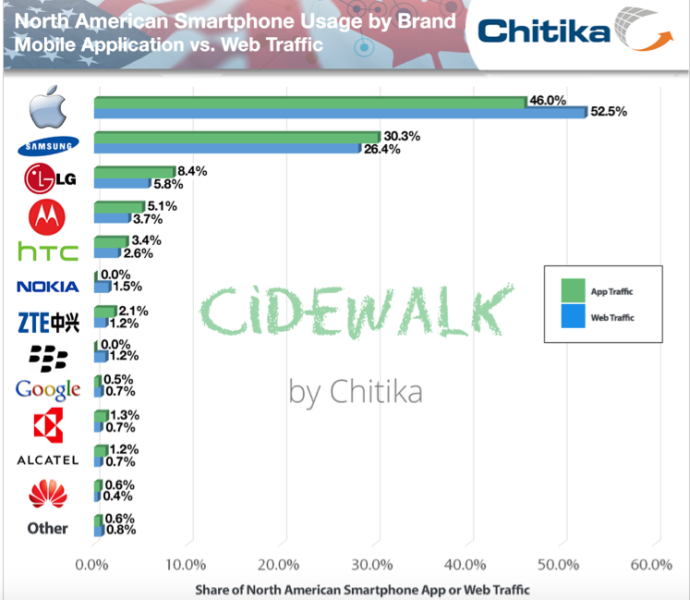
A recent report from Chitika Insights shows the iPhone generates more traffic across both apps and the mobile web in North America than any other smartphone manufacturer. Perhaps surprisingly, its share of traffic was larger on the mobile web than across app usage.

For the study, Chitika analyzed two sets of data including half a billion mobile exchange impressions through their Cidewalk platform (for app traffic) and millions of ad impressions from the Chitika Ad Network (for web traffic).

Screen-Shot-2014-12-15-at-9.02.27-AM-690x600

While Android devices collectively make up 54% of app-based internet traffic throughout North America, Apple takes the largest individual share. Apple also generates more web traffic (52.5%) than all Android devices combined. In both instances, Apple leads the second most popular smartphone maker, Samsung, by approximately 20 points.

This may seem strange to many, as Google search is prominently featured and more deeply ingrained in Android devices, while the iPhone emphasizes its app store strongly. Chitika explains the interesting findings by saying:

It’s likely that Apple users, in aggregate, are simply more likely to use their browser throughout the course of a given day. Safari has regularly earned praise for its functionality on mobile, and, perhaps more importantly, Apple makes it the default browser for any link clicked on an iOS device. This familiarity may predispose iPhone users to more often trust in their browser when performing tasks, as opposed to finding and using an associated app.

Source: Wired

Source: Wired

Instagram made big news recently by speeding past Twitter in active users, reaching 300 million to Twitter’s 284 million. Perhaps surprisingly, Twitter’s board members didn’t seem concerned by the numbers. Evan Williams, Twitter co-founder and board member didn’t mince words when he reportedly told Fortune “I frankly don’t give a s*** if Instagram has more people looking at pretty pictures.”

Well, if the last report wasn’t enough to give Twitter’s board pause, maybe a new study on brand engagement will make them less flippant.

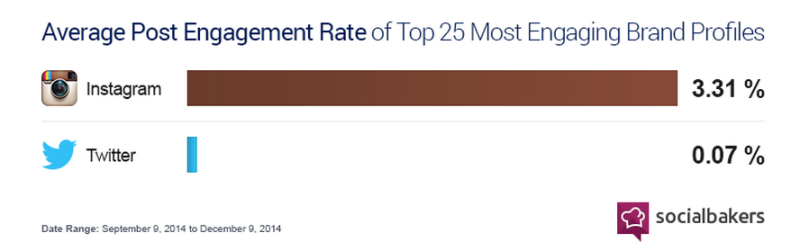
Social analytics firm Socialbakers compared the top 25 brands in Instagram engagement with the top 25 on Twitter and found Instagram received up to 50 times more engagement rates per post.

socialbakers-instagram-engage-800x251

By comparing three months of data ending December 9, Socialbakers found the average Instagram post for a major brand has a per fan engagement rate of 3.31% (counting likes and comments), whereas top brands on Twitter only receive an average rate of 0.07% per tweet including retweets, replies, and favorites.

Throughout the three month period of the study, brands included averaged 38 times more total interactions on Instagram (6.5 million a month) compared to Twitter (167,000). Socialbakers didn’t release a full list of included brands, but they did divulge five brands appearing on the lists for both Twitter and Instagram: Victoria’s Secret, Starbucks, GoPro, Forever21, and Aeropostale.

Socialbaker’s report isn’t much of a shocker in light of past reports. A previous Forrester Research study released last May found Instagram’s per follower engagement rate for major brands to be an astounding 120 times higher than Twitter.

Mobile-Search-Image-MashableDespite numerous  studies showing that mobile is beginning to overtake desktop, a new survey by Marin Software shows only a third of the 300+ digital marketers polled in the U.S. and UK make mobile a priority.

Over half (57 percent) said they optimize for mobile when they can but don’t put great focus on it, while 10 percent said mobile is not a significant part of their strategy at all.

The survey does suggest lack of time and resources could take partial responsibility for the lag. Three-quarters of those polled said their jobs became more complex over the past year as a result of media fragmentation and data overload.

Other portions of the findings suggest hurdles in implementing cross-channel marketing may also play a significant role. Attribution modeling across channels was cited as the biggest road block to implementing effective cross-channel marketing. As Ginny Marvin explains, “If marketers can’t successfully measure the impact of their mobile campaigns, they’ll put their attention elsewhere.”

These problems were reflected in the findings that half of those surveyed also cited a lack of transparency into the necessary data.

While properly prioritizing mobile can be difficult, the latest indications show that mobile will only be more important in the next few years and smartphones improve and society gets more comfortable using phones and tablets in their day-to-day life. Marketers and businesses who stall on prioritizing mobile will eventually have a lot of catching up to do.

Much like Bing, Twitter, and Facebook, Google releases a yearly list of the topics we’ve been searching for over the past 12 months. Compiled by analyzing the trillions of searches performed on Google in 2014, the list shows a more serious side to the internet compared to their competitors’ lists which tended to highlight the cute, funny, and scandalous.

Google shared lists for both the U.S. and globally, and the top search of the entire year is not devoted to either of the popular sporting events in 2014 or the social events happening around the world. Instead, the top search highlights the impact Robin William’s comedy brought the world. The deceased actor took the top spot for trending searches in the U.S. and globally.

The global and U.S. lists are largely the same in most categories. For example, eight of the top ten U.S. trending search terms also made the global list. The two search terms exclusive to the U.S. – Ferguson and Ukraine – show America’s continued interest in important news both at home and abroad.

Google’s Top Ten U.S. Trending Searches

Robin Williams

  1. Robin Williams
  2. World Cup
  3. Ebola
  4. Malaysia Airlines
  5. Flappy Bird
  6. ALS Bucket Challenge
  7. ISIS
  8. Ferguson
  9. Frozen
  10. Ukraine

Google’s Top Ten Global Trending Searches

  1. Robin Williams
  2. World Cup
  3. Ebola
  4. Malaysia Airlines
  5. ALS Ice Bucket Challenge
  6. Flappby Bird
  7. Conchita Wurst
  8. ISIS
  9. Frozen
  10. Sochi Olympics

Google’s Top Ten Trending “What is…?” Searches

Ebola

  1. What is Ebola?
  2. What is ALS?
  3. What is ISIS?
  4. What is Bitcoin?
  5. What is Asphyxia?
  6. What is Gmaergate?
  7. What is WhatsApp?
  8. What is MERS?
  9. What is Hamas?
  10. What is Airdrop?

Google’s Top Ten “How to…?” Searches

Airdrop

  1. How to Airdrop
  2. How to Contour
  3. How to Vote
  4. How to Kiss
  5. How to Craft
  6. How to Colorblock
  7. How to Wakeboard
  8. How to Refurbish
  9. How to Delegate
  10. How to DIY

Google Maps Most Searched Places in 2014

Walmart

  1. Walmart
  2. Starbucks
  3. Target
  4. McDonald’s
  5. Home Depot
  6. Bank of America
  7. Walgreens
  8. CVS
  9. Wells Fargo
  10. Costco

If the typical list is not your thing, Google also compiled the following video to summarize the year in search. For the full collection, visit Google’s Year in Search for 2014.

Facebook CTA

Facebook has been rolling out tons of new features aimed at improving business pages lately, but the most recent feature could be the most important of them all. Yesterday, the social media site announced it would be launching call-to-action buttons visible on business pages.

As the announcement explains:

“Pages are an important destination for people on Facebook, and we’re building new ways for people to interact with businesses through them. Today, we’re announcing a new call-to-action feature that will help Pages drive business objectives.”

This new feature allows users to more quickly make the action they are most likely to be looking for, and you can more efficiently direct visitors on your page to your most valuable destination. Whether you want users to sign up for your mailing list, browse your e-commerce store, or book a reservation, there’s a button to fit your needs.

Matt Southern broke down the 7 call-to-action button options announced so far, along with briefly explaining what each is likely to be used for. Facebook’s announcement did not go into details beyond the names of the buttons, but you can get an idea what to expect below:

  • Book Now: To direct visitors to book a table at your restaurant or, a room in a hotel, or a similar kind of reservation.
  • Contact Us: You can likely use this to direct visitors to a contact form, or if you’re brave perhaps it could be a button to email you directly.
  • Use App: If your company has its own app this could be a button to open the app on your mobile device.
  • Play Game: If you’re a mobile app development company this could be a link to play your latest game.
  • Shop Now: Direct visitors to your e-commerce store.
  • Sign Up: Direct visitors to your mailing list sign up page, or a webinar sign up page, or something like that.
  • Watch Video: Pretty self-explanatory, direct visitors to watch a video of your choice.

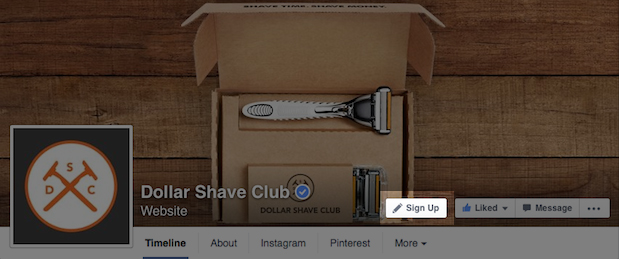
For an example of how these buttons will work, you can see the business page for Dollar Shave Club, who has had access to these call-to-action buttons already. Apparently it is working well for them:

“Over the course of a three-week test, the Sign Up call-to-action button delivered a 2.5x higher conversion rate versus other comparable social placements aimed to drive new user acquisition.”

These buttons will roll out in the US over the next few weeks and worldwide next year.

quality contentOver the past few years, search engine optimization (SEO) has endured a drastic shift from focusing on building link profiles filled with as many links of any quality that you could accumulate to emphasizing the value sites offer to users by assessing content quality. Of course, as the shift has occurred many online marketers were left wondering “what exactly is quality content and how do search engines judge my content?”

Google has remained fairly tight-lipped on the subject, only suggesting a few obvious and time-tested strategies for improving content for users. However, Bing’s Senior Program Manager, Michael Basilyan, went into great detail on how Bing evaluates content quality in a recent blog post.

In Bing’s case, the algorithm looks at multiple factors including relevance to specific queries, authority, utility, and even the overall presentation of the content. Basilyan encourages content creators to be ever-aware that every search is made by real people wanting real information to help them, rather than meaningless paragraphs crammed with keywords.

If you want your site to be visible on Bing’s search results and your content to be useful to users, Basilyan recommends focusing on these three areas:

  • Authority: How trustworthy is the content, the author of the content, and the website it is published on? Signals from social networks, cited sources, and name recognition is considered when determining an author’s authority.
  • Utility: How useful and detailed is the content? Content that provides appropriate levels of depth, along with supporting information, is considered to be more useful for searchers.
  • Presentation: Is the content presented in a way that’s easy to read? A well-presented page is one that makes its content easy to find, rather than one that forces the user to sift through unrelated material to find what they really want.

The blog post also highlights that Bing does not discourage the use of advertising, saying “Bing will promote and support websites and webmasters that provide ads relevant to the content of their website.” But, if your content interferes with usability it may also affect your visibility and Bing’s own assessment of your content.

google-christmas13-1356442914

The holiday season is a busy time for local businesses, but many local companies have noticed a steady drop in customers as the internet has made home shopping increasingly more convenient. The good news is that you don’t have to keep bleeding business so long as you have a reasonable internet presence and you are willing to invest the time to optimize your online business presence.

Jade Wang from the Google Business Help team just offered a list of tips local businesses who have already established themselves online can do to improve their conversion rates and draw in more foot traffic. If you want to score a bigger piece of your market, now is the time to do it by following these simple tips:

Got special holiday hours?

Let your customers know that you’re open for business extra late and update your hours as needed. You’ll want to update hours about two days before they should go into effect. If you’re open 24 hours a day, enter 12:00am – 12:00am.

Highlight your holiday spirit

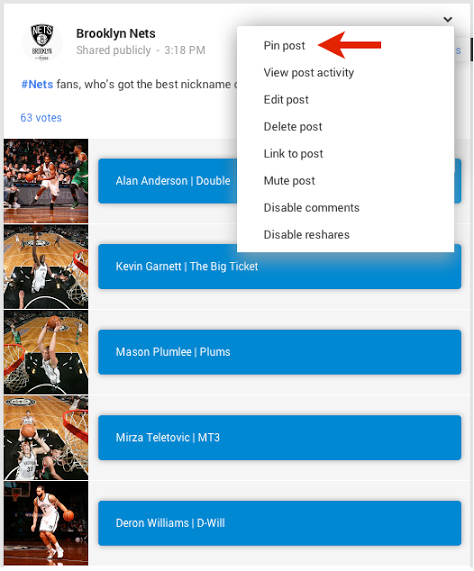
If you’ve got a holiday promotion or special information that you’re sharing on Google+, you may want to make it a pinned post. That way, you can keep that content front and center.

Expand your reach to sleepless shoppers

Our data shows that consumers will be even more restless, with one third of all shopping-related searches now happening between the hours of 10pm and 4am. Take a look at our blog post for tips on how AdWords can help you cover your bases.

Check your list (twice)

Remember to log back into Google My Business (Locations) regularly to make edits as needed and let us know that you’re actively managing. You can also check up on any updates to your business information from other users and ensure that it’s accurate and updated.

Wang shared the advice via the Google Business Help forums, which can be viewed here.

Google Authorship

It can seem like the entire world hates Google+ sometimes, but in reality the social media platform has carved out a niche audience that has stayed loyal over several years, and recent changes have given the platform a strong presence in local search results.

As Google has upped the presence of “local packs” or groups of local results on searches that appear to be geographically linked and this has given businesses with Google+ profiles a big step up in visibility.

Google+ gets beat on for not having near the number of daily active users as sights such as Facebook, Twitter, or Pinterest, but it is not going anywhere soon simply because of how useful the site can be. Now Google+ has made it even easier to keep the most useful information in a prominent location on your page by pinning the most important posts at the top of your feed.

You can use this to keep business information such as contact numbers or location info in a highly viewable place, but this can also be extremely useful for bringing attention to sales, special promotions, or any other big events coming up for your business that you want the public to know about.

To pin posts, just click the drop down arrow at the top-right corner of your published updates and select ‘Pin post’ as in the example below.

pinning

The feature has already rolled out on desktop and Android but, in typical Google fashion, iPhone users will have to wait until they decide to share the feature with iOS.

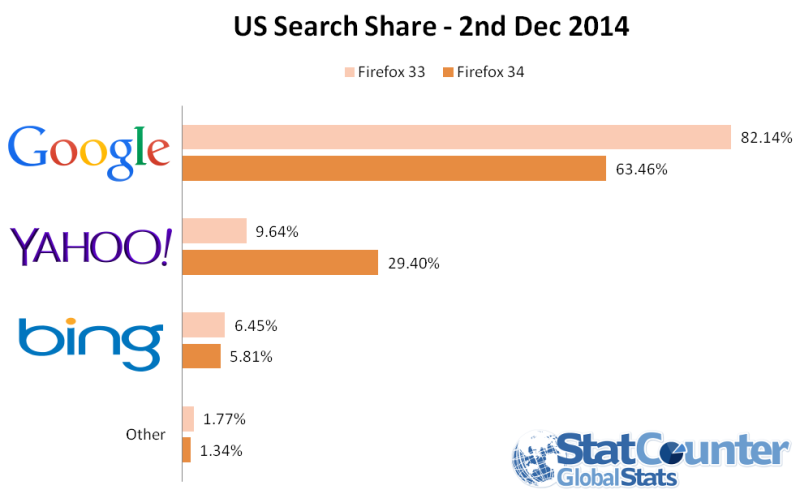
Google has had a strong grip on the vast majority of web traffic, but a new report suggests they are losing their grasp. In just two weeks since Yahoo replaced Google as the default search engine in Firefox’s latest version, the search engine has experienced a 29.4 percent growth in usage, while Google has experienced a significant drop.

Analytics firm StatCounter said that “Yahoo search was used three times more on Firefox 34 than on Firefox 33.”

It should be noted, the user base of Firefox 24 is relatively low as many users haven’t upgraded yet and Firefox’s US market share overall is only about 15 percent. However, StatCounter still showed that Yahoo has benefited a fair amount from this deal, growing from 9.6 percent to 29.4 percent. In comparison, Google usage in the latest version of Firefox fell from 82.1 percent to 63.5 percent.

Screen-Shot-2014-12-03-at-3.38.35-PM-800x494

In the big picture it is clear that Google still has a massive lead on other search engines, but that lead doesn’t seem near as solid as it once did. This report shows that “default” search engines still hold a lot of influence over how users interact with the web. With Google’s agreement with Safari also coming to an end in the near future, there is a large chance that Yahoo or Bing could continue to make significant gains.