FBVidVsYouTube

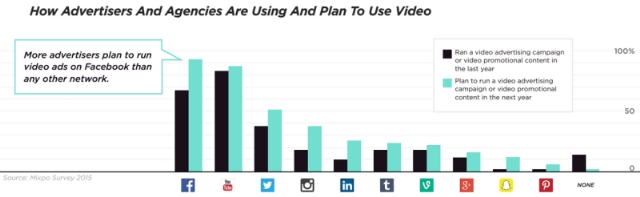
YouTube has been the prime place to be for video advertising for years, but Facebook is making a strong effort to take the throne. It also seems to be working. A new survey from video advertising company Mixpo suggests Facebook video may overtake YouTube as the number one video advertising platform as early as this year.
Facebook Video vs YouTube

The survey polled 125 agencies, brands and publishers on their plans for video advertising this year. According to their results, 87 percent said they plan to run video ad campaigns on Facebook, compared to 81.5 percent on YouTube.

Facebook video’s rise has been incredibly quick, following a revamp of the service early last year. Since then, the platform has claimed incredible viewing and sharing stats for videos which are attracting many advertisers.

The findings of the survey also show more businesses and advertisers are seeing the value in video advertising, as more marketers report planning video advertising campaigns across all platforms in 2015. Similarly, the number of advertisers without plans for video advertising this year has fallen to nearly non-existent.


You would think the sky is falling given how webmasters and online marketing experts are responding to Google’s huge upcoming mobile algorithm. Sites are tossing around all manner of terrifying nicknames such as the mobilepocalypse, mobilegeddon, mobocalypse, or mopocalypse to stir up fear and panic, but the truth is the upcoming update shouldn’t be all that scary for you.

If your site serves mobile users and you care at all about your customers, you should already have made efforts to make your site mobile-friendly. While a big ranking drop seems frightening, the truth is that mobile users are probably already avoiding your site. Don’t think of the upcoming change as being forced to change your site to please search engines. Thank of it as improving your site for mobile users.

Countless sites are talking about the “mobilepocalypse” as if the world is ending, but I’ve already covered the simple set of steps you need to take to check that your site is ready for the mobile update. If you aren’t passing Google’s mobile test, this infographic from Nine Hertz will walk you through what needs to be done before the 21st.

 Mobilepocalypse

Google’s upcoming mobile-friendly algorithm is fast approaching, and many webmasters have questions about exactly what they need to do to prepare their sites ahead of time. This was especially clear in a recent Google+ Webmaster Hangout which allowed some webmasters to directly ask Google employees all their lingering questions on the new mobile update.

There is a lot of good info to be found in the hangout, but I’ve collected some of the most important parts in case you don’t feel like sitting through the hour-long video.

Expect the Rollout to Last a Week

Initially, Google made it seem like the algorithm would be like turning on a switch, but it sounds like the rollout will actually be more similar to past algorithms. Current estimates say it could take up to a week to fully be implemented. Keep this in mind as you start monitoring your traffic starting the 21st.

There is No Grey Area

Your site is either mobile-friendly or it is not. There is no scale or middle ground. If you live up to Google’s criteria you will be considered mobile-friendly, and otherwise your site will be flagged until you make the necessary changes. Thankfully it is easy to know ahead of time if your site is ready for the rollout with a simple testing tool.

Google Yourself to See if You are Ready

Google’s testing tool is the official way to check your site’s status, but you can also see if your site is mobile-friendly with a simple search from your smartphone. According to the experts, if you see a grey “mobile-friendly” label next to your site in the listings, you are all set. On the other hand, if you don’t see that label you should probably get to work.

Common Mistakes

These tips follow a list of common mistakes websites make when going mobile-friendly, which Google recently published. If you aren’t seeing the “mobile-friendly” label, make sure to check out this list to guarantee you aren’t missing a small mistake.

GMB Put On Map

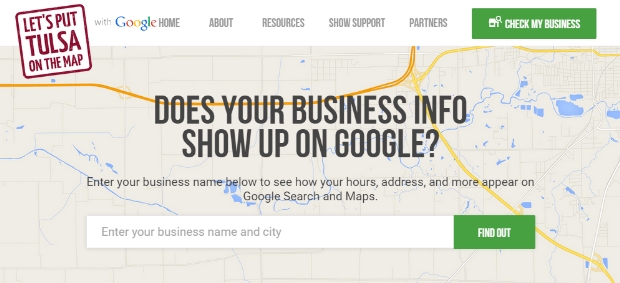
Google is doubling down on their efforts to bring local businesses around the world online with a new program called “Let’s Put Our Cities on the Map.

The new program seeks to assist small businesses and local organizations from over 30,000 cities worldwide to set-up complete local listings on Google.

The search engine claims consumers are 38 percent more likely to visit and 29 more likely to consider purchasing from businesses with complete listings, yet a huge number of companies do not have local business listings on any search engine.

Dandelion Marketing

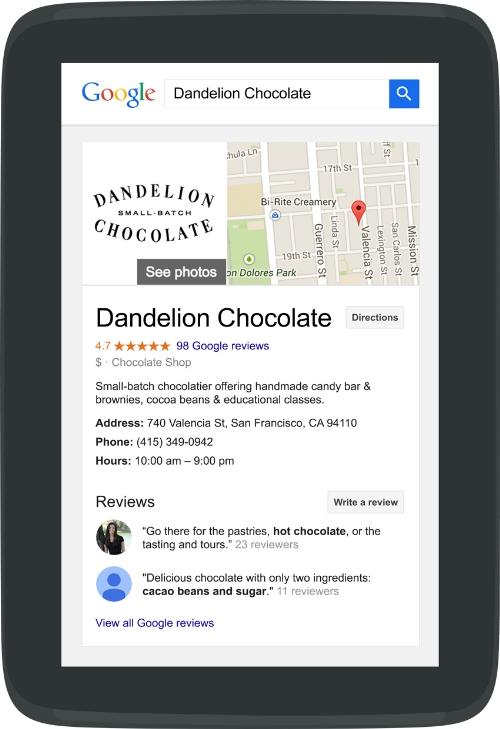
For the new initiative, Google is providing each participating city with a custom website where local businesses can see how they appear on Google Maps and in search results.

Google is also giving local business owners an easy-to-follow guide for getting their business listed with Google My Business, as well as a free website and domain name for a year through Google’s partner Startlogic.

The program is also encouraging consumers to get involved, by inviting consumers to create postcards in support of their favorite local businesses which can be shared on Google+, Twitter, Facebook, and LinkedIn. However, Google makes it clear these postcards won’t have any impact on search engine ranking.

“Sharing the postcards won’t make businesses appear higher in search, but will hopefully spur them to verify and start managing their business listing,” a Google spokesperson told Search Engine Watch.

Google is also partnering with local organizations such as chambers of commerce and small business development centers to offer workshops aimed at teaching local businesses how to control the information listed about them on Google Search and Maps.

Facebook Messenger

Facebook unveiled several big upgrades to its current platform of products and services this week during its annual developer conference in San Francisco. The biggest announcement has been rumored for some weeks, but the social media giant also had a few other interesting changes hidden up its sleeve that will allow the platform to be more fully integrated with the rest of the internet.

Messenger is a Platform Now

Of course the big news from the conference is Facebook’s decision to officially launch Messenger as its own platform, which will allow developers to more freely integrate features from Messenger into other apps.

For example, Facebook demonstrated how users may be able to order from an online retailer, then change the order or shopping details later using the Messenger app. You can find out more details in the official announcement.

360-Degree Videos are coming

It was announced that spherical, 360-degree videos will be coming to Facebook at some point in the near future. These spherical videos will also be brought to the Oculus VR platform.

Embeddable Facebook Videos

Facebook is quite proud of the success of its video service and it is making it easier than ever to share videos you like from the site. Soon, videos uploaded to Facebook will be embeddable across the web. This provides clearer incentives for content creators to consider uploading videos directly to the social media site rather than through competitive platforms such as YouTube.

Firefox Yahoo

Google has been heavy-handed in trying to woo Firefox users back to their search engine since Yahoo became the default search engine for the browser. It also appears to be working.

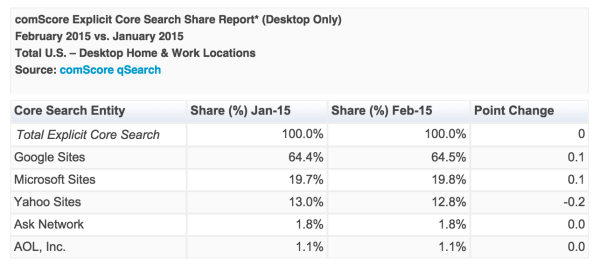
ComScore released the latest US search market share numbers for February and it seems Yahoo is gradually losing the gains they have made since they made a deal to become the default search engine for the browser and Google is reaping the benefits.

Screen-Shot-2015-03-18-at-10.47.35-AM-600x278

Since the switch over lost Google a small portion of users, Google has been practically begging users to make switch back. While there hasn’t been a mass exodus back to the motherland of Google, Yahoo is seemingly losing a slow but steady stream of users back to Google.

According to comScore’s report, Yahoo lost approximately 10 percent of its search volume from January to February, while Google recouped a tenth of a point along with Bing. This lines up with another recent report from StatCounter which also indicated a loss by Yahoo between January and February.

Screen-Shot-2015-03-18-at-10.57.59-AM-600x379

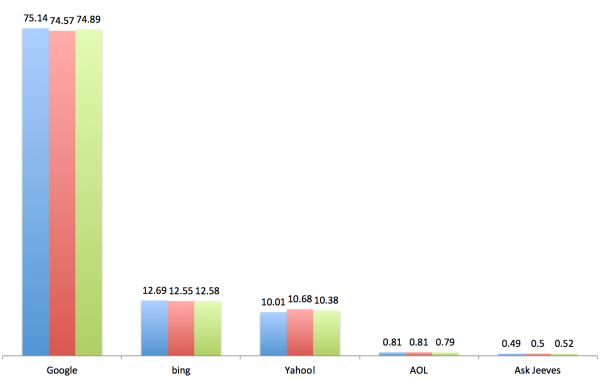
From the time Yahoo became the primary search engine to January, Yahoo had gained 1.2 points. Now Yahoo is still above their previous levels, but it has list .2 percent of those gains. The question is whether the trend continues.

It is important to note comScore’s numbers don’t include data from mobile searches, where Google is even more dominant.

Google is making it easier for mobile users to fill out forms thanks to a new enhancement to its autocomplete attribute in Chrome, the company announced yesterday.

As in the past it is up to webmasters to make sure the forms on their sites are marked up with the autocomplete attribute, but it is an important step to take. Past analysis shows implementing autocomplete on your forms increases conversions and reduces cart abandonment.

Google also encourages sites to use the autocomplete attribute, citing increased completion rates and saying:

“Making websites friendly and easy to browse for users on mobile devices is very important. We hope to see many forms marked up with the “autocomplete” attribute in the future.”

The new enhanced autocomplete attribute allows you to easily label input element fields with common data categories like ‘name’ or ‘street-address’ without having to alter other aspects of your site. This way, Chrome is able to accurately fill-in each line when users tap on the field from their smartphone or tablet.

Google offered a sample form so you can see get an idea what the new markup code looks like. You can see how each field is marked up by going to this page and viewing the source.

Instagram Banner

Is Facebook still the king of social media? In terms of sheer traffic Facebook may still have a sizable lead, but businesses are finding it may not be the best platform for their marketing. In fact, a report by L2 and Olapic shows brands are starting to invest more effort elsewhere.

Brands are now posting more content to Instagram than they are on Facebook, most likely due to the continuously declining organic reach for brands on the big F.

The signs of Facebook’s downfall as the primary place for social media marketing have been around for quite some time. As organic reach started to fall, brands began migrating to other social networks and cutting back on their organic efforts on the site in favor of paid advertising.

Facebook’s paid advertising platform allows brands to get even more reach than they had developed organically, but at the sake of organic reach. In comparison, Instagram is (for now) almost entirely based on organic content.

Instagram may not stay the most popular platform for branded content for long, either. The Facebook-owned social image sharing platform has already implemented some advertising options and have publicly announced plans to expand paid advertising on the site. Nonetheless, most brand activity on the site is currently organic.

L2-instagram-600x322

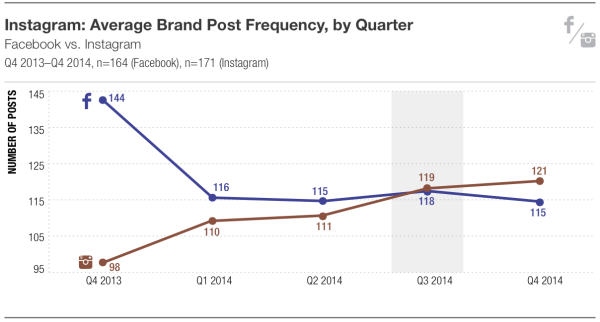
The L2 report found the 250 participating brands posted an average of 9.3 times per week on Instagram compared to 8.8 times on Facebook in Q4 of last year. Compared to the same time period in 2013, Facebook was down from 11.1 a week, while Instagram boosted itself by nearly two full posts a week.

Other notable findings from the report included:

  • The auto industry, led by luxury brands like BMX, Mercedes-Benz, Audi and Porsche, outperformed all categories (Beauty, Consumers Electronics, Travel, Watches & Jewelry, Fashion, Sportswear, Retail, Drinks) with a 1.52% per post engagement rate on Instagram. Drinks — Stella Artois, Jack Daniels, Belvedere, Pabst Blue Ribbon — was second at 1.32%.
  • Of the top 200 highest performing posts, 65% prominently featured a product, 43% included general lifestyle photography and 29% included a brand ambassador or other influencer.
  • Hyperlapse has lapsed with only 75 — or only 2.4% of brand videos posted since August — brand posts using the time-lapse video app. Brand Hyperlapse activity has fallen off steeply since September and the engagement rate on the videos is 0.69 percent, slightly less than conventional Instagram videos.
  • Photo posts drive higher engagement that video, 1.03% to 0.79%. Videos attract more comments, but photos draw significantly more likes.

11057091_1622144431330260_1923819740_n

The best marketing is always informed by data. The more data you have the more you can pinpoint who you should be reaching out to and what they are interested in, and Facebook is making it easier than ever to find out who you audience really is.

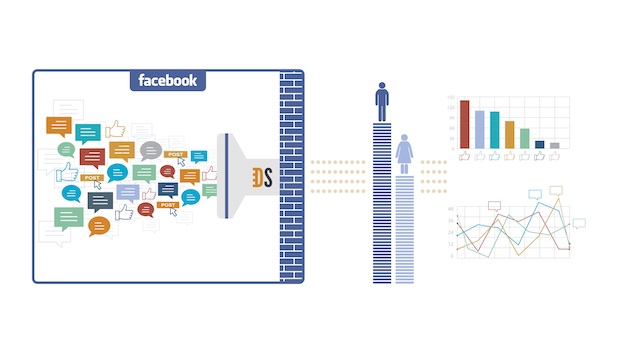
Tuesday, Facebook announced it would be granting Page owners access to “topic data” which tells marketers and business owners what audiences are saying on Facebook about all sorts of topics including events, brands, and activities.

Obviously there are some privacy concerns with this type of data, but Facebook says all personal information is being withheld.

With topic data, fashion retailers can see what types and styles of clothing their customers are talking about, and businesses can gauge the public opinion on their brand.

This isn’t the first time marketers and business owners had access to this type of information, but previously they had to use third-party tools to get this level of insight. Facebook also claims that these tools frequently used sample sizes that were too small to be effective and argue it was “nearly impossible” these tools were accurate.

Advertisers should know there is no way to directly use this data to target ads, but it absolutely can be used to craft more effective ads and target them more accurately for your market.


Reviews are one of the best tools local businesses have for establishing a reputation and trust within their community. The problem is it can be difficult to convince customers to leave their opinion on Google or Yelp, especially due to Yelp’s strict “no review solicitation policy.”

Yelp’s Luther Lowe gave a tip to help get past this hurdle and start generating reviews at the LSA SMX West Local Search Advantage Workshop.

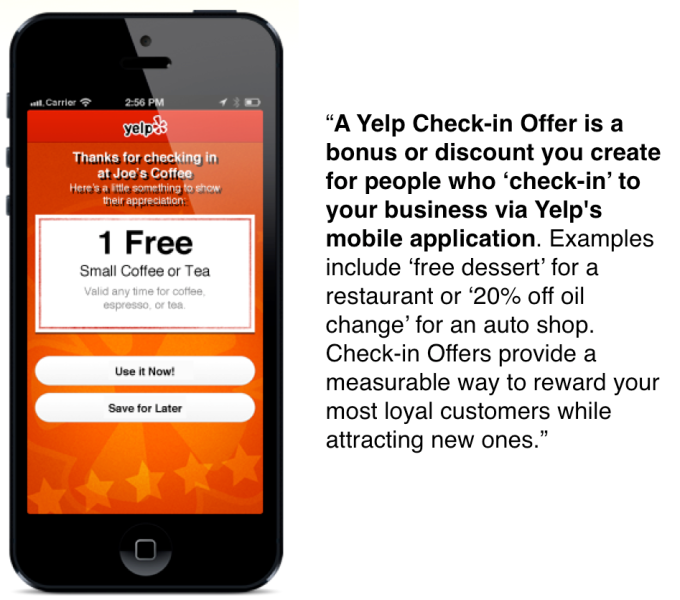
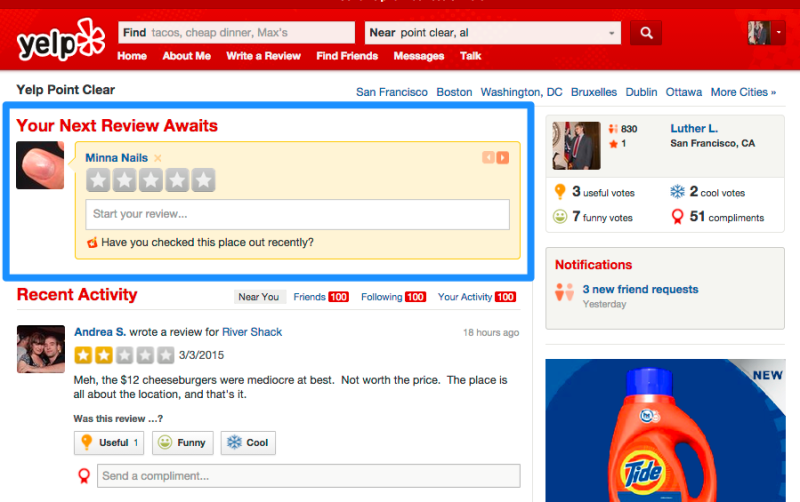
Yelp’s policy against review solicitation prevents businesses from asking for positive reviews, though it has not prevented some other creative attempts to gain a positive standing on the site. However, Yelp does allow incentivized check-ins. Obviously check-ins are not reviews, but when users check-in to receive an offer, they are automatically prompted to review that business the next time that return to the site or mobile app.

Screen-Shot-2015-03-06-at-6.28.09-AM-800x502

This system gives businesses a means of encouraging users to leave a review without placing their hands on the scale. The problem with allowing incentivized reviews is obviously that many people would be pushed to give dishonest reviews, but through a pre-review reward users are still free to speak their mind.

From a business matter, this also benefits Yelp because more check-ins equates to more value and usage, but it also gives a valuable place for businesses to lightly nudge customers to help spread the word.