
yahoo_logo_detail

Want to know what everyone will be searching for this spring ahead of time? Yahoo claims to have the answers in their newly revealed list of top search trends for this spring. Using search data from last year and recent months, Yahoo uncovered the top trends in search to keep an eye on this season.

These are the top search trends for spring 2016, according to Yahoo:

  • DIY: Spring is the season of house improvement projects, which means people are searching for “how to” tips for their new venture. January, March, and April are the peak months for “how to build” searches, especially in the Southeast. In particular, Yahoo says sheds, tree houses, decks, and raised garden beds are especially popular this year.
  • Painting: Along with DIY projects, searches for phrases like “what paint colors go with…” are going up. Putting a new paint of coat on living rooms and kitchens are the most popular projects for many searchers this year, according to Yahoo.
  • Organization: As people are making the switch from their winter clothes to their warm-weather wardrobe, there’s going to be a big increase searches for closet organization.
  • Outdoors: Searchers are also getting ready for the warm weather by searching for outdoor equipment and furniture like patio furniture, outdoor furniture, lawn mowers, and spring sets.
  • BBQs: Unsurprisingly, searches for “grills” go way, way up from March to May.
  • Chairs: Adirondack chairs are a big item this year, looking to peak in April. Interestingly, Yahoo says people searching for this style of chair are also 98% more likely to drive a luxury SUV.
  • Allergies: Allergy season is just getting started, but clearly people are already ready for it to be over. From February to June there is a large increase in searches asking “when do seasonal allergies end.”
  • Taxes: Up until Tax Day, this is going to be a popular topic for searchers every year. However, this year has some noteworthy changes from the past. Over a quarter of searches for “tax prep” are expected to come from mobile devices, and those looking for tax prep advice are skewing younger than 35 years-old with an annual income below $75k.

Yahoo is offering this information to help search marketers and seasonal businesses refine their content strategies and get ahead of the trends this year. If you act now, you can take advantage of the insight to make yourself the first choice as this year’s hot searches heat up.


google-rankbrain-algorithm

Google has always kept it search engine ranking algorithm a closely guarded secret, but it is finally letting webmasters and online marketers in on the three most important factors for ranking well. Google has confirmed the top three ranking factors are links, content, and RankBrain.

The news isn’t much of a surprise. Links have long been one of the most important signals for websites, and content has become an essential cornerstone of SEO in recent years.

Google said RankBrain was the third most important ranking signal last year, but its inclusion is still a little puzzling. RankBrain is technically a part of the Google algorithm, but it is hard to call it a search signal so much as an artificial intelligence system which informs Google’s main search algorithm.

Andrey Lipattsev, a Search Quality Senior Strategist at Google, confirmed the top two are links and content during a Google hangout yesterday. Lipattsev was asked what the top search signals are, to which he told SEOs:

I can tell you what they are. It is content and links pointing to your site.

Of course, there are over 200 search signals and Lipattsev suggested “there is no order” to the most important search signals, so don’t expect a complete ordered list of search factors anytime soon.

You can see the video of the Google hangout below, with Lipattsev responding to the question around the 30:20 point.


Source: Shawn Campbell

Source: Shawn Campbell

When Twitter’s algorithmic timelines started appearing as a test on the social media site, you would have thought they had announced users had to commit a sacrifice before posting. Angry memes were shared, many users threatened to leave the site, and the “end of Twitter” seemed to be on the horizon.

It turns out first impressions don’t always mean anything.

Despite the initial uproar, Twitter’s algorithmic timeline is actually going over well and will soon become the default for all users.

Slate reports Twitter has been gradually rolling out a default algorithmic timeline for users for weeks now, and the reception has been largely positive. According to a Twitter spokesperson quoted in the report, the percentage of users to opt-out of the new timeline has been in the “low single digits.”

This isn’t a case of users being slow to opt-out either. Data shows users are engaging with it more frequently in almost every way compared to the traditional chronologic timeline.  Users with the new timeline are tweeting, replying, retweeting, and favoriting more than ever.

Part of the warm reception may be related to how Twitter is handling the rollout. Instead of pushing out the change to everyone all at once, Twitter is gradually rolling it out and notifying every user individually as their timeline changes.

Users who dislike the new timeline can always opt-out and return to the traditional time-based timeline. All you have to do is go to the settings area and uncheck “Show me the best tweets first.”

While Twitter is changing some things up, another controversial move by the site appears to be on the backburner for now. During an appearance on the Today Show, Twitter CEO Jack Dorsey stressed the site would be retaining its 140 character limit for Tweets.

During press appearances for the 10th anniversary of the platform, Dorsey clarified they would not be doing away with the character limit. He said, “It’s staying… It’s a good constraint for us, and it allows for of-the-moment brevity.”

This week, Google announced it will be boosting “the effect of the ranking signals” for its mobile-friendly ranking algorithm. While this means mobile-friendly sites will be prioritized even further in search results “beginning in May,” don’t expect the second coming of “Mobilegeddon.”

As Google said, if your site is already mobile-friendly, you have no need to fear, because “you will not be impacted by this update.”

The update is going to roll out gradually, meaning its impact will be even less noticeable.  Since the mobile-friendly algorithm runs on a page-by-page basis, it could take some time for Google to re-index all affected pages.

Between the slow rollout and the limited expected impact, the update might not seem like much to get excited about. But, if your site isn’t mobile-friendly, it means you have even more motivation to make the change before May. Even if your audience isn’t particularly likely to convert on mobile, you could be missing out on leads and traffic that is going to your competitors instead.

You can use the Google mobile-friendly tool to make sure your site passes the bar and won’t be impacted by the coming update.

Blog Images (61)

Google Analytics is an essential tool for webmasters and marketers looking to take control of their marketing efforts and increase both revenue and engagement. Now, Google is taking the platform even further with the introduction of the new enterprise-oriented measurement platform, Google Analytics 360 Suite.

In an announcement posted this week on the blog Inside Adwords, Vice President of Analytics, Display, and Video Products Paul Muret said:

“Sophisticated marketers who use analytics platforms are 3X more likely to outperform their peers in achieving revenue goals. It’s no wonder enterprise-class marketers have been telling us they need more from their marketing analytics tools. Many toolsets can’t cope: They’re too hard to use, lack sufficient collaboration capabilities, are poorly integrated, and require hard to find expertise.”

Muret also told Marketing Land that marketers are “trying to engage with brief moments of engagement” referring to so-called micro-moments. “If the value is not delivered” within the brief window of time, “consumers will quickly move on.”

The new platform is intended to deliver an enterprise-oriented analytics service that is both comprehensive and easy-to-use while focusing in on those brief moments of engagement and opportunity.

Google has remained mum on if there are any new data sources feeding into the Suite, and cross-device tracking remains the same. Rather, Google Analytics 360 Suite is intended to expand upon Google Analytics Premium, its previous enterprise-oriented analytics platform.

The suite includes four new tools, as well as two old mainstays:

Google Audience Center 360 (beta). This powerful data management platform (DMP) helps marketers understand their customers and find more like them across channels, devices, and campaigns. It offers native integration with Google and DoubleClick, plus it’s open to third-party data providers, DSPs and more.

Google Optimize 360 (beta). This website testing and personalization product helps marketers deliver better experiences. Marketers can show consumers multiple variations of their site and then choose the version that works best for each audience.

Google Data Studio 360 (beta). A new data analysis and visualization product that integrates data across all suite products and other data sources ― turning it into beautiful, interactive reports and dashboards. Built-in real-time collaboration and sharing is based on Google Docs technology.

Google Tag Manager 360. Built from our industry-leading tag management product, it empowers enterprise marketers to move faster and make decisions with confidence. It offers a simplified way to gather site information (all those tiny bits of code) and powerful APIs to increase data accuracy and streamline workflows.

Google Analytics 360, formerly known as GA Premium, will roll out exciting new capabilities throughout the next couple of months as investments continue to grow. It will serve as the measurement centerpiece by analyzing customer data from all touch-points and integrating with our ad products to drive marketing effectiveness.

Google Attribution 360, formerly known as Adometry, has been rebuilt from the ground up to help advertisers value marketing investments and allocate budgets with confidence. Marketers can analyze performance across all channels, devices, and systems to achieve their most effective marketing mix.

All these tools are available on the dashboard, and Google has said the platform also includes a broad set of integrated third-party providers, such as customer relationship management platforms.

The individual products will be offered à la carte, under to-be-announced pricing. Google Analytics Premium and Adometry will be relaunched under the Google Analytics 360 Suite platform “in the coming months.” Google Analytics Premium and Adometry customers will also be offered access to the new tools in a limited beta test in the future.

Pinterest-logo

Pinterest’s promoted pins and ads have made a huge splash in the 18 months of beta testing its small platform with select brands, and now it is set to become even bigger. The site is rolling out its ad tool, Promoted Pins Ad Manager, to all small and midsize brands in the United States.

The company also announced it would be increasing the number of interest-level targeting options from 30 to 420. In the past, advertisers could only choose from 30 broad interest groups such as food, beauty, and fashion. The new options are more specific, so marketers can target their audience much more accurately with categories like “healthy food,” “sustainable architecture,” and “street-style fashion.”

“Pinterest knows more about the interest of its users than any other platforms,” said Nipoon Malhotra, Pinterest’s ad products lead. “This is very different from a graph that represents something you browsed a month ago.”

Pinterest also noted that marketers who spend at least $1 per day advertising on Pinterest see a 20 percent increase in clicks on their posts.

Pinterest Pins function just like normal Pins on the site, however, they are shown to more people than a typical Pin. By using the Pinterest Ads Manager, you can target exactly who you want to see your Pins based on interest targeting, keywords, or customer database targeting using your customer list.

While most users still think of Facebook as mostly a way to interact with their friends, post selfies, and share information, many businesses and marketers are starting to realize just how powerful Facebook’s advertising platform is.

While Facebook ads can be an incredibly powerful way to boost your content and your brand’s recognition, it can be hard to stand out among the over 3 million advertisers on the platform.

Creating the perfect ad to rise above the noise and grab the attention of your audience means balancing several different factors, including the optimal amount of text, creating images and videos with the perfect dimensions, and knowing where to best reach users on the page.

For a brand just getting started with Facebook ads, it can all be a little overwhelming. Thankfully, WebpageFX recently shared the infographic below, which details everything you need to know to make the perfect Facebook ad.

facebook-ad-anatomy-infographic

Want to make the perfect Facebook ad for your business and guarantee you reach your audience? TMO can help. Contact us and we can review your advertising efforts and tell you how to optimize them to get the most out of your advertising.

Source: Robert Scoble / Flickr

Source: Robert Scoble / Flickr

Despite once being the gold standard for assessing a site’s authority and optimization, Google announced this week it will be shutting down PageRank and all toolbars featuring the tool will no longer show a PageRank score.

The algorithm-based tool would assess web pages and rank them on a scale of one to ten based on numerous signals that Google uses to evaluate pages. It was an easy-to-understand way to quickly “score” a website and know if optimization, link building, or other marketing efforts were having a positive effect. However, the tool has not been updated in years.

Many webmasters have been holding onto hope that PageRank would get an algorithm update, but the company has been slowly moving away from it for some time. PageRank scores were never displayed inside Google Chrome, and the scored were dropped from Google Search Console in 2009. The Google Open Directory website, which showed PageRank metrics, was also shut down in 2010.

The last bastion of the PageRank score was the IE Google toolbar, which continued to show scores up until now.

Google has confirmed it will not be updating the tool for the public, but it will continue to be used by Google internally.

The move signals a big shift away from Google’s old way of doing things, but in practical terms it will change very little. Since PageRank hadn’t been updated since 2013, SEOs and webmasters have learned to rely on other tools and methods of assessing their marketing efforts.

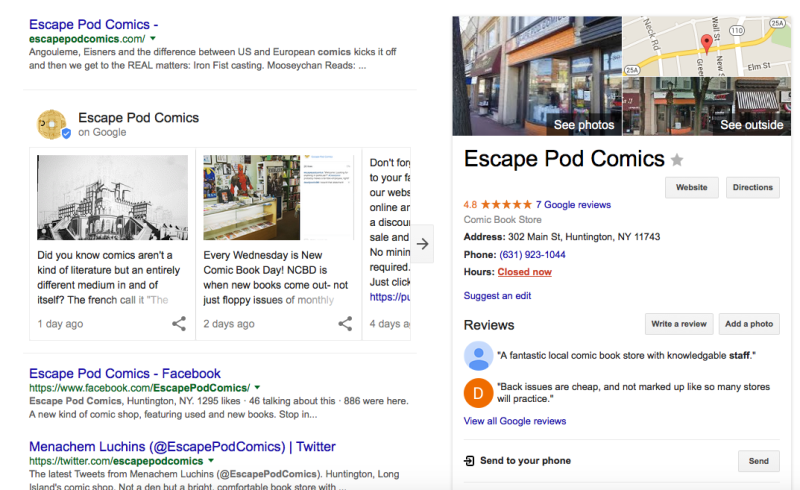
Google is experimenting with a new change that could up the profile of local businesses in the search results. The search giant is conducting a limited test featuring a new card carousel of results and content from local businesses near the top of search results pages.

Mike Blumenthal first noticed the test, but it has since been confirmed by Google. The “Local Business Cards” use the same functionality as Candidate Cards, which were recently launched. The main difference with this new test is how limited it is.

Currently, Google is only including a “few dozen” hand-chosen local businesses in the experiment. Instead of pulling the content being used to fill the cards from search engine content or Google My Business listings, Google is also using custom content for the cards.

This test is also notable for being the first time Google has allowed animation or GIFs on the search results pages.

On desktop, you can see the Local Business Cards directly adjacent to the Knowledge Panel featuring that business. On mobile, it is shown below the Knowledge Graph. You can see an example below:

The idea behind the new test is to allow businesses to stand out more in search results and highlight content or information about the business’s products or services in ways not quite possible through the Knowledge Graph. With this in mind, Google has also made content directly sharable from within the carousel.

Screen-Shot-2016-03-04-at-2.33.00-PM-800x490

Most likely this is an early test since Google chose such a small number of businesses and is using custom content to fill the cards. There’s no telling when or if Google will roll out the feature to a wider audience. Hopefully, the cards come soon, as they could be a huge benefit for local businesses that depend on organic search traffic.

YourBusinessStory

Facebook announced a new video offering for small businesses called Your Business Story, which would allow Pages to easily create and share montage-videos incorporating still images and music. At the same time, the company let slip that it now has over three million advertisers.

Your Business Story is a simple tool similar to the previously announced SlideShow offering. The company didn’t say anything about ads being included in the platform, but the note about their recent advertising milestone suggests the new offering will eventually work its way into Facebook Ads.

In the announcement, Facebook said:

To celebrate the businesses that use Facebook to grow, we created Your Business Story — a tool that makes it easy to create a video that shows what your business brings to the world. Because we believe the best way to tell the story of three million businesses is to empower each one to share their own.

Three million advertisers is a significant milestone for the social media platform. In September, the company announced it had reached 2.5 million. Before that, it claimed two million advertisers in February 2015. That means Facebook has been bringing in about half a million advertisers every six months for about the past year.

The announcement also said the majority of the businesses that use Facebook’s ad services are small businesses, also saying “50 million small businesses now use Pages on Facebok.”