Tag Archive for: Social Media Marketing

Twitter is following Facebook and Instagram’s lead by prioritizing live streams in users’ feeds. The social network announced it would begin bumping live streams to the top of users’ timelines while the streams are active.

This means anytime someone you are following begins streaming, you will be able to see it automatically at the top of your feed.

As Twitter said in the announcement:

“We’re making it easier to find and watch live broadcasts. Now, when accounts you follow go live, the stream will appear right at the top of your timeline.

Catch breaking news, your favorite personalities, and can’t-miss sports moments. Rolling out now on iOS and Android.”

The decision to prioritize live streams in people’s feeds isn’t exactly shocking. While streams can be rewatched after the original event is over, being able to interact with streamers during the video is a big driver of engagement for streams. Once the initial stream is over, engagement with the post typically dwindles significantly.

This is why Facebook and Instagram have similarly prioritized live streams on their platforms by sending notifications to users and highlighting active streams in the primary feed.

Although Twitter has yet to clarify, it seems likely the boost applies to both video live streams and the new audio-only streams rolled out for users last week.

in a year full of scandals and congressional inquiries, people appear to be changing how they use Facebook.

A new study from Pew Research Center shows that a huge portion of users has taken steps to reduce their usage and increase their privacy within the past year.

Interestingly, the findings show that users are specifically ditching the Facebook mobile app, with more than a quarter of US adults deleting the app on their phone. Even more have gone on a trial separation by taking a break from the platform entirely.

Among the findings of the study are several notable discoveries, including:

  • 54% of users have adjusted their privacy settings
  • 42% have taken a break from checking Facebook for several weeks or longer
  • 26% have deleted the Facebook app from their phone
  • 74% have done at least one of the above

These numbers on their own are very concerning for Facebook, but they become even more illuminating when broken down by age group. The survey shows that young Facebook users are widely stepping away from the platform or restricting their privacy.

Among users aged 18-29, 44% have deleted the app, compared to just 12% of users over the age of 64. Similar shifts were found among those who have changed their privacy settings.

Notably, there was no significant difference between the ages of those who have taken a break from Facebook.

The survey was conducted between May 29th and June 11th this year, after news broke about Facebook’s involvement in the collection and selling data on millions of users by Cambridge Analytica.

While these trends are certainly eye-raising, it remains unclear exactly how Facebook’s scandals have actually affected the company. The company’s latest quarterly report indicates the average daily users in North America has remained steady throughout the year.

Facebook is running an extremely limited test letting just five publishers create and test responsive headlines, images, videos, and copy to see which versions of their posts perform better in real time.

The new tool allows the select few publishers to test up to four unique versions of any organic post, according to Digiday. It also allows these publishers to see data such as interactions and click-through rate, as well as predictions of these metrics as the ads roll out. This way, publishers can actively gauge which version of their content fares best.

While Facebook wasn’t willing to release specific data on the test yet, Facebook product manager Mollie Vandor said that more than half of the time, publishers wound up choosing a different version of the story than they had originally created.

The intention is to help boost organic performance for publishers in a time where organic reach and engagement continues to fall across the platform. According to BuzzFeed News, one of the publishers given access to the test, the tool does improve performance. However, it isn’t enough to mitigate Facebook’s ongoing demotion of organic reach.

“This comes as everyone’s traffic on Facebook has gone down a lot, so it’s good to be able to get the most out of our posts, but we’re still getting a lot less,” said BuzzFeed news deputy director, Fran Berkman.

As a Facebook rep told Marketing Land in a written statement:

Our goal with this test is to provide more visibility into how their organic content is performing on Facebook on a post by post basis. Also to enable publishers in the test to derive learnings and identify their own best practices over time. With this level of insight, publishers are better equipped to drive meaningful engagement around their content and have a stronger sense of control over how their content performs on Facebook.

Vandor echoed this sentiment, saying the tool “is a way to maximize how they pitch their content to people on Facebook.”

“Instead of us saying, ‘Here’s a list of universal best practices,’ we’re trying to give publishers the tools they can use to develop their own best practices.”

When asked if the tool would be available to other publishers and advertisers in the future, Vandor wouldn’t say anything decisively. She did, though, say the company is “actively exploring” expanding the tool to others once it is made easier and less resource-intensive to use.

For years, Facebook has made it easy to integrate your other social media accounts from across the web, by allowing users to cross-post content from one platform onto Facebook. For instance, Twitter users were able to share their Tweets on Facebook without ever leaving Twitter’s platform.

That all changed last week, however, when Facebook officially deprecated its Publish actions permissions from its API, effectively making it impossible for other social networks to include built-in cross-posting.

According to Facebook, this move affects approximately 60,000 apps – including some big hitters like Twitter.

Twitter’s support team confirmed the change, though they explain there are still other ways to share Tweets across the web:

Facebook announced it would be deprecating Publish action permissions back in April, saying a few categories of apps with long product life cycles would be given extra time to update their software.

Facebook confirmed to Marketing Land’s Amy Gesenhues it had rolled out the change last week. The company also stated Facebook users could still share content using Facebook’s Share dialogs.

Essentially, this boils down to Facebook staking its territory and trying to keep users within its platform as much as possible. Unfortunately, that means users and businesses who had been using Twitter’s integration to share content on both platforms at the same time will now have to go through more tedious methods.

At the same time Facebook removed the ability to automatically publish content to the site, the company says it also removed access to its API platform for hundreds of thousands of inactive apps. Both actions are part of a recent effort from Facebook to clean up its app landscape after recent controversies of what user information apps were able to access.

After the smash success of Stories on Instagram, the social platform is testing new features aimed at increasing engagement. Most notably, the company introducing more open-ended question features that let viewers interact more with the Stories they watch.

Currently, Instagram users have been able to include basic polls in their Stories with multiple-choice answer options. The only other way to interact with people sharing Stories was to message them directly.

Now, the company is testing expanding the feature by allowing Instagram users to share and respond to complex questions without having to DM. The goal is to make Stories a better tool to generate actual conversations between creators or brands, and their followers.

While the feature has been spotted by numerous people and Instagram has confirmed the test with reporters, little else is known – such as when it might be available to the wider public.

The move is just the latest effort by Instagram to emphasize video on their platform and capitalize on the success of Stories, which now draw more viewers than Snapchat’s total user base. The company recently launched an even larger video platform, IGTV, which allows users to create and share long-form video content.

During the announcement of IGTV, CEO Kevin Systrom laid out the company’s desire to emphasize video content and how it saw its place in the social ecosystem.

“On Instagram, people are watching 60 percent more video than they did just last year,” said Systrom. “An entirely new category of video now exists, and it’s being made by creators. Teens may be watching less TV, but they’re watching more creators online … That makes Instagram one of the largest and most engaged audiences anywhere in the world.”

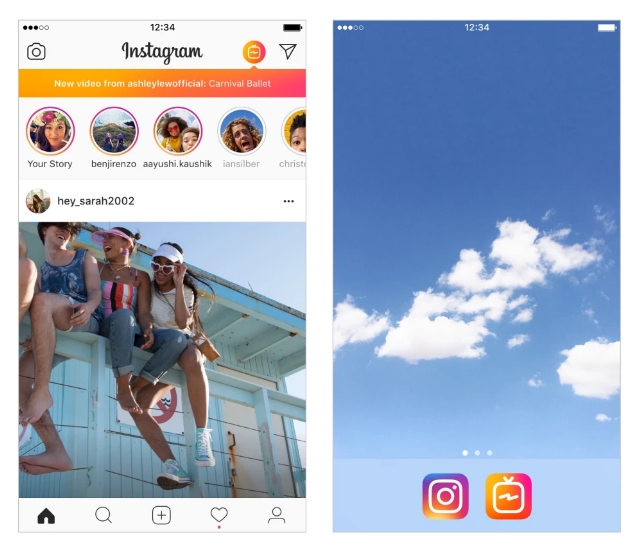
Instagram is betting big on long-form videos with a new video platform called “IGTV” which will show off videos up to an hour long. Until now, users were only allowed to upload videos up to one-minute-long, so this is a big upgrade for users.

While the feature is entirely accessible within Instagram’s app and web platform, Instagram is also launching a stand-alone app available on both iOS and Android devices today.

“We made it a dedicated app so you can tap on it and enjoy video without all the distraction,” CEO Kevin Systrom explained.

So far, indications are that Instagram “celebrities” will get most of the attention within the IGTV section on the Instagram app, but businesses can still get some use out of the ability to upload longer, more in-depth videos.

Businesses may also benefit from being able to curate their own Channels of content that users can subscribe to within IGTV. This way, they will be notified anytime you post a new video.

For now, Systrom said that IGTV is entirely-ad free, but it likely won’t last forever. Once it has established itself on Instagram’s platform, I’d expect ads to start appearing.

How to start your own IGTV Channel

Creating a channel is easy and can be done within the Instagram app.

Step 1: Tap the IGTV logo near the top-right corner of your Instagram home screen.

Step 2: Tap the gear icon on the bottom right of the screen.

Step 3: Select “Create Channel” at the bottom of the screen.

Step 4: After a brief introduction to IGTV, select “Next” on the following two screens. Then, tap “Create Channel.”

Step 5: Congratulations, your channel is officially active and you can start uploading videos to IGTV.

Instagram logo

Instagram is coming up in the world. This week the social network revealed it has reached more than 1 billion monthly active users, jumping from 800 million in September of last year.

The extra 200 million users also make the site the fastest growing social network around right now by a fair amount.

For context, while Facebook remains the biggest social network overall, its growth in monthly users has fallen to just 3.14%. Snapchat, trapped by its own niche market of younger users, is growing even slower at 2.13%.

Instagram, however, continues to grow by almost 5% from quarter-to-quarter.

There is certainly some irony in the latest numbers. While Snapchat continues to stall, Instagram is largely making its gains on the back of similar features like Stories and image stickers.

Stories, in particular, have taken off to surprising popularity. According to the latest numbers, there are more people posting Stories on Instagram than Snapchat’s entire userbase.

The continued growth of Instagram also hints at Facebook’s gradual disconnect with younger users. Teens and other young social media users are adopting Instagram, rather than signing into Facebook.

The social network still has plenty of hurdles in its path, but their user growth shows it may be worthwhile to establish a business presence on the platform sooner rather than later.

Facebook gives business page owners a lot of information that can be useful for growing your brand and increasing engagement with your business page. However, that information has been limited to just those using the desktop version of the site until recently.

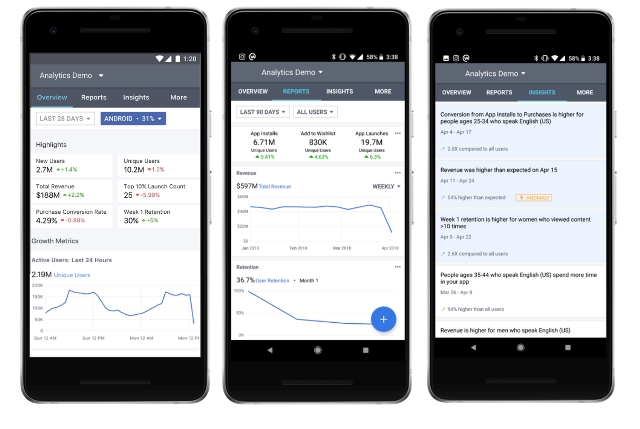
This week, Facebook introduced a new Analytics app capable of measuring your business page performance on the go.

The app, now available for both iOS and Android, includes all the major metrics you could hope for to keep an eye on your business page even when you’re away from the office or a desktop computer. You can also set up alerts to notify you when notable changes occur to your performance.

With the new Facebook Analytics app, you can:

  •  Check the metrics you care about most in a personalized overview tab.
  • Create dashboards with the reports you have saved on desktop.
  • Browse automated insights relevant to your business.
  • Get notifications about anomalies in your data.

You can download the Facebook Analytics app in the Apple App Store or Google Play.

Once you have it installed, you can get started monitoring your business page by logging in with your usual Facebook Analytics credentials.

If you’ve spent much time trying to promote your business on Facebook, you’ve probably recognized the social platform isn’t exactly the best at transparency.

There are a lot of questions about what exactly you can and can’t post, which made it even more frustrating that there was no way to appeal the decision if Facebook decided to remove your content for violating its hidden guidelines.

That is beginning to change, however. Likely thanks to months of criticism and controversy due to Facebook’s lack of transparency and it’s reckless handling of users’ data, Facebook has been making several big changes to increase transparency and regain people’s trust.

The latest move in this direction is the release of Facebook’s entire Community Standards guidelines available to the public for the first time in the company’s history.

These guidelines have been used internally for years to moderate comments, messages, and images posted by users for inappropriate content. A portion of the Community Standards was also leaked last year by The Guardian.

The 27-page long set of guidelines covers a wide range of topics, including bullying, violent threats, self-harm, nudity, and many others.

“These are issues in the real world,” said Monika Bickert, head of global policy management at Facebook, told a room full of reporters. “The community we have using Facebook and other large social media mirrors the community we have in the real world. So we’re realistic about that. The vast majority of people who come to Facebook come for very good reasons. But we know there will always be people who will try to post abusive content or engage in abusive behavior. This is our way of saying these things are not tolerated. Report them to us, and we’ll remove them.”

The guidelines also apply to every country where Facebook is currently available. As such, the guidelines are available in more than 40 languages.

The rules also apply to Facebook’s sister services like Instagram, however, there are some tweaks across the different platforms. For example, Instagram does not require users to share their real name.

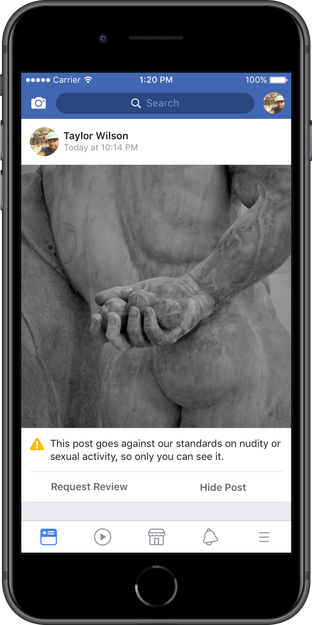
In addition to this release, Facebook is also introducing plans for an appeals process for takedowns made incorrectly. This will allow the company to address content that may be appropriate based on context surrounding the images.

If your content gets removed, Facebook will now personally notify you through your account. From there, you can choose to request a review, which will be conducted within 24 hours. If Facebook decides the takedown was enacted incorrectly, it will restore the post and notify you of the change.

One could argue social media has always been a popularity contest based on friend-counts and likes, but Pinterest is making it even more explicit thanks to some new changes to business profiles.

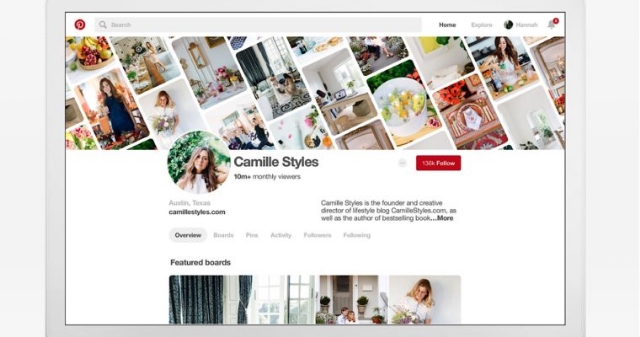
The most notable change is the addition of a monthly viewer statistic that can be seen by everyone, not just your account administrators. The feature will show the total number of people who saw your business’s pins over the past 30 days.

The addition of a view count is likely to provide a more reliable estimate of just how prominent a page is. While followers can easily be bought or acquired with bots, views are a little trickier to misrepresent.

However, many might say this gives an unfair advantage to businesses who advertise through promoted pins.

In addition to the view count, Pinterest is also introducing the ability for business profiles to include dynamic cover images that highlight specific content relevant to users. That can include individual pins or entire boards.

Pinterest says the changes will be rolling out over the next couple months, so keep your eyes out for more news about how monthly viewer statistics may affect your Pins.