It might not be a surprise to learn that Amazon dominates the search engine results pages, but you might be surprised by just how much they lead all other major brands.
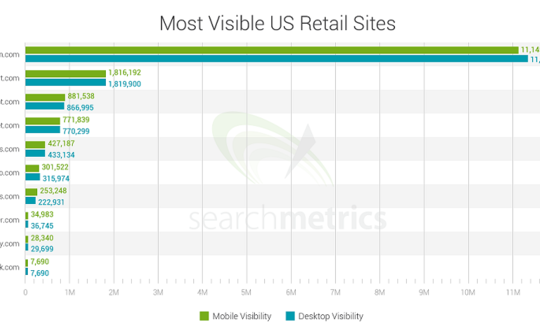
A recent performance study of 10 leading U.S. brands published by SearchMetrics makes it clear that Amazon has by far the most visibility across Google’s search results on both desktop and mobile.
In the study, SearchMetrics used the top 10 retail sites listed in the National Retail Federation’s list of top 100 retailers and parsed the search results of millions of Google search terms to establish a mobile visibility score along with a desktop visibility score.
To calculate the visibility score, the study evaluated the number of times a brand appears across a keyword set, the brand’s rankings within those search engine results pages, competitiveness of keywords, and the click through rate of those results pages.
Even compared to other major competitors, Amazon is an absolute giant. With the staggering rating of 11,145,359, the online retail company dwarfs Walmart, its closest competitor with a score of 1,816,192. Following Walmart were The Home Depot with 881,538, and Target.com, with a score of 771,839.
The focus of the study was mobile search, as it is most often the first touch point to purchase. However, the analysis also showed the rankings remain the same on desktop.
00Taylor Ballhttps://www.tulsamarketingonline.com/wp-content/uploads/2018/07/TMO-Logo.pngTaylor Ball2015-06-05 13:48:132015-06-05 13:48:13Amazon is The Most Visible Mobile Site In Google Search Results By Far
In less than 24 hours, we will all be living in a post-“Mobilegeddon” world. That means Google’s mobile friendly update will start rolling out tomorrow after months and months of rumors and hints. Normally Google doesn’t announce upcoming algorithm changes ahead of time – perhaps because it creates a panic – however this time the company gave webmasters plenty of time to make sure they are prepared.
Basically, the mobile friendly algorithm aims to make sure users who are searching with smartphones are only shown sites that are properly optimized for mobile devices.
Given that Google has been heavily implying this day would come for over a year, it is slightly surprising to see the number of panicked webmasters. Google has given brands every opportunity to ensure their sites are up to snuff, but Zineb Ait Bahaiji of Google’s Webmaster Trends team confirmed the algorithm will have the largest impact of any of Google’s recent algorithms.
Google’s Penguin and Panda algorithms are infamous for their impact on search results pages, but Bahaiji told the crowd at SMX Munich that the mobile algorithm would absolutely affect more than either animal-themed algorithms.
Panda affected 12% of search queries when it was released, while Penguin impacted 3.1% of queries.
If you are concerned your site isn’t prepared for the oncoming “Mobilegeddon”, check outourpreviouscoverage to see what you need to do to appease the search engine’s new algorithm. You can also check to see your site’s status by using Google’s mobile friendly testing tool.
Google is constantly making changes – both big and small – and the latest changes will affect how your site appears in the search results.
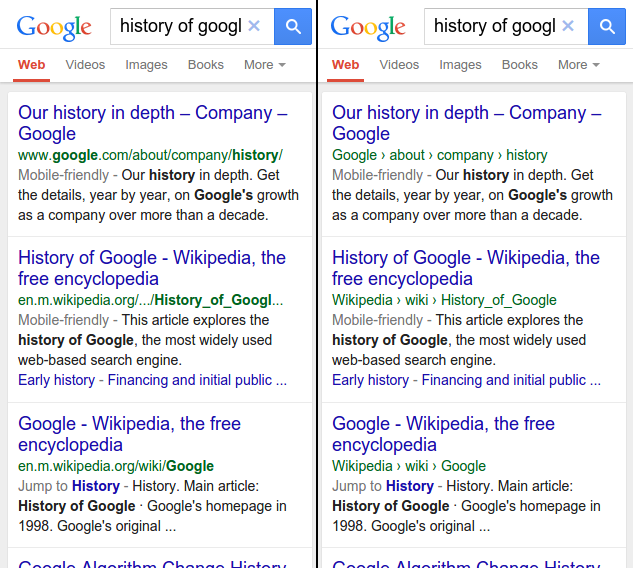
Yesterday Google announced it would be altering how URLs are shown on mobile search results. Well, altering isn’t the right word. More accurately, Google is completely removing URLs in favor of the “real world” name of the site.
Instead of showing the simple URL, the search engine will display the site’s location in a breadcrumbs-like format, as shown below:
As Google explains in their announcement, the change intends to make searching easier for users.
“To help mobile searchers understand your website better when we show it in the mobile search results, today we’re updating the algorithms that display URLs in the search results to better reflect the names of websites…”
The new style will be rolled out gradually and are exclusive to mobile search results. For now, the change will only be affecting the US, but will likely come to other countries in the near future.
If you want to keep control of how your site name is shown, there is a simple structured data markup set you can use.
Just use this structured data markup to tell Google’s algorithms exactly how you want your website name displayed.
00Taylor Ballhttps://www.tulsamarketingonline.com/wp-content/uploads/2018/07/TMO-Logo.pngTaylor Ball2015-04-17 14:13:552015-04-17 14:13:55Google Removes Mobile URLs in Favor of ‘Real World’ Name
Google’s upcoming mobile-friendly algorithm has webmasters panicking as the deadline fast approaches. As always, when there is fear there is also plenty of misinformation.
In particular, there is one myth going around which is stirring up quite a bit of trouble.
Google has attempted to be clear that their new mobile algorithm will demote pages that don’t pass a mobile-friendliness test when they might appear in mobile search results pages. Unfortunately, that is being misconstrued.
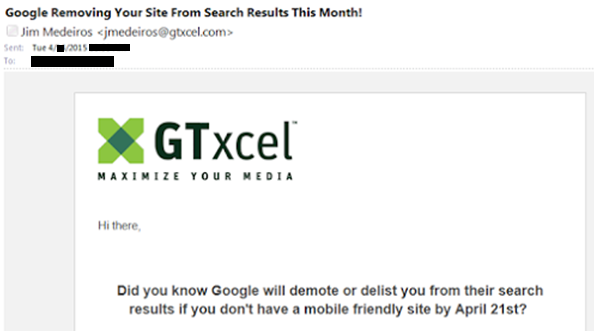
As Barry Schwartz shared, emails are going around proclaiming Google will be completely removing sites from search results if they don’t live up to the mobile standard. Not demoted, but completely de-listed and removed from Google.
The rumor was noticed when Ashley Berman Hale, an active personality in the Google Webmaster Help Channels, posted an email she recently received with the title “Google Removing Your Site From Search Results This Month!”
The copy of the email then goes on to say, “Did you know Google will demote or delist you from their search results if you don’t have a mobile friendly site by April 21st?”
Now, the mobile algorithm on the horizon is certainly controversial among webmasters, but there is no need to be spreading outright lies. Google’s initial announcement of the algorithm was relatively vague, but they have been working hard to make sure webmasters’ questions were getting answered. It also didn’t take long for many of the experts from Google to chime in and clear the air.
Google’s Gary Illyes posted a response on Twitter:
So I don't mind getting people motivated to go mobile friendly, but I do mind spreading false things. Not nice, guys https://t.co/0X0VxMQlIE
Google’s John Mueller also posted a short statement on Google+ to make matters perfectly clear:
It’s great to get people motivated to make their website mobile-friendly, but we’re not going to be removing sites from search just because they’re not mobile-friendly. You can test your pages & reach our documentation (including some simple tweaks that might work for your CMS too) at http://g.co/mobilefriendly
Hopefully this settles the matter once and for all. Google’s algorithm WILL demote your site on mobile search results, but it WILL NOT affect you on desktop search results or completely remove you from the listings.
00Taylor Ballhttps://www.tulsamarketingonline.com/wp-content/uploads/2018/07/TMO-Logo.pngTaylor Ball2015-04-15 13:56:412015-04-15 13:56:41Google Responds To Claims They Would De-list Non-Mobile Friendly Sites
Are we at peak Facebook? I hear that question all the time, with all sorts of statistics to suggest the social media giant is beginning to falter, but a new study by the Pew Research Center shows Facebook is standing strong.
The most commonly cited “sign” of Facebook’s demise is the falling rate of teens signing up for the service, but the new findings show Facebook is still the top social media platform for U.S. teens by a huge margin.
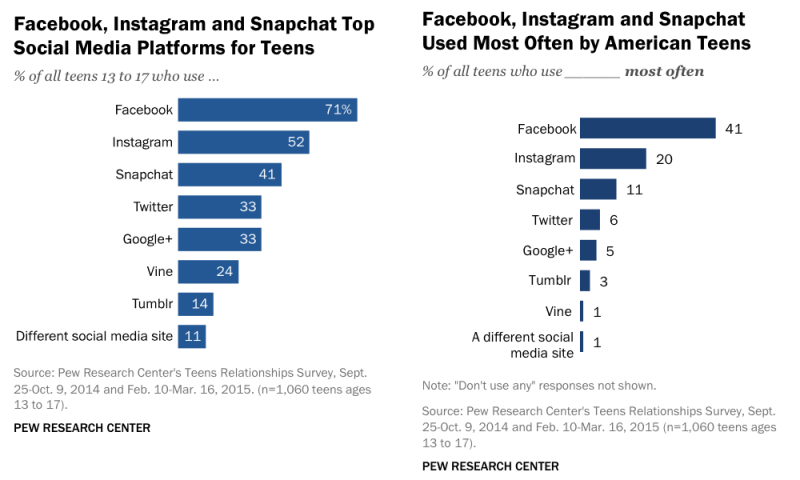
According to the Pew study, 71% of Americans between the ages of 13 and 17 use Facebook which is roughly equal to the percentage of U.S. adults using the service.
In fact, the biggest difference found between how teens use social media compared to their elders isn’t related to Facebook at all. The big differences is what other social media platforms they are using. Adults lean towards LinkedIn and Pinterest for their social networking, but teens are moving to more informal, content-based platforms such as Instagram and Snapchat.
Over 50% of the nationally representative sample of 1,060 individuals reported using Instagram, while 41% have adopted Snapchat. The only other platforms specifically included in the survey were Twitter (used by 33%), Google+ (33%), Vine (24%), and Tumblr (14%).
The survey did find a slight schism between younger and older teens, but the split is less clear than most predict. Facebook is more popular with older teens, while less than half (44%) of the 13 year olds reported using the network. Household income also seems to be a factor in social media use, as 77% of teens from families earning less than $50,000 annually reported using Facebook, compared to 68% of families who earn more.
The findings of the survey also had some interesting facts for the other social media platforms. For example, Instagram is more popular with girls by a long shot. Over 60% of girls reported using the photo and video sharing site, while only 44% of boys claim to have signed up for the service.
Less surprising for anyone are the findings that teens are in fact very active on the internet; 92% report going online daily, and 24% said they are connected “almost constantly.”
More than half of the teens (56%) go online several times a day, while 12% report once-a-day use, and only 6% report weekly use of the internet. Also of little surprise is the news that smartphones are driving this rise in teen online engagement. Of the 73% of teenagers with access to mobile phones, 94% go online at least once a day.
Perhaps the biggest finding from the study is that while Facebook may be in the lead, it does not have the monopoly it once had. Only one in five of the teens who use social network say they only use a single platform. Of those, Facebook was the most common single choice with 66%, while 13% use Google+, 13% use Instagram, and 3% use Snapchat.
00Taylor Ballhttps://www.tulsamarketingonline.com/wp-content/uploads/2018/07/TMO-Logo.pngTaylor Ball2015-04-10 12:19:102015-04-10 12:19:10Pew Study: Facebook Still The Leader Among Teens
You would think the sky is falling given how webmasters and online marketing experts are responding to Google’s huge upcoming mobile algorithm. Sites are tossing around all manner of terrifying nicknames such as the mobilepocalypse, mobilegeddon, mobocalypse, or mopocalypse to stir up fear and panic, but the truth is the upcoming update shouldn’t be all that scary for you.
If your site serves mobile users and you care at all about your customers, you should already have made efforts to make your site mobile-friendly. While a big ranking drop seems frightening, the truth is that mobile users are probably already avoiding your site. Don’t think of the upcoming change as being forced to change your site to please search engines. Thank of it as improving your site for mobile users.
Countless sites are talking about the “mobilepocalypse” as if the world is ending, but I’ve already covered the simple set of steps you need to take to check that your site is ready for the mobile update. If you aren’t passing Google’s mobile test, this infographic from Nine Hertz will walk you through what needs to be done before the 21st.
00Taylor Ballhttps://www.tulsamarketingonline.com/wp-content/uploads/2018/07/TMO-Logo.pngTaylor Ball2015-04-06 11:56:302015-04-06 11:56:30Don’t Fear The Google ‘Mobilepocalypse’ With This Infographic
Google’s upcoming mobile-friendly algorithm is fast approaching, and many webmasters have questions about exactly what they need to do to prepare their sites ahead of time. This was especially clear in a recent Google+ Webmaster Hangout which allowed some webmasters to directly ask Google employees all their lingering questions on the new mobile update.
There is a lot of good info to be found in the hangout, but I’ve collected some of the most important parts in case you don’t feel like sitting through the hour-long video.
Expect the Rollout to Last a Week
Initially, Google made it seem like the algorithm would be like turning on a switch, but it sounds like the rollout will actually be more similar to past algorithms. Current estimates say it could take up to a week to fully be implemented. Keep this in mind as you start monitoring your traffic starting the 21st.
There is No Grey Area
Your site is either mobile-friendly or it is not. There is no scale or middle ground. If you live up to Google’s criteria you will be considered mobile-friendly, and otherwise your site will be flagged until you make the necessary changes. Thankfully it is easy to know ahead of time if your site is ready for the rollout with a simple testing tool.
Google Yourself to See if You are Ready
Google’s testing tool is the official way to check your site’s status, but you can also see if your site is mobile-friendly with a simple search from your smartphone. According to the experts, if you see a grey “mobile-friendly” label next to your site in the listings, you are all set. On the other hand, if you don’t see that label you should probably get to work.
Common Mistakes
These tips follow a list of common mistakes websites make when going mobile-friendly, which Google recently published. If you aren’t seeing the “mobile-friendly” label, make sure to check out this list to guarantee you aren’t missing a small mistake.
00Taylor Ballhttps://www.tulsamarketingonline.com/wp-content/uploads/2018/07/TMO-Logo.pngTaylor Ball2015-03-31 13:29:572015-03-31 13:29:57Three Tips For Preparing Your Site For Google’s Mobile-Friendly Algorithm
Google has been heavy-handed in trying to woo Firefox users back to their search engine since Yahoo became the default search engine for the browser. It also appears to be working.
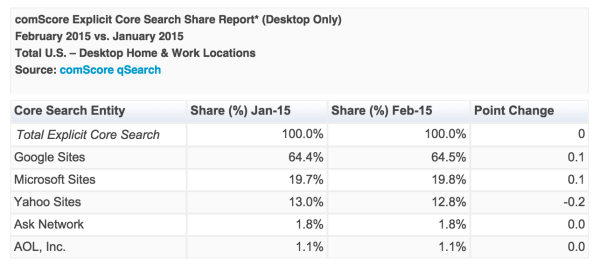
ComScore released the latest US search market share numbers for February and it seems Yahoo is gradually losing the gains they have made since they made a deal to become the default search engine for the browser and Google is reaping the benefits.
Since the switch over lost Google a small portion of users, Google has been practically begging users to make switch back. While there hasn’t been a mass exodus back to the motherland of Google, Yahoo is seemingly losing a slow but steady stream of users back to Google.
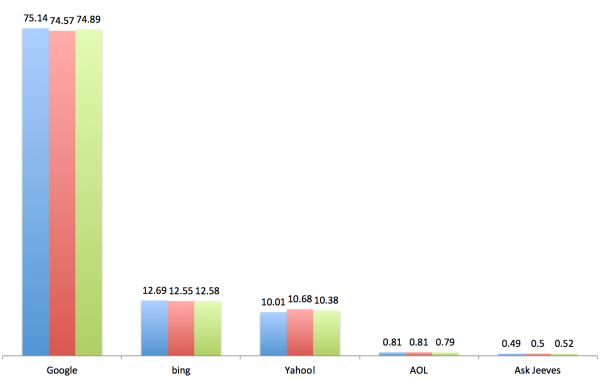
According to comScore’s report, Yahoo lost approximately 10 percent of its search volume from January to February, while Google recouped a tenth of a point along with Bing. This lines up with another recent report from StatCounter which also indicated a loss by Yahoo between January and February.
From the time Yahoo became the primary search engine to January, Yahoo had gained 1.2 points. Now Yahoo is still above their previous levels, but it has list .2 percent of those gains. The question is whether the trend continues.
It is important to note comScore’s numbers don’t include data from mobile searches, where Google is even more dominant.
00Taylor Ballhttps://www.tulsamarketingonline.com/wp-content/uploads/2018/07/TMO-Logo.pngTaylor Ball2015-03-19 12:44:242015-03-19 12:44:24Yahoo Loses Its Grasp as Google Regains Search Share After Mozilla Deal
The release of Google My Business was intended to make it easier for businesses to maintain a consistent appearance across all of Google’s services, but one feature was seriously lacking. While Google My Business allowed businesses to upload an image to their profile, the companies still had difficulty controlling which images would be used in various listings.
That is a serious problem when you are trying to establish a consistent brand presence online.
Today, Google announced a major update to Google my Business that finally gives companies some agency in their appearance across Google’s platform. As the announcement explains:
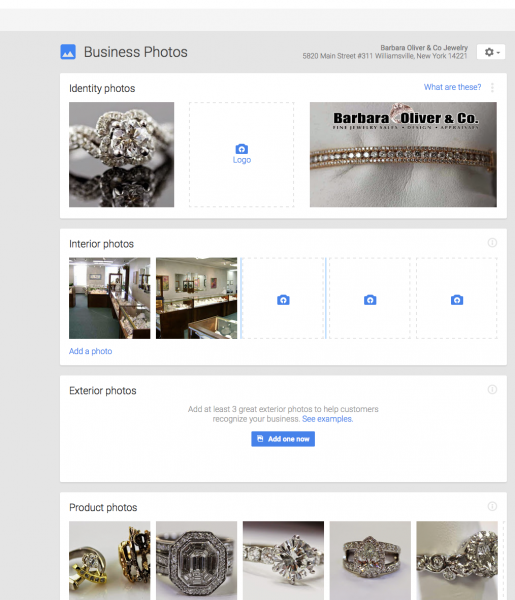
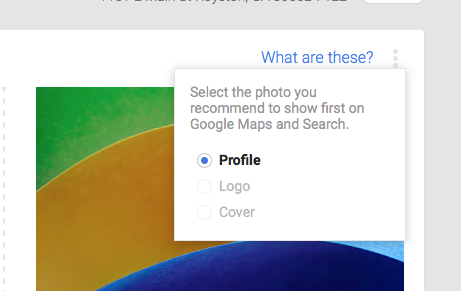
Starting today, you can tell us which image you’d like to appear when customers search for your business on Google. Just log in to Google My Business on the web or in the Android or iOS apps, and visit the Photos section. While you’re there, you can also give your business a fresh look online by updating your profile, logo and cover photos.
The upgrade unifies Google’s three interfaces for images into one simple interface. There is no longer any guesswork in making sure your brand is always presented how you want it on the search engine.
Google Help Files explains the best practices for uploading photos for your business:
Your photos will look best on Google if they meet the following standards:
Format: JPG, PNG, TIFF, BMP
Size: Between 10KB and 5MB
Minimum resolution: 250px on the longest side for profile & logo photos; 720px on the longest side for other business photos
Aspect ratio: The longer dimension of the photo should be no more than four times the shorter dimension. Landscape photos look better than portrait photos on Google products. Panoramic photos may use different aspect ratios.
Quality: The photo should be in focus, well-lit, have no photoshop alterations, and no excessive use of filters. The image should represent reality.
00Taylor Ballhttps://www.tulsamarketingonline.com/wp-content/uploads/2018/07/TMO-Logo.pngTaylor Ball2015-02-24 14:14:422015-02-24 14:14:42Upgrade Gives Businesses Control Over Their Images On Google
Google Webmaster Tools is usually the best friend for any webmaster trying to keep informed, but users have noticed the normally up-to-date service has not been updated in over a week.
The problem was noted by Search Engine Land last week and has been the main topic of conversation on the Webmaster Tools forums all weekend, but so far Google has no response.
The closest thing we have to a response comes from forum user ‘Kai Z’, who wrote “Known issue. […] Give it a few days to update/ return”. Normally forum posts like this wouldn’t carry much weight but it seems notable that Google webmaster trends analyst John Mueller marked this response as ‘best answer’. Naturally this has caused quite a bit of speculation but could potentially be meaningless.
The outage seems to line up with a similar issue in Google Analytics. Many users reported data in analytics was missing for Monday February 9, but Google that problem received a prompt response from Google on its product forums: “We’re sorry for our unusually bad case of the Mondays. We’ve fixed the issue and no data was lost. Analytics users should start seeing any missed [data] soon.”
Most likely the problem will be resolved fairly quickly, but the lack of transparency from Google on what is causing the lack of updating has caused some concern within the SEO community.
00Taylor Ballhttps://www.tulsamarketingonline.com/wp-content/uploads/2018/07/TMO-Logo.pngTaylor Ball2015-02-16 14:33:502015-02-16 14:33:50Google Webmaster Tools Is Missing Data and Google Isn’t Saying Why






 Google Webmaster Tools is usually the best friend for any webmaster trying to keep informed, but users have noticed the normally up-to-date service has not been updated in over a week.