Tag Archive for: search marketing

A recent analysis by Datos and SparkToro highlights major changes in how people are searching, largely driven by the widespread implementation of AI across Google’s search systems. 

A new study of data from millions of real users found a significant drop in how often people in the United States are making searches on Google compared to just a year previous. 

Despite Google’s user numbers remaining stable, data indicates that individual users are performing fewer searches – a trend that has significant implications for traffic to organic results, Google ads, and discoverability on search. 

What The Study Says

According to Datos and SparkToro’s report, the average number of desktop Google searches per person has dropped by nearly 20% year-over-year for U.S. users. Notably, this phenomenon is largely limited to American users, while Europe only saw a decline of about 2-3%. 

Despite this shift, the report says that the amount of traditional searches has remained largely stable over the past year, accounting for approximately 10% of all U.S. desktop activity. 

AI Overviews Credited With Reducing Searches Per User

Based on their analysis, Datos largely credits AI with changing how people are searching. 

The primary reason behind the change is that users are increasingly getting the information they need with fewer queries. It is believed this is because AI-powered results and instant answers reduce the need for follow-up searches. 

While repeat or follow-up searches have seen significant drops, searches that don’t typically result in a click to a website remain high, indicating people are still relying on Google to find information. They are just getting the information more quickly, and largely without clicking through to websites. 

While AI is largely credited with the shifts away from repeated searches or follow-up queries, the study emphasizes that users are largely avoiding dedicated AI search tools. Dedicated AI search tools currently account for less than 1% of total desktop activity in the U.S., and the study notes that Google’s “AI Mode” accounts for a tiny percentage of overall usage. 

Other Notable Findings

The report largely focuses on the shift in searches per user, but it mentions a few other notable changes in search behavior. 

Most significantly, Datos found that users are turning to longer, more complex queries to find the information they need. Specifically, users are more frequently using longer search phrases, typically between six to nine words, when searching. This means keywords are getting longer and shows that businesses should adapt the keywords they focus on accordingly. 

The report also shows that when people do click through to a website from Google’s search results, they are increasingly going to one of a handful of websites. Instead of varying search results, the majority of clicks are going to YouTube, Reddit, Amazon, and Facebook. 

The Takeaway

The sharp decline in searches per user in the U.S. reflects a new phase in search behavior. Increasingly, AI-powered instant answers are changing how users engage with search engines, often eliminating the need for multiple searches or clicks on external sites. For businesses, this means it is more crucial than ever to diversify the channels you are marketing on, rather than relying strictly on search to drive organic traffic.

For more, read the full report from Datos here.
The latest update to Google My Business’s listings makes product catalogs even more powerful by displaying them in both desktop and mobile search results.

Since October 2018, when they were first introduced, product catalogs on Google My Business would only appear in mobile search results.

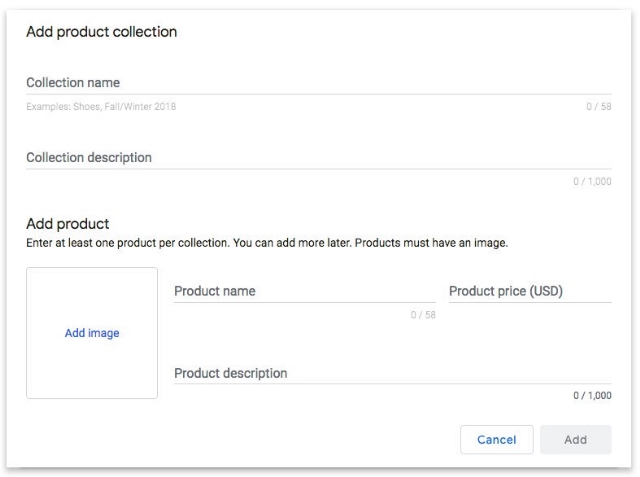
To add your products to your own listing, all you have to do is upload a form in the ‘Products’ tab called to the product editor. Once added, all items in your catalog will be eligible to show in results for relevant searches that bring up your Google My Business page.

The catalog appears within the ‘Products’ tab of your GMB listing shortly after uploading it.

As always, the new GMB feature is free to use with your Google My Business account. The only requirement is that you have claimed your business listing.

While the new feature does bring product catalogs to desktop search results, they are still not viewable directly within Google Maps. To view the listing from there, you will have to click to specifically view a business’s local listing.

untitled-design-27-700x400

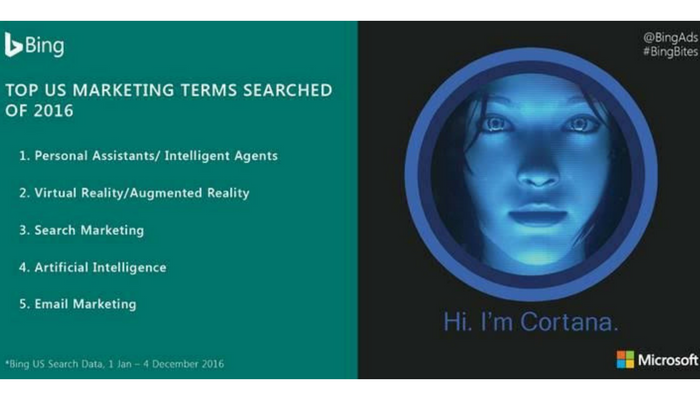
Bing has unveiled the top marketing keywords searched for throughout last year, based on their US search data. The new reveal sheds light on what people are thinking of and what the biggest upcoming trends are, with personal assistants beating out the competition.

”Personal assistants and artificial intelligence were a clear priority for marketers over the past year. Advances in chat bots and virtual assistants, such as Alexa, Cortana and Amazon Echo – as well as updates to several smartphone chat bots, were likely drivers for these search terms.”

Of course, Microsoft owns both Cortana and Bing, so it is possible that played a role in the high rank of personal assistants on the list. Still, the popularity of other services such as Siri and Alexa shows that virtual assistants are quickly becoming a major part of the tech and marketing landscape.

In addition to personal assistants, Bing says augmented reality and virtual reality are also poised to play a big role in marketing.

”Virtual and augmented reality came second to intelligence, with the popularity of searches representing the growth of this technology throughout 2016 – and it’s likely continual development into next year.”

Check out the rest of the top marketing search terms for 2016 below:

  1. Personal Assistants/ Intelligent Agents
  2. Virtual Reality/Augmented Reality
  3. Search Marketing
  4. Artificial Intelligence
  5. Email Marketing

bottraffic-incapsula-050115

The bad news is half or more of your website traffic likely comes from bots. The good news is that is actually a huge improvement from in the past.

A new report from Imperva Incapsula shows that approximately 48.5% of all traffic to websites comes from bots, not actual online users. That number comes from a review of over 19 billion visits to 35,000 Incapsula client websites around the world with a minimum daily traffic count of at least 10 human visitors gathered over a 90 day period in 2015.

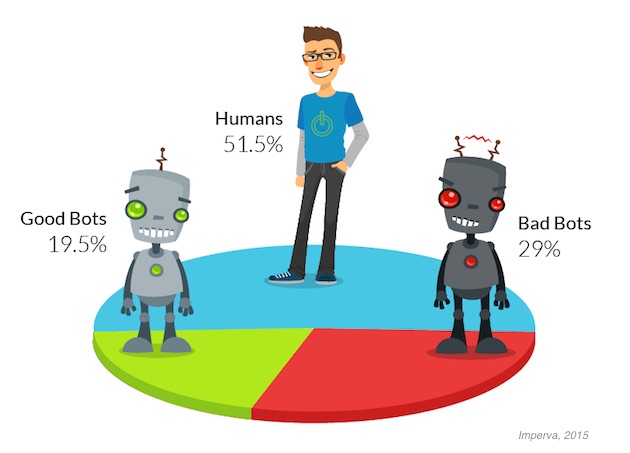
According to the data, 51.5% of all Web traffic comes from human users, while 29% come from “bad bots” which automate spam or other malicious activity, and 19.5% came from “good bots” which are used by search engines and other online services.

share-incapsula-050115

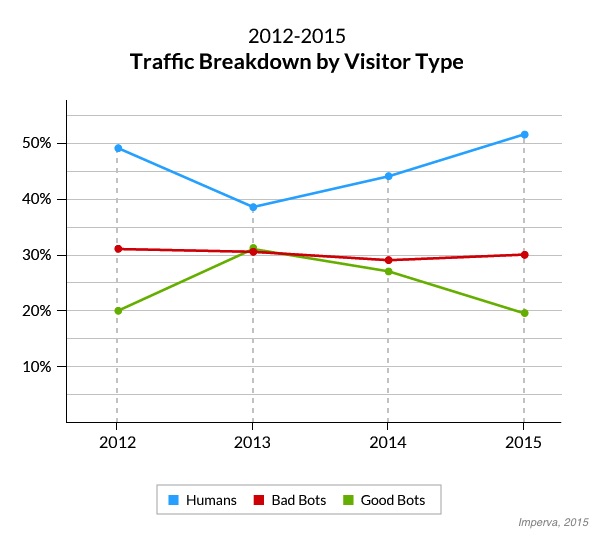
While this sounds bad, the share of human traffic is actually rising compared to past year. The report explains:

In a similar 2013 study conducted by Imperva, humans made up only 31.5% of all visits to sites, compared with 51.5% in 2015. This shift is mainly due to an increase in human traffic as more people use the Web and a decrease in good bot traffic.

size-incapsula-050115

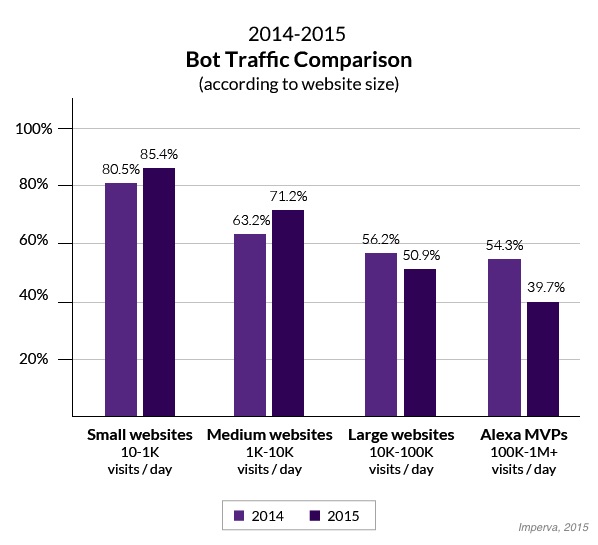
The ratio of bots-to-humans your website receives is likely influenced by how popular your site is, as the most popular sites examined showed the smallest ratio of bot traffic (39.7%). In comparison, the least popular sites included in the traffic had the highest share of bot traffic (85.4%).

No matter what percentage of your traffic comes to bots, the best solution is to continue emphasizing marketing that directly connects with real humans such as social media marketing and PPC.

BingLogo

As of January 1st, Bing is officially powering AOL’s search results as the result of a long-term deal made by the two companies in June of last year. Rick van der Kooi, Corporate VP of Microsoft Search Advertising announced the change, saying:

“Today, I am excited to share that as of Jan. 1, Bing powers AOL’s web, mobile, and tablet search, providing paid search ads and algorithmic organic search results to AOL’s properties worldwide.”

Van der Kooi also shared some interesting bits of information to help illustrate the scale of the partnership, including:

  • 1 in 5 searches happen on Bing.com
  • Bing also powers search results for the third largest search provider in the US (Yahoo)
  • With Bing now powering AOL searches, the engine now powers close to one-third of all US PC web searches.

The company looks to gain even more ground by acquiring the built-in audience from AOL, which is responsible for generating billions of search queries a year.

Unlike Bing’s deal with Yahoo, Bing’s will be powering 100% of AOL’s search results across all devices. In the Yahoo agreement, only 51% of Yahoo’s desktop search results are powered by Bing, with no support for mobile.

The latest research from the Interactive Advertising Bureau and Pricewaterhouse Coopers, which examines the first half of 2012, finds that the biggest contributor to online advertising in the U.S. continues to be spending on Search Marketing.

With 48% of all interactive advertising in the first half of the year, search ads brought in $8.1 billion.  It is also 19% higher than during the same period of 2011.

Performance pricing, usually cost-per-click, remains the dominant pricing model and has continued to get stronger.

For graphs of the data, visit Pamela Parker’s write up over at Search Engine Land.