Tag Archive for: News

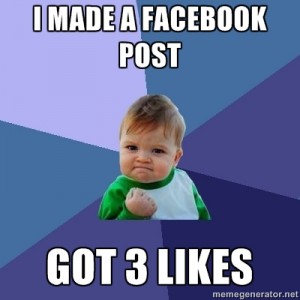
Facebook MemeWhen the news broke of Facebook’s updates to their News Feed, advertisers everywhere scrambled to analyze the changes. Well, it appears we got it a bit wrong. One of the most reported elements of the updates aimed at “rewarding high-quality content” focused on the supposed removal of memes from user feeds, but it doesn’t appear that is actually the case.

Facebook really is revamping how they judge the quality of the content they deliver to users, but Facebook’s News Feed Manager Lars Backman gave some insight to the changes and denies there is an attack on memes during a recent interview with AllThingsD. Instead, Backman says it is a broader effort “to provide user value” in the News Feed.

The most interesting aspect of the interview actually says Facebook isn’t differentiating different forms of content for the most part. As Backman told Peter Kafka:

Are you paying attention to the source of the content? Or is it solely the type of content?

Right now, it’s mostly oriented around the source. As we refine our approaches, we’ll start distinguishing more and more between different types of content. But, for right now, when we think about how we identify “high quality,” it’s mostly at the source level.

So something that comes from publisher X, you might consider high quality, and if it comes from publisher Y, it’s low quality?

Yes.

However, while this sums up Facebook’s approach overall, Backman did say there is a specific type of content they are trying to do away with, but it isn’t memes. Instead, Facebook is attacking the types of content that blatantly begs for likes or shares, such as Like this if you are having a good day!

So, when the text or photo has a call to action, those posts naturally do much better. And in a traditional feed ranking, where we’re evaluating just on the number of likes, those things all did very well.

In a way, Facebook is simply leveling the playing field, because those types of content offered very little to users aside from surface level interaction, but they were consistently doing very well on likes and shares which were making them more visible. However, if your user base responds well to the average meme, you shouldn’t be afraid to use them as a part of your content.

The holiday shopping season is currently at a fever pitch, where it will likely stay until Dec. 26th, and more and more consumers are using the internet to aid their purchases. Online shopping isn’t new, but the prevalence of smartphones has made it easier than ever to turn to the internet to find what you need and shoppers aren’t shy about consulting the web before any purchase.

But, how does this affect shopping patterns and what are these consumers looking for exactly? If your brand is online, chances are you want to capitalize on the huge amount of online shoppers both at home and those using their smartphones while they shop. Unfortunately, a new survey from Search Engine Land and SurveyMonkey suggests this may be harder for smaller brands to do than anticipated.

It shouldn’t come as any surprise that many online shoppers are looking for well known brands, but it might raise your eyebrows to learn it is the most important factor to many shoppers. The survey conducted on November 21-22 of this year shows that 70% of shoppers are focused on finding brands they are already familiar with. The only other factor which received over 50% of the response was free shopping.

The good news is this doesn’t spell the end for local businesses trying to grow their brand during the commerce season. Location and reviews still made a strong showing in the results, as did sales. Many shoppers also focused on retailers who offer images and easily viewable prices for their products.

Smaller brands can also take some solace in knowing the survey was limited to a relatively small sample size of roughly 400 Americans using SurveyMonkey Audience. You can see a chart of the results below.

Online Shopping Survey Graphic

Source: Search Engine Land / SurveyMonkey

Paid ads on social media are becoming more and more prevalent, to the extent that Facebook finally admitted recently that businesses will be practically forced to pay for brand outreach on their platform. Which makes it so surprising that Google+ had, until recently, strayed away from paid advertising. But, the search engine giant may have had an ace up their sleeve this entire time as they have recently unveiled their form of promoted posts, called “+Post” and it is a doozy.

Most aspects of +Post are extactly what you have come to expect from paid advertising on social networks. A brand pays for priumium placement of a post, and more users are shown the ad. It is a simple model which has worked for numerous other social media platforms. What makes +Post different is where the ads will be shown.

The majority of social media networks are only able to show promoted posts on their social media platform. Facebook promoted posts show up in your Newsfeed, “Promoted Pins” will be appearing on Pinterest soon, and Instagram is rolling out their own curated form of promoted posting to ensure ads fit their market and the style of Instagram. But, Google+ is connected to something much larger: all of Google’s network and products. So, +Post will have a massively larger reach than other social networks’ forms of paid advertising.

As Google explains:

+Post ads amplify your brand’s content by easily turning Google+ posts into display ads that run across the web. The live, social ad format allows you to go beyond clicks to live conversations with your audience. People can join a Hangout On Air, add a comment, follow your brand or give a +1, right from an ad.

+Post Screenshot

This is an incredibly smart move for the search engine, as Google+ is still struggling to find a larger active user base, and the advertising model may drive more users to their social platform. The +Post ads act like regular posts in Google+ no matter where they are displayed, which effectively bleeds Google+ into all other aspects of Google (more so than before).

In Google’s own words:

Ads become more relevant with social context. Comments, +1s, and shares from friends can move people to engage with your ad. Social actions on ads and Google+ add up together, showing the full picture of engagement with your content. +Post ads expand in a lightbox to bring full screen social creatives across the web.

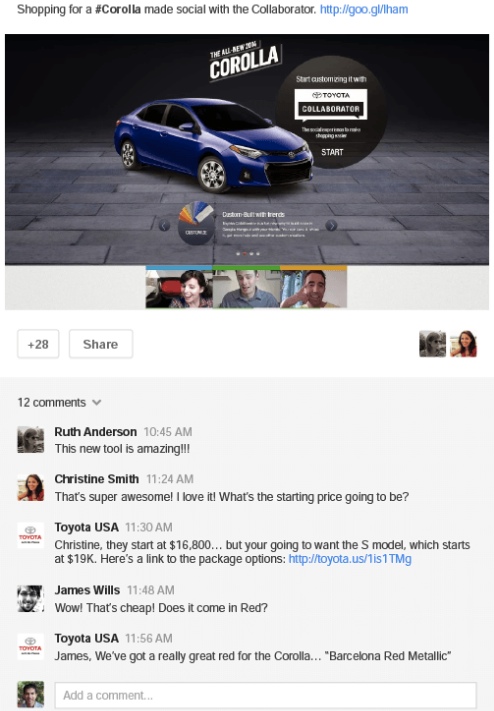
Jessica Lee from Search Engine Watch reports a few brands have gotten to try out +Post before the announcement, specifically Toyota who was used for Google’s promo video:

http://youtu.be/4yCUgx7H2zo

Hacker Code

Social media users around the world have reason to be concerned as nearly two million login credentials have been found online by security researchers this week. The credentials included those for the largest social media platforms including Facebook, Google, Yahoo, LinkedIn, and Twitter.

Researchers from Trustwave’s SpiderLabs division posted a blog post reporting the information they found online after using the source code of a botnet controller, a controller for a collection of internet-connected programs, called Pony.

With that data the researchers were able to trace information connected to data-stealing capabilities and they discovered a massive collection of passwords from many of the biggest websites and social media services. In total 1.58 million website login details were stolen, along with 320,000 email account credentials, 41,000 FTP logins, and 3,000 Remote Desktop credentials.

The researchers believe the attack came from the Netherlands, based on a proxy server there which was operating as an intermediary between infected machines and the overseeing command-and-control server botnet.

“This technique of using a reverse proxy is commonly used by attackers in order to prevent the command-and-control server from being discovered and shut down. Outgoing traffic from an infected machine only shows a connection to the proxy server, which is easily replaceable in case it is taken down,” they wrote.

“While this behaviour is interesting in and of itself, it does prevent us from learning more about the targeted countries in this attack, if there were any.”

While they were at it, the researchers took the time to analyze the data and see what the most common passwords were. The results are depressingly unsurprising.

The most used password was the standard 123456 password, with 15,820 accounts using the simple code. The second and third most used passwords were variations on this, with 123456789 and 1234 filling the respective slots. ‘Password’ was the fourth most common password, and 12345 came in fifth. Sadly, it seems many will never learn to start using more difficult passwords.

Google is making it easier for webmasters to identify and address smartphone specific errors they might not have known about in the past. Previously, detecting and fixing errors that happen on smartphone errors was complicated, so the search engine added a section to the crawl errors report in Webmaster Tools that displays the more common errors Google sees webmasters make in regards to how mobile users access their site.

Pierre Far, Google Webmaster Trends Analyst announced the feature earlier today, saying that some of the errors may “significantly hurt your website’s user experience and are the basis of some of our recently-announced ranking changes for smartphone search results.” While Google is trying to help make it easier for webmasters to solve problems with their site, the search engine is also using this as another means to push webmasters towards making their sites more mobile friendly.

The new report for smartphone errors looks like this:

Smartphone Errors

Some of the errors included are:

  • Server errors: A server error is when Googlebot got an HTTP error status code when it crawled the page.
  • Not found errors and soft 404’s: A page can show a “not found” message to Googlebot, either by returning an HTTP 404 status code or when the page is detected as a soft error page.
  • Faulty redirects: A faulty redirect is a smartphone-specific error that occurs when a desktop page redirects smartphone users to a page that is not relevant to their query. A typical example is when all pages on the desktop site redirect smartphone users to the homepage of the smartphone-optimized site.
  • Blocked URLs: A blocked URL is when the site’s robots.txt explicitly disallows crawling by Googlebot for smartphones. Typically, such smartphone-specific robots.txt disallow directives are erroneous. You should investigate your server configuration if you see blocked URLs reported in Webmaster Tools.

Not only are these errors capable of ruining the user experience for visitors on mobile devices, they can severely damage your site’s visibility if you don’t resolve the issues quickly. At least now there is a convenient way for you to find the problems.

No More MemesYesterday Facebook announced some pretty major changed to their News Feed. Specifically, clicking an article may not show up to three related articles, and new comments on a story you’ve already seen can “bump” that story back into your feed as it is made relevant again. Lastly, they are going to begin policing the “meme” content to an extent, especially on mobile.

While the first two changes have received significantly more attention by marketers, the new meme policy will likely have the biggest immediate impact for companies still using the image marketing practices widely preached just a year ago.

Image marketing on Facebook refers to the practice of sharing content by posting a picture with a link in the comment, rather than using the more standard link post. This lead to many marketers using lighthearted and sometimes confusing memes while underhandedly also sharing their content. This type of practice has been slowly being dismantled for the past few months, ever since Facebook changed how prominently Link posts were shown in the News Feed. Before that update, image posts were shown with much more prominent display size, so it was a ripe target for abuse.

Now that Facebook is targeting memes it is pretty clear that the old image marketing practices are outdated and it makes more sense to simply follow the more common link marketing practices. Not only is it a more honest approach to serving content to your visitors, but Facebook is going to show you favor.

As Greg Finn from Marketing Land explains, Facebook has gone “all in” regarding turning their social media platform into a more focused news source. A recent study has shown that 1 out of 3 Americans now use Facebook as a news source, and Facebook seems determined to put a heavy emphasis on that mode of usage for their site. Looking forward, the only way to stay ahead of their changes is to focus on delivering your audience the best quality content you can create.

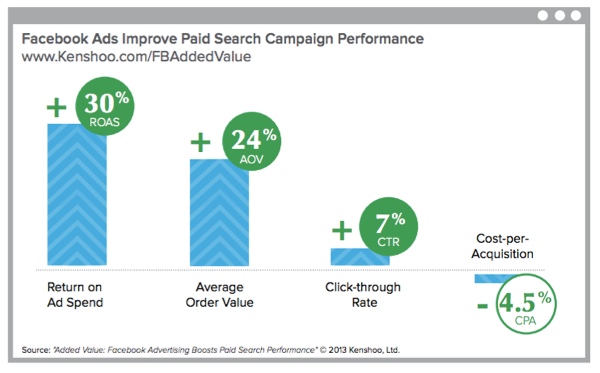
Marketing has become a holistic practice. You can’t just focus on one channel and expect to have the impact that those who are using every method to connect with the public are getting. For online marketing this means you can’t rely on just SEO or PPC to get the visibility you want. A new study from the digital marketing tech company Kenshoo proves this point by showing that marketers using social advertising and paid ads together see better conversion rates than those who only use a single channel.

In what Search Engine Watch reports to be the first study of its kind, Kenshoo discovered that when a person was exposed to both a brand’s Facebook ads and paid search ads, there was a 30 percent more return on advertising spending than when a person was only exposed to paid search ads exclusively.

“The fact that Facebook advertising on its own during this study was declared a successful initiative and had such a strong impact on paid search is indicative of the power of the platform,” Kenshoo said in its report.

Kenshoo PPC and Social Ads Report

“If marketers only had one Key Performance Indicator (KPI) to compare media channels, the metric of choice would be ROAS [return on ad spend], which is calculated as Revenue/Cost. For example, if an advertiser spent $20 and generated $100 in sales it had a 5x ROAS. Even media with different conversion goals can be easily evaluated based on how much it returned versus how much it spent.”

Kenshoo also noted that click-through rate improved along with returns on ad spending. Paid ads saw a 7 percent increase in CTRs when a person had seen both Facebook and PPC ads, “indicating that social advertising was able to positively impact consumer awareness and perception of the brand.”

When combined, search and social advertising also resulted in 4.5 percent lower cost per acquisition, according to Kenshoo.

“On the surface, 4.5 percent may not seem significant when compared to some of the other high numbers reported in this study,” Kenshoo said, “yet ask any advertiser if they could lower their costs to bring in orders by this amount and they would all jump at the opportunity.”

Google's John Mueller Courtesy of Google+

John Mueller

Recently I discussed a common issue sites have where a misplaced noindex tag on the front page of a site can keep search engines from crawling or indexing your site. It happens all the time, but it isn’t the only reason your site might not be crawled. The good news is there is little to no long term damage done to your site or your SEO, according to a recent statement from Google’s John Mueller.

Barry Schwartz noticed Mueller had responded to a question on the Google Webmaster Help forums from an employee for a company who had accidentally blocked GoogleBot from crawling and indexing their site. In John Mueller’s words:

From our point of view, once we’re able to recrawl and reprocess your URLs, they’ll re-appear in our search results. There’s generally no long-term damage caused by an outage like this, but it might take a bit of time for things to get back to “normal” again (with the caveat that our algorithms change over time, so the current “normal” may not be the same state as it was before).

So don’t worry to much if you discover you find your site has been having problems with crawling or indexing. What matters is how quickly you respond and fix the problem. Once the issue is solved, everything should return to relatively normal. Of course, as Mueller mentions, you might not return back to your exact same state because these things are always fluctuating.

Local SEO Infographic Banner

It constantly surprises me how many local businesses don’t believe in investing in proper online marketing and optimization. Given, I see every day how establishing a quality online presence and optimizing it for higher visibility can benefit a business. Still, many local businesses hold the conception that online marketing is only important for national level businesses, and they couldn’t be more wrong.

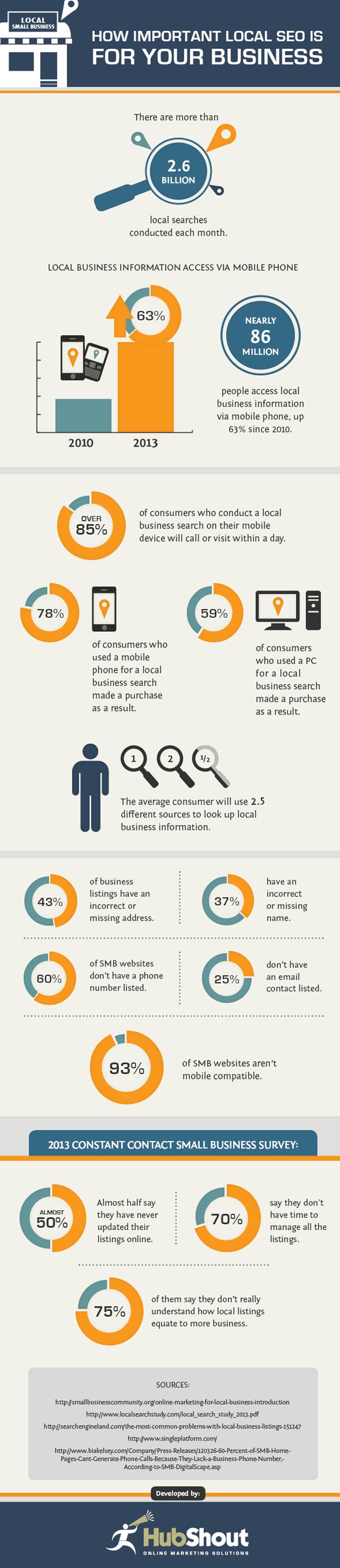
Current estimates say that more than 2.6 billion local searches are conducted every month. More importantly, statistics show that these local searchers are becoming more and more mobilized to quickly go from search to purchase thanks to the use of smartphones to search on the go. Nearly 86 million people are regularly using their mobile phones to look up local business information, and these searchers are highly primed to convert. Simply put, without an online presence and the optimization to make your brand visible you are missing out on a large chunk of potential customers.

Hubshout recently created an infographic to illustrate how important local search engine optimization (SEO) really is for your business. Not only does the infographic show what you are missing out on by neglecting your online presence, it also shows how many many businesses have yet to establish themselves online in a meaningful way. There is still a lot of untapped opportunity online, you just have to make the leap.

Local SEO Infographic

Source: Hubshout


googleadwordsYou may have noticed earlier this month that the AdWords Bid Simulator tool has a new feature which offers estimates for conversions in addition to impressions and clicks to show how bid changes may affect conversion volume and values.

For each bid option that appears in the tool, the bid simulator gives the number of conversions and conversion values if assigned or set. As Ginny Marvin explains, conversion estimates display how many clicks you would likely result in a conversion in one day, based on a “recent 7 day period.” Notably, Google does not say their estimates will be based on the most recent 7 days.

Google says the estimates will be more accurate if you have more conversion history and conversion volume in your account, so you will want to have conversion tracking set up and stable for a couple weeks before you start trying to use the bid simulator conversion estimates.