Google’s Carousel may seem new to most searchers, but it has actually been rolling out since June. That means enough time has past for marketing and search analysts to really start digging in to see what makes the carousel tick.

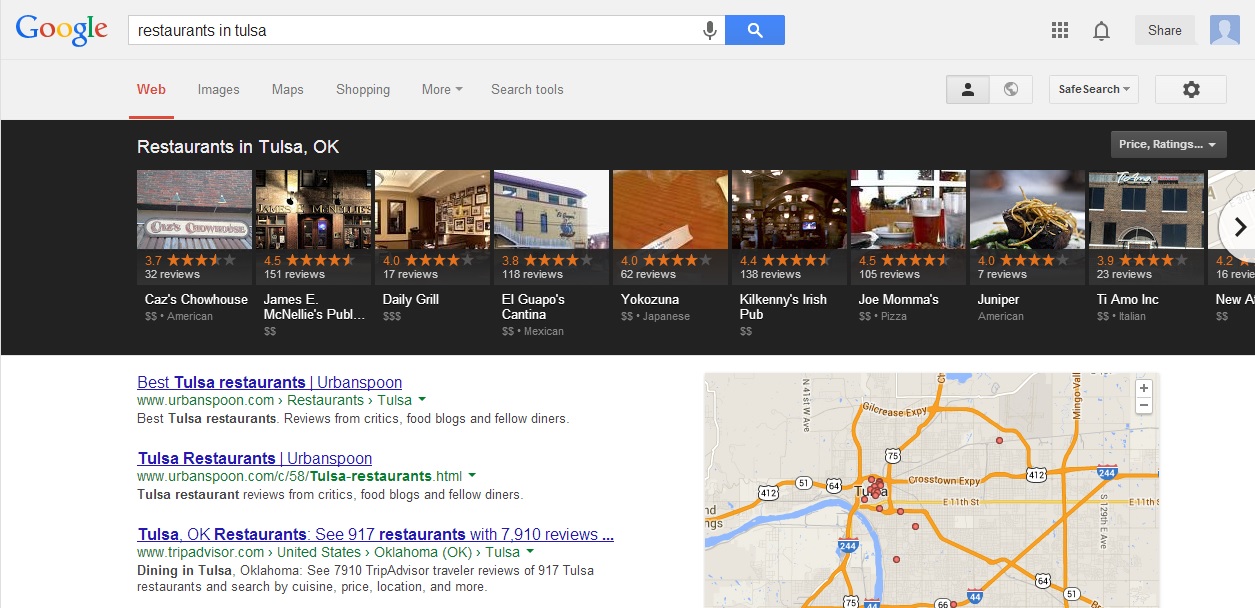
If you’ve yet to encounter it, the carousel is a black bar filled with listings that runs along the top of the screen for specific searches, especially those that are location based or for local businesses such as hotels and restaurants. The carousel includes images, the businesses’ addresses, and aggregated review ratings all readily available at the top, in an order that seems less hierarchical than the “10 pack” listings previously used for local searches.

Up until now, we’ve only had been able to guess how these listings were decided based on surface level observations. But, this week Digital Marketing Works (DMW) published a study which finally gives us a peak under the hood and shows how businesses may be able to take some control of their place in the carousel. Amanda DiSilvestro explains the process used for the study:

  • They examined more than 4,500 search results in the category of hotels in 47 US cities and made sure that each SERP featured a carousel result.
  • For each of the top 10 hotels found on each search, they collected the name, rating, quantity of reviews, travel time from the hotel to the searched city, and the rank displayed in the carousel.
  • They used (equally) hotel search terms—hotels in [city]; best hotels in [city]; downtown [city] hotels; cheap hotels in [city].
  • This earned them nearly 42,000 data points on approximately 19,000 unique hotels.
  • They looked at the correlation between a hotel’s rank in a search result based on all of the factors discussed in step 1 to determine which were the most influential.

Their report goes into detail on many of the smaller factors that play a role, but DMW’s biggest findings were on the four big factors which determine which businesses are shown in the carousel and where they are placed.

1. Google Reviews – The factor which correlated the most with the best placement in the carousel were by far Google review ratings. Both quantity and quality of reviews clearly play a big role in Google’s placement of local businesses and marketers should be sure to pay attention to reviews moving forward. However, it is unclear how Google is handling paid or fake reviews, so many might be inspired to try to rig their reviews. For long-term success, I would suggest otherwise.

2. Location, Location, Location – Seeing as how the Google Carousel seems built around local businesses, it shouldn’t be a surprise that location does matter quite a bit. Of the 1,900 hotels in the study, 50 percent were within 2 miles of the search destination, while 75 percent were within 13 minutes of travel. Businesses would benefit from urging customers to search for specific landmarks or areas of cities, as you never know exactly where Google will establish the city “center”.

3. Search Relevancy and Wording – According to the findings, Google seems to change the weight of different ranking factors depending upon the actual search. For example, searching “downtown [city] hotels” will result in listings with an emphasis on location, while “best hotels in [city]” gives results most dependent on review rankings.

4. Primary Markets and Secondary Markets – It seems both small and larger businesses are on a relatively flat playing field when it comes to the carousel. Many small hotels are able to make it into the listings, right next to huge chains. The bigger businesses may have more capabilities to solicit reviews, but no hotel is too small to be considered for the carousel.
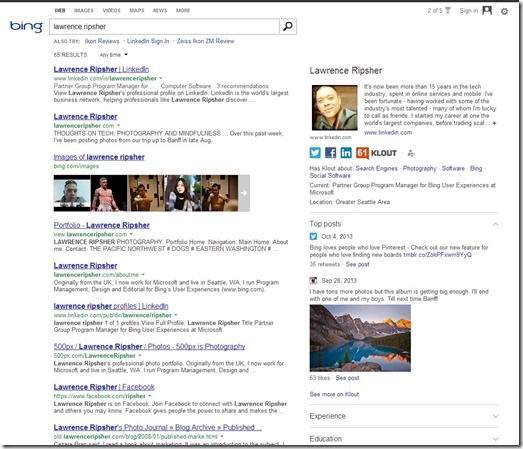
Bing gave people more control over what shows up about them online last week when they partnered with Klout to create Bing Personal Snapshots. Personal Snapshots are an extension of the previously implemented People Snapshots, but it functions to give you some say in how you appear within the Snapshot column on Bing.

Bing and other search engines are one of the most common ways to find information about people, but those search engines usually gather that information from social media, which isn’t always full of information we want displayed to everyone who searches our names.

These new Personal Snapshots allows you to ensure the information you want displayed is shown while your more personal or embarrassing details can be withheld.

This works by allowing users to sign up for Klout and claim a profile, which Bing will then connect to your social networking profiles. From there, you’ll have some ability to manage your digital appearance and persona. The update will also allow Bing to show your most influential moments from social media within the same bar, along with a verified badge.

This isn’t total control over your online identity, but the change gives more power over your online presence than previously available.

If you don’t have a profile with Klout already, you should be aware that it is a social ranking website which relies on analytics to evaluate individuals’ online influence over social networks.

Leave it to Matt Cutts to always be there to clear the air when there is an issue causing some webmasters confusion. One webmaster, Peter, asked Matt Cutts whether geo-detecting techniques is actually against Google’s policies, as it is common for websites to be designed so that users are given the information (price, USPs) most relevant to their lives based on geo-location.

In some understandings of Google’s policies, this may be against the rules, but it turns out all is fine, so long as you avoid one issue.

In one of his Webmaster Chat videos, Cutts explained that directing users to a version of a site, or delivering specific information based on location are not spammy or against Google’s policies. It only makes sense to offer viewers information that actually applies to their lives.

What Google does consider spam is directing their crawlers or GoogleBot to a web page of content that users cannot see. Sending GoogleBot to a different location that what visitors see is a bad idea, which is considered spam or a form of cloaking. Instead, treat GoogleBot as you would any user, by checking the location information and sending the crawler to the normal page reflecting that data.

Most of the changes we see to Google are relatively minor. The average user might notice that the layout is a little different, or the ads are in a new place, but in general most of the massive changes to Google occur under the hood, in their search ranking and spam fighting algorithms. But, as you’ve probably seen by now, Google Carousel is Google’s latest update, and it is a fairly substantial change to how Google users see results.

The carousel is a row of images across the top of some search engine result pages (SERPs) laid on top of a black background. At the moment, the carousel contains up to 20 results, and it appears mainly on SERPs for travel, hospitality, or restaurant related searches. However, the carousel has also sporadically been appearing on queries for sports, entertainment, and education, suggesting the future directions the carousel may be expanding in.

Instead of getting what was called the 6- or 10-pack, users get these images as well as review ratings, property name, and address. To compliment the new carousel you also see the usual sponsored links you often get for other searches. Interestingly, the variation of terms for which the carousel appears seems to be random. Jim Yu from Search Engine Watch notes that a search for “hotels near disneyland” gets the carousel, while “disneyland hotels” did not.

The first bit of good news for search marketing professionals is that all of the results included in the carousel are essentially all in the first spot. Of course the majority of viewers will likely view the results from left to right, but they are not visually ranked in the same manner they were before.

The other good news is that the Google Carousel opens up numerous opportunities for local businesses to strengthen their brand online. BrightEdge research reported that the carousel currently affects 14 percent of keywords across all industries, with travel and hospitality being the most affected.

Restaurants are also highly impacted by the new layout, while entertainment terms only get the carousel for five percent of searches. Clearly, those most affected are also those with the most to gain: local businesses.
There are a few things you can do to ensure you’re business gets into the carousel for relevant searches in your area, and to be sure to beat the other competition within the listings. Yu suggests:

  • Set up a Google Places for Business and Google+ page. You can visit this post to learn more about the most important aspects of both services, and understand how to merge the two types of pages for a single business.
  • Make sure images for your pages are high resolution, unique, and up to date. Keep them sorted in terms of priority, so that users will see the images you want them to first.
  • Encourage happy customers to review your business on Google. Not only will it help you gain conversions online, research has shown it plays a large role in getting your business in the carousel.

SpeedometerHave you noticed a difference using Google on your smartphone this past week? Last week Ilya Grigorik, a Google developer advocate, announced Google was making a tiny tweak which should speed up mobile search on both Safari and Chrome by 200-400 milliseconds.
The company implemented an attribute called <a ping>, which allows them to basically do the click tracking and redirect practically at the same time, as Barry Schwartz explained.

You might not actually be experiencing search with the change, since Google is “gradually rolling out this improvement to all browsers that support the <a ping> attribute.” Grigorik also took the time to explain exactly how the change works:

What’s the benefit? Whenever the user clicks on a result, typically they are first sent to a Google URL redirector and then to the target site. With <a ping>, the click is tracked using an asynchronous call, meaning that the user sees one less redirect and a faster overall experience!

It remains incredibly unclear what Google’s thoughts or plans are for PageRank, as Matt Cutts, Google’s head of search spam, commented on Twitter yesterday that there won’t be any updates to PageRank or the toolbar anytime before 2014.

Neils Bosch asked the esteemed Google engineer whether there would be an update before next year, to which Cutts responded, “I would be surprised if that happened.”

According to Search Engine Land, it has been over 8 months since the last Google Toolbar PageRank update, back on February 4, 2013. Many have proclaimed the toolbar dead, but Cutts has personally defended the toolbar on a Webmaster chat within the past year, and said the toolbar won’t be going away.

However, as Cutts himself explained, Chrome doesn’t have a PageRank extension, Google dropped support for Firefox in 2011, and Internet Explorer 10 doesn’t support toolbar extensions. It seems clear there will be less and less of an audience for the toolbar, so its relevancy and use will likely taper off until it just kind of disappears.

It is always possible that Google might put out a surprise update next year, but don’t expect PageRank to be around forever.

Do you remember last year when Bing aggressively marketed their “Bing It On” challenge? Back then, Bing also made the claim that searchers prefered Bing in the blind test 2:1. Now, a recent study from the “Freakonomics” blog harshly disputes Bing’s claims as well as strongly critiquing their marketing of the study as possibly constituting deceptive advertising.

Law and economics professor Ian Ayers explained the study and says the claims made by Bing came from a small sample of only 1,000 participants, too few to be a reliable sample of the population. He attempted to replicate the study at Yale Law School where he teaches:

I set up a similar-sized experiment using Microsoft’s own BingItOn.com site to see which search engine users prefer. We found that, to the contrary of Microsoft’s claim, 53 percent of subjects preferred Google and 41 percent Bing (6 percent of results were “ties”)…

The thing is the results of this study still aren’t too bad for Bing. Yes, it shows that Bing’s claims may have been disingenuous, and Google could very possibly still be the more favored search engine. However, Bing still came out with a very respectable number of people favoring their search engine. This could be a sign that Bing could very feasibly grow their market share further than they have. They currently take 18 percent of the market, compared to Google’s static 67 percent.

Of course, Microsoft has responded to the study already. They issued a formal statement from Matt Wallaert, behavioral scientist at Bing, which read:

The professor’s analysis is flawed and based on an incomplete understanding of both the claims and the Challenge. The Bing It On claim is 100% accurate and we’re glad to see we’ve nudged Google into improving their results. Bing it On is intended to be a lightweight way to challenge peoples’ assumptions about which search engine actually provides the best results. Given our share gains, it’s clear that people are recognizing our quality and unique approach to what has been a relatively static space dominated by a single service.

There was also a much more extensive response to the Ayers study in the form of a post on the Bing Blog.

And of course, Matt Cutts from Google couldn’t help but share his two cents on Google+:

Freakonomics looked into Microsoft’s “Bing It On” challenge. From the blog post: “tests indicate that Microsoft selected suggested search words that it knew were more likely to produce Bing-preferring results. …. The upshot: Several of Microsoft’s claims are a little fishy. Or to put the conclusion more formally, we think that Google has a colorable deceptive advertising claim.”

I have to admit that I never bothered to debunk the Bing It On challenge, because the flaws (small sample size; bias in query selection; stripping out features of Google like geolocation, personalization, and Knowledge Graph; wording of the site; selective rematches) were pretty obvious.

So yes, Bing’s study had a fair amount of problems, and their critics seem poised to take action about deceptive marketing, but there is an upshot for Bing. The search engine still performed very well in the results and could gain a fair amount of searchers in the future. But, it also confirms something Bing may have been more worried about. As Greg Sterling points out, “the Google brand and not necessarily search quality is now what sustains Google’s dominance in search.”

Just as with any field, there are plenty of supposed SEO experts who are more than happy to offer your services and guarantees they can’t back up in order to get you to sign a contract. There are a few different ways these scammers operate, but when it boils down to it they all promise online success while stealing your money.

Any time you are hiring a company for online marketing, it is best to do your homework and ensure you’re getting what you’re paying for. You can find great success online, but if an offer sounds too good to be true, it probably is. Jaydeep Dosi from Search Engine Journal shares the most common claims you should be wary of.

We Offer Free Services

Proper SEO is time consuming to manage, the economy is unforgiving, and search engine optimization is a highly competitive field. How could any business with a long-term hope of survival offer free of cost services? The answer is they can’t. Yes, real SEO professionals are able to offer special rebates or low pricing occasionally. You will even see offers for one odd service offered for free within a larger transaction, but nothing comes entirely for free. SEO “experts” claiming not to charge you are likely more interested in your information and other details you don’t want them getting ahold of.

We Guarantee First Page Ranking

Watch the wording on these types of offer closely. Many SEO professionals emphasize their goal to get your site to the first page on search engine results pages (SERPs), but they can’t honestly guarantee it. They also can’t guarantee any level of traffic, though that is also certainly a goal. The reality is search engines guard their information closely, and they change their algorithms all the time. We work to stay on top of these changes and learn as much as we possibly can to gain exposure and visibility, but nothing is guaranteed.

We Submit Your Site to Hundreds of Search Engines

This isn’t a lie so much as a misrepresentation. Think for a second. How many people do you know using any search engine besides one of the main few. Google, Bing, and Yahoo are all still relevant in their own ways, but there aren’t hundreds of useful search engines. There aren’t even tens of relevant search engines. You really don’t need your site submitted to more than two or three of the most popular engines, so don’t get caught paying for wasteful services.

We Have Connections Within Google!

Any company advertising this way is a downright fraud. The majority have absolutely no connection with actual Google employees. But, more importantly, do you really think a Google employee is going to risk their job to help a friend rank their client’s sites higher? Nope.

We Know Everything About Google’s Algorithms

A company may claim to be an expert on Google’s algorithms, but you should press them to share exactly what they mean. While one might be an “expert” in that they keep up constantly with all the latest news and information about how Google’s search engines operate, it might be hard to consider them a real expert compared to an actual Google engineer. However, an SEO professional claiming to know every detail of Google’s algorithms is blatantly lying. These algorithms are dynamic and ever-evolving, not to mention they are so complex it would be impossible to know and understand the entire system. Search engines aren’t telling us their secrets.

We Have a Secret Formula for Success

The worst snake oil peddlers don’t even try to tell you what they will actually do. Successful SEO practices are no secret, and anyone who will help you achieve your goals will tell you so. To be truly successful in SEO, you just need to work hard and with focus from the very beginning and be responsible for keeping up to date with the current best practices and guidelines.

Google-Webmaster-Tools-LogoLast week SEO and online marketing professionals all had a collective freakout as keyword data stopped showing up in Webmaster Tools. They even made memes! Well there is good news, Google has said the issue was an unintended bug, and should be fixed soon.

Google made a very public switch to secure search last week, in an effort to encrypt all search information and provide “extra protection” to searchers. Webmasters immediately noticed nearly all of their keyword referral data disappeared and was replaced with “(not provided)”. The best way to deal with the issue was to access similar keyword data under Search Queries within the Search Traffic section of Google Webmaster Tools.

But there was a problem, when secure search was implemented that keyword data stopped being reported or provided within Webmaster Tools. Many questioned whether this was a mistake or a change in policy, while the regular anti-Google group proclaimed Google had lied and was intentionally hiding the data; Matt Cutts had previously estimated only one to two percent of keyword data would be affected by secure search.

Now, John Mueller, a member of the Google Webmaster Tools team in Europe, as well as a separate Google spokesperson have both clarified the missing data was the result of the bug, and they are working hard to solve the problem.

Mueller posted to the Google Webmaster Central forum, “The team is aware of the problem and working on speeding that data back up again. Thanks for your patience in the meantime.” The spokesperson told Search Engine Watch, “We’ve recently fixed a small bug related to data reporting in Webmaster Tools. We expect reporting to return to normal in the coming days.”

BudgetAs it comes time to prepare for business strategies going into the next year, many are wondering exactly how much they should be planning for in their SEO budget. Well, there is good news and there is bad news. The good news is SEO continues to yield great returns on your investment. The bad news is SEO is getting more and more expensive to do well. Jayson DeMers put together five reasons you should be asking for more for your SEO in 2014.

1)You Can’t Cheat With Cheap Backlinks

Not too long ago, you could just buy packages of a huge number of cheap backlinks and skate into high rankings on Google. That might be a bit of an exaggeration, but not much. However, Google has made it very clear they won’t let you play that game anymore. They’ve started penalizing those who try to use cheap shortcuts to a lot of backlinks, and they’ve gotten great at spotting when you do try to game the system.

Article spinning, excessive social bookmarks, paid links, duplicate content, and keyword stuffing have all been ruled illegal in Google’s book. You’ve got no choice but to go legit now.

2) Recovering from Google Penguin Can Be Costly (And You Need an Audit Anyway)

While many have already managed to recover from a drop in the rankings thanks to Penguin 2.0, there are plenty who haven’t been able to make a full recovery yet, and even more who are likely to be penalized in the coming year. But, recovering from Penguin takes a lot of time and effort, and time means money.

Usually, site owners need to undergo complete SEO link profile audits to identify all of the problems costing their site and begin recovery. Even if you haven’t been hit with an unnatural link warning within Google Webmaster Tools, it is still wise to perform an audit to spot any potential trouble links before Google does.

3) Good Content Marketing Isn’t Cheap

Google has begun to favor quality content pretty heavily, but this also means the bar has been raised. You used to be able to write just a few short blurbs every work and get reasonable traffic and authority in Google, but now every brand has a blog. You have to put in more work to stick out.

DeMers goes as far to suggest the standard minimum word amounts to rank well are going to go up, even as high as 2,000 words per article. He uses Google’s new in-depth article section as an indicator of this move, though Google’s own words paint a slightly different picture. “Users often turn to Google to answer a quick question, but research suggests up to 10% of users daily information needs involve learning about a broad topic.”

I don’t think article word count will necessarily go up as more blogging continues, but exploring your topic more thoroughly is usually a good idea. Google will still allow succinct content into the rankings for those who are looking for quick and ready answers, but that content can’t be weak. Even the shorter content you put out needs to offer a real and identifiable value to visitors.

4) You Need a Content Marketing Strategy

Content marketing doesn’t simply consist of publishing content. There is much more that has to be done to get that content out in front of your audience’s eyes. That’s why many have called content marketing the new SEO, even though many SEO professionals are expected to handle content creation as well.

There is some truth to the idea however. Publishing useful and interesting content builds your brand and generates brand signals that do get your content ranking in search engines. However, this just shows how important it is to have a plan put in place ahead of time for your content marketing. If you don’t plan ahead, you’ll likely fall into the low quality content pattern with less flashes of quality unique work.

If you are expected to handle SEO and content marketing at the same time, you’re going to need more resources to ensure everything is done right.

5) Outsourcing Social Media to Scale Up

Social media appears to be ingraining itself into search engine rankings at an alarmingly fast rate, and as such it requires a lot of attention. It is gaining steam both as an outreach and audience engagement strategy as well as driving traffic and boosting rankings.

The problem is, depending on the size of your SEO team, you likely don’t have the time and means to properly handle your social media on your own. Business owners don’t have the spare time to be investing heavily into social media, and an SEO professional’s time is already spoken for by a multitude of tasks. If you’re brand can afford it, outsourcing social media means your social efforts will be focused and well planned, while your other responsibilities won’t falter.