If you’ve ever received a notification from Google about a manual spam action based on “unnatural links” pointing to your webpage, Google has a new tool for you.

Links are one of the most known about factors Google uses to order search results, and they examine the links between sites to decide which pages are reputable. As you probably know, this is the foundation of PageRank, another of the most well-known “signals” Google uses to order search results. Google is concerned about spammers trying to take advantage of PageRank, and often they have to take manual action.

The notification you may have received in Webmaster Tools about those unnatural links suggests you got caught up in linkspam. Linkspam is the use of paid links, link exchanges, and other tactics like those. The best response to the message would be to remove as many low quality links as possible from your site. This keeps Google off of your back, and will improve the reputation of your site as a whole.

If you can’t seem to get rid of all of the links for some reason, Google’s new tool can help you out. The Disavow Links page allows you to input URLs which you would like disavowed from your site, and the “domain :” keyword will help you disavow links across all pages on a specific site.

Everyone is allowed one disavow file per website, and the file is shared among site owners through Webmaster Tools.

If you need assistance finding bad links in your site, the “Links to Your Site” feature in Webmaster Tools can also assist you in starting your search.

Google’s Webmaster Central Blog included a few quick answers in their announcement for the tool for questions you may have, noting that most sites will not need to use the feature in any way unless they’ve received a notification.


 

Handshake

Sometimes, the determining factor in whether your work for a client will have a happy ending or not is simply how strong your relationship is with that client. By effectively communicating, making sure you understand their goals and using the right language, you give yourself the best chance to succeed.

Purma Virji has, what she calls, “5 amazing tactics” to build that strong client-consultant relationship. Check out her in-depth look at Search Enging Watch.

1. Learn from each other

In order to successfully fulfill the client’s needs, you need to be on the same page. Understand what they want out of the project. When you pitch ideas to them, back them up with reasoning and a cause-and-effect approach. Set realistic timelines that you both can live with. Be sure that they understand your language. Educate them so they know what’s possible and how valuable your work is.

2. Lines of communication open, not flooded

Your client wants to feel that their voice is being heard and they want to have access to you. However, allowing anyone involved in the process to contact you at all times will be too time consuming. Instead, set a communication schedule and stick to it.

Set a weekly meeting time where everyone involved has a chance to voice concerns and you have an opportunity go over timelines, new ideas and progress.

You should also send out regular updates to keep your client involved. Ideally, these short reports will answer any questions they might have before they come to you with them.

3. Be prepared when asking for buy-in

Do your homework and have metrics ready when asking for an increase in budget. You should know exactly how much time and funding will be needed for a specific project. Then, be sure to articulate why it will be worth it.

4. Prioritize

When first starting out on a project, your to-do list will probably seem pretty daunting. You want to knock out as much as possible and show your client that you are making quick, effective progress.

To do so, tackle the tasks that are short and simple but could yield big results first. Anything that involves a simple adjustment without weeks of testing should be at the top of the list.

5. Be honest and upfront about bad news

Mistakes will happen. Goals will be missed. You will not meet every expectation. If you handle bad news correctly, however, you can and will overcome it.

Send out a detailed email as soon as the problem is discovered. Set up a meeting if warranted.

When discussing it with your client, summarize the problem while including how much it is costing. Talk about what you’ve done to fix it, what is needed and when you expect to overcome it. Also, try to find the good that has come out of it. Maybe you’ve avoided potential lost time or discovered a new method of doing things or just gained some valuable knowledge.


New research from Compete.com is suggesting being the first result on a SERP can make a huge difference from being second.

The analysis comes from “tens of millions” of consumer-generated search engine results pages from the last quarter of 2011. It also had some really interesting findings. 85 percent of all listings shown are organic, with only 15 percent paid search listings.

Out of the organic listings, 53 percent of clicks are going to the very first result, with the second result only seeing 15 percent, and all others getting even less.

Analysts from Compete.com summarize “since the vast majority of listings on a SERP are organic, and the majority of clicks are on the first listing, it’s imperative that brands strategy including constantly monitoring results due to the ongoing evolution of search engine algorithms.”

The paid results are also getting a large amount of clicks. Most specifically, ads in the top of the page perform very well, with between 59 percent and 9 percent of all paid results clicks. Ads on the right hand of the page however, get at most 4 percent of paid results clicks.

Overall, it is important to get your listings in the top position, if you want your page to be getting attention. For graphs and analysis of the results, read Miranda Miller’s article at Search Engine Watch.


In the past 18 months, Google has waged war against spammers. It began with their attempts to purify organic search rankings by introducing the Panda and Penguin updates. Now, with an AdWords policy update this week, Google has targeted those evil doers of the PPC game.

Ali Harris has an in-depth look at the changes at ClickThrough Marketing, but here’s a quick rundown of what you need to know.

Google’s goal is to improve the ad experience across the board, meaning only those with ill intent will object and most users and campaign managers will applaud.

By weeding out the spam, your Quality Score will likely rise and your cost-per-click will likely drop. But, you have to know the rules and follow them.

  • Your ads and keywords must be easily relatable to the landing page they point to.
  • If you mention a specific promotion or product in an ad, the landing page must feature it too.
  • No more throw-away lines like “Click Here Now!”
  • Just like in English class, poor grammar will be punished.
  • Keyword campaigns must be relevant and clear.
  • If your landing page has ads, they must be clearly discernable from original content.
  • No phone numbers
  • No email inbox look-alike ads

Essentially, you are expected to use common sense and be sincere in your advertising. If your goal is to trick users into clicking your ads, you will be punished.

Those punishments start modest but can become severe.

Campaigns that are flagged as not in compliance won’t run the disapproved ads until they are changed. If advertisers feel they were judged unfairly, they are able to submit their ad for review again.

Suspensions could be doled out to domains to temporarily stop their use of AdWords.

For repeat or serious offenders, accounts could be banned along with any related or future accounts.

Most likely, you’re already keeping tabs on AdWords metrics, particularly Quality Score. But now would be a good time to go through your campaigns with a fine-toothed comb in order to be sure you’re in compliance.


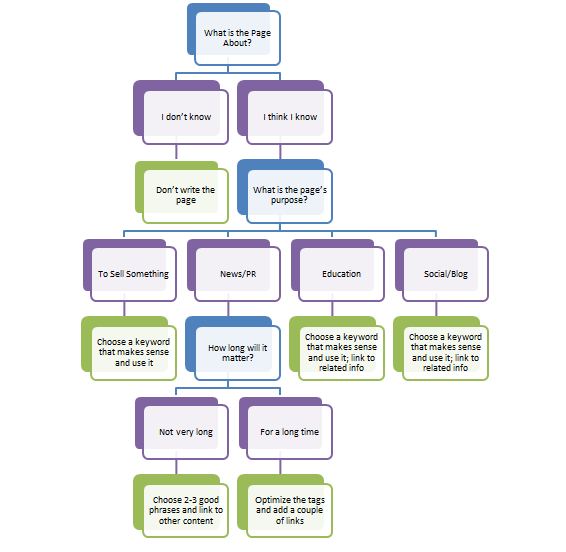
While we’ve been talking about how to optimize content quite a bit, there really are no guidelines out there for more broad questions you should be asking when going through the process of optimization. Jenny Halasz from Search Engine Land realized this, and created a flow chart for the optimization process, complete with what questions you should be asking yourself.

Optimization Flow Chart

“What is the page about?” – This is a really simple question, and if you can’t answer it, you probably shouldn’t be building the site. For your page to have any value, you have to know what it is about, obviously.

“What is the purpose of this page?” – Are you trying to create a blog post? Or maybe a sales pitch? How about a press release? No matter what the purpose is, you certainly need to have one, and be able to identify it while working on the page. Thinking about this before hand will help you put your content into context.

“How long will this content remain relevant?” – Educational pieces stay relevant until more information is found. Depending on the field, this could be years or just a few months. Product pitches on the other hand, stay relevant until your next line is due to be released, which can last as much as a year or two. Either way, adapt your content to the time frame it will still be important.

“What makes sense for optimization?” – The previous questions should be considered when creating the page, but now we’re at optimizing the site for search. Are the keywords you’re using relevant? How are you handling linking? Make sure you actually consider these factors rather than “going through the motions.”

The flow chart and questions should help you focus your process to reflect your client’s needs. Every step needs to be planned, and every question should be answered. If you’re optimizing right, the answers should come to mind pretty quickly.


I’ve talked a lot about how important it is to try to think like your customers. It’s always important to find out what people are thinking, what questions they are asking, etc., but I didn’t offer any specific ways to accomplish this. But today I have one method of finding out what questions people are asking about topics important to you.

Justin Arnold from The Mighter Pen suggests using Twitter because it offers real time feedback on what people are talking and thinking about relative to keywords.

Of course, this is pretty common knowledge, but what people don’t realize is Twitter has some key features built into its search engine that really benefit the person looking for questions people are asking.

Finding out what questions people are asking is as simple as adding a space and a question mark after a querie. Suppose you are writing about painting. You can search ‘painting’ but you probably will get a lot of extraneous posts not of interest to you. If you search ‘painting ?’ however, Twitter filters your results to only include tweets with questions.

Now, the problem we are faced with is Twitter is used pretty heavily for promotion. Don’t you wish you could filter out any tweet containing links to avoid all of the ads? Well, you can. Just add ‘-filter:links’ to your searches to do away with all of the promotions. What you have now is a list of questions users are asking about a topic in real time.

This is just one way to try to get into the minds of your audience. Trying to gain some perspective is always important when creating content.


I’ve read a number of articles suggesting that Facebook is not an ideal marketing platform because your business will see a small click through rate from your Facebook page to your website and, perhaps, an even smaller conversion rate. And you know what? That opinion is dead on.

Those aren’t the proper metrics to measure Facebook success, however. In baseball, you don’t figure batting average by how many times the hitter successfully contacts the ball. He has to actually get a hit. Well, in terms of Facebook, your business gets a hit when a user ‘Likes’ your page, not when a user buys something from you. I know, that’s pretty contradictory when you consider the basics of marketing. But, it’s time to embrace the idea that sometimes brand awareness is the goal.

Avinsash Kaushik wrote a tremendous, but lengthy, blog post recently on this and many other topics that I urge you to read. He touches on advertising on Facebook, as well. Again, this is not a way for you to drive traffic to your site. You advertise on Facebook to get Facebook users to your Facebook page. It’s all very Facebook-centric.

Obviously, Facebook is not the only weapon you need in your marketing arsenal. Having a large, interested, captive audience on Facebook is a great thing. You can deliver as many messages to fans of your page as you want and they don’t cost you anything. But, while those fans might buy your product when a need arises and they might tell others about your product, you need other, more traditional marketing methods to truly impact your bottom line.

The most interesting part of marketing on Facebook seems to be that you can’t be marketing to users on Facebook. That is, those that attempt to use Facebook in the wrong way, which is marketing directly to consumers rather than attempting to build an audience with their page, fail with Facebook. But, if you have great content and create an entertaining forum for fans to gather with your Facebook page and don’t alienate them by bombarding users with ads and attempts to turn them into conversions, you’ll succeed with Facebook. Soon, those fans of your page will turn into conversions on their own and may even breed more conversions.

So, whether you’re struggling to gain ground or are just starting out with Facebook for your business, remember to measure success the right way and always consider your audience.

The overlap between SEO and content strategy often ends up turning content creation into a marketing ploy, and little more. The blogs cite industry folks and data, and offer tips that are either glaringly obvious or recycled to the point of redundancy.

Guillaume Bouchard from Search Engine Watch has another idea for content creation. Think about what people want, not what “works” within the market. What works changes as fast as the industry can, while what people want stays relatively consistent. Long term success comes from reading what your visitors want.

For SEO professionals, you can follow the 70/20/10 model for a simple model for content creation.

The 70/20/10 model goes like this:

  • 70 percent of content should be low-risk
  • 20 percent should try to improve on what already works
  • 10 percent should be high-risk experimentation

The model comes from Coca-Cola, and can be transferred to SEO pretty easily. Link baiting is low-risk. Optimizing and trying to capitalize on some newer trends in the market covers trying to improve on what works, and that leaves 10 percent experimentation.

70 Percent: The Link Bait – Link baiting certainly has its pros and drawbacks, but for this model just think of it as content made with a purpose. It informs audiences, communicates complicated ideas, and establishes your reputation as an expert. This helps establish your brand in the industry. This acts as the mainstay of your content. Always available, but it can’t be all you have.

20 Percent: Optimize and Sharpen – For optimizing, look at what content is doing the best and what people are saying about your content. Try to improve upon what is doing best, and reinvigorating old debates with new information. Stay aware of trends and ideas in your industry, and react to them with content. This type of content creation helps keep you tuned to the changes in your industry, and keep you relevant, which will always translate to your audience.

10 Percent: Proactive and Reactive Experimentation – Time to have some fun. Experimentation requires really understanding your audience, and being confident enough to have an opinion. Think about fashion trendsetters. They see what is popular now, and act on their impulses in response. Content creation experimentation is all about seeing what is popular in the field, and making new content that people have never seen before.

This model isn’t something to keep set in stone, but it will help keep you relevant and interesting. Those are two things audiences always want.