
Internship PosterAn online marketer’s day is often very hectic. There are so many things you have to take care of for your campaigns and sites, but then you also have to manage clients. Thankfully, if you work at a larger company, you may have the benefit of keeping interns around.

Internships are a common and popular way for college students or recent graduates to get experience in their field of choice. In some cases, these internships directly lead to full-time employment, while in others it simply gives the interns the skills and experience needed to break into their field. Many places offer paid internships, which pay less than full-time employment, but it is not uncommon for interns to work for free.

One of the best areas online marketers can utilize interns in is PPC. There are many tasks for well-rounded PPC management that are not overly difficult, but simply extraordinarily time consuming. These interns are generally highly tech-savvy and come well-experienced at creating nice Excel and Word documents, which make them perfectly suited for many of the tasks, and a good intern will be ready to learn the skills they need to manage PPC work.

Melissa Mackey pinpointed six specific PPC tasks that are a perfect fit for interns. They offer specific but varying skills which will benefit the interns in their career, while also saving you some tedious work.

1) Keyword Research

PPC absolutely relies on keywords, and every PPC professional has spent more hours than they can count undertaking keyword research. It is a critical part of the process, but it can take more time than many other tasks. Interns can help cut down a long list of keyword suggestions for the PPC manager, or you can train them to do more in depth research. Of course, you probably don’t want to let them make the final call on keywords, but you will save yourself time by getting them involved.

2) Search Query Reports

Search query reports are part and parcel of PPC and keyword research. It must be done, but it is an utter time-drain that could easily be done by an intern. Your intern should be able to identify potential positive and negative keywords, while they learn some of the basics of PPC.

3) Competitor Research

When you are researching your competitors, they are usually putting effort into their campaigns. Of course, they do research into you too, but any time you are pulled away from active efforts is potentially time spent falling behind competitors. Tools can help cut down the time you put into research, but you can also have your intern pull data from competitive tools for you. They can also run AdWords auction insights reports regularly. This means you can keep an eye on the competition without having to be pulled away from your own efforts.

4) Ad Copy Test Ideas

If you’ve been running an account for a while, you should be updating ad copy tests every month. But, after a while you can begin to run out of new ideas to test. Enter your intern with their own new ideas. Interns can come up with many ideas for ad copy that you’ve never thought of, and as Mackey says, “there are very few bad ideas when it comes to ad copy.”

5) Audits

An HTML-smart intern can be a great benefit for auditing a website. You can have them place a test order or fill out a test form, as well as checking conversion tracking codes along the way. Interns might not be able to run complete PPC account audits, however they can help with those efforts too. They can find ad groups with too many keywords, or keywords with poor quality scores.

6) Reporting

Reporting is often a PPC manager’s absolute least favorite task. Reporting can take up entire days at the beginning of the month, and that is you have good automation tools. Praise the lord interns can be taught to pull reporting data and help organize it so it flows well. PPC managers will just have to add analysis and insight.

Blogger Portrait

Source: Marisa Vasquez

Unless you’ve been living under a rock for the past year, you’ve likely heard how important creating content is to your SEO strategy. For larger companies, it isn’t hard to find resources for solid content creation, but smaller businesses see a much larger hurdle. Smaller businesses means smaller budgets, but these businesses still need to find a way to market themselves.

Social media and blogs have made it easier than ever to create and share content with your audience, so small businesses have many more feasible options than in the past. This content creates a relationship with your audience and cements your brand as a trusted resource, and it doesn’t have to cost an arm and a leg as long as you focus on the right types of content. Phillip Thune highlighted four of the best ways small businesses can deliver quality content without destroying their budget.

Blogs

No matter what your marketing strategy, if you have on online presence (which you should) you need to have a blog. A blog is the cornerstone of any SEO or online marketing plans, and it offers you a convenient way to share new products, industry news, and interesting facts with your consumers. Not only does a blog give your company a voice, it also improves your SEO so that more people can find you. Plus, when something gets posted, it can be easily shared to all the most popular social media platforms.

Ebooks

Ebooks are digital books or publications that people can easily receive via the internet. They can then be read on your computer or any tablet or smartphone. These publications share information and establish credibility by showing your expertise to your clients. Most businesses request information such as an email address for these ebooks, so they also generate leads. These require a bit more effort on a single concentrated piece of content, but they often gain more traction than blogs so long as you create something valuable to readers and you share it enough to be seen.

Slide Presentations

You have no doubt put together a few slide presentations throughout your career, and are familiar with their easy-to-read format. They are used for sales presentations and conferences, but they can also be used to share educational content. These slideshows are easily shared on SlideShare, YouTube, or Vimeo, and will help gain trust and reputability within your field.

Press Releases

Press releases have long been the best way to spread information and establish credibility in your market and your local community. They announce information about new products or services, while also showcasing your brand’s place as a respected part of your community. Traditionally, these are shared with journalists or newswires, but they also encourage bloggers and other publications to share your story. Sharing your press releases will help small businesses establish relationships with journalists within your community, but you can also share them online to spread directly to your customers.

Keyword Planner Screenshot

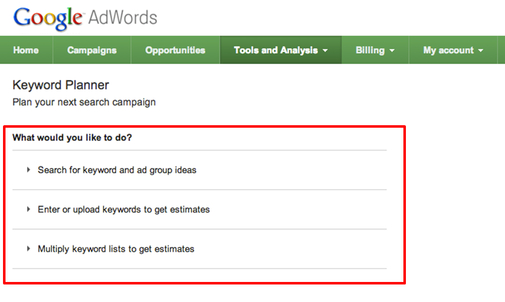
The time has come. As of yesterday, the Google Keyword Tool is officially dead. The sentiments are mixed as the tool has been frequently used by webmasters and SEO professionals across the world, but Google has offered a replacement called the Keyword Planner which has some advantages over the old tool. It also has some drawbacks associated with the switch.

In Google’s opinion, the Keyword Planner can accomplish all the important tasks the Keyword Tool could, as well as that of the Traffic Estimator. There are even some new features included which neither of the older tools offered. Matt Southern from Search Engine Journal broke down the pros and cons of being forced to make the change, which are shared below. Chances are in a few months you won’t even remember using the old Keyword Tool, but the transition could take some getting used to.

Positives

The Keyword Planner allows local SEO professionals and marketers to acquire keyword search volume data down to a city level with better geographic segmentation than the Keyword Tool and Traffic Estimator. It also has the ability to bundle geographic regions together.

SEO professionals and marketers are also able to upload up to 10,000 keywords from their own list to get performance data. The planner displays search volume by ad group, landing page, and any other categorization established by the user.

Negatives

The most common gripe I have heard about the Keyword Planner is that, unlike the Keyword Tool, the planner required users to be logged into AdWords before being able to use the tool. However, there are some functions removed from the Keyword Tool which will have a larger impact on how you view and understand the data.

The Keyword Planner does not feature match type data for search volume, device targeting, and doesn’t include global vs. local monthly searches. The ability to filter by closely related search terms is also missing, though Google has stated it will be back within the coming weeks. They explained the missing match types and device differentiation in a statement, which read:

In general, you’ll notice that the average search volume data is higher in Keyword Planner as compared to the exact match search volume data you got with the Keyword Tool. That’s because we’ll show you the average number of searches for a keyword idea on all devices (desktop and laptop computers, tablets, and mobile phones). With Keyword Tool, we showed the average search volume for desktop and laptop computers by default.

According to an announcement from Google late last week, you can now opt out of five new ad format options when creating AdSense ads.

Their announcement said:

“These enhancements are designed to improve the performance of your ads, but we know that sometimes you may prefer not to include them. Based on your requests for more control over the ways ads are served on your site, we’re happy to let you know that you can opt out of the following advanced ad format features[…]”

  • Similar Sized Display Ads – This feature shows smaller ads that are performing highly in larger ad units
  • Enhanced Text Ads – Displays text ads with performance enhancing features such as product ads or clickable arrow icons.
  • Expandable Ads – Displaying rich media ads that can expand beyond the original ad size after a user-initiated action.
  • Enhanced Display Ads – Shows display ads with performance-enhancing features such as mouseover highlights.
  • Animated Display Ads – This feature allows you to display non-static ads that were created using Flash or animated Gif formats.

AdSense obviously isn’t rolling back these new features, but simply trying to give publishers more control over their ads. More control is never a bad thing, right?

Facebook Sticker IconDespite constant detractors proclaiming the death of Facebook, advertising on the social media platform continues to show strong results for marketers according to the Q2 review of Facebook advertising by Kenshoo Social. Their statistics show significant increases for all metrics, from analysis of more than 75 billion Facebook ad impressions from advertisers using the Kenshoo Social platform.

Throughout Q2, the company saw click through rates rise 18.5 percent, with total clicks increasing by 16.5 percent compared to Q1 of this year. Engagement rates beyond the click also saw substantial increases as conversions rose 56.9 percent and revenue increased by 28.3 percent.

Todd Herrold, senior director of product marketing for Kenshoo Social says the gains are the result of advertisers continuing to refine their techniques and becoming more savy about the social media platform, as well as improvements made by Facebook itself. He told Marketing Land:

“Facebook has been steadily optimizing its ad units and launching new ad targeting products designed specifically for direct response, including Custom and Lookalike Audiences, Partner Categories and the Facebook Exchange (FBX).”

Google Adwords Time Chart

Jon Diorio and the Google+ account for Google Ads announced today that a new feature is available in Adwords that will allow you to get a better look at your data. It is a small addition, but many advertisers will find it very useful.

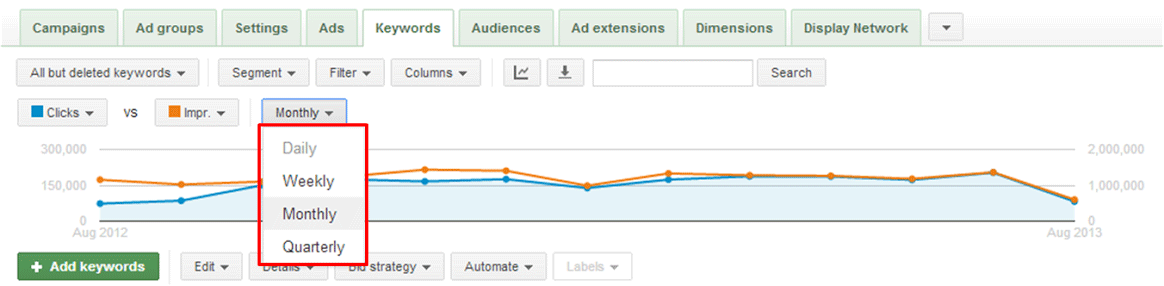
Beginning today, you can control the time aggregation on Adwords charts to show data down to a day-by-day view. You can also view it by week, month, or quarter. This way, you can see the big and small pictures with just a couple clicks, and keep track of the smaller level trends.

The announcement read:

Today, we’re making it easier and faster to get a customized view of how your performance is trending with a new button right above your chart in AdWords that lets you toggle between Daily, Weekly, Monthly, or Quarterly data (shown below). We hope this will save you time and make you more efficient while optimizing your search campaigns.

Blogger Portrait

Source: Marisa Vasquez

Content marketing is all the rage in SEO right now. As links continue to get devalued (though they can still be potent if gained properly), optimizers and marketers are moving their focus to the actual content you see on the page. This is potentially a great shift to providing consumers with real value, but generating content on a regular basis is costly and intensive. If you slack, it can be worthless at best, and damaging to your rankings at worst.

This isn’t to say you shouldn’t do it. But, content marketing has to be done right, with smart choices about how to spend your time and efforts. All it takes is some planning and extra thought that too many forget to do. If you think ahead, you can avoid most of the common content marketing mistakes far too many make. Jayson DeMers pinpointed some of those common mistakes, and if you know how to identify them, you can fix them.

1) Writing for the Wrong Audience

Every article or piece of content you put out there should be of value to someone, but that audience shouldn’t be arbitrary. As a business, you have a specific audience that you should be paying attention to. If you understand your audience, you can better choose topics and write in the appropriate tone for who you are trying to connect with. Home services such as plumbing and roofing have very different consumers and audiences than tech startups.

One of the most common ways to forget to write for consumers. We tend to get excited about the content we are putting out and the work we’ve put in – and that is great – but we also tend to geek out and write for those who are spending hours scouring blogs like us. We forget to communicate with the actual people needing their services. For every article, you need to ask, are we writing for our consumers or our peers?

2) Using the Wrong Metrics

Creating content takes a ton of time. You have to research, try to brainstorm unique topics, follow all the social media feeds. It would be tragic if all those efforts weren’t being properly measured and fine-tuned. However, getting started with the right metrics for your business at first can seem even more troublesome than making all that content.

Getting started, it is common to focus on measuring outputs rather than results. It helps ensure you follow through on your content marketing efforts and are achieving the basic creation aspect. But, once you’re in the flow of creating content you have to evolve your metrics to ensure they are actually achieving the larger desired results. You have to make sure you’re getting an actual return on your investment.

Not only do you want to make sure that you are strengthening your front on using the right keywords, you want to be checking on your conversions. You’re content isn’t successful if it isn’t helping direct people to the next step. Are you including clear calls to action? Are you getting people to make the next step you want? If not, you may want to change your strategy.

3) Failing to Focus on Branding

Content serves the purpose of making your brand trustworthy to consumers. Brand development can help build your brand as a leader in your market, or it can build the reputation of a service or product. Simply put, creating content allows you to build your brand as a leader in your industry to those who haven’t used your product or service yet. Writing as a leader or member of your business should showcase your expertise and make consumers trust you. The trick is doing it in a professional way, without being heavy handed.

Trying to make a hard sell with your content isn’t advised, so you have to achieve these goals much more subtly. The primary goal is educating and informing, but that has to be put in a package that will also strengthen your brand. It is a difficult line to walk, but with focus on your brand and the audience, you will find the proper mix.

Reddit AlienSocial media marketers have been aware of Reddit for a long time, and many have even tried to take advantage of the large community. But, the site is notorious for rejecting any attempts to disguise marketing, not to mention being confusing for new users and too streamlined for marketers to track any meaningful data.

Now, Marketing Land reports a free new tool called Reddit Insight has been created by Hack Reactor to help Redditors and marketers alike analyze their accounts, posts, keywords, and subreddits.

The tool can analyze an entire profile or a single post simply by entering the username or URL. It displays where users are gaining Karma or Upvotes (signs of approval on the site that also increase visibility of posts)as well as detailed information on numerous other site specific information, such as how keywords are faring by subreddit through word clouds and topic clusters.

The tool allows marketers and analysts to explore the data from as large or small of a scale as you want. While you can overview entire subreddits or user histories, you can also break down how users are reacting to specific comments and interactions.

They present it all in bright colorful graphs that are easy to immediately understand which makes the data both accessible but also great for explaining your social media tactics and their results to clients.

Details can make or break a social media strategy. Little mistakes and small forgotten aspects can make your company look unprofessional and under-prepared. Listing all the ways I regularly see companies making small mistakes that still severely handicap their strategy would be practically endless, but Mashable had nine entrepreneurs share what they think is the one most important detail they see others routinely forgetting. You may have an otherwise strong social media strategy, but if you’re neglecting any of these, you are under performing.

  1. Link to Your Site – It is way to common to see small businesses creating great content and sharing them on their Facebook or other social pages, without any sort of link to the actual website anywhere readily available. Even if users like what you’re putting out, they can be turned off by searching for a link and simply give up. It should be easy for them to find out more about what you do.
  2. Retargeting – Many small businesses forget to retarget people based on their own social media campaigns using specific URLs in order to track specific leads around the web. If done right, this can be a highly effective marketing tactic, but it continues to go under-utilized. If you are retargeting, you can serve potential leads the ads that would make them most likely to convert, as well as collecting data to track exactly how effective your social media strategy actually is.
  3. Focus Your Social Media – Too many small businesses spread themselves thin across a barrage of social media sites. Focusing on a couple of the most popular sites like Facebook and Twitter makes a much larger impact than barely having a presence on all of them. You’ll find you’re better connecting with your audience and making more conversions without any more effort than you were already using on social media.
  4. Email is Still Important – Email may be the oldest “social” way to connect with customers one-on-one, but it is still the easiest method as well. Everyone checks their email, and statistics show that customers who receive emails are more likely to connect on other social sites.
  5. Don’t Forget About YouTube – If resources and skills allow, YouTube can be an incredible piece of your social media strategy. Videos that show your expertise cement your reputation and showcase your skills to potential customers, while entertaining videos draw a wide audience base that otherwise may not be interested in your service. YouTube content is one of the easiest to share across all platforms, but if you can’t invest in a quality video, you might consider putting your resources elsewhere.
  6. Keep the Original Content Coming – The big catchphrase now is “content is king” but for that content to do anything, it has to be valuable. If you create content that is worth viewer’s time, you can easily connect with a wide range of viewers and build your brand’s reputation.
  7. Run a Personal Blog – Running a personal blog humanizes your company and raises your value by highlighting the intelligent and skillful people working within your company. Everyone knows that companies are always trying to market their service, but they view personal blogs as a more honest way to assess the abilities of those actually running the company.
  8. Don’t Forget Facebook Targeting – Targeting software for Facebook admin pages allow select posts to only reach a specific demographic so that you can more narrowly market to their tastes without hurting the sensibilities of others. It’s easy to use (it’s one of the three icons beneath the text box), yet so many small businesses forget about it.
  9. Make Your Employees Into Advocates – Including your employees in your social media builds trust between your potential customers and your business and puts a face on your brand. If you use organic thoughts from your employees leveraged with your strategic direction, you can make your employees some of your biggest advocates.

When most people think of SEO, they see it as a way to earn the top spot (or close to it) on the search engine result pages (SERPs). Markets can be highly competitive, and if SEO can get you above others in your industry than most companies see the process as being worth their time and money. While that is true in some ways, it is also far from the whole truth.

The wide perception about SEO implies that it is only really important for largely internet based businesses or those in competitive markets. However, SEO can benefit anyone who wants to develop an online presence and make themselves available to the ever-increasing number of consumers who use the internet as their primary shopping tool.

Small or niche businesses with limited resources may ask what the point of investing in SEO could be when there is little to no competition. What is the point when you’ve already earned the top spot, with no signs of losing it in the future? Amanda DiSilvestro has spent quite a lot of time considering this issue (enough for two separate articles across different sites) and the conclusive answer is that SEO can help businesses in niche markets in tons of ways that may not seem apparent at first.

Optimization means improving usability

Between Google’s recent shift of focus from links and keywords to quality usability for users, many aspects of optimization are centered entirely on improving how your site functions for the people that actually use it. SEO can be perceived as a marketing tactic, but it is more importantly a usability tactic. Sites that readers enjoy using are more valuable than those that barely function, and Google recognizes that and ranks sites accordingly.

You’ll have competition eventually

No matter how niche your business is today, eventually the vast majority of companies will see competition. Chances are, if you don’t see competition eventually your niche is in danger of becoming irrelevant. Either way, it is always best to be ahead of any competition that arises, and solid SEO essentially helps you fortify your grasp on the market. Rather than battling a new competitor when they show up, you’ll be prepared and far ahead of their attempts to overthrow you.

You want to be the best, not the only option

Ignoring SEO means your site isn’t living up to its potential. Customers view site usability and professionalism as indicators of the reputability of the company running the page. Because SEO is becoming synonymous with usability, optimizing your site communicates your value to search engines and your users at the same time. If consumers see you as the only option, but think your site and brand look sub par, they will view you as the only option they have rather than the best possible option. That pushes potential customers away and could even cause an enterprising individual who notices your weakness to try to enter your little market.

Conclusion

SEO isn’t immediate. It takes a lot of time to get the results you want. While you may feel comfortably established as the top (or only) option in your niche, things always change eventually. Getting ahead of the curve will save you stress in the long run and make potential customers trust your company more.