Before long, Facebook’s video service is going to look a lot like YouTube. Facebook announced several new features to their mobile app that will seem very familiar to YouTube users and will make videos an even larger part of the Facebook platform than before.
Among the features is the new ability to collapse videos into a floating window, so you can browsing your Facebook seamlessly while you watch a video. The change will make watching videos on the platform less of an interruption and more a part of the experience.
Facebook is also testing implementing a new list of recommended videos to watch next after users finish watching a video. If you don’t see something that piques your interest, you can also look in the all new dedicated Facebook video feed, where you’ll find nothing but user shared videos.
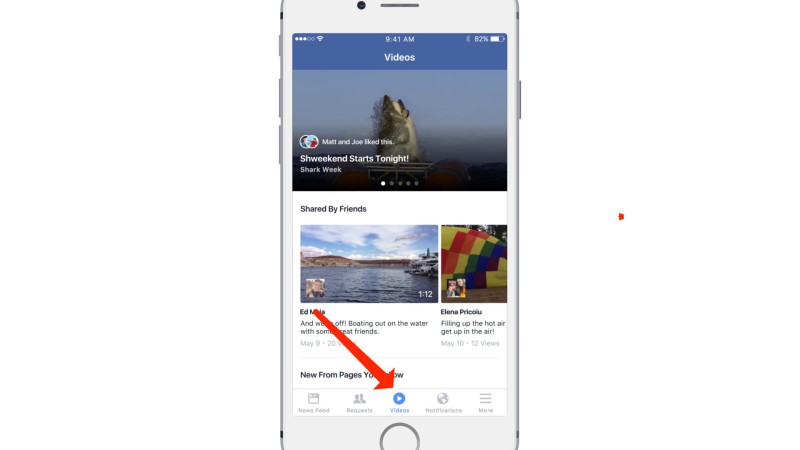
The dedicated video feed acts much like your normal News Feed, but exclusively for video and can be found by tapping the “Videos” icon along the bottom navigation menu of the Facebook app.
If you see something you think you might want to watch, but can’t at the immediate moment for some reason, you can now save it for later, allowing you to easily return when you are someplace more suitable for watching video. All your saved videos can be easily found in the “Saved” bookmark in the menu.
Facebook is still working out the kinks on most of these new features, so don’t expect them to be rolled out too soon. Instead, it appears the new features will see a slow testing and rollout phase, with no telling when we will see a full launch.
00Taylor Ballhttps://www.tulsamarketingonline.com/wp-content/uploads/2018/07/TMO-Logo.pngTaylor Ball2015-10-14 15:52:572015-10-14 15:52:57Facebook Is Challenging YouTube With New Video Features
Halloween isn’t even here yet, but many retailers are already prepping for the holiday sales surge. According to the National Retail Federation, those retailers can also plan on seeing an even more sales than last year. The NRF predicts sales will jump 3.7 percent to $630.5 billion in November and December 2015.
While the total amount of sales is still expected to rise this year, the increase isn’t as large as the boost in 2014. Last year’s sales grew 4.3 percent compared to 2013.
Online sales are expected to see a large amount of this increase, outpacing the overall growth by rising between 6 and 8 percent this year to $105 billion.
According to the NRF’s report, holiday sales could account for around 19 percent of the retail industry’s total annual sales, projected to reach $3.2 trillion. Those predictions exclude auto, gas, and restaurant sales.
“With several months of solid retail sales behind us, we’re heading into the all-important holiday season fully expecting to see healthy growth,” said NRF President and CEO Matthew Shay. “We expect families to spend prudently and deliberately, though still less constrained than what we saw even two years ago.”
“Price, value and even timing will all play a role in how, when, where and why people shop over the holiday season,” said Shay. “Retailers will be competitive not only on price, but on digital initiatives, store hours, product offerings and much more.”
The NRF holiday sales forecast takes into account many factors including consumer credit levels, disposable personal income, and previous monthly retail sales releases. The numbers do include a non-store category which considers direct-to-consumer, kiosks, and online sales.
This week, Google announced it would make a big change to ensure advertisers are only charged for display ads that are viewed.
During a keynote discussion at SMX East in New York, Brad Bender, vice president of product management of the Google Display Network said: “I’m pleased to announce that GDN is moving to 100% viewable. We’re going to migrate all of the CPMs in the system to viewable CPMs. All advertisers will be able to see viewable metrics so they can make better decisions.”
Bender told the audience the change will be rolled out to GDN users in the upcoming weeks. The change is likely to be received warmly by advertisers as there has been some concern over statistics (provided by Google) claiming 56 percent of online display ads never have the chance to be seen.
These ads are often not seen due to being low on the page or on a non-activated tab.
According to Marketing Land, Bender said Google has been working on the viewability issue and did not charge advertisers last year for over 70 billion impressions that went unseen.
For more on the change, read Google’s announcement on the Inside Adwords blog.
00Taylor Ballhttps://www.tulsamarketingonline.com/wp-content/uploads/2018/07/TMO-Logo.pngTaylor Ball2015-10-02 14:47:082015-10-02 14:47:08Google Display Network Commits To Only Charge For Ads That Get Seen
Over the weekend, Google announced a powerful new feature in AdWords that will allow advertisers to target their audience unlike ever before. Through Customer Match, a new feature rolling out in the coming weeks, advertisers will be able to target ads by email address.
After you upload a list of email addresses, Customer Match will pair them with the corresponding Google users who you can target ads to. Advertisers can also target ads to similar audiences who share similarities with the individuals in the email list.
Customer Match is capable of targeting ads to anyone signed-in to Google on Gmail, Search, and YouTube.
With the audience sets generated by Customer Match, you can craft ads specifically build around reaching them, such as in the example provided by Google:
“Let’s say you’re a travel brand. You can now reach people who have joined your rewards program as they plan their next trip. For example, when these rewards members search for “non-stop flights to new york” on Google.com, you can show relevant ads at the top of their search results on any device right when they’re looking to fly to New York.”
There are still no details about any security measures in place to protect customer email addresses uploaded to Customer Match, other than stating the process is conducted in a “secure and privacy-safe way.”
Google has made a big deal about its ability to prevent advertisers from paying for ads that aren’t seen by real human eyes, including on YouTube’s ad network, but a new study by a team of European researchers suggests something is amiss. According to their findings, advertisers are still being forced to pay for ads despite YouTube’s systems flagging the view as “suspicious” or fraudulently coming from a bot rather than a human.
The experiment from researchers at NEC Labs Europe, UC3m, Imdea, and Polito, was conducted in three stages. First the researchers uploaded videos to YouTbe and set up an AdSense account to monetize them. Then, the team set up AdWords accounts to run ads against the video, before creating and deploying bots designed to specifically view the videos with the ads.
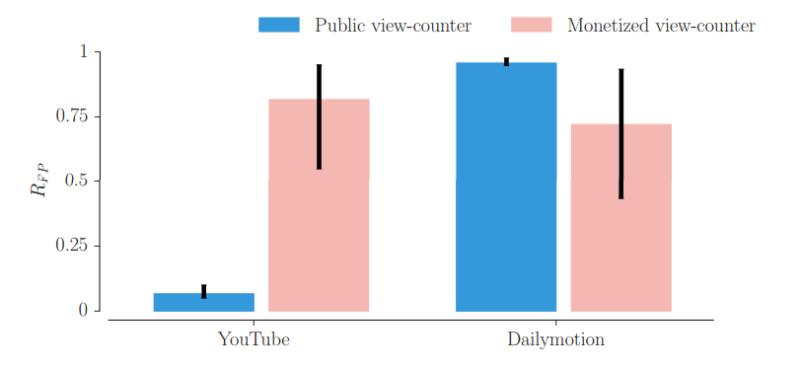
While the researchers concluded that “among the studied online video portals, YouTube is the only one implementing a sufficiently discriminative fake view detection mechanism,” they also found “that YouTube only applies this mechanism to discount fake views from the public view counter and not from the monetized view counter.”
That means that YouTube filters out views it deems as fraudulent for the public view counter, but they are still charging advertisers for those views.
Throughout their experiment, the group observed the number of monetized views was consistently larger than the number of counter views and came to the realization that “views considered suspicious are removed from the public view counter, but monetized.”
This isn’t the first time Google has been accused of charging for fraudulent clicks. When similar situations were brought up with YouTube, the company said the discrepancies are likely due to users watching the video ad, but not the video itself. That would lead to the view to be monetized but not included in the public counter.
However, the researchers say that cannot be what happened here because the bot was designed to “view” both the ads and the accompanying video all the way through.
The team also took the fact that YouTube performs part of its view validation after the fact into consideration, however after six months the team saw no compensation adjustments. That happened even after YouTube suspended the AdSense account due to the bots’ suspicious activity.
The team also found YouTube is vulnerable to relatively simple attacks. They say they have given their findings to Google and will continue to refine the tools used for the study and potentially make them widely available.
A Google spokesperson said, “We’re contacting the researchers to discuss their findings further. We take invalid traffic very seriously and have invested significantly in the technology and team that keep this out of our systems. The vast majority of invalid traffic is filtered from our systems before advertisers are ever charged.”
00Taylor Ballhttps://www.tulsamarketingonline.com/wp-content/uploads/2018/07/TMO-Logo.pngTaylor Ball2015-09-25 13:57:342015-09-25 13:57:34Are You Paying For Fraudulent Views On YouTube?
Google made big news earlier this year when it declared it would favor sites that switch to HTTPS, and now Twitter is taking a similar path. A member of Twitter’s development team published a thread on the Twitter Community forum explaining the company’s future plans for HTTPS and setting a deadline for the company’s switch the HTTPS.
Starting October 1st, Twitter will begin utilizing HTTPS for all new outbound links, meaning any new link you share will be packed in “https://t.co”. This way Twitter can securely send users to their intended destination, even when the destination page is not an HTTPS link.
Similar changes have been made by popular sites such as Reddit and Wikipedia, however in those situations the sites began using HTTPS site-wide.
This will also have the added side effect of increasing URL lengths in the future, depriving you of one more character to write with when sharing a link.
This also causes issues with tracking referral traffic to non-HTTPS sites, as Twitter explains non-HTTPS sites may see an apparent decrease in referral numbers.
“Web browsers drop the Referer header from a request by default when downgrading from an HTTPS t.co link to an HTTP destination in compliance with the HTTP specification for the Referer header… Based on our estimates you may see a 10% drop in traffic attribution from Twitter as a result of this security change.”
The company also warns that sites will see a steady decrease in referral traffic recorded from Twitter in the future, as users update to the latest browsers that support this policy.
Google has issued a stern warning against those who repeatedly try to game the search engine. In a blog post published at the Google Webmaster Blog, Google’s Search Quality Team said any webmaster who repeatedly violated the Google Webmaster Guidelines and gets caught will face “further action” against their sites.
In the post, Google explored how site owners are getting hit with manual penalties, going through the extensive efforts to get the penalty revoked, and immediately going back to their old spammy ways.
However, Google says these people aren’t slipping under the radar like they may think. The Search Quality Team explains even the most subtle changes get picked up by the search engine:
“For example, a webmaster who received a Manual Action notification based on an unnatural link to another site may nofollow the link, submit a reconsideration request, then, after successfully being reconsidered, delete the nofollow for the link.”
These type of shenanigans won’t get anyone on the friendly side of Google, and repeat violators will see further reconsideration requests become harder and harder to earn. While they won’t say exactly what penalties to expect, they also say that sites it determines were deliberately attempting to spam will be hit with “further actions”.
It can sound tempting to try to earn some short-term gains by bending and breaking the rules, but in the long run you are digging your own grave. Google doesn’t forget, and it certainly won’t stop checking on your site after you get a penalty removed. If you want to stay out of trouble, make sure you stay on the right side of the Webmaster Guidelines.
On October 1st, Bing is shutting down Link Explorer, a link analysis tool that has been available from the company since June 2012, according to a new announcement. This is likely bad news for the many webmasters who used the tool to gain a deeper understanding of their own inbound links or to get a look at the links pointing to competitors’ sites.
According to the announcement, Bing isn’t shutting down the tool due to lack of popularity or demand, but because they had simply outgrown it. The size and architecture of Bing’s index have reached the point where there is just no way for Link Explorer to prove effective.
“We will no longer be able to power Link Explorer inside Webmaster Tools,” the company says — while suggesting its own Inbound Links tool as an alternative. Bing’s Duane Forrester explains the Inbound Links tool is more efficient for assessing your own links.
Link Explorer’s powers were limited since its inception as it only gave a view of a limited sample of your backlinks, meanwhile the Inbound Links tool you can view and export up to a million inbound links in just a few clicks.
Forrester also encourages those who used the tool to evaluate their competition to look for one of the many third-party alternatives available, saying the third party tools “provide even more comprehensive link analysis” than provided by Link Explorer.
00Taylor Ballhttps://www.tulsamarketingonline.com/wp-content/uploads/2018/07/TMO-Logo.pngTaylor Ball2015-09-17 12:32:532015-09-17 12:32:53Bing Announces It Is Shutting Down Link Explorer Tool
Any business owner who has ever received online reviews – whether they were negative or positive – can tell you the power online reviews have in influencing how others perceive your brand. All it can take is one glowing or irate review on a popular service such as Google or Yelp to make or break your business.
Most business owners will also tell you the most likely person to leave a review is an angry customer, but a new survey from Mike Blumenthal published on GetFiveStars suggests those business owners may be wrong.
While it is true that extreme reactions are the most likely to result in reviews for your business, the evidence suggests consumers are actually more likely to reward excellent service than they are to attack businesses which provided a bad experience.
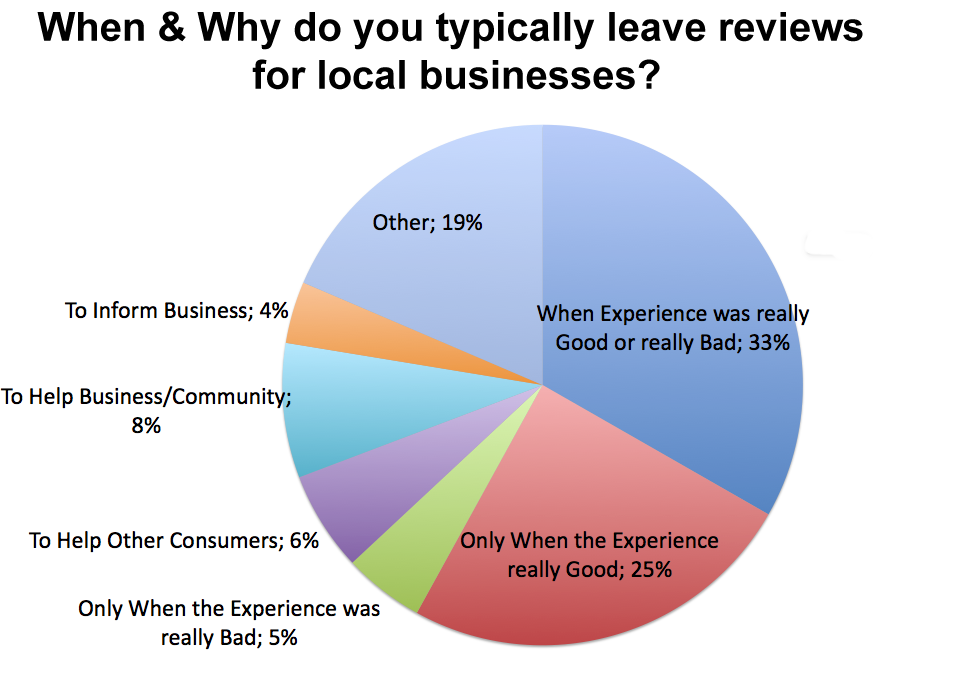
Blumenthal surveyed over 600 consumers that self-reported being active online reviews, asking when and why do you typically leave a review for a local business, and the findings show that few reviewers see calling out exceptionally bad service as their primary motivation.
In actuality, most reviewers actually see their reviews as a means to help inform the community, the business, and other consumers.
For the survey, Blumenthal and colleagues allowed the respondents to answer in their own words, which were then categorized into the following categories:
When Experience was really Good or really Bad
Only When the Experience really Good
Only When the Experience was really Bad
To Help Other Consumers
To Help Business/Community
To Inform Business
Other
While the largest cohort of consumers was defined by extremes with a third of respondents only writing reviews based on really good or really bad experienced, the second largest group is entirely characterized by individuals who only use reviews to celebrate excellent service.
Importantly, this group was not much smaller than those who were motivated by extreme experiences on both ends of the spectrum, suggesting business owners are more likely to get positive reviews for good experiences than they are to receive poor reviews when they drop the ball.
To put this in context, 25% of active reviewers reported leaving reviews only when the experience was overwhelmingly positive, but 5% of reviews only leave reviews for truly poor experiences. That means the average reviewer isn’t the perpetually angry critic they are often portrayed as.
The truth is the vast amount of reviewers aren’t out to get anybody. They view themselves as integral parts to the current business ecosystem and an important part of society.
Ultimately, the reason online reviews may seem overwhelmingly negative is because it is simply much more difficult to provide exceptional service than it is to provide a terrible experience. That doesn’t mean it is impossible.
As a business owner, you should naturally be striving to provide the best service possible. If you are doing that, all you have to do to start drawing in scores of positive reviews is make it easy for your consumers to give you feedback and be sure to listen to their needs. If your customers feel like you are listening and responding to what they have to say, you should expect to see great reviews flooding in within no time.
The Financial Times is reporting that YouTube will begin allowing third-party verification of ad viewability by the end of the year following major pushback from major advertisers.
Until now advertisers have had to rely fully on YouTube’s viewership metrics to gauge how their ad efforts are working, but third-party authentication could potentially provide a less biased and full understanding of how your ads are being viewed and it may even help finally settle the dispute between which video platform is more popular.
The report claims Unilever and Kellogg’s are the key instigators for a move to enable independent viewability measurement. Kellogg’s is especially notable as it has even stopped its ad buys on YouTube due to lack of third-party verification.
Google does allow advertisers to buy ads on a viewable impression basis, but the verification is reliant on the company’s own Active View measurement tool.
Using its own measurement tools, Google has boasted of incredibly high viewability rates. In one study this year, Google said 91 percent of ads served on YouTube were found to be viewable using Active View.
Google declined to comment specifically, but told The Financial Times, “We’re committed to meeting all of our clients’ measurement needs” and “are taking our clients’ feedback into account as we continue to roll out new solutions”.
00Taylor Ballhttps://www.tulsamarketingonline.com/wp-content/uploads/2018/07/TMO-Logo.pngTaylor Ball2015-09-08 16:07:252015-09-08 16:07:25YouTube Supposedly Prepping For Third Party Measurement Verification







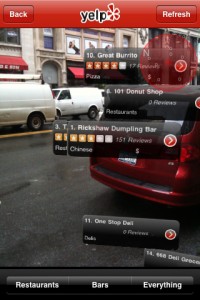 Any business owner who has ever received online reviews – whether they were negative or positive – can tell you the power online reviews have in influencing how others perceive your brand. All it can take is one glowing or irate review on a popular service such as Google or Yelp to make or break your business.