Image Source: Pepsi

Image Source: Pepsi

Earlier this year, Twitter rolled out a new feature known as #Stickers that let users add searchable emoji to their photos posted on the social platform. Since then, Twitter says millions of photos containing #Stickers have been tweeted and shared around the world.

Initially, the emoji available for these “virtual hashtags” were limited to the options Twitter created. However, the site is starting to open the door to allow brands to create their own #Stickers as an ad type called Promoted Stickers.

As Twitter says in their announcement:

“Brands can design four or eight stickers — like accessories and other props — for users to add to their own photos. Photos with a brand’s stickers are shared with all of a user’s followers, allowing brands to be featured by their fans in a truly authentic way. #Stickers act as a visual hashtag, meaning that photos with your brand’s sticker will be connected and discoverable to anyone who taps your brand’s sticker. This allows a brand to see and engage with the people who are using their stickers in creative ways.”

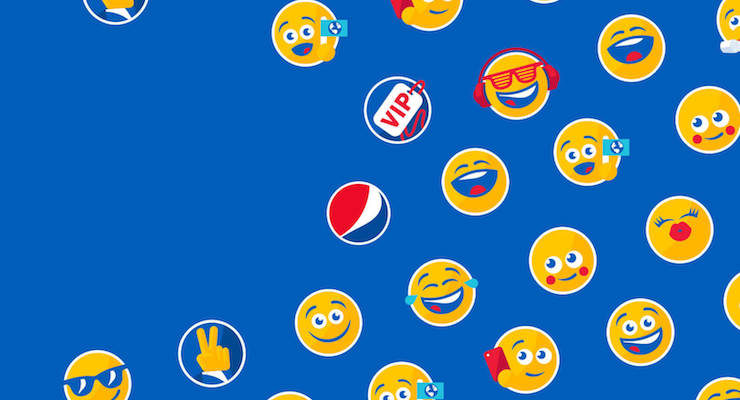
Pepsi is the first brand to use Promoted Stickers, with 50 custom “#PepsiMoji”rolling out to 10 countries, including the USA, Canada, Mexico, Argentina, and Russia. The stickers are part of a larger “Say It With Pepsi” campaign and can be found in the Twitter #Stickers library.

The company has already begun sharing tweets with the stickers, like this one from Pepsi Canada:

Since Twitter is initially keeping the Promoted Stickers limited to a select number of brands and managed accounts, it is unclear how much they cost or what tools may be available to help create new branded stickers. It is also unclear when or if the social platform plans to expand the service to more brands in the near future.
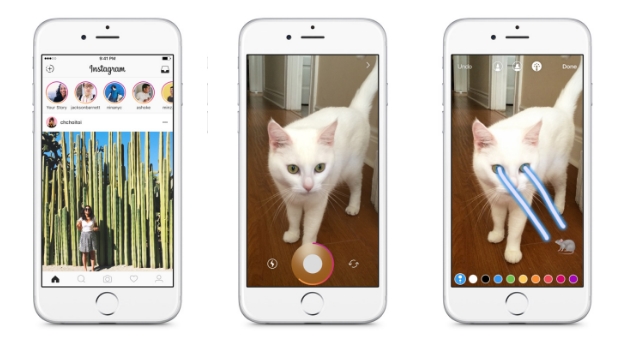
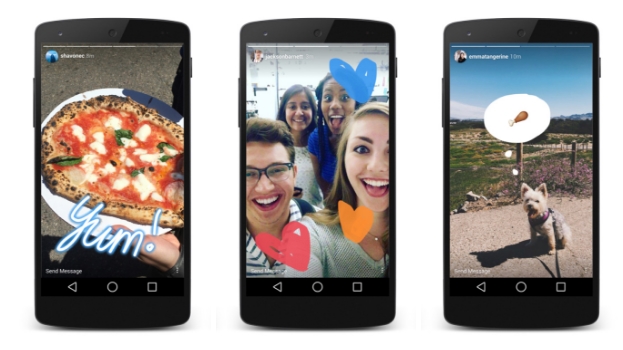
Instagram is launching a new feature, but many are saying the new feature seems inspired by another popular social photo app – Snapchat. The new feature called Instagram Stories lets users and brands share a collection of moments that disappear after 24 hours.

Insa1

If that sounds familiar, it is because the feature is very similar to Snapchat Stories. Not only does it allow users to easily package their best moments of a day into one easy-to-view collection, but Instagram Stories also includes the ability to draw on photos or videos to make them even more exciting.

“With Instagram Stories, you don’t have to worry about over-posting,” an Instagram rep told AdWeek.

Insta2

The new feature is already available on iOS and Android mobile operating systems. It can be found at the top of Instagram feeds, where you can either share your own stories or tap icons to look at what others have shared in the past day.

Unlike most Instagram videos, clips included in stories are limited to 10 seconds. There are also no likes or comments on stories.

For now Instagram isn’t saying whether marketers will be able to take advantage of stories by promoting them like normal posts, however, businesses can still use the feature to engage with the community and build recognition for their brand and products.

Source: Shawn Campbell

Source: Shawn Campbell

Twitter’s ad revenue and engagement may be going up, but Twitter’s advertising platform is struggling to maintain growth as they see fewer advertisers using their service to promote their content.

According to Twitter’s latest shareholder letter, ad revenue grew 18 percent year-over-year, reaching $535 million in Q2. Similarly, ad engagement shot up 226 percent and the cost per engagement dropped by 64 percent.

That’s the good news. The bad news is Twitter is “seeing a continuation of the trends discussed last quarter with less overall advertiser demand than expected. This is reflected in both our Q2 performance and Q3 outlook.

The social media giant says there are two reasons their number of advertisers is dwindling while earnings are growing:

First, there is increased competition for social marketing budgets, which requires us to continuously raise the quality bar on the advertising solutions we bring to market.

Second, while we have worked to drive higher ROI for advertisers (by leveraging our current user base, ad formats and innovations in targeting, creative and measurement), we’re still priced at a premium CPE relative to others. This has proven to be a headwind in growing Twitter’s share of overall social budgets and in our ability to grow faster in both video and performance advertising.

Ultimately, Twitter is going through growing pains and it is reflected by the loss of advertisers. While Twitter is charging more than most social platforms, it is struggling to maintain its active user base who have been largely unimpressed by newer features and changes to the interface on mobile and desktop.

Instead, advertisers are following users who are turning to platforms like Snapchat, which already has more active daily users than Twitter.

The company announced several new ideas to help recapture their audience’s attention and incentivize advertisers to use their service. Among them, it showed off a “new look and feel” to its marketing efforts that emphasize that Twitter is “where you go to see what’s happening everywhere in the world right now.”

Twitter is also heavily investing into live sports streaming with agreements to stream games from all the biggest sports leagues in the U.S., including the NFL, MLB, and NBA. The only question is if these decisions will reignite the spark that originally made Twitter one of the most popular social networks in the world.

phone-875488_640

Does it seem like your ‘Contact Us’ page never actually leads to contact with customers or interested consumers? These days, every business with a website has a contact page, but few are putting the time and care into these pages that they invest in other areas of their site.

I couldn’t count the number of stylish and modern websites I’ve found with contact pages that look weeks or even years old. Sometimes the web design looks distinctly dated, like a forgotten room in a house that has since undergone numerous renovations. Even more worrying, some businesses forget to update their contact information after address or phone number changes.

Any of these issues can deter potential customers from contacting you or purchasing your products or services in the blink of an eye. The good news is, they are also easily fixable. Today, I wanted to offer you some quick ways to turn your ‘contact us’ page from one of the least effective pages on your site to a consistent source of leads and customer engagement.

Be Consistent

The most important factor when listing your contact information anywhere online is consistency. Your business name, address, phone number, and all other contact information should be exactly the same whether they are on your contact page, Facebook, or Yelp. Not only does it provide huge SEO benefits, but showing consistency and a clear identity for your business helps build trust with consumers.

Try Some Variety

Just about every ‘contact us’ page lists a local address and phone number, but often there isn’t much else on the page. While these are both important, you are also missing out if these are the only ways you are encouraging consumers to contact you.

Potential customers aren’t always in a place where they can easily make a phone call and they are not always able to make it out to your physical location. Instead, they may want to drop a quick message to you over Facebook or Twitter. Providing many different ways for your customers to contact you will make you seem more available and allow more people to reach out when they need to.

Show Some Personality

The biggest problem with the vast majority of contact pages I see are that they are just plain boring and tell nothing about who you really are. If someone comes to your ‘contact us’ page, they are looking to learn more about you. If your page is just a simple list of email addresses and phone numbers, you are missing a huge chance to build your brand identity and reinforce who you are.

Don’t Ask Too Much Too Quickly

Some contact pages include forms which ask for small amounts of user information. These can be helpful for keeping messages organized, but being overzealous can drive people away. Your contact page isn’t necessarily the best place to build your email list or ask for detailed user information. Test out shorter forms that ask less of customers initially or make signing up for email subscriptions optional. Otherwise you may find your contact page is actually pushing interested people away.

For far too many businesses, a contact page is treated as an afterthought when they should really be a priority. They are one of the most important pages on your site and act as a foundation for you to start building a relationship with consumers. If you want to really start hearing from consumers, invest time in your contact page to turn it into a page that is as welcoming and informative as the rest of your site.

It may seem like everyone is online these days, but somehow some businesses still don’t have websites. Your business might even be one of them.

If your business has gone this long without a website, you probably have your reasons. You may think you don’t have the money or you simply don’t need one. Neither of those is correct.

A website is a fundamental part of running a business in 2016 and many consumers won’t consider purchasing from a business if they can’t find information about them online. That’s true even for brick and mortar stores. In this connected age,people will even Google stores from their parking lot to make sure the trip inside will be worth their time.

Rapid Web Launch put together an infographic breaking down every reason you might have for not having a website and why it is wrong. I know you’ve gone this long without one and your business may be doing fine, but there’s nothing to lose and everything to gain by getting one set up today.

Check out the infographic below or at Rapid Web Launch.

NoWebsite

Twitter Banner

Social media is one of the quickest and easiest ways for a customer to reach a business, which is why sites likes Twitter and Facebook are fast becoming de facto customer service platforms. Users expect to be able to reach a business and have their problems solved through social media and it is important for businesses to be available.

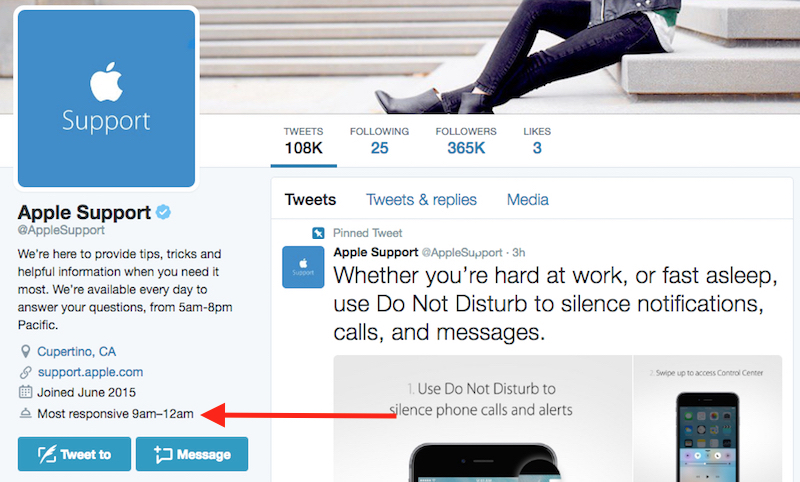
Twitter has recognized its power as a customer service platform and has been testing features to help customer’s take advantage of this. One such feature was released this week which shows users when brands and businesses are most likely to respond on Twitter.

apple-most-responsive-twitter

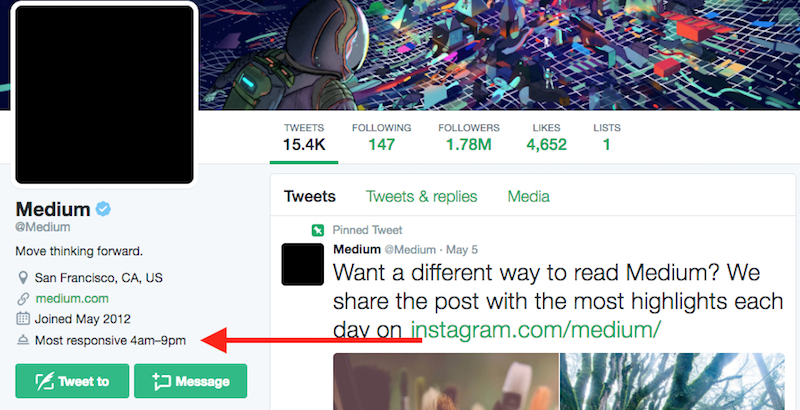
The new “most responsive feature” is starting to pop up on profile pages for pages like Apple Support, but also on brand pages like Medium’s profile on both desktop and mobile.

medium-most-responsive-twitter

Little is known about the feature since it was first spotted this morning. Twitter hasn’t said whether the feature is just a small test or if you can expect to see it spread in the coming weeks and there is no indication of whether businesses have any control over the listing.

Ultimately, the new feature is just a test to keep an eye on. Not only does it provide a potential way to improve customer interactions with brands, but it signals Twitter’s intentions to highlight the customer service potential of their platform. You can likely expect to see similar features and information for brands that offer customer service through Twitter in the future.

HTTPS

It has now been two years since Google announced it would be making HTTPS a minor ranking signal, and a recent study from Moz shows just how many sites have made the switch since then.

After Google’s announcement, there was an initial surge in sites changing from HTTP to HTTPS, but many held back to assess just how important the security protocol was to the search engine and ultimately decided it wasn’t worth the risk. Google only considers HTTPS a minor factor in their ranking algorithm and there has been concern about potential risks when making the switch.

To check up how far along the transition is, Dr. Pete Meyer from Moz compiled data to see just how close is Google is to changing the web over to HTTPS.

Before Google started including HTTPS in its algorithm, Meyer says only around 7% of all pages featured on the first page of Google search results used the more secure protocol. A week after the switch that number had climbed to 8%. Since then, the number has steadily been rising, reaching over 30% this year.

Moz reports that “as of late June, our tracking data shows that 32.5% (almost one-third of page-1 Google results now use the “https:” protocol.”

However, Meyer says he is not convinced everyone that has made the switch was motivated by algorithms and ranking signals. Instead, he believes it is a sign that Google’s PR campaign to make HTTPS more attractive and desirable for sites is working.

Meyer also says that in another 1 to 1.5 years we are likely to see 50% of the sites shown on the first page of search results to use HTTPS, which he predicts will lead Google to strengthen the ranking signal.

Ultimately, many are still hesitant about changing their entire site’s HTML structure to HTTPS and the risks that come along with site-wide changes like this. However, Dr. Meyers says it is wise to keep an eye on how many sites in your industry are using the protocol and to be watchful for any upcoming algorithm updates that may make HTTPS even more prominent in search results.

AdWords In Store Visits

It is no secret that many consumers often get annoyed with ads. Either they get worn down by sites that go overboard with ads littered across their pages or they just get tired of seeing ads that aren’t relevant or interesting to them. Thankfully, Google has found a way to give users the power to only see the ads they want.

Google is sending out notifications to users through Chrome and Gmail alerting them to a new web portal which puts the power to control ads into the users’ hands – among many other things.

The opt-in service allows you to voluntarily give Google a small number of personal details and surveys your interests to better target ads that are actually useful to users.

The feature is a part of Google’s new portal called ‘My Activity’, which displays all your activity across Google and Google devices in reverse chronological format including your past searches, visited websites, Map searches, and ads you’ve interacted with.

Obviously this might make many people nervous to see all the information Google can collect and store about their activity, but the portal also gives you the power to delete any information you don’t want to be there.

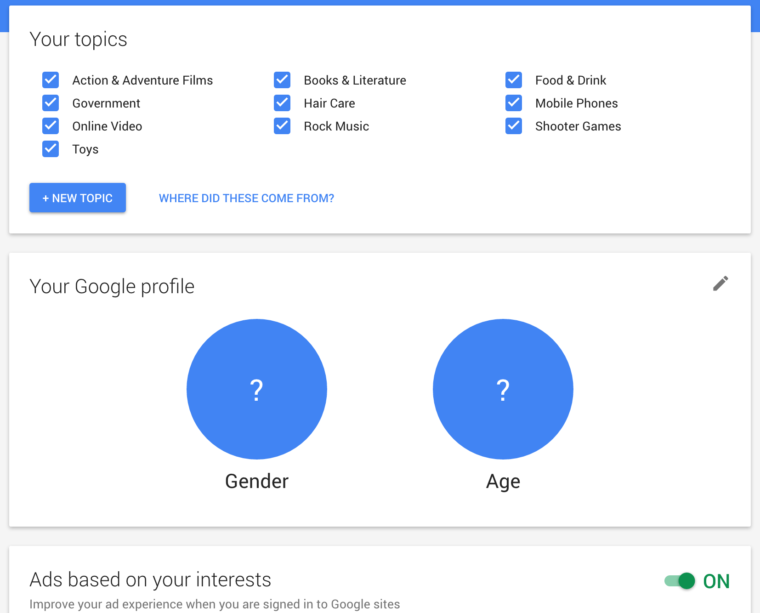
The ability to control the ads you see is specifically in a section of the portal called Ads Personalization. Here you will find checkboxes on topics you want to see ads on, along with sections to provide your age and gender.

Screen-Shot-2016-06-29-at-8.52.37-AM-760x613

If you turn on the feature, Google will use this information to serve you ads based on your previous search history, recently watched videos on YouTube, and other information you provide. Conversely, by opting in you are agreeing to provide Google with information about ads you have interacted with.

Users who don’t opt-in will be shown ads based on other more general information such as location data.

Google is far from the first company to use user data to target ads towards users. In fact, they’ve been doing this for years. However, this is possibly the first time a company has so transparently allowed users to control what information is being collected and how it is being used to serve them ads.

Twitter Banner

The magic number for Twitter appears to be 140. The social network built its platform around 140 character tweets, and now it is taking a similar approach with its video service by limiting videos to 140 seconds, according to a recent announcement.

Twitter has allowed users to share videos on its network since last year, but the videos have been limited to 30-seconds maximum until now. The only exception was for a select number of advertisers who could post videos up to 10 minutes long. Now, users are getting a taste of that creative freedom with videos that go slightly beyond 2 minutes long.

The change will also be having an impact on the Twitter-owned Vine, which is known for looping 6-second-long micro-videos. Now, Vines can be used to preview or promote twitter videos which can be viewed by clicking the new “Watch more” button.

According to the company’s announcement, video tweets have gone up by over 50% since the start of this year and these new changes will allow more flexibility for users.

Along with this news, Twitter also announced that iOS and Android users are getting a new viewing mode which shows Vines or Twitter videos in a full-screen mode along with suggested videos.

Keeping a clean and orderly URL structure for your site can be more than just a helpful way of keeping your pages organized. SEO-friendly URL structure can also make your site easier for search engines to index and modestly improve how Google and Bing rank your site.

Unfortunately, establishing the absolute best URL structure can be a bit confusing. Some would have you believe it is more art than magic, while others would argue “everybody is doing it wrong”.

John E. Lincoln from Ignite Visibility and Brian Dean from Backlinko set out to clear up the confusion with a handy infographic that explains the best practices for keeping your URLs easy to index and easy for users to sort through, including the most common questions like URL length and keyword usage.

See the infographic below or at Search Engine Land.

SEOFriendlyURL