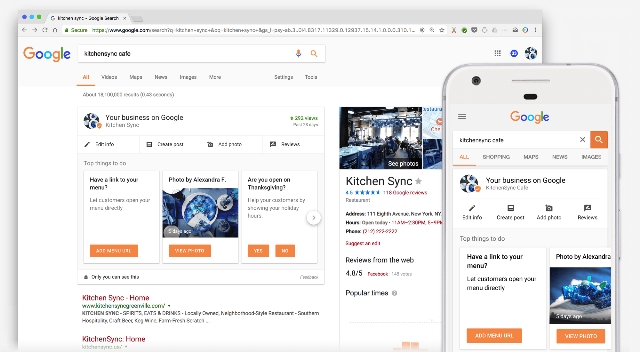
Your Google My Business listing is one of the best ways to make sure potential customers in your area find your business. The listings provide the information about where your business is, your hours, and what types of products or services you offer, and the listings often appear above any other regular search results.

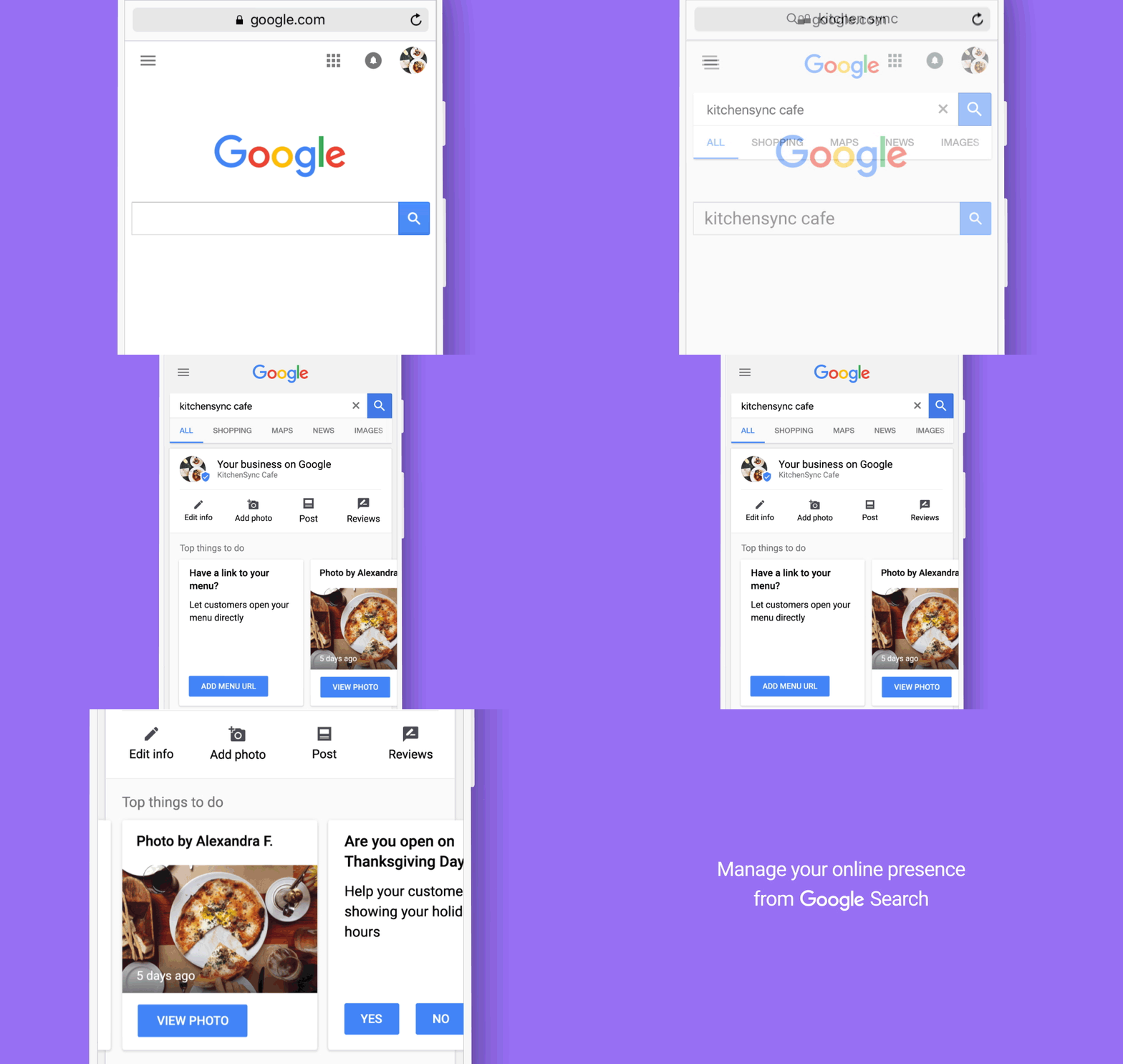
Now, Google is making it easier than ever to maintain and edit your GMB listings by letting you manage them straight from the search results pages.

When you search for your business while logged into the Google account associated with your GMB listing, you will now be shown a new dashboard where you can edit your business information, add new stylish photos, share posts about your business, and even see how many views your listing is receiving.
If you are like the many businesses who have incomplete listings or haven’t updated your business info in years, now is the time to take action. Google highlights a number of reasons that having a thorough and informational listing is important for local businesses in their announcement, including:

  • More than 80% of online searchers use the web to find local information.
  • Businesses with complete listings on Google are twice as likely to gain customer trust, and
    • 38% more likely to attract in-store visits
    • 29% more likely to see a purchase
Source: CourseEnvy

No matter how good your marketing or advertisements are, you can’t succeed online without a great landing page. Whether you’re landing page is irrelevant to people’s interests or it is just too slow or cumbersome for mobile users, your potential customers are going to bounce back to the search results if they can’t get to what they need quickly.

Of course, no one intentionally sets up a bad landing page. Sometimes, you just can’t see what’s not working without an extra set of eyes to show you the problems you’ve overlooked. Thankfully, Google is helping give you exactly that, with a new Landing Pages tool designed to identify why specific landing pages need improvements.

The Landing Pages tool, which was announced earlier this year, is rolling out for advertisers over the next few weeks.

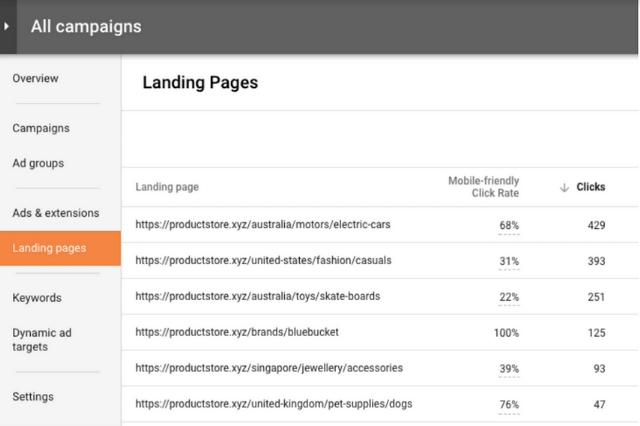
With this tool, you can quickly assess your landing pages based on the amount of engagement (clicks) each URL receives, as well as the “Mobile-Friendly Click Rate” (MFCR). The MFCR is a measure of the percent of mobile clicks coming to your landing page from smartphones or other mobile devices.

The new report allows you to identify exactly which landing pages need work. For example, pages that are not optimized for mobile but that receive a high MFCR should likely be improved and optimized to prevent high bounce rates.

Once it is completely rolled out, the Landing Pages tool will be able to provide data on landing pages for search, display, and video campaigns. However, currently, the MFCR data is only available for search campaigns.

Everyone knows social media is fickle. You can share something you think is great and get no response, while an offhand post that you threw up blows up with likes, comments, and shares. So what makes the difference?

Of course, there are countless reasons that some things perform better than others on social media, but one of the biggest factors is likely something you haven’t considered – timing.

Timing really is everything on social media, but it can be hard to discern exactly when the best time is for you to start posting. The right time on Twitter may not be the right time on Facebook, LinkedIn, or Instagram. Complicating things more, the best times are different for varying industries.

So, how do you figure out when the right time is for you? You could just try different things until something works, but I suggest using the infographic below to take a more informed approach.

The infographic from CoSchedule combines all the best data about timing on social media to give you a complete guide for discovering the prime time for your social media activity. Check it out below or head over to CoSchedule’s site for a more in-depth breakdown.

Google Accelerated Mobile Pages

Since their launch, Google’s Accelerated Mobile Pages (AMP) has been gradually growing in popularity and functionality. More than 2 billion pages now utilize the stripped-down and sped-up content system, and a new survey shows users are also responding very well to AMP.

A poll conducted by 9to5Google indicates that more than half of all internet users prefer to click on AMP content over regular links to full content hosted on your website.

The question posed by Justin Duino from 9to5Google asked: “Are you more inclined to click on an AMP link than a regular one?

With almost 1500 responses so far, 51% of people say the “Yes, I prefer the stripped down versions of websites when reading something.

The other responses include:

  • No, if I want to read something, I will open the link whether it’s AMP or not – 24%
  • No, I prefer loading the entire website – 13%
  • Yes, but only when my device is using mobile data and I don’t want to load a full website – 9%
  • Other – 2%

Of course, informal online polls are hardly considered incontrovertible proof. The results are open to interpretation and informed by numerous factors. For one, the people who frequent 9to5Google’s site are more likely to be tech-inclined and informed about the latest news and features in search. They also likely view Google in a more positive light than the average person.

Still, there is plenty of evidence that content producers and brands love AMP, but there’s been little effort to actually ask users how they feel about the format. Based on this, they are largely in favor of the stripped-down content that lets them get straight to what they clicked on with as little loading time as possible.

Wish you could put personalized messages into search results? Until now, the only way for you to get a specific message out to people finding your business was to send out tweets popular enough to get included or to publish paid search ads.

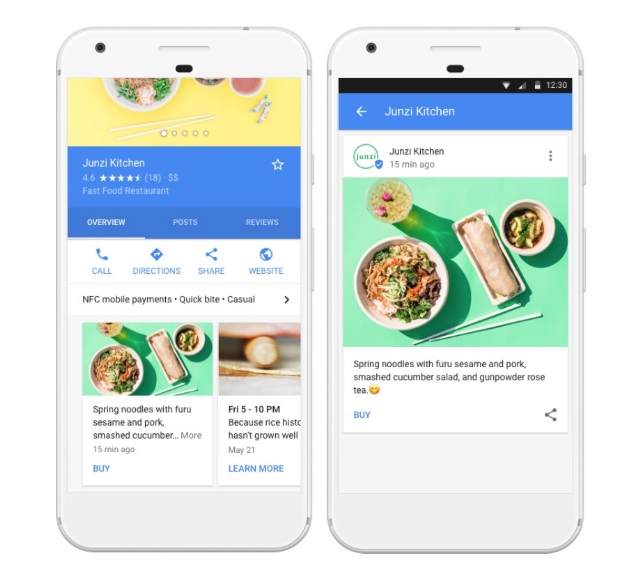
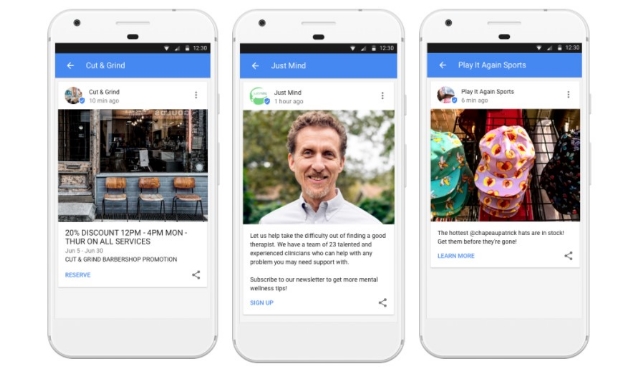
That’s all changing now, though. Google released a new feature this week called Google Posts for all businesses with a Google My Business Listing. With Google Posts, you can finally share your message on search results without the costs of ads or hit-and-miss nature of social media.

Any time you share a Post, it will appear in search results and Google Maps pages that include your business listing. The message will initially be just a small snippet, but searchers can expand it with a single tap to read more.

There are potentially limitless ways businesses can take advantage of the new feature. Specifically, Google suggests getting started by updating customers with information about new sales, upcoming events, and new product launches to build excitement.

In addition to your customized message, you can also include photos and custom calls-to-action to encourage making a reservation, signing-up for your newsletter, or linking to your latest special offer.

Google Posts are already available to any business with a verified Google My Business account. You can get started sharing your messages and customizing your listings now from any desktop, iOS, or Android device.

These days, everyone knows about content marketing in some form. Whether you’re a business releasing blog posts and videos, or a consumer downloading ebooks and clicking on sponsored posts, there’s no denying that content marketing is ubiquitous in the modern day.

But, you might be surprised to learn this isn’t a new phenomenon. Content marketing has been around long before the social media, blogs, or even the internet.

It would be hard to pin down exactly when someone got the idea to promote something through content in some form, but Uberflip suggests content marketing’s seeds go all the way back to cave paintings in their Back to the Future themed infographic.

Let’s hop in the Delorean and check out all the landmarks and milestones that have shaped our modern content obsessed culture with A Visual History of Content Marketing:

A Visual History of Content Marketing

Do you have a search box or form on your website? Are you still using HTTP for your site? If so, you may want to begin the process of switching to HTTPS sooner rather than later.

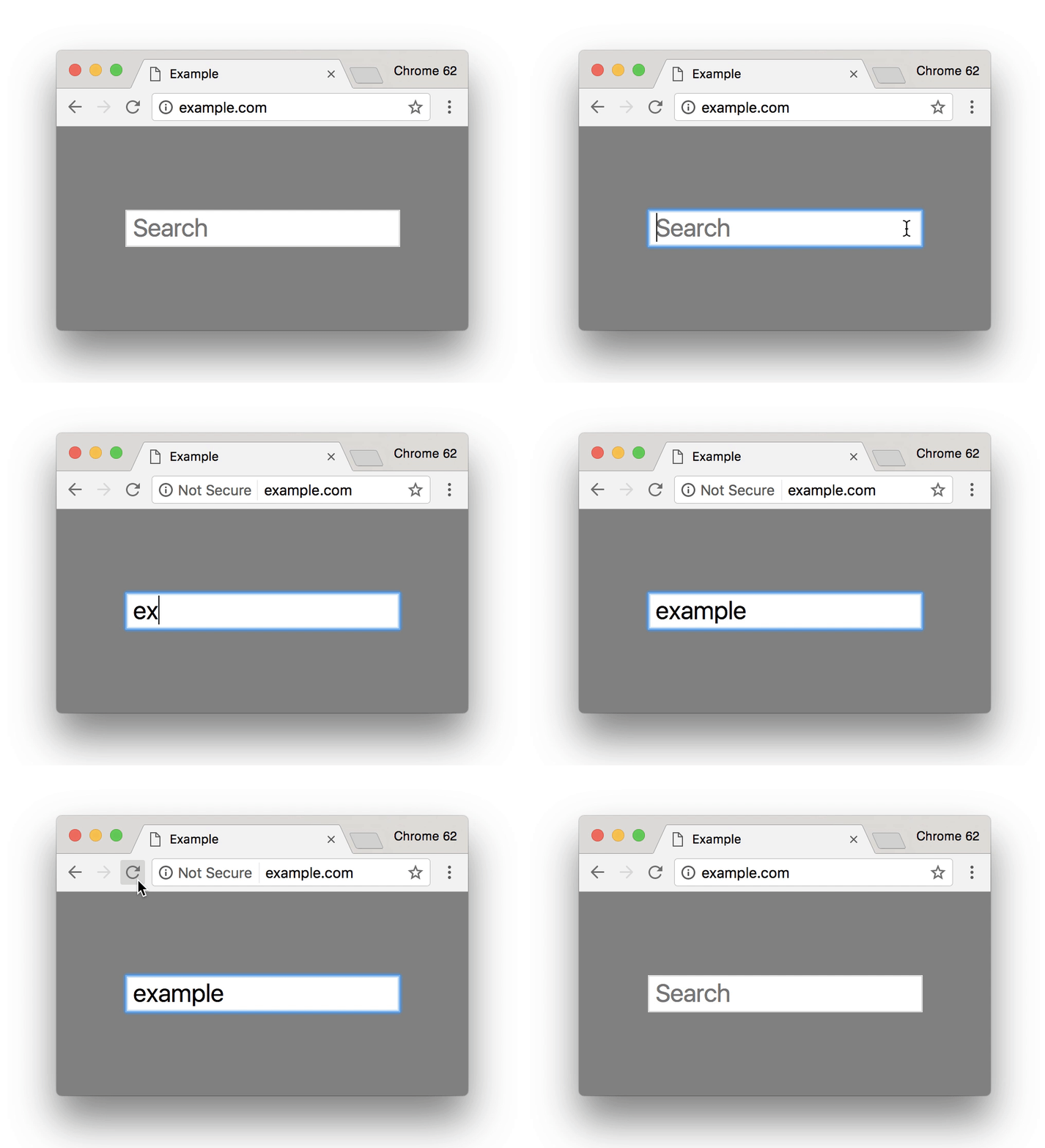
Google says it is preparing to launch new efforts within their Chrome browser to encourage webmasters to migrate to HTTPS, the newer, more secure security certificate for websites. Beginning I October, the browser will begin showing warning messages to visitors on pages with search boxes or forms.

As Google says, “[in] October 2017, Chrome will show the ‘Not secure’ warning in two additional situations: when users enter data on an HTTP page, and on all HTTP pages visited in Incognito mode.”

You can preview what the warning will look like in the gif below:


The warnings are just the latest effort by Google to encourage the adoption of HTTPS. Just recently, Chrome warned webmasters that pages with logins are now required to use HTTPS.

The end goal for Google is to mark any web page using HTTP as insecure, but it could be a lengthy process.

HTTPS
Between the countless public hacks, identity thieves, and an increasing awareness of how vulnerable personal information is, protecting customer’s personal data has become a hot-button topic over the past year.

Perhaps this may be why an increasing number of sites are switching to the more secure HTTPS web security protocol. In fact, a new report from Moz suggests the more than half of first page listings on Google are using HTTPS.

While Google has suggested site security could potentially influence a website’s ranking, Moz says the steady growth of HTTPS suggests the rise is more likely attributed to sites making the switch – not an algorithm update. Google has also stated that it has no plans to increase the weight of HTTPS on rankings in the future.

To verify the findings, Moz worked with Rank Ranger who produced almost the exact same results using its system.

Dr. Pete Meyers, who reported the findings for Moz, believes up to 65% of front page results on Google could be using HTTPS by the end of the year. This is entirely possible, given that Chrome is set to begin marking non-HTTPS pages as non-secure if they ask for personal information such as a password or credit card information.

Interestingly, the growth of HTTPS appears to be fairly equal across markets. The results suggest approximately half of the biggest names in Google search results have adopted the security protocol, while newer pages are using HTTPS because it is inexpensive and easy to use.

How long does your website take to load? If it takes more than three seconds, you’re likely losing more than half of your visitors.

It is no secret that everyone wants everything as fast as possible. That is especially true on the web. The faster your page loads, the more people will stick around and the happier they will be with their experience.

What you might not know, is that your site speed can directly affect your conversions and sales.

Data from Kissmetrics shows that up to 79% of customers who aren’t satisfied with your site’s performance say they are less likely to buy from the same site again. Taking that a step further, many first-time customers may leave before they ever get a chance to see what you have to offer in the first place.

Web Development agency Skilled collected 12 case studies from real businesses in an infographic showing just how powerful page load time really is. If you’ve ever doubted the importance of keeping your site optimized to be as fast as possible, you’ll likely be a believer after seeing these:

Page Speed

Google Logo

Do you have an on-site search engine to help visitors find the products and content they want? Do you rely on Google’s Site Search service for your search engine? If so, you should begin making plans for a replacement.

Google has confirmed it will be shutting down the Google Site Search product and discontinuing support by the fourth quarter of 2017.

Google Site Search powered internal search engines with Google’s own search technology, charging users based on monthly query volume for the product.

The paid site search product wasn’t Google’s only on-site search product. The company is directing consumers using the company to use either the ad-powered free custom search engine or cloud search product.

In a statement to Search Engine Land, a Google spokesperson said:

We are winding down the Google Site Search product over the next year, but will provide customer and technical support through the duration of license agreements. For GSS users whose contract expires between April 1st and June 30th, 2017, we are providing a free 3-month extension with additional query volume to allow more time for them to implement the necessary changes to their site. GSS customers may also take advantage of our Custom Search Engine solution, an ads-supported model that offers similar functionality. We continue to build out new functionality and invest in new technology that make enterprise search a great experience for our customers. Just recently, we introduced the general availability of Google Cloud Search for G Suite customers.