Tag Archive for: SEO

New research from Compete.com is suggesting being the first result on a SERP can make a huge difference from being second.

The analysis comes from “tens of millions” of consumer-generated search engine results pages from the last quarter of 2011. It also had some really interesting findings. 85 percent of all listings shown are organic, with only 15 percent paid search listings.

Out of the organic listings, 53 percent of clicks are going to the very first result, with the second result only seeing 15 percent, and all others getting even less.

Analysts from Compete.com summarize “since the vast majority of listings on a SERP are organic, and the majority of clicks are on the first listing, it’s imperative that brands strategy including constantly monitoring results due to the ongoing evolution of search engine algorithms.”

The paid results are also getting a large amount of clicks. Most specifically, ads in the top of the page perform very well, with between 59 percent and 9 percent of all paid results clicks. Ads on the right hand of the page however, get at most 4 percent of paid results clicks.

Overall, it is important to get your listings in the top position, if you want your page to be getting attention. For graphs and analysis of the results, read Miranda Miller’s article at Search Engine Watch.


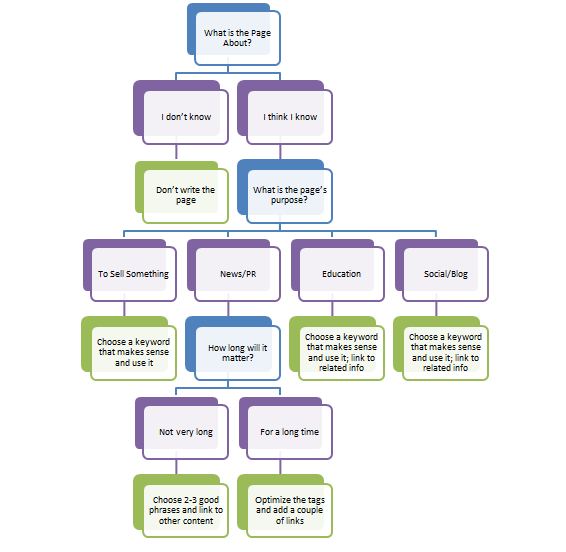
While we’ve been talking about how to optimize content quite a bit, there really are no guidelines out there for more broad questions you should be asking when going through the process of optimization. Jenny Halasz from Search Engine Land realized this, and created a flow chart for the optimization process, complete with what questions you should be asking yourself.

Optimization Flow Chart

“What is the page about?” – This is a really simple question, and if you can’t answer it, you probably shouldn’t be building the site. For your page to have any value, you have to know what it is about, obviously.

“What is the purpose of this page?” – Are you trying to create a blog post? Or maybe a sales pitch? How about a press release? No matter what the purpose is, you certainly need to have one, and be able to identify it while working on the page. Thinking about this before hand will help you put your content into context.

“How long will this content remain relevant?” – Educational pieces stay relevant until more information is found. Depending on the field, this could be years or just a few months. Product pitches on the other hand, stay relevant until your next line is due to be released, which can last as much as a year or two. Either way, adapt your content to the time frame it will still be important.

“What makes sense for optimization?” – The previous questions should be considered when creating the page, but now we’re at optimizing the site for search. Are the keywords you’re using relevant? How are you handling linking? Make sure you actually consider these factors rather than “going through the motions.”

The flow chart and questions should help you focus your process to reflect your client’s needs. Every step needs to be planned, and every question should be answered. If you’re optimizing right, the answers should come to mind pretty quickly.


The overlap between SEO and content strategy often ends up turning content creation into a marketing ploy, and little more. The blogs cite industry folks and data, and offer tips that are either glaringly obvious or recycled to the point of redundancy.

Guillaume Bouchard from Search Engine Watch has another idea for content creation. Think about what people want, not what “works” within the market. What works changes as fast as the industry can, while what people want stays relatively consistent. Long term success comes from reading what your visitors want.

For SEO professionals, you can follow the 70/20/10 model for a simple model for content creation.

The 70/20/10 model goes like this:

  • 70 percent of content should be low-risk
  • 20 percent should try to improve on what already works
  • 10 percent should be high-risk experimentation

The model comes from Coca-Cola, and can be transferred to SEO pretty easily. Link baiting is low-risk. Optimizing and trying to capitalize on some newer trends in the market covers trying to improve on what works, and that leaves 10 percent experimentation.

70 Percent: The Link Bait – Link baiting certainly has its pros and drawbacks, but for this model just think of it as content made with a purpose. It informs audiences, communicates complicated ideas, and establishes your reputation as an expert. This helps establish your brand in the industry. This acts as the mainstay of your content. Always available, but it can’t be all you have.

20 Percent: Optimize and Sharpen – For optimizing, look at what content is doing the best and what people are saying about your content. Try to improve upon what is doing best, and reinvigorating old debates with new information. Stay aware of trends and ideas in your industry, and react to them with content. This type of content creation helps keep you tuned to the changes in your industry, and keep you relevant, which will always translate to your audience.

10 Percent: Proactive and Reactive Experimentation – Time to have some fun. Experimentation requires really understanding your audience, and being confident enough to have an opinion. Think about fashion trendsetters. They see what is popular now, and act on their impulses in response. Content creation experimentation is all about seeing what is popular in the field, and making new content that people have never seen before.

This model isn’t something to keep set in stone, but it will help keep you relevant and interesting. Those are two things audiences always want.


It’s hard to keep up with Google’s constant adjustments, and AuthorRank is a future feature that isn’t as understood as it probably should be. Its history dates back to August of 2005 when Google filed a patent for “Agent Rank”.

This patent included ranking “agents” and using the public reception to the content they create to determine their rank. Basically, the more popular websites with positive responses would be higher in rankings than less-authoritive “agents”.

After the patent, “AgentRank” disappeared for a while, until in 2011 Eric Schmidt made references to identifying agents in order to improve search quality. A month later, they filed a patent for what is assumed to have become Google+, which acts as a digital signature system for identification, which can be tied to content. And that content can be ranked. Hello, AuthorRank.

It has yet to be officially implemented, but there have been rumors all year that AuthorRank is under development, and AJ Kohn has stated it could completely change the search engine game. It would act as a factor in PageRank, which makes high-quality content higher ranked.

Mike Arnesen at SEOmoz says it’s not a matter of “if Google rolls out AuthorRank, but when.” He also has some great suggestions of how to be prepared for when AuthorRank arrives. I highly suggest reading his extensive article, because I agree strongly with the idea AuthorRank will be here sooner rather than later.

With Google’s recent focus on social media, and the natural concept that people want to see quality content in their results, it is just a matter of time before AuthorRank is a serious concern to the SEO industry.


The internet is awash with tips and suggestions for SEO, but there aren’t many articles that clear up those pesky rumors and myths of the industries of optimization and blogging. So I’m here to help tear down those lies people hear and tell themselves about building an audience.

1) Making good content before you have an audience is a waste of good content – This is totally untrue. First impressions are all you get online, and if you are “reserving” all your good stuff for when you have a bunch of visitors, you will never get popular.

It is like selling a product before you’ve made the actual product. If you have just a few people coming to your site but they see good content, they will keep coming back as well as spreading the word. If you have a large amount of people visiting because you are advertising widely, but your content is worthless, they’re all going to leave and never look back.

Yeah, it isn’t fun to make great stuff that only a few are reading, but you have to keep an eye on the future. Great content attracts people eventually, as long as you put in the extra work to promote it. Plus, once you have an audience, they can always still find that great content no one was reading a month ago.

2) Great content will bring an audience – I emphasized that quality content will help attract an audience above and that still rings true, but there is other important work to be done before you’ll gain a crowd. You have to “pound the pavement” so to speak. Neglecting to actually promote the content can end up costing you links in the end.

Rae Hoffman at CopyPress has a full list of strategies for promoting great content, but the biggest emphasis is only push your awesome content. Spending energy on mediocre content won’t go anywhere, but if you can back up your promotion with quality content, you will get the launch you need.

3) Having a unique voice isn’t always possible – If you can’t find your specific voice, then you are doing the wrong type of work for you. Your site will never gain traction if you can’t have your own identity. You need a point of difference, or POD.

Finding your own POD can be as simple as combining seemingly seperate interests into your blogging, such as the girl who runs SkinnyTaste. She was just another amateur photographer who also loved making tasty low fat recipes. Both of those areas are flooded with contributors, but by combining the two into a blog with great recipes and enticing high quality pictures of the food, SkinnyTaste became a contender.

4) I’m not a great writer, so I’ll never be a great blogger – If you have found your own voice or POD, being a technically great writer is irrelevant. Many bloggers would have not gotten great grades in school if they turned in work in the style they blog in because they often make grammatical errors. Readers don’t care however, as long as the writer has a unique voice and interesting information.

5) Once I’ve got an audience, the rest will be easy – Rae Hoffman’s article earlier mentions Perez Hilton in this situation, and I can’t imagine a better blogger to express this point. Perez Hilton became a cultural figure for a short period because of his strong opinions and voice. So where is Perez Hilton now? Still blogging, but his television appearances have fizzled out, and you rarely hear his name brought up anymore. This is because Perez’s blogging became less celebrity journalism filtered through Perez’s voice, and more about why being Perez Hilton is wonderful. His focus left the gossip people were craving, and moved to the benign stories of a psuedo-celebrity.

The point of Perez’s story is once you gain popularity, you can’t rest or slack off. People are coming to you for whatever special information or content you are offering, and if you start slipping that audience will be gone faster than you could ever dream of.

Most of these myths are the type that people tell themselves when they are scared of making the leap into blogging, or the lies people give for why their site is floundering. Don’t let them keep you from getting started making a name for yourself, and if you are struggling, consider whether you’ve found your voice or POD or not.


It is way too common for people in SEO to forget to align their SEO strategy with social media activity. Often, the two teams work completely disconnected from the other. This is in no way a comprehensive, efficient marketing plan.

SEO must be integrated into social media activity. Here are some suggestions for specific strategies you can take to bump up the effect your social media activites have on SEO performance.

1) Using Social Media for Link Development – Since search engines have begun incorporating social signals into their ranking algorithm, it has become essential for SEOs to pay attention to social media. Now Google+ has become a part of Google search, and Bing uses Facebook data to personalize what people see in their search results.

While all of that is practically common knowledge, Ray Comstock at Search Engine Watch believes “link development is the most important benefit that social media can bring to the SEO table.” Google’s Panda and Penguin updates has made using social media to foster relevant link connectivity has become as important as they could be. The most effective way to market content online is through social media.

It is critical for SEO professionals take advantage of the activities of their social media team to gain relevant links through marketing quality content.

2) Aligning You Blog for SEO and Social Media – If you can create consistently quality content, blogging is easily one of the more efficient ways to build links and authority. It attracts links within your industry, but it also becomes keyword focused content that tends to rank highly in the long-term. Most often, bloggers forget to create relating internal links from a company’s blog to their main website content. Blog posts are an opportunity to direct people to other relevant content, especially your own.

3) Aligning Your Blogging Team for SEO & Social Media – Blogging is an important part of an SEO strategy, so you want to make sure your blogging team is trained on the best SEO policies and practices, as well as giving them the most important keywords and landing pages on your site. If you do that, your team will be more likely to create content based around those keywords, and creating internal links within the blog assists with your SEO goals. Plus, it is always nice for visitors to be able to find more content on your site.

Bloggers should also be interacting with the authoritative blogs in your area of expertise by contributing in intelligent and thoughtful ways which will build relationships with other experts in your field. It builds your reputation as well as making valuable connections that can lead to guest blogging.

By making sure your SEO and social media efforts are alligned, you both streamline the process in an effective way, as well as boosting SEO performance from a link building perspective.


Bad URL structure is far too common of an issue in SEO. It can drag down your rankings, keep your pages from appearing in search engine indexes and destroy ranking authority from any other pages and websites you are a part of.

This is sometimes the fault of content management systems who can build poor URL structures within the websites. Elsewhere, some platforms devise URLs with illegal characters.

Search engines do try to read and index even the most poorly made URLs, but paying attention to your URL management and optimization has its own set of benefits. It’s about time you made sure you are doing your part.

It isn’t difficult to diagnose URL based issues, however. You can check for errors and warnings that suggest URLs are causing the issues, and you can audit all of your URLs for proper syntax.

Google and Bing Webmaster Tools also have reports that reveal duplicate content. From there, you can examine the webpages themselves and their locations. Google and Bing aren’t even the only ones with these types of tools. Plenty of third-party SEO tools can help identify these types of issues. Also make sure to check for unsafe characters.

Tom Schmitz from Search Engine Land has charts to help make clear what characters you should be using and when. He also has many other suggestions on how to solve issues with poor URL structures.


While I’ve written extensively about why you should have an optimized site for mobile, I’ve rarely directly mentioned the two most obvious points for why you should. Websites that aren’t mobile friendly annoy visitors and it’s bad business.

Mobile users have more immediate needs, and they look for content that is designed to fit their needs.

A recent Google survey of mobile users says that 72% emphasized the importance of websites that are mobile-friendly. However, as important as mobile optimized sites are to users, 96% said they have visited a site that doesn’t work properly on their device.

The survey had 1,088 US participants who own smarphones and use them for internet browsing, and the survey was performed by independant groups.

Roughly three-quarters of respondents said they are more likely to visit a mobile optimized site than one that isn’t mobile-friendly, and they are five times more likely to give up on their task if the site isn’t optimized for mobile needs.

Following with those numbers, most customers said they are more likely to buy online when the site they find meets their mobile needs. Unfortunately, 61% are more likely to leave if the site isn’t mobile friendly. Even worse, when visitors find sites that aren’t mobile friendly, they are disappointed in the company itself.

So what are the needs of mobile users? They want sites that load in less than 5 seconds, big finger-friendly buttons and quick access to business contact information. They also want the pages to be designed to fit their screen, and links to the company’s social media profiles.

Basically, they want pages that work easily on a mobile interface, with easily accessible information and efficient designs. Mobile users want to be able to act immediately and most aren’t doing research on their mobile devices. They want ways to make contact and take action.

If your page isn’t meeting these needs, you are probably losing customers.

If you want to read the actual list of what the survey says mobile-users want, read Miranda Miller’s article at Search Engine Watch.

While your content quality is always important, it is always important to remember aesthetics when building up a blog. Adam Thompson from Search Engine Journal has a good rule for considering how your blog appears. “What’s on the inside only matters if the outside is attractive enough to keep viewers reading”.

This applies even when writing a blog post. Most internet users scan content instead of really delving in and reading. You need a quality title to intrigue readers, and good formatting to draw the readers to areas with the most important information. If you can do this well enough, your formatting may help grab your visitors and make them actually read.

We have a list of seven tips for formatting your blog, but beforehand, there are four requirements you need to meet.

  1. Have a high-quality theme – Make sure it is related to your brand, and if you choose a premium theme, you can have a designer customize it to match your brand.
  2. Use Great Titles – If your titles aren’t quality, visitors won’t bother to even skim the body text.
  3. Ensure you’re using social sharing buttons and widgets – Keep them relevant and easily accessible, but also remember not to clog the page.
  4. Follow SEO practices – Always make sure you meet the basic SEO best-practices such as static URLs, optimized page titles, meta descriptions, and image alt tags.
Now that we’ve covered those basic requirements, here are seven tips for successfully formatting your blog posts.
  1. Subheadlines – Breaking up your blog post with subheadlines help readers scan your post, and your subheadlines should give the reader a good idea what the post is about.
  2. Real Photos – Stock photos can always help add some good color and pizzaz, but if it isn’t adding anything unique to your post, then it shouldn’t be there. Your photos should be communicating something specific.
  3. Photo Captions – Captions help transform your pictures from basic aethetic touches to communcation of real ideas. Using captions well allows photos to be used to communicate specific information to the reader quickly.
  4. Custom Graphics – Sometimes charts or graphs may be the best way to quickly communicate information visually. While they require some extra time and money, custom graphics help clearly visualize data and spruce up your post.
  5. Pull Quotes – Pull quotes are an easy way to entice viewers to get intrigued in your post. If you use them right, your viewers will be intrigued by the quote and want more information or context.
  6. Use Color – Black text on a white background is old and boring. Add some color to liven up your page and engage viewers. It can be as simple as changing the colors of your Hx tags, or brightening up pull quotes. Don’t overdo it, and make your site neon, but use color to highlight information and attract readers.
  7. Bullet Point Lists – If your information is easily communicated in a list, always use bullet points or a numbered list. It makes it much easier for readers to scan for the interesting points, and still gain quite a bit of information.
If you can employ these tips in your blog, you will make viewers want to read, rather than trying to push them to the content. Coerce them to actually read by making it pleasant and engaging for them.


We’ve talked quite a bit about the quickly growing use of mobile devices to search the web. The latest reports show between 10% to 20% of all traffic on the web, and some popular websites, claim that roughly a fourth of their traffic is coming from mobile devices, if you include tablets.

Of course, this all shows that ignoring mobile web use at this point is not a good decision. Those that are innovating in the field of mobile optimization will have a much brighter future than those that continue to resist the mobile shift. The sooner you optimize your site for mobile use, the better chances your company will do well in the future.

There are two factors that differentiate mobile devices from other traditional computing devices. They both are obvious, but both factors have undeniably huge effects on users’ web experiences. The first is portability. Since mobile users are accessing the web on the go, their current location and activities become important to what they are accessing online. The second factor is screen size. Mobile screens do seem to be getting larger, but they will never go anywhere near standard computer screen size. Take advantage of screen size limitations of mobile users, rather than fight it.

With between 15-20% of all searches on Google, Bing, Yahoo, etc. coming from mobile users, how does that change search behavior?

Search Behavior Due to Location

Microsoft’s research has found that 30% of all mobile searches are related to their location, and 61% of searches end in a phone call. Like I said, a person’s locations and activities are clearly important to mobile user’s.

Of course, the recent changes to search engines have made great strides to customize search results based on user’s locations, but you should still make an effort to specify your business’s location on search engines using their web master settings.

The major search engines also look for location signals from the title and text present on a website. If you own a local business, make it easy for them to find these signals. Emphasize the location on the site so search engines prioritize your website in search results around your area.

Can you still take advantage of mobile users’ locations even if your business has more than one location? Of course!

If your business has multiple locations, you should be creating internal pages for your different locations, with a present hierarchy starting from the homepage so that search engines will notice the location specific pages too. You will still have to deal with standard issues such as speed, relevance, and backlinks, but taking advantage of location will help get individual pages ranked based on where your users may be.

Search Behavior Due to Screen Size

Screen size contstraints are a more physical limitation, but it strongly effects how people search and visit pages. The clearest difference between mobile and desktop search is the number of paid results and advertisments. On most search engines, there are far less paid ads on mobile because of the screen size. That means organic results on mobile are more important than on desktop.

Screen size also limits the number of results you recieve at any given moment. On a typical smartphone you can only see a few results at a time. Desktops give users a broad range of results immediately, but on mobile the top three results are key. Mobile users are not prone to research, and they rarely go past the first page of results, so it is important to get your page as high in the rankings as possible.

Search behavior on mobiles are certainly unique from their desktop counterparts, and mobile requires a similarly unique SEO strategy. Of course, desktop is still important, so the best way to approach the issue is by creating a seperate mobile site that is optimized for mobile user experience. The longer you wait to optimize, the more trouble you will have later.

For more, read Paras Chopra’s article at Search Engine Land.