Chances are you are already trying out AdWords Enhanced Campaigns. If not, you’ll likely be testing the new waters soon. So now seems like a good time to go through some basics to ensure you’re getting the most of your campaigns and enlisting the new features to work for you.
Lisa Raehsler has a checklist at Clickz for you to go over as you launch your new campaigns. Some of the advice is the same you would get with standard AdWords campaigns, but bears repeating. The rest is valuable insight into how to use Enhanced Campaigns new features to your full advantage, which can gain you more conversions and cost you less money.
For the past couple of weeks, you may have been hearing a lot about AdWords newest endeavor, ‘Enhanced Campaigns’. They are reportedly starting as an added option but the idea is to make them a more integral part of AdWords in just a couple short months.
Daniel James wrote an article at Bit that explains a little about the added features of enhanced campaigns and how you might utilize them. Most exciting is the ability to link to different versions of your site based on what device a user is currently on when they click your ad and a function that identifies whether your store is open at the time an ad is clicked.
The new features seem to be geared toward directing customers to what they are searching for, while you spend less per conversion. These all seem like good things for everyone involved.
Last week the internet felt tremors that were very similar to the shock waves unleashed by Google’s Panda Updates, but something was different this time. Google didn’t announce or confirm the update, and they say they won’t confirm any updates in the future.
At this point, it is widely assumed the small shakeup last week was the Panda Update that Google’s Web Spam guru Matt Cutts said would be coming sometime soon at SMX West early on last week. But, as Search Engine Land reports, while he was talking, Cutts also said that Google’s Panda Updates would no longer be unveiled in big monthly changes. From now on, Panda’s changes will occur gradually.
The shift from big abrupt changes to a more fluid update system means that sites hit for low-quality content may not be able to diagnose their issue as easily. Site owners can’t look at their Analytics and see a big drop correlated with a confirmed update around that time period. However, Danny Goodwin says it may mean a faster recovery.
Site owners who have done their proper due diligence will no longer have to wait for the next update to roll around to see if Google has viewed their work favorably.
Google confirmed 24 of the Panda Updates, and the 25th is believed to have occurred late last week, but from now on, there won’t be any big announcements or confirmations. Just like everything else at Google, their web spam algorithms will be constantly changing over time rather than abruptly transforming.
00TMOhttps://www.tulsamarketingonline.com/wp-content/uploads/2018/07/TMO-Logo.pngTMO2013-03-18 12:54:252013-03-18 12:54:25Panda Update May Have Happened, But Don’t Expect Google To Say So
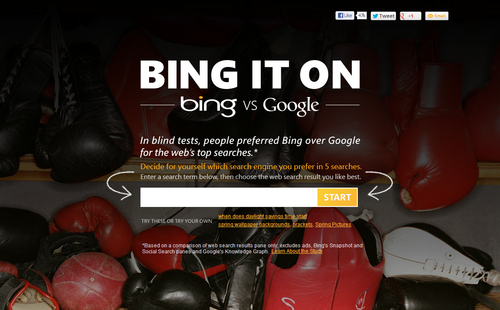
It’s been a week since Microsoft dropped their “Scroogle” attack ads aimed at Google, but they are still running their “Bing It On” challenge trying to convince searchers that Bing is superior to Google. Yet, all of Microsoft’s attempts don’t seem to be working. Despite Microsoft saying Bing It On testers preferred Bing 2:1, Google continues to claim well over half of all searches.
This has Greg Sterling from Search Engine Land wondering why no one believes Microsoft’s and other competitor’s “Better Than Google” claims. Is Google’s brand just that strong? Does it come out of habit?
The most obvious reason people don’t buy Bing’s campaign is they are blatantly aware it is all marketing. They used the same principle as a blind taste test, but those types of tests don’t come off as explicitly biased as a website “blind” test. Just to get to the test you have to go to a website with Bing in the name.
No one is going to trust Bing’s statistics when they are that blatant about the test. There is nothing blind about going to “Bingiton.com“. It also doesn’t help that there is a big disclaimer at the bottom of the search page explaining how the test doesn’t use the full search capabilities of either engine.
Google believes part of the reason users aren’t responding to Microsoft’s negative marketing is customers respond better to companies that “focus on building good products” rather than slinging mud. While Google remained as silent as possible on the “Scroogle” ads while they ran, now that they have been stopped, Google search chief Amit Singhal finally spoke about the issue at a SXSW conference, when taking questions from Twitter. “We focus on our users.”
Google’s right, customers don’t respond to negative marketing campaigns against well established brands as well as they respond to the new and innovative products Google is producing.
But, what about independent studies? A recent study by Butler University found that not only did Bing have better quality answers according to their criteria, but so did ChaCha, Ask.com, Bing, and Yahoo. Why has this type of study not put a huge thorn in Google’s side? One reason is Google’s incredibly strong brand. There is also the “Google Habit” or the comfort with the interface, but more than anything it is personal experience.
ChaCha may have better answers, but most users will agree it is not convenient enough for when you need to make a quick search and find a simple answer. Bing has been making users uncomfortable with their blatant attack ads, and any survey that puts Ask.com ahead of Bing, Yahoo, and Google will be heavily doubted in this age. The website lost its reputation years ago as other search engines grew, and it never regained it, just as Yahoo has steadily lost its market share to Google.
The only companies that can compete against Google are equally strong brands such as Amazon and Apple. Google is so well established in the American market, that it is hard to believe any study reporting that there are a handful of “better” ways to search. But, Google didn’t just install itself into ourcollective hive mind. Google is trusted because they offer a search engine users are pleased with, and they are constantly innovating new and exciting products. If they ever stop innovating, Bing might have a shot. Until then, attack ads and over the top marketing campaigns aren’t going to do much.
On Friday, Google launched “How Search Works” in an effort to inform the public exactly what Google does. The centerpiece of it all was a large infographic filled with broad information about how the search engine crawls and indexes the web, how their algorithms work, and how Google fights spam. With the infographic, Google also released tons of resources that SEOs will find of interest.
One of those resources was the official release of Google’s Search Quality Rating Guidelines for the first time ever. Many have already seen a version of this document, as an older, edited version was leaked and circulated quietly already. What is interesting is how different the new version is from the one passed around in the past. The non-public version of the document clocked in at 161 pages, which makes the new 43 page version feel slim.
It is possible Google chopped down the version they actually use for public release in order to maintain a small amount of secrecy as to how Google’s human search quality raters grade results, but it is also possible the company has been steadily revising and streamlining their guidelines over time.
To understand which document you should put more weight in, you need to compare what has been changed, and what has been left in. For example, the third and fourth parts of the document have been completely cut, removing detailed guidelines on how to rate pages, how to gauge the reputation of a website, and even specific examples of public webpages with example ratings. Matt McGee took the time to document every change to the guidelines before their public release. It is up to you to decide which version you should favor.
Pay-per-click advertising, such as Google AdWords, can offer a variety of benefits for your company, but you should also be aware of the things it cannot do. Unfortunately, there is a lot of chatter that creates myths about the capabilities of PPC advertising. Lisa Raehsler of Clickz recently set out to debunk some of these myths.
1. PPC and Instant Sales
Don’t expect to start your AdWords account, then kick back and watch your sales numbers soar. You’ll need time to tweak your campaigns and hone in on your target audience. This is especially true for niche markets.
2. PPC Isn’t A Cure All
There are times when pausing your PPC campaigns is actually the best option. Don’t rely on them to help sales rebound in all situations.
3. Consider More Than Conversions
Just because an ad doesn’t directly lead to a conversion doesn’t mean it isn’t doing its job. Many consumers need multiple interactions before they will turn into a conversion. Your ad may have just opened the door for a future conversion.
4. PPC and SEO
There are plenty of people who have pushed the rumor that companies who advertise with AdWords receive better position in Google search. It’s simply not true.
5. The Top Spot Isn’t Tops
Many times, the top spot will perform best in sales, but you’ll also be paying for that position. The conversion rate for lower positions can sometimes beat that number 1 spot and you’ll pay a much lower premium.
Anytime a new website owner starts looking for an SEO, they always want to get to that precious number one spot for searches on Google. It’s hard not to want it, especially when quite a few people don’t even scroll down the page when they search for something. However, you shouldn’t be measuring SEO success by rankings.
There are plenty of SEO metrics to measure site success with, and rank isn’t near as important as you might think. Nick Stamoulis pinpointed three reasons you shouldn’t be focused on rank when you start using an SEO service.
Search is Personalized – Search engines are getting more advanced with their searches, and Google has a huge amount of user data they can take advantage of to craft search results that are personalized for every user. If you manage to show up in the number one spot for one searcher, you likely won’t for another. Rankings aren’t a concrete list of sites anymore, but a fluid collection of sites based on what you have shown interest in before.
Rankings Fluctuate – Aside from the differences in search results from user to user, Google is constantly updated their algorithms and finding new content. The web is in a continuous state of change, and the rankings evolve to match this. While Google’s big algorithm changes may make drastic differences to results, the smaller continuous updates going on can change a couple rankings for any keyword every day. Search engines also favor brand new content, so sites that have slacked off start to fall down the rankings.
Ranking for the Wrong Term is Useless – No honest SEO company will promise to get you a specific ranking. Some markets are more competitive than others, and you can’t control what Google does. That doesn’t stop some less reputable SEO services out there from promising they can get you the number one rank. The problem is, they will get you the number one rank for a keyword no one is searching for. If no one is searching for it, no one will notice that your page is the first result.
https://www.tulsamarketingonline.com/wp-content/uploads/2018/07/TMO-Logo.png00TMOhttps://www.tulsamarketingonline.com/wp-content/uploads/2018/07/TMO-Logo.pngTMO2013-03-05 10:11:242013-03-05 10:11:24Three Reasons You Shouldn’t Care About Rankings
Google has been fighting spam with algorithms and manual penalties, but the best tool this whole time may have been information. Google has offered Webmaster Guidelines for ages now, but there has still been quite a bit of misinformation as to how exactly search works. Those who don’t spend their time reading tech and internet books, blogs, and websites probably don’t have any idea how search works.
As Search Engine Journal pointed out on Friday, Google has heightened their resolution towards open information with an infographic entitled How Search Works. The infographic is broad and won’t give a lot of new information towards exactly what search signals are being favored or what the best methods are (that’s what the Webmaster Guidelines are for after all) but the infographic will be very helpful to those who may not understand how Google handles indexing the entire internet.
What may be of some interest to SEOs and other internet professionals is the additional information Google released along with the unveil of How Search Works, including Search Quality Rating Guidelines, charts of what type of spam they have been removing, and how often Google gets Reconsideration Requests. Even when they don’t give a lot of specifics, any information directly from Google is always great for those of us trying to make our websites fit their requirements as well as possible.
Two years ago Google unleashed Panda onto the world, and SEO hasn’t been the same since, especially when it comes to link building. Hundreds of thousands of sites have been penalized and some have made their way back to where they were, but countless others have perished or are still trudging along trying to recover.
Some of those sites were mostly innocent and got in trouble for just being a little too unscrupulous or not quite knowing what they were doing with link building, but the wide majority of these sites hit by penalties were flagrantly engaging in cheating trying to get their site’s traffic up by gaining a massive quantity of low quality links instead of a respectable number of solid links.
Still, those penalized have had to try to find a way to get their site restored to its former traffic rates and search rankings, and after two years of toiling away, the question eventually arises: “Should I just give up and start over?” Well, Eric Ward gives a simple question to that. “Are you going to do things differently with the new site than you did with the old site? If not, then it really doesn’t matter.”
Most of the websites unable to reclaim their former “glory” are still struggling because they haven’t wised up. The only way to be able to consistently rank highly on Google and Bing is to run a quality site people will want to visit. You can use SEO to get you there, but you can’t fake a good site.
Your daily schedule is pretty tightly booked. Usually, trying to cram in some time to optimize your AdWords campaigns to get the most out of your online advertising budget is pretty low on the list of priorities. But, if you put in a little time upfront, you can run an efficient and effective campaign for just minutes a day.
That’s the premise that Ben Cohen works from in his article for Business2Community. He’ll tell you where to allocate your precious time and how to set up your account so you can manage it quickly and get on to your other duties. If you have an AdWords account already, you understand how valuable this information could be. If you’ve been hesitant to start an account because it is so time consuming, this could be just what you need to get started.
00TMOhttps://www.tulsamarketingonline.com/wp-content/uploads/2018/07/TMO-Logo.pngTMO2013-02-26 21:07:202013-02-26 21:07:20Time Savers For Managing Your AdWords Account

 Chances are you are already trying out AdWords Enhanced Campaigns. If not, you’ll likely be testing the new waters soon. So now seems like a good time to go through some basics to ensure you’re getting the most of your campaigns and enlisting the new features to work for you.