
Tag Archive for: Google

You have probably already seen the statistic that states Google accounts for two-thirds of the world’s search queries. So where do the other one-third go? That would be the Yahoo Bing Network. Gregg Hamilton, at Search Engine Watch, jumped from this realization to investigating the pros and cons of the two dominant PPC platforms: AdWords and YBN.

The conclusion seems to be essentially what you’d assume, AdWords is superior. But, YBN has some merit. Though you’ll get less exposure, you’ll also get less competition. And with that, you’ll see a lower cost-per-click. You likely won’t get as much traffic and you’ll see a lower click-through-rate, but if you’re on a budget, YBN may be of interest to you.

Did you know you can become “AdWords Certified”? It’s news to many people, but there is actually a licensure exam of sorts to test your expertise and acumen.

Bill McCaffrey went through the process and wrote about his experience at Business2Community. While he doesn’t go into much detail about what exactly the exam covers, your interest may be piqued enough to look into it yourself. Having the title, “AdWords Certified”, after your name may not make much of a difference to you, but having the knowledge that comes with it could enable you to better understand PPC advertising. At the very least, you may be able to ask more informed questions of those who handle your online marketing campaigns.

Today is April Fool’s Day, and of course that means every major company has unveiled a new fake product. Google, for example, announced Google Nose, which would let you smell your results, if it worked. That’s the type of prank you normally expect to see from big companies. They’re all in good fun.

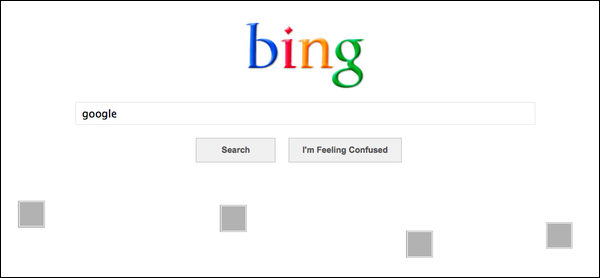
Well, Bing decided to make their April Fool’s Day prank a fake new product and a slam directed obviously at Google all in one. They announced, through a blog post, Bing Basic, a redesign of their front page, only accessible through a special “telltale query”, “you’ll get something a little more bland” than their front page.

If you guessed the “telltale query” was “Google” and that Bing Basic removes the big pictures from their front page in favor of a colorful logo, white space, and a simple search box, you’d be correct.

bing-april-fools-2013

Of course, this Google bashing is far from new for Bing, but it is kind of odd to see a company take a day normally full of nonsensical and sometimes wonderful fake ads, webpages, redesigns, and other fun little jokes and turn it into a swipe at the competition. It certainly isn’t the first time though.
In the meantime, I’ll be dreaming of the day Google Treasure Maps is a real thing.

It can be hard to notice, but Google’s search engine results pages (SERPs) are constantly changing. Sometimes it is a result of new algorithms or updates to Penguin or Panda, but often it is a result of Google’s non-stop tweaking of their formula. If you weren’t consistently studying and analyzing SERPs, you probably haven’t even noticed.

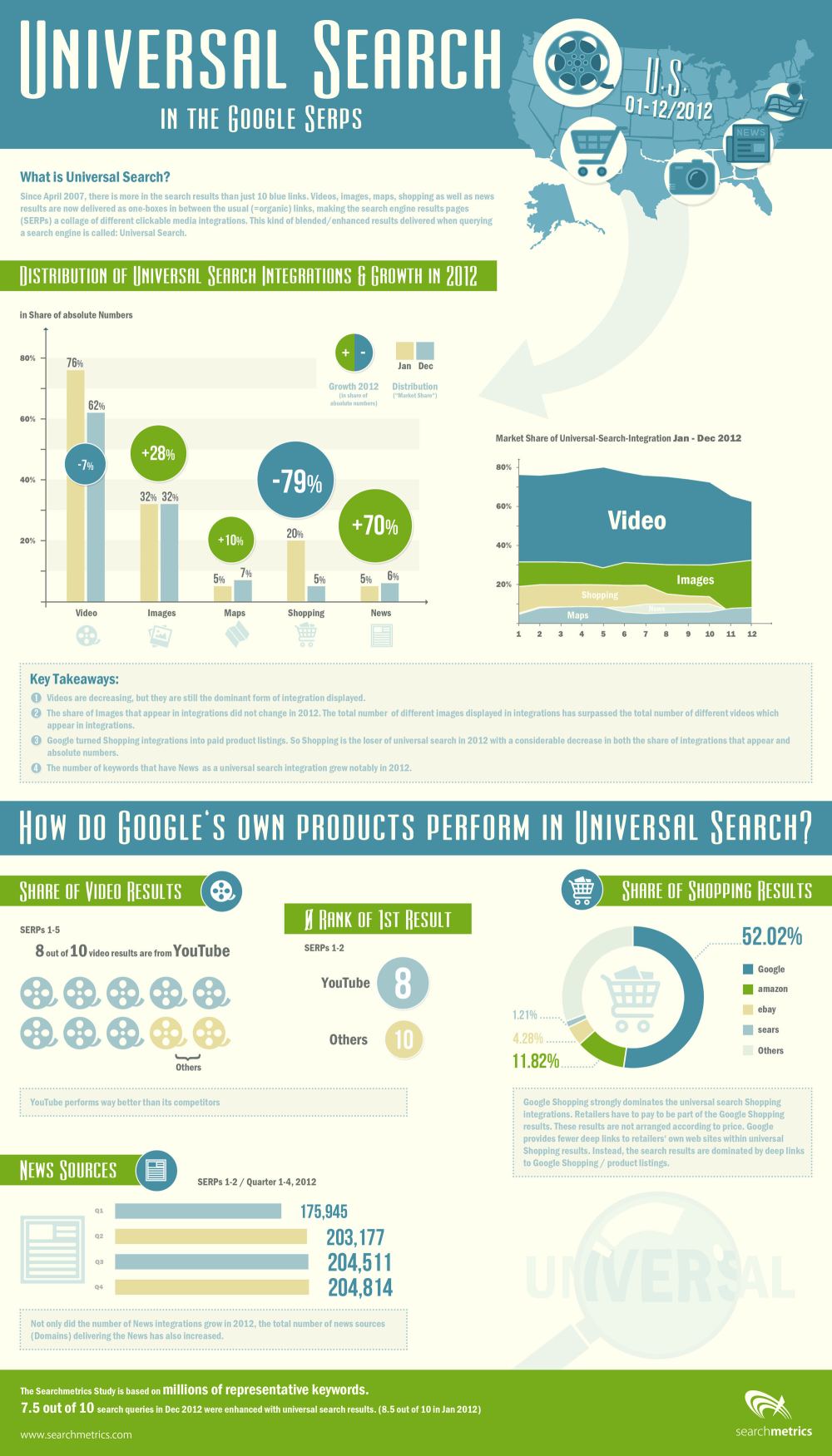
SearchMetrics does just that type of analyzing of SERPs, and they just released their study of last years result pages, and there are some interesting points for all search marketers wanting to know what Google is favoring in their results. The highlights of the study, as pointed out by Search Engine Journal, are:

  • A small decline in video integration
  • A significant increase in image integration
  • A sharp decline in shopping
  • A large increase in news integration

The decline in video integration is one of the most surprising, as I’ve heard more than one analyst predict video will be one of the most popular mediums for content marketing this year. If they’re predictions are true, video makers will have stiff competition getting their content onto the SERPs.

Similarly, eCommerce pages are on the rise, and the data suggests business owners should be considering paying into the Google Shopping network to have their products seen by more people.

On the other hand, the big increase in news shows big opportunities for content creators reporting on events and doing news worthy journalism.

SearchMetrics made an infographic to go along with the release of their study, which you can view below or here.

rsz_universal-search-in-the-google-serps

Did you know there are more than 700-thousand mobile apps for Android or iPhone? How about that the mobile app industry was valued at an estimated $30-billion in 2012? Those are pretty astounding numbers and they suggest that, if you haven’t already gotten into the app game, you should do so soon.

Now, Google is making it easy to find and download your app too with the introduction of a “click to download” ad template in AdWords. It’s part of the “Enhanced Campaigns” you’ve been hearing so much about. Mobile users can download an app with a single click from search listings. iPhone and Android users only, however, as currently, Blackberry and Microsoft are being left out.

Head over to Business2Community where Larry Kim has the particulars on how to set up your mobile app ad in AdWords.

Screen-Shot-2013-03-19-at-2.26.52-PMWhile everyone in SEO collectively yells every time a Google Panda update rolls around, announced or unannounced, Google’s spam fighting algorithm Penguin may be of more concern for many website owners.

Though Google’s estimates say less than four percent of websites have been affected by Penguin, a new study by Portent suggests that Penguin will eventually be a concern for SEOs everywhere, if it continues to follow its trend.

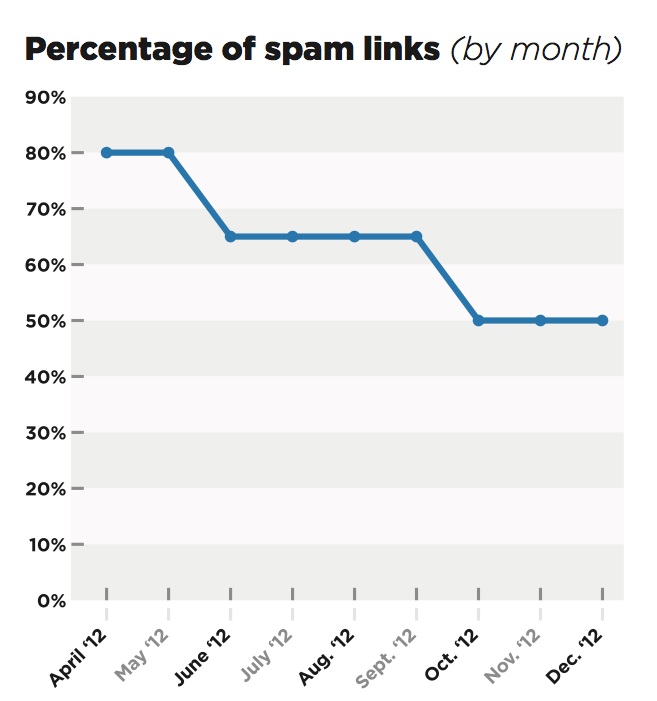
Since the reveal of Penguin, Google appears to have become less tolerant of spammy links. The study looked at 500,000 links which show that Google has been steadily reducing its webspam tolerance, and increasing the likelihood of site penalties over time.

This isn’t an issue for most legitimate site owners, as it takes roughly 50-percent spammy backlinks in your profile to trigger a Penguin site penalty, but when Penguin came out, a site needed to have 80-percent of it’s backlinks classified as spam to attract the attention of Google.

Still, a site with 50-percent spammy links isn’t watching their profile all that carefully, and is probably engaging in some pretty questionable strategies. The concern is where Google will draw the line. Will they keep tightening their grip until only 5-percent of backlinks are allowed to be “spammy”? We won’t have any idea until another Penguin update appears.

Source: WikiCommons

Source: WikiCommons

It is no secret how important a mobile SEO strategy is in today’s market, especially with predictions coming out stating mobile internet usage will overtake desktop internet usage in the next year.

Eventually, mobile search could catch up to desktop search, and users aren’t just staying on any website they find. Two-thirds of consumers say they are more likely to purchase from a website that has a mobile-friendly website, and more than a few survey has shown how low-quality sites or long load times repel searchers like a disease.

You probably knew all this. The debate over the importance of a mobile SEO strategy is over. The real question for most web designer’s is how do I achieve a mobile-friendly website? You have two options: a responsive web design, or an entirely separate mobile website.

There are pros and cons to both methods of course, but gradually it appears responsive designs are winning, especially when SEO is a factor. Jay Taylor, writer for Search Engine Watch, breaks down three reasons why responsive design seems to be taking the lead.

The biggest reason stems from a big endorsement from Google. It is an SEO professional’s job to please the almighty Google, since they command more searches than all of the other engines combined, and Google loves responsive design so much they called it the best practice for the industry.

Google’s preference for responsive design is likely because responsive sites have one URL and the same source code, regardless of how it is viewed, which makes the site easier for Google to crawl and contextualize. Separate mobile sites, on the other hand, have separate URLs and HTML, which complicates everything for the search engine.

Further more, content on responsive sites is easier for users to interact with and share than content that is separated between different websites. If that seems weird, imagine what happens when you get a link over Facebook from a friend who was on their phone. If you open that link on your desktop, you might get sent to a stripped-down mobile website if they use the separate website method.

When Google recommends a method for achieving your mobile SEO strategy, it is always best to do as they say, but there are other reasons responsive design is slowly taking over the search market. It allows a more uniform experience across devices, and makes managing your entire strategy easier. Everyone likes their work to be easy right?

AdWords recently introduced a new feature capable of showing your ads to more users, while also delivering a highly targeted audience. It sounds too good to be true, but, as Jeremy Decker reports for Search Engine Journal, the ‘similar audience’ feature makes it a reality.

The new feature picks up where remarketing leaves off. Now, not only will prevous visitors of your site be shown your ads, but also other users who have a similar search history as those users. This means that those who may be interested in your product but have not yet found your site will be shown your message and, hopefully, driven to your site.

KeysChances are you are already trying out AdWords Enhanced Campaigns. If not, you’ll likely be testing the new waters soon. So now seems like a good time to go through some basics to ensure you’re getting the most of your campaigns and enlisting the new features to work for you.

Lisa Raehsler has a checklist at Clickz for you to go over as you launch your new campaigns. Some of the advice is the same you would get with standard AdWords campaigns, but bears repeating. The rest is valuable insight into how to use Enhanced Campaigns new features to your full advantage, which can gain you more conversions and cost you less money.

For the past couple of weeks, you may have been hearing a lot about AdWords newest endeavor, ‘Enhanced Campaigns’. They are reportedly starting as an added option but the idea is to make them a more integral part of AdWords in just a couple short months.

Daniel James wrote an article at Bit that explains a little about the added features of enhanced campaigns and how you might utilize them. Most exciting is the ability to link to different versions of your site based on what device a user is currently on when they click your ad and a function that identifies whether your store is open at the time an ad is clicked.

The new features seem to be geared toward directing customers to what they are searching for, while you spend less per conversion. These all seem like good things for everyone involved.