Tag Archive for: Google

google-alerts1

Google is continuing its efforts to promote privacy in search by prioritizing indexing HTTPS pages over their HTTP equivalents.

In the announcement, Google explains its long-term aim is to eventually direct users to secure webpages with a private connection. The step to only index HTTPS pages when an HTTP equivalent exists is their most recent move in this process, following the small rankings boost given to HTTPS pages last year.

Unlike the change to Google’s algorithm in August 2014, this move will not have any effect on rankings. Instead, it simply means that Googlebot will only index the HTTPS version of a URL when both an HTTPS and HTTP version exist.

While Google’s commitment to secure search may lead to more rankings boosts for HTTPS pages in the future, this change is mostly to improve the efficiency of Google’s current indexing process. As they explain in their announcement:

“Browsing the web should be a private experience between the user and the website, and must not be subject to eavesdropping, man-in-the-middle attacks, or data modification. This is why we’ve been strongly promoting HTTPS everywhere.”

Google Logo

Christmas is almost here and the New Year isn’t far behind, which means it is time for the annual end-of-the-year lists to show us what people were searching for this year. Yesterday, Google released their “Year In Search” video and list to highlight the most important topics of 2015.

The most searched for topic of the year is also possibly the most tragic; Google counted over 897 million searches about Paris this year, largely due to two major terrorist attacks in January and November. Particularly, in the immediate wake of the November attacks, Google saw the most searches about the city ever performed in the search engine’s history.

The Year In Search list also features several top news events such as Hurricane Patricia, the discovery of water on Mars, the terrorist group ISIS, and the earthquake in Nepal.

While the end of the year list features several events that united us through tragedy, it also shows the more lighthearted topics that caught our collective hearts and minds over the past year.

“Star Wars” was a huge topic of discussion for the internet, with more than 155 million searches before its world premiere. However, the most searched for film of the year was actually another highly anticipated sequel. “Jurassic World” took the lead spot, although Google didn’t detail exactly how many searches it received.

With all the focus on Donald Trump these past few months, you might expect him to lead the most searched for public figures, but The Donald only came in seventh place behind Charlie Sheen and the Orange Is The New Black character Ruby Rose.

Instead, the three most talked about public figures of the year were Lamar Odom, UFC fighter Ronda Rousey, and Caitlyn Jenner, who saw a huge spike in interest following her gender transition announcement on ABC News’ “20/20” in April.

You can see Google’s inspirational Year In Search video below, or you can browse all the Year In Search lists at Google Trends.

Source: Robert Scoble / Flickr

Source: Robert Scoble / Flickr

Most online advertisers consider conversion tracking an essential part of their toolkit. After all, why pour money into advertising if you can’t properly see how effective it is and optimize it? However, there are many businesses who are not using conversion tracking or importing goals from Google Analytics into AdWords. Google says they have a new feature just for them.

The new Smart Goals are powered by Google Analytics and aim to help businesses without a way to measure conversions evaluate their advertising efforts and optimize their campaigns.

Unlike conversion tracking and Analytics goals, Smart Goals don’t measure actions taken directly on an advertiser’s website. Instead, it uses the anonymized conversion data collected from other websites by Google Analytics to identify visits “most likely” to convert based on Google’s estimate.

The announcement explains:

To generate Smart Goals, we apply machine learning across thousands of websites that use Google Analytics and have opted in to share anonymized conversion data. From this information, we can distill dozens of key factors that correlate with likelihood to convert: things like session duration, pages per session, location, device and browser. We can then apply these key factors to any website. The easiest way to think about Smart Goals is that they reflect your website visits that our model indicates are most likely to lead to conversions.

To set up Smart Goals, advertisers will need to link their Analytics and AdWords accounts and must receive at least 1,000 clicks rom AdWords over a 30-day period “to ensure the validity of your data.” From there, select Smart Goals, under Goals in the Admin tab.

Advertisers can even preview well Smart Goals can work for their site before activating it by exploring the new “Smart Goals” page under Conversions in Analytics. This page lets you analyze the behavior of Smart Goals visits and compare those to the visits deemed unlikely to convert. If you like what you are seeing, you can then import Smart Goals into AdWords.

Once Smart Goals have been imported, advertisers can set a target cost per acquisition (CPA) with the Smart Goals being the acquisition. The announcement says, “in this way, you’re able to optimize your AdWords spend based on the likelihood of conversion as determined by our model.”

Google says Smart Goals will be rolling out over the next few weeks. While it may serve as a reasonable solution for some businesses, for most Smart Goals may seem like a bit of a stop-gap solution. To really take control of your online advertising and guarantee you are getting your money’s worth, you will want to use conversion tracking,

If you need help getting started, contact us. We can get you set up and help you optimize your advertising to ensure the best results.


Google-star-wars-easter-egg-800x492

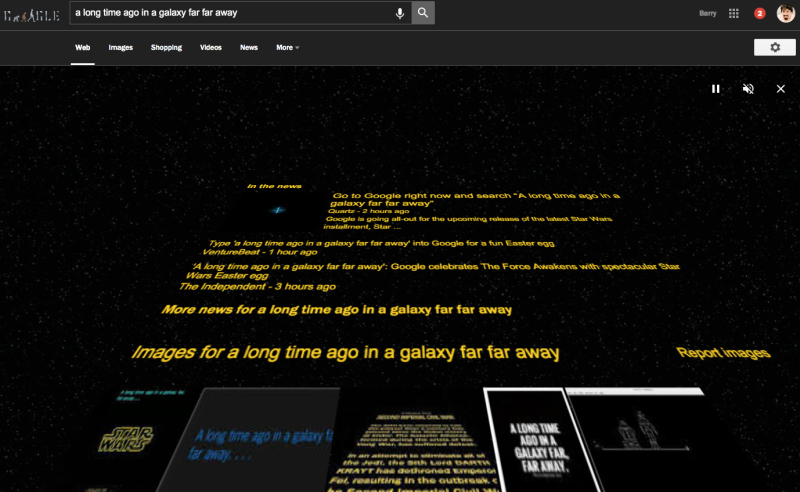
As the premiere of Star Wars: The Force Awakens grows closer, Google is getting in on the excitement. The company recently announced its new #ChooseYourSide campaign, and indicated it was planning a number of Star Wars Easter eggs ahead of the film’s release on December 18.

Well, you don’t have to wait for the Easter eggs to start popping up. The first surprise for Star Wars fans who use Chrome has already been found.

Just Google the famous first line from the original 1977 Star Wars movie (“a long time ago in a galaxy far far away”), and you will be treated to a page in the style of the series iconic opening crawl. Instead of an summary of intergalactic politics and jedi-related events however, the scrawl shows search results over a Star Wars-themed background.

You can find out more about the #ChooseYourSide campaign over at Marketing Land. Fans will have to keep waiting for the film’s release, but keep your eyes peeled for more exciting Easter eggs in the meantime.

For the first time, Google has released the full version of their Search Quality Rating Guidelines, a document used by Google Search Quality Rates to help determine how to rate the search results they are testing.

The document has become public in the past, through several leaks. Just this week, the October version was leaked. The search engine also released an abridged version in 2013, but now the company has decided to officially release the entire 160-page version previously only available to Search Quality Raters.

Google’s Mimi Underwood said that “ratings from evaluators do not determine individual site rankings, but are used help us understand our experiments.” She added, “The evaluators base their ratings on guidelines we give them; the guidelines reflect what Google thinks search users want.”

As expected, Underwood also implied the document will be updated over time, “as search, and how people use it, changes.”

You can download the full Search Quality Rating Guidelines here.

With Halloween in the rear-view mirror we have officially entered the holiday season, and Google is rolling out new features to help businesses prepare. Google My Business announced it is launching a new feature that allows businesses to set their holiday hours in advance, so shoppers will always know when you are open.

In the past, businesses had to manually update their hours manually if they changed their hours for the holiday season, and when the season is over you had to go back in and change the hours back.

Now, if you know ahead of time when you will start running your holiday hours, you can schedule your Google My Business page to automatically update your opening hours when the time comes. Google will also tell shoppers if what they are seeing are special holiday hours.

If your closing hours are flexible, there is also a new option to have a message displayed saying “hours may differ.”

The feature will stick around, so if you have regular special hours for other events or holidays you can also set those up ahead of time.

How to Schedule Special Hours on Google My Business

  • Log in to your Google My Business account and select the location the hours will apply to.
  • On the “Location details” page, scroll down until you see the “Special hours section” and click the link.
  • Select the date when the hours will begin and enter the opening and closing times for that day.
  • Click the box next to “Closed” if your business will be closed on a specific day. You can also set your hours to 12:00am-12:00pm if you are open 24 hours.
  • Click “Add another” to add more special hours for the location.

For more information on the features or setting up your special holiday hours ahead of time, check out Google’s help center article.

google-alerts1

While it is increasingly important for your site to be mobile-friendly, there are some unique risks to running a mobile-friendly site webmasters should be aware of. Google has been encouraging sites to implement mobile-friendly strategies, but it is also cracking down on mobile-only redirects if they are used for fraudulent or deceptive purposes.

Most of the time, mobile-only redirects are used to send mobile users to content they requested in a mobile-friendly format, however some use the redirects deceptively to direct smartphone traffic to unwanted content. In some cases these deceptive redirects can send smartphone users to entirely different websites than the one they requested.

The majority of webmasters aim to use redirects properly, but it has recently been found that deceptive redirects can find their ways onto websites without the webmaster ever knowing. This can potentially happen one of two ways:

  • Advertising: A malicious script installed to display ads may redirect mobile users to a different site without the webmasters knowledge.
  • Hacking: Some hackers set up redirects to spammy or malicious domains for mobile users only.

While it has become known that these redirects can be created without a webmaster’s awareness, Google has recently made it clear they will continue penalizing sites with these deceptive redirects. Google’s webmaster guidelines explicitly forbid these types of redirects and the search engine says it will enact manual penalties when they are discovered.

Thankfully, there is an incredibly easy test you can do right now to make sure your site hasn’t come down with a case of deceptive redirects. Just search for it in Google on your phone and click on the results.

Google also encourages webmasters to monitor their sites for user complaints as well as regularly reviewing analytics data for unusual activity such as any sudden drops in mobile traffic.

If you do find any evidence of deceptive mobile-only redirects, Google recommends checking Search Console for any warnings about site hacks. If you don’t see any alerts, it is possible there may be an issue with third-party scripts on your site. To figure out which one is causing problems, you will have to go through and disable them one at a time until the problem is resolved.

google-rankbrain-algorithm

Move over Penguin and Panda, Google’s newest search signal doesn’t rely on engineers to keep it updated and refreshed. RankBrain, a new artificial intelligence system, is already processing a “very large fraction” of searches on Google every day.

RankBrain was announced in an exclusive report from Bloomberg and has already been implemented to help Google address and better understand the large number of ambiguous queries made on the search engine every day.

RankBrain isn’t a complete algorithm, but instead acts as one of the “hundreds” of signals Google uses to rank sites and content for users. Reports estimate Google uses over 10,000 signals and sub-signals, but RankBrain isn’t your average signal.

According to Greg Corrado, Google senior research scientist, RankBrain is now the third most important signal in matching results to a search query. He would not say what the other two more important signals were.

RankBrain basically extends Google’s ability to understand associations between words and use those associations to provide better results. For example, in the past a search for “Barack” would pull results from pages and content that contain that specific word. Now, the same search might also include results which include information related to “US President,” “Barack Obama,” or even possibly “Michelle Obama’s husband.”

As Bloomberg explains in the report:

RankBrain uses artificial intelligence to embed vast amounts of written language into mathematical entities — called vectors — that the computer can understand. If RankBrain sees a word or phrase it isn’t familiar with, the machine can make a guess as to what words or phrases might have a similar meaning and filter the result accordingly, making it more effective at handling never-before-seen search queries.

It may not seem like a huge revelation for the search engine, but RankBrain plays an important role in filtering the results users see. It is still unclear just how far RankBrain extends and how it processes signals such as links or photos on pages, but chances are RankBrain has already had an impact on your results you are seeing when you perform a search.

mobile-closeup-campaign

Last week, during Recode’s Code/Mobile conference, Amit Singhal, senior vice president of Google Search, announced that over half of all searches conducted on Google each month are coming from mobile devices.

Mobile has quickly become a dominant force in search, but it has only overtaken desktop in both search and ad volume over the past year.

For this count, Google is not including mobile devices with screens over 6 inches in size, such as tablets. According to the company, Google is primarily counting mobile views as those coming from smartphones.

During his announcement, Singhal explained how the definition of search is changing as the way people interact with their devices and the internet evolves:

“Search as we think about it is fundamentally how you will interact with computing. Computing may live in a 4-to-6-inch device, it may live in a desktop, it may live on a 1-inch round device.”

The news was leaked by John Mueller on Google+ this week, while offering a warning to those who have yet to make their sites mobile-friendly:

“More than half of Google’s searches are now coming from mobile. If you haven’t made your site (or your client’s sites) mobile-friendly, you’re ignoring a lot of potential users. “

According to Search Engine Journal, Google also announced it has indexed over 100 billion links within apps, showing how Google is growing beyond the traditional idea of the web page.

Google is launching a new set of algorithm changes intended to remove hacked sites that spew spam from the search engines. According to the company, the changes will affect approximately 5% of queries and has already begun rolling out.

Google says it is cracking down on hacked spam to protect both searchers and site owners, but the move could have consequences for legitimate site owners unaware their site has been hacked. These sites are dangerous to those who visit them as they can lead to malware downloads, marketing of illegal goods, or completely redirecting people to unintended, low-quality sites.

For queries with a particularly large amount of hacked spam present in the SERPs, Google says you may see an overall reduction in the amount of results shown. According to the announcement, this is because Google is working to make sure users only see the most relevant results for their queries.

In some particular searches, as much as a quarter of the search results have been removed.

Google has said these changes will be part of an ongoing effort to continuously refine its algorithms to improve SERPs and cut out bad content.