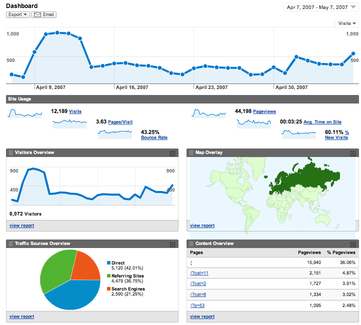
Analytics is one of the most ignored aspects of web marketing, despite the fact that everyone is concerned with their site’s statistics. Tons of SEOs check their statistics even daily, but almost everyone relies on either a set of analytics tools or the generic settings in Google Analytics rather than looking deeper, and using more focused methods like Custom Reporting.
Relying on the generic settings in Google Analytics has two downsides. One, obviously, is the lack of focus and clarity that comes with not personally directing what statistics you are watching, and how you are gathering that data. The other is that Google Analytics changes just as often as every other part of Google, and if you aren’t holding the reins, your results will probably shift, making your data inaccurate.
If you want to take on custom reporting for your analytics, you will have a better idea of how you are performing, and what aspects of your site need work. Greg Habermann suggests starting your custom reports by looking at five recent changes to Google Analytics that you can take advantage of. All you have to do is take the initiative.
00TMOhttps://www.tulsamarketingonline.com/wp-content/uploads/2018/07/TMO-Logo.pngTMO2013-03-14 10:43:492013-03-14 10:43:49Take Charge of Your Analytics
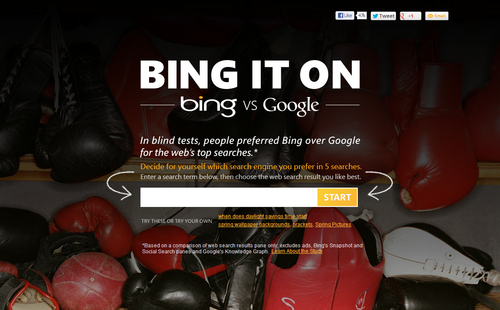
It’s been a week since Microsoft dropped their “Scroogle” attack ads aimed at Google, but they are still running their “Bing It On” challenge trying to convince searchers that Bing is superior to Google. Yet, all of Microsoft’s attempts don’t seem to be working. Despite Microsoft saying Bing It On testers preferred Bing 2:1, Google continues to claim well over half of all searches.
This has Greg Sterling from Search Engine Land wondering why no one believes Microsoft’s and other competitor’s “Better Than Google” claims. Is Google’s brand just that strong? Does it come out of habit?
The most obvious reason people don’t buy Bing’s campaign is they are blatantly aware it is all marketing. They used the same principle as a blind taste test, but those types of tests don’t come off as explicitly biased as a website “blind” test. Just to get to the test you have to go to a website with Bing in the name.
No one is going to trust Bing’s statistics when they are that blatant about the test. There is nothing blind about going to “Bingiton.com“. It also doesn’t help that there is a big disclaimer at the bottom of the search page explaining how the test doesn’t use the full search capabilities of either engine.
Google believes part of the reason users aren’t responding to Microsoft’s negative marketing is customers respond better to companies that “focus on building good products” rather than slinging mud. While Google remained as silent as possible on the “Scroogle” ads while they ran, now that they have been stopped, Google search chief Amit Singhal finally spoke about the issue at a SXSW conference, when taking questions from Twitter. “We focus on our users.”
Google’s right, customers don’t respond to negative marketing campaigns against well established brands as well as they respond to the new and innovative products Google is producing.
But, what about independent studies? A recent study by Butler University found that not only did Bing have better quality answers according to their criteria, but so did ChaCha, Ask.com, Bing, and Yahoo. Why has this type of study not put a huge thorn in Google’s side? One reason is Google’s incredibly strong brand. There is also the “Google Habit” or the comfort with the interface, but more than anything it is personal experience.
ChaCha may have better answers, but most users will agree it is not convenient enough for when you need to make a quick search and find a simple answer. Bing has been making users uncomfortable with their blatant attack ads, and any survey that puts Ask.com ahead of Bing, Yahoo, and Google will be heavily doubted in this age. The website lost its reputation years ago as other search engines grew, and it never regained it, just as Yahoo has steadily lost its market share to Google.
The only companies that can compete against Google are equally strong brands such as Amazon and Apple. Google is so well established in the American market, that it is hard to believe any study reporting that there are a handful of “better” ways to search. But, Google didn’t just install itself into ourcollective hive mind. Google is trusted because they offer a search engine users are pleased with, and they are constantly innovating new and exciting products. If they ever stop innovating, Bing might have a shot. Until then, attack ads and over the top marketing campaigns aren’t going to do much.
In pretty much every way, good web design is subjective. Trends come and go, and limitations are removed which open up entirely new options for how a site can look and act. While user experience can be quantified through testing, there is nothing scientific about what people want either. There are objective ways to look at the current desires of the public, and some things, like easily understandable navigation methods, will never go out of style, but in a decade, the rules for “good web design” will be barely recognizable from the standards we have today.
However, the way people read is likely to stay the same for the foreseeable future, even on the web. Eye tracking has allowed up to study just how people tend to look at text on the web and paying attention to how users read and look at websites, designers can make informed decisions on how to design their site around their visitors’ patterns.
Eye tracking has been around since the late 1800’s, though it only became commonly used for studying design and marketing in the 1980’s and 90’s. The first big study on web page viewing happened in 2006 by Jakob Nielson, which shows that visitors read web pages in a steady pattern; people’s eye make horizontal swipes across the page, then move down vertically. There have been numerous other studies since, and they all show that internet users continuously scan websites in the same pattern.
The pattern is usually referred to as an F-shape pattern because of how eyes start at the top left corner, moving to the right in a straight pattern, then back to the left hand side where they scan about a third of the way down the page, then back out to the right in a straight line.
If you want to know how you can harness eye movement patterns to inform your web design decisions, Carrie Cousins from Designmodo explores all of the possible implications of eye tracking studies. She breaks down every pattern seen in the studies and even gives examples of websites that are already designed around viewing patterns.
One of the most crucial design decisions for a new company is the logo. Great logos are instantly recognizable and evoke the brand image with just one image. When anyone discusses McDonald’s, Apple, Nike, or NBC, it is hard not to imagine the Golden Arches, iconic apple, or swoosh because they are so deeply ingrained in their corporate image.
Creating a logo that perfect is deceptively difficult to do however. The business world is awash with bad logos that no one will ever remember. There is no magic recipe for a great logo, but there are some rules to follow that will help a logo stick out. I’ve given some tips on logos before, but Sarah Clare from Vandelay Design had some suggestions designers should keep in mind.
One of the most common mistakes is just over-doing the logo. Clean lines and simple contrast are striking and easily able to be replicated in any format, neon sign to stationary. Text can be included but only when necessary, and limit it to the brand name. Even if you’ve been in business for 200 years and you’re doing a logo redesign, your icon isn’t the place to tell people that.
It is hard to understate how important it is that your logo is able to be reproduced anywhere. Something may look good on a computer screen, but logos are sometimes printed on endless materials like pens, paper, mugs, and even mints, and stress balls. You want people to be able to recognize the logo whether it is 1″ x 1″ on a memo, or plastered on a billboard.
While a logo has to be simple, it also has to convey the tone and personality of your business. A high tech company with a childish logo may have trouble convincing potential customers of their abilities, especially because everyone in tech hates comic sans. Usually bright colors are reserved for companies more associated with children as well, but Google’s logo shows why that isn’t a hard rule.
As a business owner, you will see your logo more than you actually see your brand name, or at least it will feel like it. If you want your brand to be successful in the marketplace, you need a logo people will instantly be able to identify and connect with. It seems like a small task, but being lazy on the logo can torpedo a new brand.
The breakout star in SEO so far this year appears to be content marketing. It was pretty talked about in 2013, but with Google’s penalties and algorithms it will only be more important as the year progresses.
Of course, just as with any SEO tactic, content marketing has its risks. Google has shown that even using the best practices too much can still lead to penalties, and the Penguin and Panda updates have made it clear that you have to put good thought into any campaign you are going to run. Algorithmic updates by their nature don’t have room for leniency.
If you want to keep succeeding with SEO, you have to follow the rules to the letter. Of course, this is complicated Google’s reluctance to give hard rules for SEO. From what we know, it seems moderation is really the key to content marketing and optimization.
Adam Mason, writer for Search Engine Journal and SEO manager at Zazzle Media, shows the best method of dealing with content marketing optimization is to learn the history and know what has changed in the past few years. If you want to know how to push your content marketing campaigns without being hurt by penalties, his article covers anything and everything you would want to know.
https://www.tulsamarketingonline.com/wp-content/uploads/2018/07/TMO-Logo.png00TMOhttps://www.tulsamarketingonline.com/wp-content/uploads/2018/07/TMO-Logo.pngTMO2013-01-25 11:15:232013-01-25 11:15:23How To Avoid Over Optimizing Your Content Marketing Campaigns
You know how sometimes a group of words are thrown around together so much their meaning becomes blurry? If you don’t understand what I mean, think about how you understand brand, identity, and logo. Almost any article about logo design will intrinsically link these three words together without clarifying where the line between each one is. I’m as guilty of this as anyone else.
Jacob Cass from Just Creative noticed this and put it upon himself to clarify the differences between brand, identity, and logo, and what each does. Breaking it down simply:
Brand is the “perceived emotional corporate image” of the business all together.
Identity combines all of the visual aspects that form a brand.
Logos identify a business in the simplest form by using icons.
It is a heirarchy in which a logo is part of the visual identity of a company, which helps mold the brand as a whole.
Branding
It is hard to write shortly about branding, as Cass even points out, but to summarize the concept, it is the audience’s idea of a service, product, or organization. Visual aspects of the brand including its marketing and logo can help mold it, but ultimately, the audience decides the shared perception overall. “A designer can’t make a brand […] a designer forms the foundation of the brand”, which the audience then builds upon with their reception of the product and marketing as a whole.
Identity Design
That foundation the brand is built on is it’s identity, or its image. Every business creates sets of visual devices they use to interact with their audience including color palettes, fonts, layouts, etc. Every visual aspect is considered part of the identity, even things like a web page design, and especially the logo.
Logos
I’ve talked quite a bit about logos before, but when it comes down to it, a logo identifies your brand. It becomes one of the most prevalent aspects of the image, and shapes how customers perceive your brand.
According to Cass, a logo doesn’t sell or describe a company, but that is the only aspect of his article with which I don’t completely agree. Once a business is established, their logo is understood by the quality of the company and product it represents. However, for young businesses trying to establish themselves, a quality logo is important in attracting companies by letting them quickly know what that company does and showing they care about how their audience feels about them.
Conclusion
The three are absolutely linked, but when writing about them we often make it unclear what each seperate part really is. Logos affect identities, which set the floor for a brand. All are important, but they are all unique to each other
https://www.tulsamarketingonline.com/wp-content/uploads/2018/07/TMO-Logo.png00TMOhttps://www.tulsamarketingonline.com/wp-content/uploads/2018/07/TMO-Logo.pngTMO2013-01-08 08:45:012013-01-08 08:45:01The Differences Between Branding, Identity, And Logos
SEO relies on data. That’s a pretty simple fact. Still, for some reason, some SEOs still do all their research by hand and manually track their performance, usually by making Excel charts that seem to stretch for days. I honestly don’t completely understand how they put the time into even trying to do this, at this point in SEO. So for this article I won’t be answering the question posed in the title, but instead showing why manual data gathering doesn’t make sense anymore.
To do well in SEO, you require fresh and accurate data to base your decisions upon. If you spend all your time and effort doing data gathering by hand, how do you have the time to make solid judgments and strategies for your customers?
SEO, of course, did start out with that exact manual strategy, but the reason it isn’t anymore is because this very problem I’m talking about. There is simply too much data, and data gathering can be easily automated, so doing it by hand is a waste of time and resources.
But, for those few SEOs out there still doing things the old fasioned way, there are pleny of ways to get all of your data gathering automated quickly. Myles Anderson from Search Engine Land gathered a quite a few tools you could use to get started, as well as answering just about any question about local SEO tools anyone has had ever.
It is a comprehensive guide, so if you just need the tools, head straight for that section, but if you need more convincing or don’t understand how the tools work or their benefits, Anderson makes a strong case with his explanations.
00TMOhttps://www.tulsamarketingonline.com/wp-content/uploads/2018/07/TMO-Logo.pngTMO2013-01-04 11:00:002013-01-04 11:00:00Why Do Some SEOs Still Gather Data Manually?
As with any business, you not only need to keep up with current trends and updates in online marketing, but you also need to be looking ahead to attempt to predict some of the changes ahead.
To help with this task, Business2Community presents their predictions for the 2013 landscape of social media and search engine marketing. If you’ve stayed current with the trends of the past year, there aren’t any big surprises here. But, it’s nice to see a succinct list of things to keep an eye out for in the coming year.
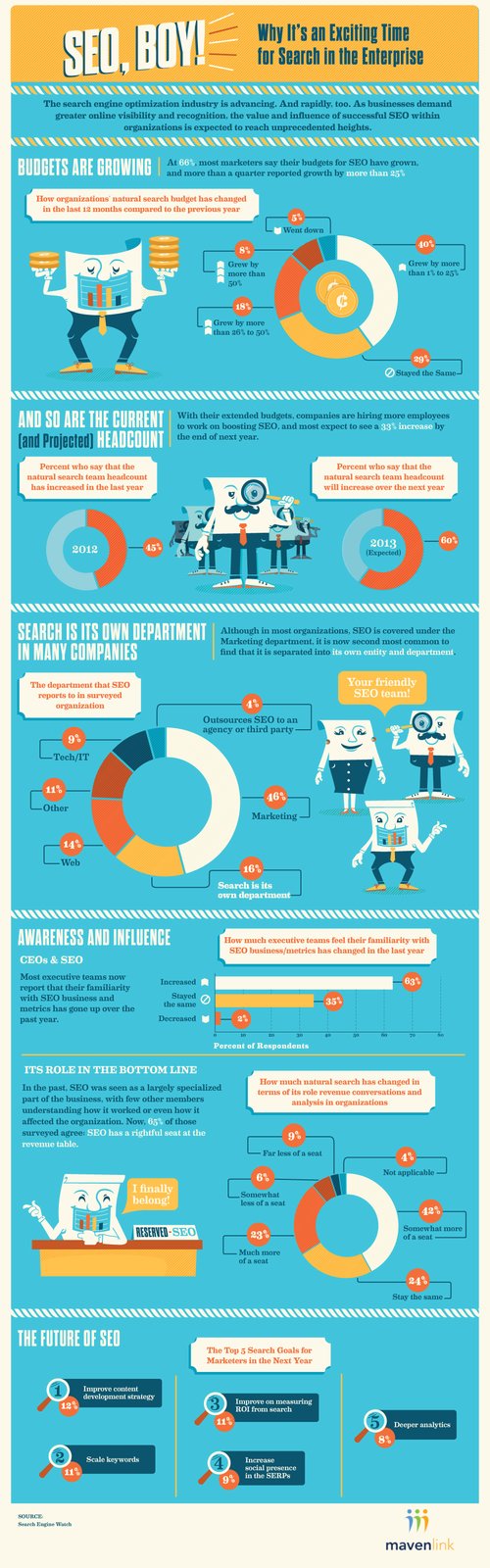
As the year draws to a close, everyone of course looks to what the past year indicates for the one coming up. I’ve already covered one article of year end analysis, and now Search Engine Watch and Mavenlink have made an infographic covering what SEO professionals are saying about the state of SEO in 2012.
What is notable about both of these year-end opinions is that they are both extremely optimistic about the future of SEO. As the internet becomes somehow even more pervasive in our every day life, more and more opportunities for SEO to grow become apparent, and there is no sign of it slowing down.
Budgets are growing, companies are paying more attention, and SEO teams are getting bigger. SEO is finally even beginning to be seen as an entity seperate from regular marketing. Before long, SEO might be really known outside of the marketing community.
00TMOhttps://www.tulsamarketingonline.com/wp-content/uploads/2018/07/TMO-Logo.pngTMO2012-12-19 11:00:012012-12-19 11:00:01The Future of SEO [Infographic]
Almost every designer has ended up working with a bad client. We all try to avoid it, but sure enough, eventually you end up with a client that will drive you up the wall. Wouldn’t it be great if you could easily pick out which clients are going to be more hassle than they are worth?
Justin Spencer has created a list of tell-tale signs at Designrfix that a client might not be worth the money. It is important to note, a bad client is not just one that doesn’t pay you on time. Slow payment, while highly frustrating, is not always the sign of a bad client, especially if they are a small company.
Instead, bad clients are those that create completely unnecessary problems as professionals. During negotiations to work with these types of clients, they will often do things like understating the difficulty of a project to lower fees. They could also try to get you to work at low prices by promising they will give you lots of work in the future.
Spencer has plenty more signs that will help clue you into a bad client. If you see more than one of these issues early on, seriously consider if the work you are going to put in for them will be worth the headaches later on.
https://www.tulsamarketingonline.com/wp-content/uploads/2018/07/TMO-Logo.png00TMOhttps://www.tulsamarketingonline.com/wp-content/uploads/2018/07/TMO-Logo.pngTMO2012-12-17 08:45:032012-12-17 08:45:03Can You Pick Out What Clients Are Bad?